
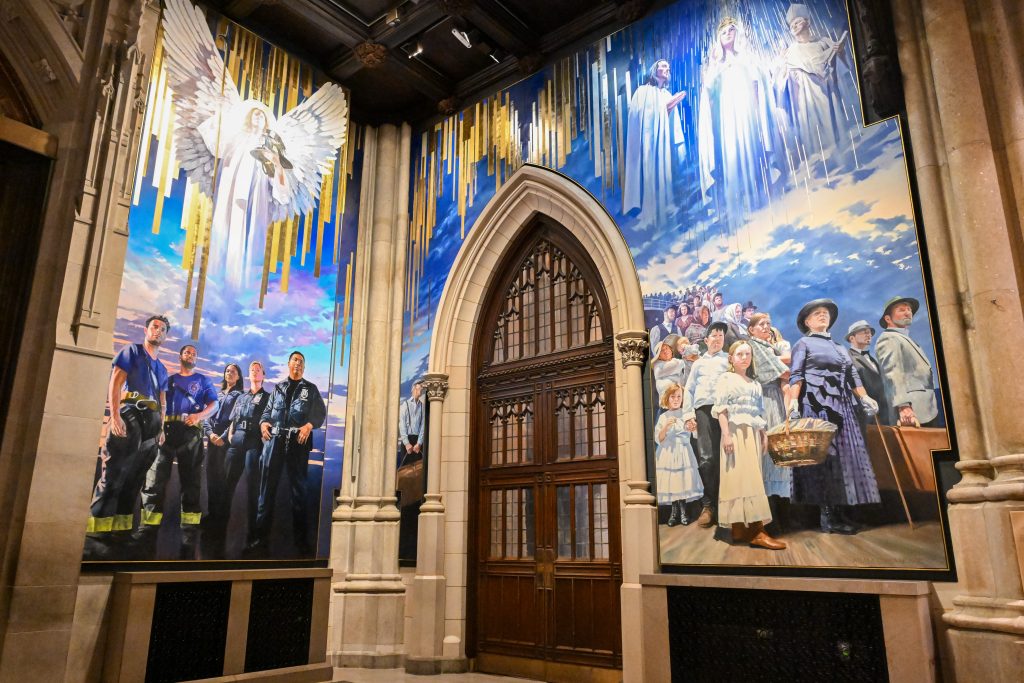
Saint Patrick’s Cathedral Honors NYC’s Immigrants with Historic 25-Foot Mural
The Cathedral’s Largest Commissioned Artwork in 146 Years
Brooklyn-based artist Adam Cvijanovic (pronounced TSVEE-ya-no-vich) was working in his studio at the Brooklyn Navy Yard when a song from the radio stopped him in his tracks. Elvis Costello’s cover of Nick Lowe’s “What’s So Funny About Peace, Love and Understanding” was playing — and suddenly, Cvijanovic knew he had found the title for his mural destined for Saint Patrick’s Cathedral.
“It was on the radio at a time when the news was really bad for immigrants with terribly cruel attitudes towards their plight,” he recalls. “It made me wonder where did all this permission to be cruel come from? Costello’s song was from an earlier generation of people who seemed to pay attention to the plight of others. Where had they all gone?” Cardinal Timothy Dolan came to agree, and last week, the powerful mural bearing that provocative title was unveiled at one of New York’s most iconic landmarks— a rock-and-roll rallying cry for compassion now permanently installed in the heart of a cathedral built by the very immigrants whose treatment inspired it.
For centuries, artwork in churches has served interconnected roles that have evolved throughout Christian tradition. Biblical scenes painted on walls or depicted in stained glass tell the stories of faith, including to those who cannot read — a role that was particularly vital during medieval times and remains important today. Local church art often reflects the community’s specific history, patron saints, and cultural heritage.
Now, the most significant work of Christian art in generations has been added to Saint Patrick’s Cathedral on New York’s Fifth Avenue.
A Vision Carried Across the Ocean
Commissioned by His Eminence Timothy Cardinal Dolan, Adam Cvijanovic’s expansive mural reflects Saint Patrick’s Cathedral’s historic role as both a beacon of faith and gathering place for New York’s diverse Catholic community. The work draws its central religious theme from the Apparition at Knock, Ireland—a Marian vision of profound significance to Irish Catholics and especially beloved by Cardinal Dolan —while celebrating the broader history of Catholic immigration to the United States to our time and honoring the commitment to service among all of the City’s first responders.
Rather than confining the vision to a single moment in 1879, Cvijanovic reimagines it as an enduring source of consolation and belonging, carried across the ocean by today’s immigrants and kept alive in the collective memory of the Church.
A Cathedral Celebration
Hundreds of well-wishers packed Saint Patrick’s Cathedral for the dedication ceremony on Sunday, September 21. Cardinal Dolan and members of the clergy from as far away as Boston blessed the artwork during a special Mass held two days after the mural’s unveiling.
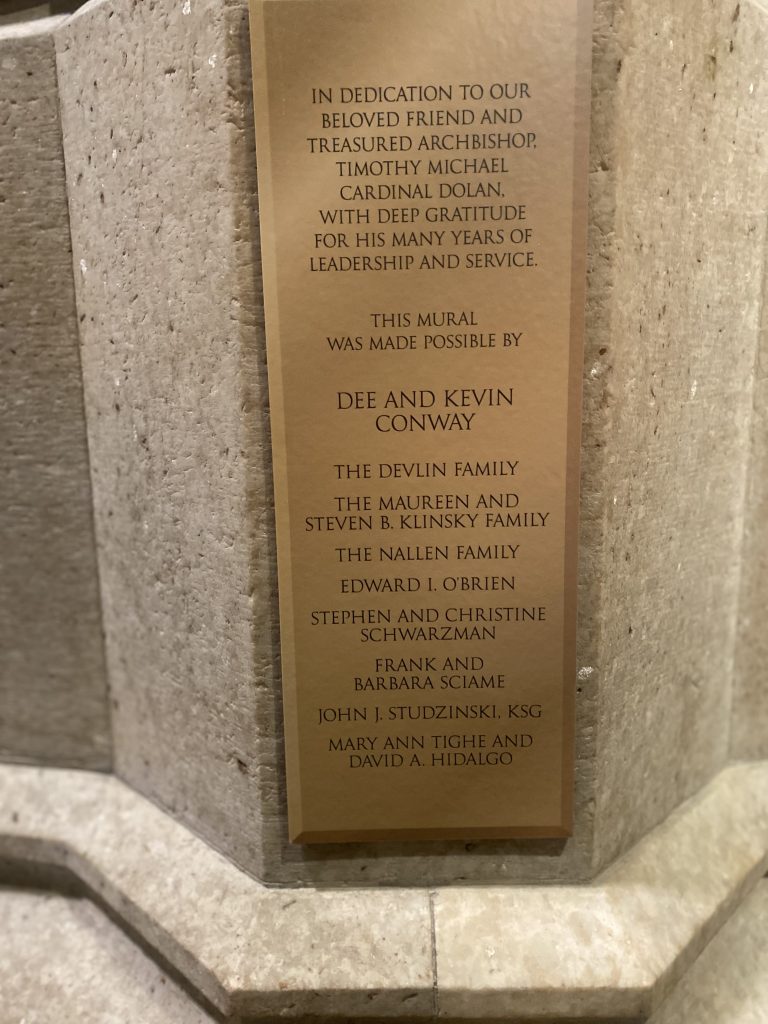
The new work, “What’s So Funny About Peace, Love, and Understanding,” transforms all three walls inside the landmark church’s Fifth Avenue entrance vestibule into a sweeping vision of faith, history, and service. The mural, the cathedral’s biggest permanent artwork in 146 years, is expected to be viewed by as many as six million visitors who tour the Cathedral each year.
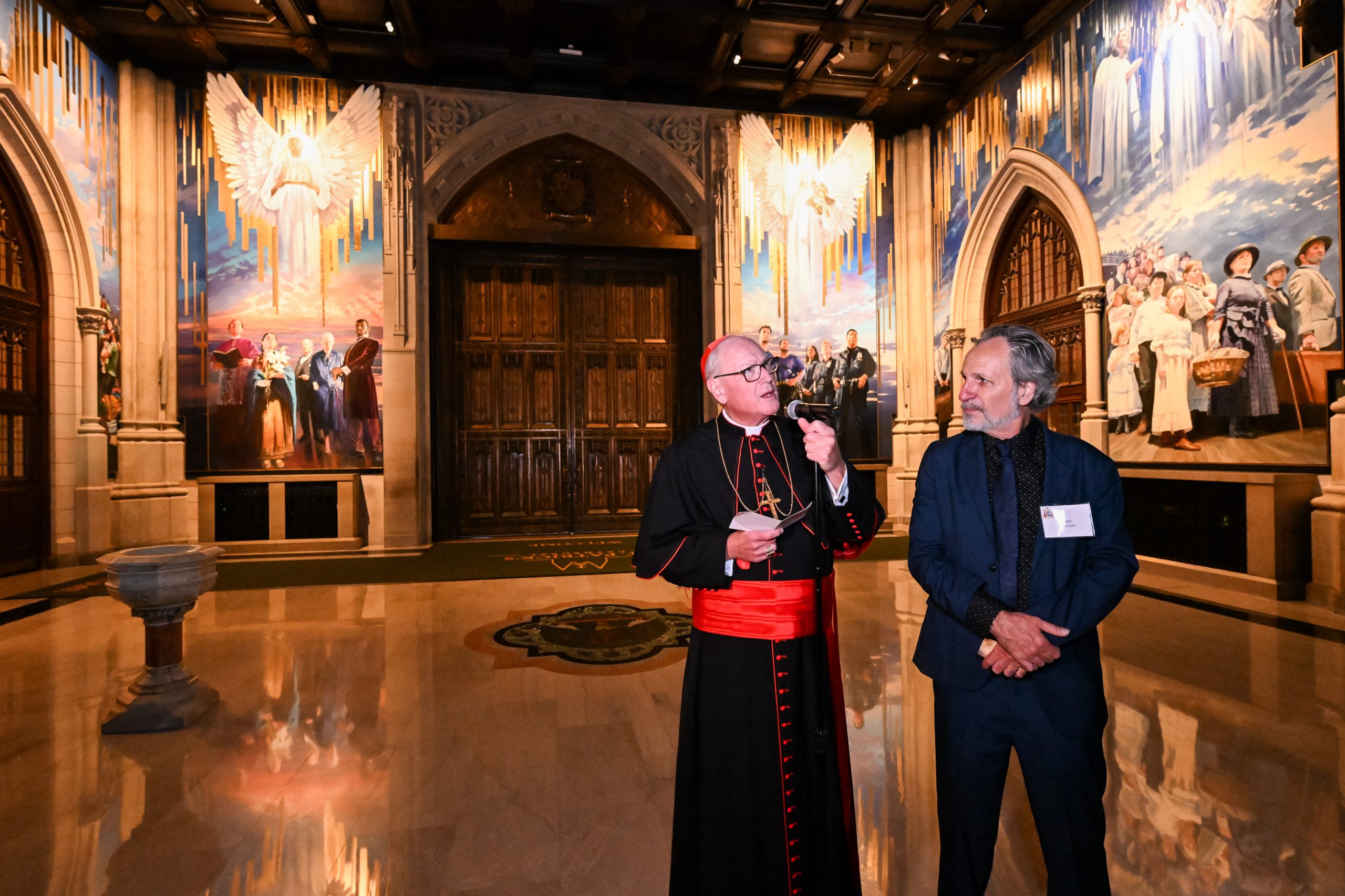
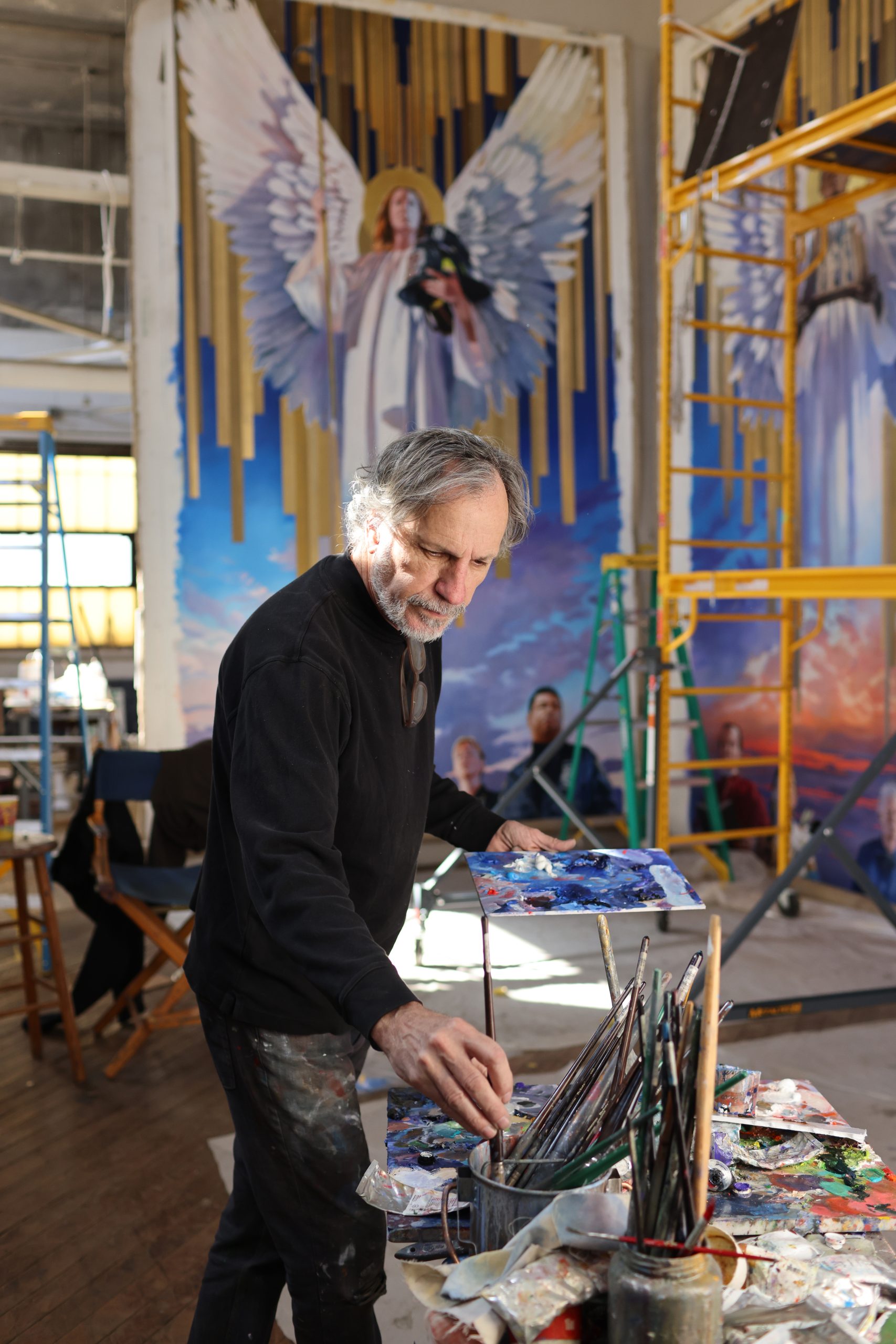
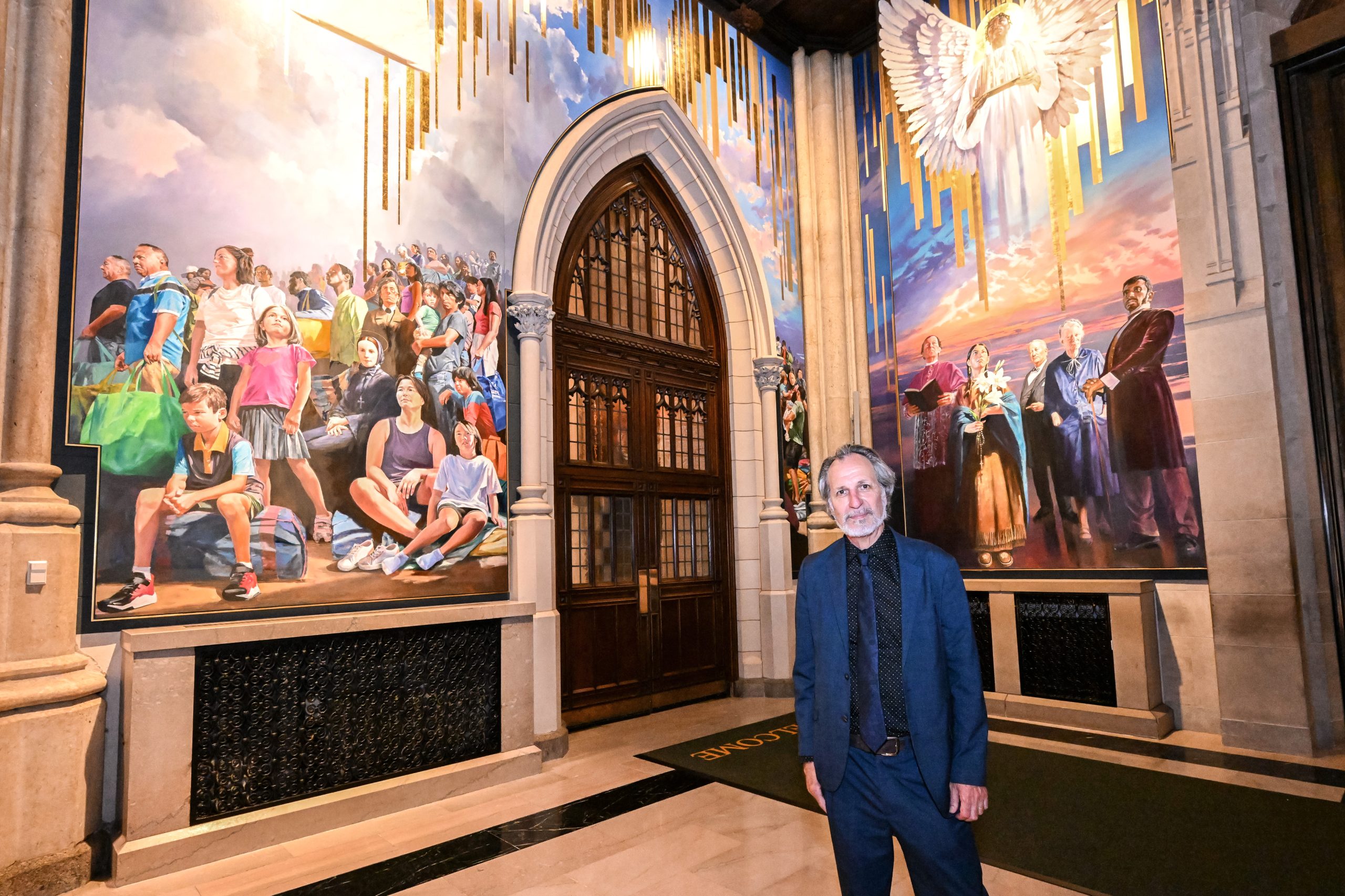
Adam Cvijanovic in his Brooklyn Navy Yard studio (left) and in the Cathedral (right). Cvijanovic grew up in Cambridge, Mass., and is known for his large-scale, realistic murals.
Sacred and Secular United
“The mural recognizes the contributions of a multigenerational host of great individuals and guardians of the city and pays tribute to the immigrants of many lands who continue to bring their faith and hope to New York,” Cardinal Dolan said.
Cvijanovic’s light-filled, realistic style brings dozens of figures to life, many at or above life size. Contemporary immigrants stand beside saints and civic figures—Mother Cabrini, Felix Varela, Dorothy Day, Al Smith, St. Kateri Tekakwitha, Venerable Pierre Toussaint and the Irish immigrant who envisioned the Cathedral but never lived to see it, Archbishop John J. Hughes — while monumental angels overhead offer the city symbolic protection.
“Each human figure, whether historic and renowned or contemporary and anonymous, realistically portrays an individual model, in keeping with the Church’s insistence on the dignity and worth of every person,” Cvijanovic explained. “My hope is that when you view them all spread across the full span of the mural, you’ll feel how all of humanity is welcomed here.”
The Artist’s Vision and Technique
Cvijanovic’s immersive composition unfolds across four sections, weaving together the sacred and the everyday. The figures of the Apparition appear above disembarking migrant families, linking divine presence to lived experience. Rendered in oil on canvas with areas of hand-applied gold leaf, the painting draws from Baroque drama, Byzantine iconography, and modernist abstraction, blurring boundaries between past and present to invite viewers into a sacred and unfolding story.
Born in Cambridge, Massachusetts, in 1960 and now based in Brooklyn, Cvijanovic is a self-taught painter renowned for expansive, site-specific works that seamlessly integrate art into architectural space. His paintings explore historical and imagined landscapes, probing the complex relationship between place, memory, and American cultural narratives.
His major public commissions span the country: “10,000 Feet,” a sweeping mural of the Indiana countryside for Indianapolis’s Alexander Hotel; a four-panel oil painting for Atlanta’s Mercedes-Benz Stadium; and an ambitious project for the Birch Bayh Federal Building and United States Courthouse in Indianapolis featuring 164 individual murals totaling more than 7,000 square feet, chronicling American battlefields from the colonial period to the present. For the Saint Patrick’s Cathedral commission, he was one of six major artists invited to submit a proposal. His vision prevailed, and two years later, his completed work was unveiled to the public.
The Apparition at Knock: A Sacred Connection
Remarkably, the Apparition at Knock occurred the same year St. Patrick’s Cathedral was dedicated, uniting two sacred sites across an ocean. Just three months after Saint Patrick’s Cathedral opened in May 1879, on the evening of August 21 in the village of Knock, County Mayo, Ireland, fifteen people ranging in age from five to seventy-five witnessed a silent vision at the gable wall of their parish church. The figures included the Virgin Mary, St. Joseph, St. John the Evangelist, and a lamb on an altar surrounded by angels. The apparition lasted nearly two hours, bathed in radiant light, yet no words were spoken.
Today, Knock remains a major pilgrimage site and place of prayer, a lasting symbol of spiritual resilience carried by generations of Irish immigrants to America.
A Living Portrait of Faith
The mural serves as both an homage to the visual traditions of European Catholic art and an inherently American work—a portrait of a living, pluralistic church that continues to evolve. It speaks to shared experiences of faith, migration, and belonging, ideals that define St. Patrick’s Cathedral as “America’s Parish Church.”
Recently, when Cardinal Dolan was asked if he considered receding from the political controversy that may greet the unveiling of the mural, said he never wavered.
“There is a bit of timeliness with the controversy over immigrants,” he said. “If somebody says this speaks to the sacredness of the immigrants and to a cherished part of the legacy of the church, that’s all to the good. Immigration used to be a unifying principle. It was almost patriotic to be pro-immigrant. Now it’s a cause of division. I’m hoping this will help bring people together.”
In concluding his homily on Sunday, invited guest Fr. Richard Gibbons, Parish Priest and Rector of Knock, suggested that a fitting way to consider the scope of the new artwork was simply to look around at the cathedral and the artwork itself. With its interplay of sacred vision and everyday life, the mural affirms that each person who enters the Cathedral becomes part of this continuing story.
All photos courtesy of Diane Bondareff/AP Content Services for the Archdiocese of New York.
Leave a Reply