
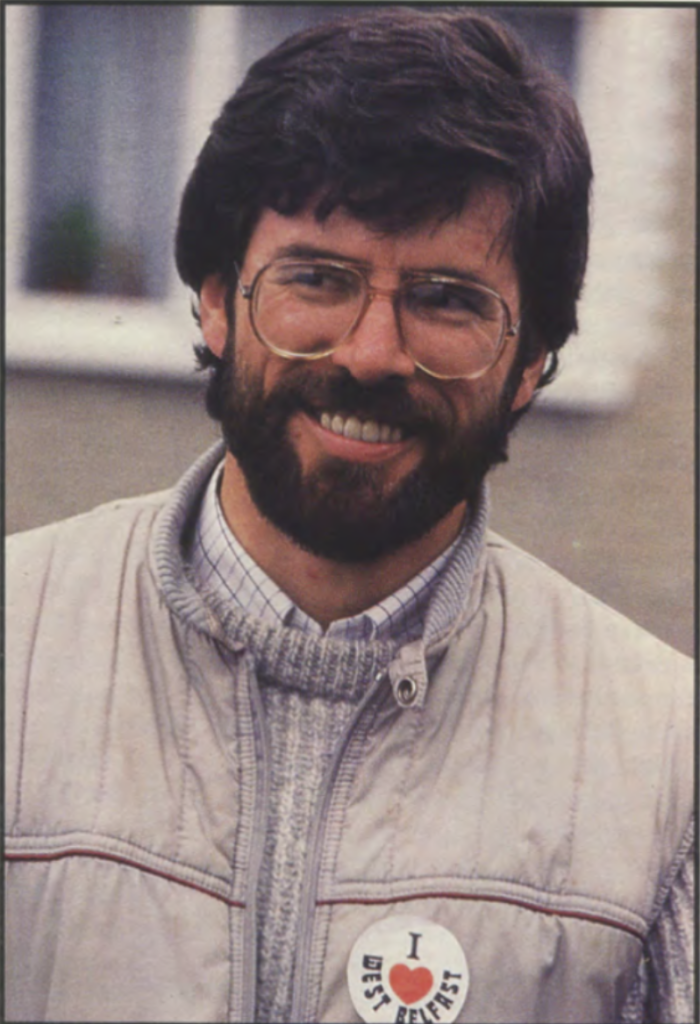
The Sinn Féin office is located in a what could hardly be called a luxury building in what seems to be a mostly deserted area of West Belfast. In the room where I sit, there is a one-bar electric fire, a couple of mismatched chairs and little else. Somewhere on the outside a band is practicing, the drums that one usually associates with Loyalists are getting a fair belting from what I presume to be Catholic kids.
I’m waiting for Gerry Adams. This year marks the 75th anniversary of the Easter Rising, which resulted in the creation of the Irish Republic and the partition of the six northern counties. “The philosophers and thinkers of the 1916 Rising did not survive it, and this set the stage for counter-revolution,” so wrote Adams; and I ponder on this statement and reflect on what I know about the president of Sinn Féin, (Ourselves Alone) the would be successor to those men of 1916.
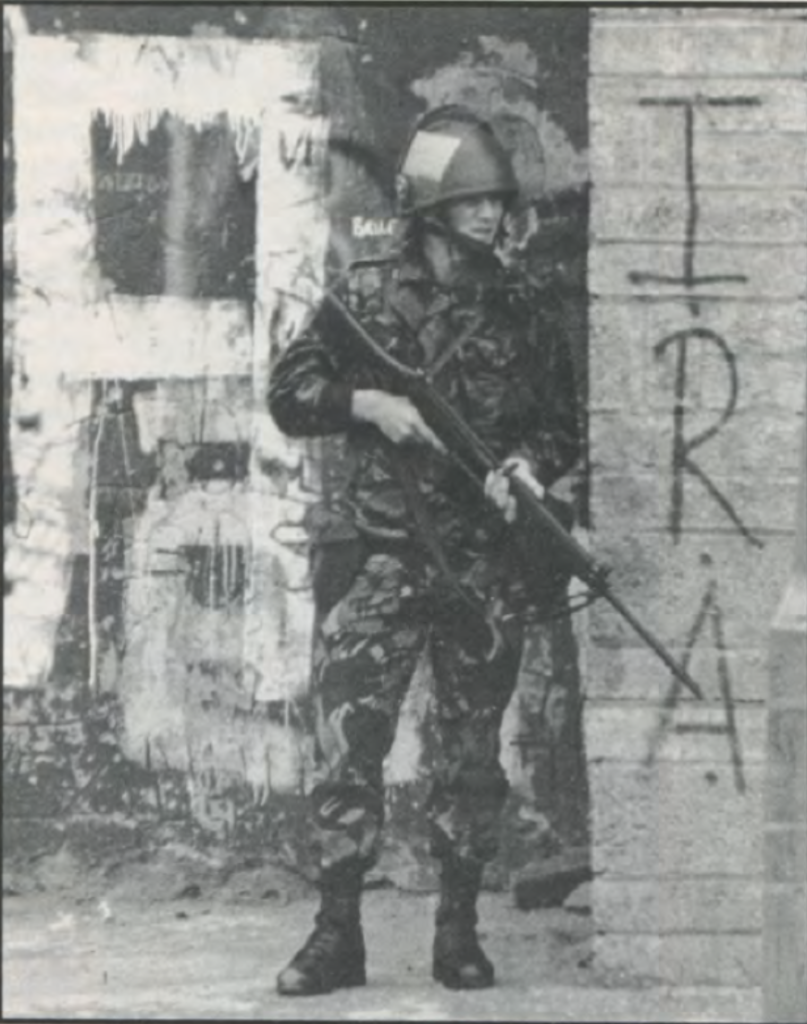
Adams joined the Republican movement in the early 1960s at a time when the 200th anniversary of the birth of Wolfe Tone (1963) saw a resurgence in Republican thinking and the establishment of Wolfe Tone committees throughout Ireland. They were mainly meeting places for Irish-language enthusiasts and a forum for political discussion. Three years later, however, with the 50th anniversary of the Easter Rising, the movement was to receive a major boost in the explosion of republican feeling that surrounded the celebrations. What followed, was the civil rights movement, of which Adams was a founding member, the dissolution of the Stormont government and direct rule of the northern counties by the Britain. The ensuing years have seen the presence, of at times, up to 30,000 British army troops north of the border and the deaths of some 3,000 people.
At one time in the late seventies Adams is said to have served as chief of staff of the IRA. He himself denies that he is, or ever was, a member of the IRA and the British authorities have never been able to provide evidence otherwise. He has served time in prison and has written several books, including A Pathway to Peace, which challenges the present day leaders of constitutional nationalism.
Writing is perhaps one of the few uncensored avenues of communication left open to Adams. Since the introduction of Section 31 by the Dublin government in 1972 and the introduction of Article 19 in the North two years ago, members of Sinn Féin have been banned from expressing their views on the airwaves.
Enter Gerry Adams, he is a tall, thin, bearded, attractive man in his early forties. He offers a cup of tea. He is busy he says, it’s a couple of days before the Sinn Féin Ard Feis and he is trying to write. There is a sense from Adams of a man not listened to, a man perfectly aware that both the British and Irish governments have gone to extreme lengths to silence him. Thus, he makes it clear given that background, that he is pleased to address an Irish American audience. But first there is the cup of tea which he very courteously pours….
What are your feelings on the anniversary of the Easter Rising?
This year’s the 75th anniversary of the Easter Rising, and leaving aside any party political decision, that was a very important event in world history. It certainly heralded the break up of the British Empire. British historians will acknowledge that, and historians in India and other countries who later won independence acknowledge that the proclamation is a fine document, I mean very radical and progressive, and it hasn’t even been marked. If you look at 1966 [50th Anniversary of the Rising] there were pageants, there were flares, there was all that drama. All the mohair suits were knocking each other down trying to get onto the platform.
And then three years later the ghosts of the North’s unfinished business came out and the politicians and the establishment started to move away and the revisionists started to move in. But the government will not – the establishment will not succeed in just going past it as if it never happened.
What conditions would have to exist for the IRA to lay down its arms?
Well, the IRA has said quite clearly that they intend to keep fighting until the British declare that they’re going to disengage. They also have said that armed struggle isn’t a dogma, that they believe its the only effective means to move forward, but that it’s up to others who hold different views to come up with alternate methods of struggle.
I especially have been arguing very strongly that politicians and church leaders engaging in the politics of condemnation or denunciation should instead be trying to find some alternative. The development of other methods of struggle to replace armed struggle could theoretically change the situation.
What alternate forms of struggle would you see?
First of all, no Dublin government has ever gone to the British and asked them to outline or to examine or to explore the possibility of bringing about Irish unity. Dublin has not raised the issue of British presence on a consistent basis. Or the right to national self-determination for Irish people. Dublin has not campaigned on international forums on the range of repressive measures here, or put forward peace proposals.
I think if the Dublin government, for example went to [John] Major [British Prime Minister] with the Peter Brooks [Northern Ireland Secretary of State] statement and said to them, “Okay you’ve said you have no economic or strategic self-interest for being in Ireland, let’s explore that. It would seem to mean that you’re not against unity. It doesn’t necessarily mean you’re for unity but it does mean you’re not against it. So let’s just look at how we could end partition.” But they haven’t done that.
This year’s the 75th anniversary of the Easter Rising, and leaving aside any party politican decision, that was a very important event in world history. It certainly heralded the break up of the British Empire.“
Why haven’t they done so?
Because it requires a leadership that has the courage to stand up–to actually stand up and be prepared to take sizable political risks–and to date I don’t think that we’ve had anyone of that calibre in the Dublin government.
Obviously, the politicians are not getting any pressure from the voters either.
I think that’s true, but you have to have two situations. First of all, the political leaders need to lead. They need to take the politically undecided people and say, “This is the way I think this should be going,” and try to bring people along.
Secondly, there’s been 20 years of anti-nationalism censorship. So I think against that background, against the media just not even dealing with the issue itself, never mind pro-establishment, it’s not surprising that people don’t see what’s going on.
In fact, what is surprising is that everyone acknowledges that there still remains a dominant sort of subtext that in every opinion poll people still say they want a United Ireland and still retain some aspiration for an end to British rule in Northern Ireland.
Sinn Féin doesn’t seem to be gaining any ground in the South.
The reason we’re not gaining ground, is to some degree, because of our own shortcomings. For decades the Republicans weren’t involved in any sort of real acts of politics of the ground and were isolated from the people. It was all about the “fourth green field” and that. I think it’s fairly true to say that we didn’t focus in on most important issues which affected people directly in their daily lives. There was a pretty major change in all that of the late 1960s and the Republican movement went through a major sort of politicization, and then commenced to be involved very actively on a whole range of issues – for example, housing campaigns and unemployment campaigns. When the movement split in 1969, those who began the Provisionals, as it was known, left that work to those who are now the Workers’ Party who are now reaping the benefit of the hard work that they put in, and continue to put in. Whereas our people got caught up in the whole clamor of what was happening at that time, with internment, with Bloody Sunday, and the ramifications of all that.
Do you have any figures on emigration from your district?
It’s very difficult to quantify because people here tend to go to Britain and there aren’t figures that would be available, because if you go to Britain, you’re still in the United Kingdom. Of course, Tyrone people have a tradition of emigrating to the U.S., but in poorer areas like this [West Belfast] emigration is less of an option. And then, of course, you also have the situation that there is a struggle going on and the people who otherwise might just give up the ghost and move somewhere else, get involved in the struggle to try to change things. So, we can’t quantify it.
Has there been a dropping off of people who are joining the Republican movement?
No. The difficulties are more tedious. Sinn Féin in the north is by and large a working-class party, with only a very limited number of people who actually have the skills necessary to build a political party. So the difficulty isn’t the membership, it has more to do with the development of skills and so on.
What about the theory that if it wasn’t for unemployment and emigration the Catholics would be the majority at this stage?
One has to be persuaded then that the reason why there is forced emigration and unemployment is so that they won’t be the majority.
There are parts of West Belfast with 86 percent unemployment and it has been that way for generations. When you get a large density of Catholic population, that figure creeps up because of job discrimination – Catholics being two and a half more times likely to be unemployed.
Would you welcome American investment?
On the basis of the MacBride Principles [a set of rules that tries to ensure that American investment in Northern Ireland is tied to fair hiring legislation] we’ve said it and we’ve campaigned vigorously. There are major difficulties with the sort of fly-by-night John DeLoreans and others who exploit cheap labor and a non unionized work force and all of that. But the need for people to improve the quality of their lives is paramount. So on the basis of having equality practiced, of course we would welcome some investment.
Some people say that the IRA bombing businesses doesn’t help.
It’s the political conflict – the overall thing – which causes the difficulty not one strand of it. A potential investor would be as likely put off by the presence of armed British soldiers on the streets as they would by – what’s becoming increasingly infrequent – attacks. But I would be prepared to accept that in propaganda terms it does give the British some sort of an opportunity to attack us. But the reality of the situation is that even before the IRA was active, you had these unemployment figures in West Belfast.
What about the reports on Sinn Féin being less outspoken in defending the actions of the IRA?
I have always had, and still retain, the political opinion that when you have the conditions for conflict such as exist here, then you’re going to have conflict. And if the big power is prepared to use military force then the people have the right to resist by military methods. And that remains my view; but I think that’s what’s happened for long enough was that Sinn Féin was being asked to defend and explain–to justify IRA operations–which really was never our business to do. I don’t see that it’s my job to act as a sort of proxy spokesperson for the IRA. If people want to talk to the IRA, let them go talk to the IRA. My job is to point out that we want to see and end to the conditions for conflict– a total demilitarization of the situation. And we actually want to see the end of the IREA and the British Army and the UDR and the RUC. We want to see a peaceful development.
Support for Republicans was at a premium after the deaths of the hunger strikers. It would seem that it’s fallen off somewhat as a result of particular IRA “mistakes.”Well, I think IRA mistakes have had an effect, obviously no one supports those actions at all, actions that have led to civilian fatalities. But that isn’t the reason why the potential, which was there during the hunger strike, hasn’t moved on. It’s because of the unprecedented lengths that the Irish and British governments have gone to trying to kill and smother those tensions and opinions that came to the surface during the hunger strikes. The fright that the Dublin establishment got with the election to the Dail of Paddy Agnew [blanket prisoner] and Kieran Doherty [died on hunger strike] led to an unprecedented increase in revisionism.
There was a whole range of laws brought in as a direct consequence of the hunger strikes and its aftermath. The British Government brought in a law which said if you had been in prison you couldn’t stand for election for a period of five years after your release date. Obviously, a lot of people who had been in prison who came back to or joined Sinn Féin, were electorial candiates until that law was enacted. And then they brought out a resolution that people standing in local elections had to pledge that they didn’t support any illegal organization. So there’s been a whole lot of repressive legislation.
The fact is that Sinn Féin had 11.39 percent of the vote in the last local government elections here in the North-we were only down by one percent. To do that against the background of censorship, people who can’t hear what we have to say, is something. All the observers, even Brooks, the British Minister, said that the IRA could not be militarily defeated. So there’s no suggestion by anybody involved that the IRA operation is any less capable now than it was nine or ten or fifteen years ago. The important thing is that they appear to be accepting that we’re in a stalemate. In effect, the challenge is to break the stalemate.
Brooks has said that he wouldn’t rule out talks with Sinn Féin.
I’ve been elected by the people of West Belfast, they’ve elected me three times. Refusing to talk to me means that these people are being disenfranchised, that the British are refusing to recognize their rights. We’re an important part of the equation; the people who I represent have the same rights as everyone else. I don’t want to talk to Peter Brooks or anybody else just for the craic. I’m interested in trying to move the whole thing forward. I think the 1990s should be a period when we get peace and we should have talks.
The point I’m making is that no matter how much you discuss what’s happening in this conflict, no matter how much you examine all the different characteristics of it and the history of it, the past and the future, it has to be settled and it can only be settled when people start talking.
How long have you been involved?
I’ve been involved since 1964.
That’s a long time.
It is, yeah.
Is there any end in sight, do you think? Is it working even slowly toward that?
I’ve never thought that the British would eagerly leave Ireland. I think it has to be at process of just going through options. Brooks is going through an option at the moment; when it fails, they will go on to another one. The only viable option at the end of the day will be a withdrawal. I think that’s when we all move forward into making our own history I don’t have any timetable for that. I never have had. I know without whining-there’s nobody who knows better than me-that from 1964 [to 1991] is an awful long time. You don’t know where it’s going to go and sometimes you do get depressed. But then something happens to pick you up and people are very resilient and supportive.
So in its own very slow, trundling way I think that we – I certainly believe-that we will see a British withdrawal from Ireland and that we will see an end to partition. What comes out of that, whether it will be the kind of Ireland I would like to see –
No matter how much you examine all the different characteristics of it and the history of it, the past and the future, it has to be settled and can only be settled when people start talking.“
What kind of Ireland would you like to see?
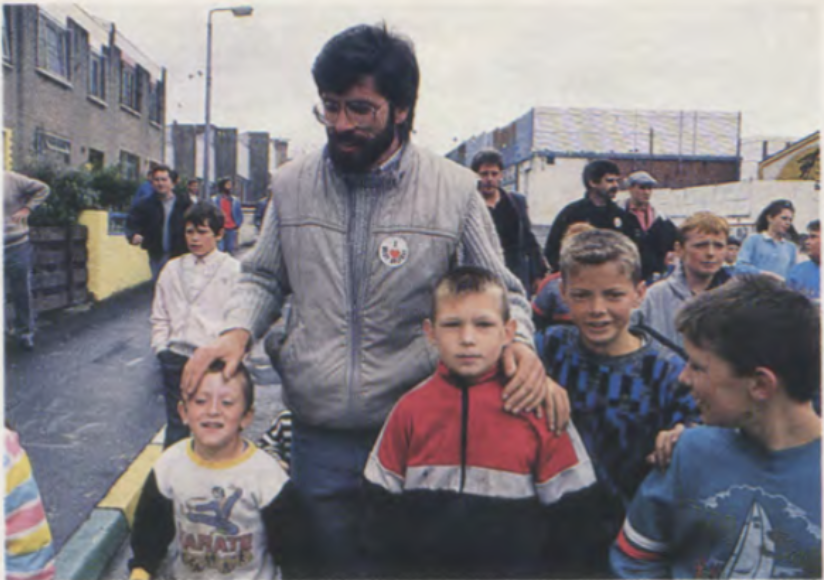
Well, first of all, I want to see a democratic Ireland. I want to see a national democracy restored. I think that’s the essence. I have come round to the view that the key to this whole business is self-government, national self-determination. I think there has to be an economic democracy as well. We have to have a redistribution of whatever wealth the country holds. I don’t think it’s worth one person dying, whether it’s a British soldier or a civilian, or a member of the IRA – or even serving one day in jail – for something that doesn’t improve the lot of the third of the people in the country who are living at the poverty level. I just don’t think it’s worth it. It isn’t just about materialism. I think we need to have an equality of opportunity. Those kids out there playing in that band [a youth band practicing nearby] should have the expectation of being a barrister or a journalist or a doctor or going to Queens University and they don’t. The expectations of the kids in that band is that they are going to Long Kesh or Maghaberry women’s prison, that’s where they are going.
How different are the teenagers now from 20 years ago?
It’s hard to know. In many cases not at all different. They’re much more politicized, much more aware. When I was a teenager I remember being given a form to fill out and it said British subject, and I couldn’t even figure out what that was. Or for example, they used to play the British national anthem in all the picture houses here, probably still do, and we used to call it “The Queen.” Now you hear kids talking about the British Queen and making a distinction. These teenagers are much more politically astute and probably more outspoken in terms of all of that. And then they’re different in other ways. I mean it’s probably got as much to do with the times that we are in. Perhaps there is a greater danger of abuse of alcohol. For many there seems to be no other alternatives. And one of the sad things is that most of those kids probably don’t know any Protestants at all, whereas, years ago, it was quite a normal thing – though polarization was still there – to know them. When I was a teenager I knew the Shankill Road very well, but most of these kids would be frightened to go to the Shankill. And most of the kids from the Shankill would be frightened to come here.
Has the role of the Catholic Church changed over the years?
Well, the whole fall-off from Mass, the fall-off of congregations, and young people having no affinity at all with the church, that’s probably one of the big changes I’ve seen. When I was a teenager the boy’s club fraternity was the big thing. It was just accepted that you went to Mass, you went to confession, you went to communion. That would be less so now. And it’s mostly because of the Catholic hierarchy’s attitude to the conflict. Most young people would be anti-hierarchy on a whole range of issues. The Church really has alienated an awful lot of young people from it.
How do you see the Irish American role in this whole thing?
Well, I actually think it’s very important. One of the reasons why I took time to do this interview was because I think that the very fact that the British information service spends so much money in the U.S. shows that they recognize the potential of the American dimension. But aside from all that, I think that those who are long-term in the States and have some relatively good quality of life worked out for themselves have a responsibility to try and help the people here. And I don’t think that necessarily means helping or supporting the IRA or even Sinn Féin. I think the key thing in the States is just for people to remember where they came from and that we’re still here and there should be a very clear focus on the disgraceful human rights record of the British that they are all the time trying to cover up.
In terms of the reasons for the original civil rights movement, many would say that the problems have been addressed?
Housing is probably the only one and even that is relative. In rural housing, the North is still the worst in Western Europe. The housing that they’re building now in the main cities, the housing in Belfast and Derry, I think’s reaches a very high standard. But those who say that the civil rights campaign – I was one of the founding members of the civil rights movement – has fulfilled its objectives are those who didn’t need very many civil rights anyway.
We’re living in a state of emergency. We have had a national state of emergency since the state was established. There are almost 700 Republican political prisoners, and I don’t know how many Loyalists there are – which means there are thousands of families involved in this conflict and there have been 3,000 people killed.
Discrimination is a major issue still ingrained in the system and that’s the backbone to all of this. It isn’t because Protestants hate Catholics, it’s because the system needed to exclude those which it saw as potentially dangerous. And excluded them then by not giving them decent housing, not giving them votes, not giving them employment.
On a personal level, when you were growing up, did you see that this is where you would end up?
No. I probably would always be involved in politics but I would prefer if it were politics of a more normal nature than what we have. And I think the quicker we get the conflict finished and get into some sort of regular politics the better.
Do you have any kind of a normal life outside of all of this?
Yes. It’s difficult but there’s no use in complaining. No one asked me to be a Republican and I still think that I have – compared to many people – a relatively good quality of life. It’s very fragile, this existence, and it would be totally alien to people who aren’t involved.
Can you go off out and go into a restaurant for dinner, for instance?
No, I can’t. Well, I probably could, but it just involves so much hassle. Actually I used to vacate my own little place and go walking and so on. But so many people, so many ordinary citizens, used to stop me that I couldn’t walk a mile and it was the same if I went to a hurling or a football match. It caused too much consternation for the people I work with. So you end up almost smothering part of your own personality because it becomes too much of a hassle. But I can’t complain. I do get away and I do go camping and walking and listen to music and have the odd jar.
It must be difficult for your wife, and your family?
Yes. But I mean they’re not on their own, you see, because there are a hundred Gerry Adams in West Belfast. I know Republicans who live in the 26 counties – wives of Republicans who are prisoners and maybe they’re the only Republican in twenty miles. Here there are the families of six or seven hundred prisoners. A bus goes three or four times a day from here packed with women going to the prisons [to visit]. So, while it mightn’t make it easier, at least there’s no sense of being on their own. I think what probably makes the big difference is being part of a struggle which involves a lot of people and therefore you don’t have time to indulge and feel sorry for yourself. Because you always meet somebody else who’s in exactly the same boat. If you’re feeling sorry for yourself, they will cheer you up and vice versa. But having said all of that I wouldn’t recommend it as a career or as a man’s life.
What about restrictions in travel?
Well, the big issue, of course, is the U.S. and the visa involved. You [Americans] can hear the British view you can hear all the Unionist view but you can’t hear a Republican view and I think it’s a major indictment of the U.S. policy that they prevent Americans from hearing information which they have a right to hear. They prevent the likes of me, from articulating a view and the main thing is that a minority opinion is not allowed.
What would you want to say to the American people?
I think the visa denial issue is very important. Also that people there should be applauded for the job they’re doing on the MacBride Principles. I think it must go on, it must concern more legislators, more U.S. government levels. Finally I think the people should see if they can become involved in the struggle, even if only means being informed. I find all the time, especially in the 26 counties, that they know more about South Africa and apartheid, than they do about what’s happening in their own country. No one should be afraid of information. It doesn’t mean you have to take a public stand, it doesn’t mean you have to become a Bobby Sands or a Mairéad Farrell. No, just to be informed of what’s happening.
Is there anything that can be done about Section 31 [Broadcasting Act]?
We’re actually once again seeking legal advice, because I think it’s one of the key obstacles to people understanding the situation. I actually think that while this sounds a bit contradictory that in many ways the advancement of Sinn Féin is secondary although obviously I want to see the advancement of Sinn Féin. It’s one of the major goals that I’ve set myself. But the need just to have information, the need for people just to understand, the need just to stop the crap that goes out is paramount.
There were two kids killed up here by the Brits. They were joy-riding, which is an awful nuisance in this part of the city especially, but the Brits killed them. About a year ago some kids were joy riding and they hit a Brit who was in the middle of the road. These two kids were killed in retaliation for that. The British Army has yet to make a statement on that killing. The Brits that did the killing weren’t even suspended, they were back on duty the next day. All the statements were issued through the RUC. It was claimed that they were killed because they drove through a roadblock. There was no road block.
I sent out a statement saying there was no roadblock and that there were eyewitnesses. For three days I was writing statements with extra eye-witnesses, people who had driven past – two men had actually seen it. And on the fifth day they admitted there was no roadblock. Now that’s the type of thing that censorship reinforces. Not only did the British kill someone but they disguised the circumstances and the facts. And you could go on and on and on. And that’s what censorship does, censorship stops informed debate. If there was an informed debate on the conflict, it wouldn’t be going on as long as this. If the people were informed, even if they didn’t rise up and man the barricades, they would at least be saying to their politicians, why?
I have never been interviewed by RTE, [Irish national television] ever. So here you have a situation where we represent 11.4 percent of the people – we are the second largest political party in Belfast and Belfast is the second or third largest city in the country. None of our representatives have ever been interviewed on RTE. Yet we represent people who, whether you agree with them or not, have feelings that have never been articulated. So there can’t be informed discussion and that censorship perpetuates the struggle.
What do you think of Mary Robinson being president?
I think it’s very good, I welcomed her at the time. I don’t agree, obviously, with a lot of her politics but I think it’s nice that a woman got elected. I think she made one mistake in that the only people who weren’t represented at her inauguration were people who are victims of the British penal system, of shoot-to-kill action and plastic bullets. There were victims of IRA actions and victims that represented all sorts of difficulties in the country and Mary Robinson said she was going to be President for all of the people. I’d like to see that that means something for Mairéad Farrell’s mother – even by being supportive, or just saying I’m your President as well. I think that Mary Robinson has a big responsibility because she has made history. And she has a big opportunity to be president for all of the people, because she can’t be alienating – I don’t mean she – but you just can’t keep alienating people without causing some very dangerous frustrations, you know you just can’t do it, you just can’t discount or write off a whole section of people.
Editor’s Note: This interview was published in the April 1991 Issue of Irish America.
Special thanks to Mary Mullan for setting up the interview with Adams.
To read more about Mairéad Farrell see HERE
Leave a Reply