

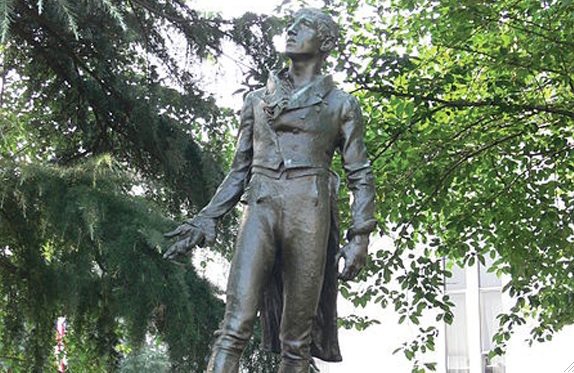
When Emmetsburg, a small mid-western town in lowa, undertook the task of refurbishing their statue of Irish patriot Robert Emmet, they were not prepared for the obstacles they would face and the length of time it would take. Now, after five years, the final chapter will be written with the rededication of the statue during the St. Patrick’s Day celebration in March, 1994.
The History
When the people of this predominantly Irish settlement in Iowa decided to name their pioneer town they chose Emmetsburg in honor of the Irish patriot Robert Emmet.
It was deemed that a statue of the patriot was necessary and so a committee formed of local Ancient Order of Hibernian members commissioned Jerome Connor for the job.
Connor, a noted Irish sculptor who had just completed a statue of Emmet for the National Committee of Irish in America, agreed to cast another image from the same mold for the Emmetsburg people.
It was during the World War I period, however, and materials were in short supply and more costly, so Connor upped the agreed upon price. Raising the extra funds proved difficult and an impatient Connor sold the statue to a group in San Francisco where it still stands in Golden Gate Park.
The irate citizens of Emmetsburg, upon learning of the fate of their statute, sent a delegation to Washington to confront Connor and he wisely agreed to cast another and ship it to the town.
Upon its arrival in Emmetsburg, in 1916, however, some objections were raised about the chosen site in the Court House Square and the statue was stored in the basement of a grocery store until a decision could be made.
Time passed and the statue was all but forgotten, except by the grocer, who had to work around it in his storage area.
Finally in 1936, he seized the opportunity to sell it to an Emmet Society group in Minnesota.
Once again the statue did not reach its planned destination, the Capitol at St. Paul. Fate decreed it was to stand in the backyard of a residence in White Haven, Minnesota, for some 22 years until one hot July night when it was quietly stolen away and appeared back in Emmetsburg.
The year was 1958, when planners for the town and county centennial decided festivities would not be complete without Robert’s return. This time he was met with open arms and anchored securely in concrete on the court house square.
Robert Emmet
Born in 1778, the son of a prosperous doctor who worked among Dublin’s poor, Robert
Emmet was a younger brother to Thomas Addis Emmet, a leading member of the United Irishmen who was exiled to France after the 1798 rebellion.
Robert joined his brother in France and hoped to enlist Napoleon in assisting a new insurrection. He returned to Ireland in 1802 and when an attempt to capture Dublin Castle failed in 1803 he was captured and hanged Emmet’s speech from the dock at his trial would become an inspiration to later generations seeking Irish freedom.
“We fight that all of us might have our country, and, that done, each of us shall have our religion,” he said, ending with, “when my country takes her place among the nations of the carth, then, and not till tee?, let my epitaph be written.”
The Sculptor
As a small boy Jerome Connor modeled figures of horses and men from the clay along the river banks in his native Ireland. Later he was to find fulfillment in a land far from the place of his birth, the United States.
His long hours of labor spent in the yards of a monument company, a means of earning a living, proved to be a valuable apprenticeship as it was here that he learned the expertise needed for a career in a sculpturing.
He first found expression in the medium of stone, but his greatest accomplishments were in bronze where he was able to capture deep feelings in his works that seemed to escape other artists.
His need for expression and perfection eventually caused his downfall. When one of his creations did not measure up to his standards, he would reconstruct the entire work. Many times this took longer than those who hired him felt necessary.
On one occasion this fact and the shortage of materials brought about a breach of contract, in turn causing him to file for bankruptcy. The action almost destroyed the man and his heart went with it.
When he received a commission to produce a monument paying tribute to all those who lost their lives in the Lusitania disaster off the coast of Ireland, he returned to his Homeland.
His later years were spent in a small studio in Dublin, molding small figures for friends and acquaintances to earn a meager living.
Connor died in 1943 at age 67.
The statue of Robert Emmet remains one of his finest sculptures.
The Committee
The first step the committee had to take was to renew interest in the statue for the townspeople had grown used to its presence in the courtyard and paid little attention while the elements quietly played havoc with their valuable sculpture.
Restoration costs of ten thousand dollars seemed totally out of reach, but periodic fund-raisers and donations from concerned citizens kept the project alive.
When a delegation of Emmet County, Michigan, residents requested the right to copy the statue in return for paying restoration costs, new interest was sparked. However, the Michigan people, too, faced fundraising problems, abandoned their plans.
A major breakthrough came when the committee commissioned a professional moldmaker to produce one hundred small porcelain busts of Emmet, each numbered consecutively, and followed by the destruction of the mold.
Complete with a certificate of authenticity, these limited edition art pieces have become valuable collector items.
By the spring of 1992, although the total amount of money had not been raised, the committee decided to proceed with the actual restoration. A team of conservators were engaged and the image of Robert, once again, seemed to have just stepped from the foundry.
The Robert Emmet Statue
Restoration Committee would like to be able to say that the restoration is paid for but unfortunately, this is not the case.
At the present time, the committee owes nearly $2,500 to the city. The money was borrowed in order to complete the project before cold weather set in. Also extensive work to the base of the statue proved more expensive than previously estimated.
Derry was drowning in a sea of Stars and Stripes.
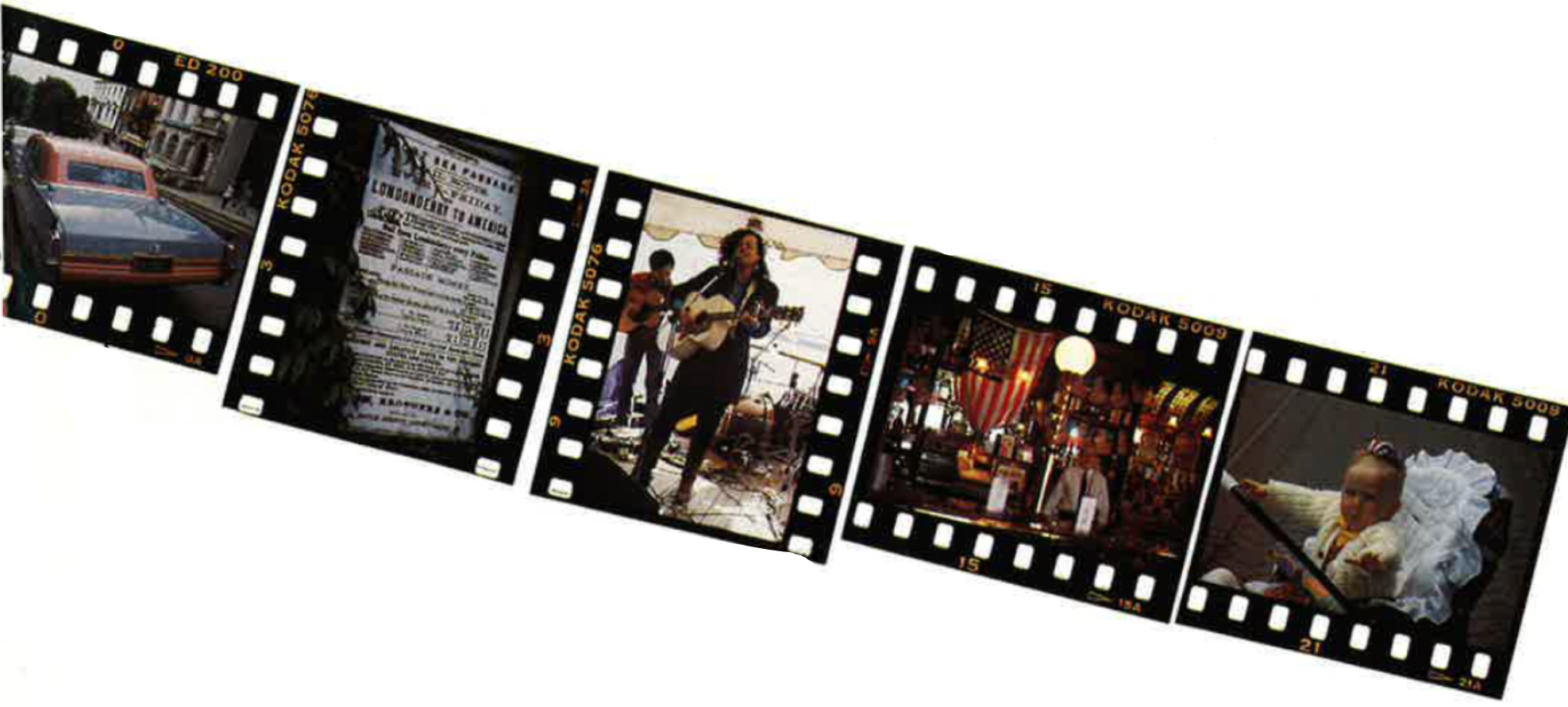
Every bar on the West Side was decked out in American flags of every shape and size imaginable, and a pink ’56 Chevy with Arizona plates was purring through the streets.
American mania had hit.
It was the first July 4 Music Festival, and from each bar came a different sound: Blues, Dixie, Cajun and Bluegrass, to name but a few. Local bands were billed alongside some of the top names in the American jazz and country music scene. Anyone with a Stars and Stripes T-shirt was wearing it, and the town was dancing until 4 a.m. as the Independence Day weekend got under way.
But why celebrate America’s Independence Day in Derry, Northern Ireland? The Festival organizers, the Derry based Impact Initiatives, said that St. Patrick’s Day was a huge celebration in America, so why not hold a similar event to mark America’s most important date? This was logic enough, but then one of the organizers, Sean Doran, discovered some surprising connections.
Did you know that the street plan of Derry’s walled city was copied on the initial development of Philadelphia? That Amelia Earhart, the first woman to fly solo across the Atlantic, landed at Ballyarnett in 1932? That, during World War II, America spent $75 million constructing — in Derry —Europe’s first advance base?
Digging deeper, Doran came up with more links. By 1832 Derry was the fourth most important emigration port in Brit-ain. John Dunlap, who printed the Declaration of Independence came from Strabane. The newspaper he founded on arrival in the States, became the first daily to be published in the USA. The Secretary of the Continental Congress, Charles Thompson, who read out the Declaration of Independence for the first time, was born in Derry. Reason enough to celebrate July 4?
The Pub Corporation (eight pubs owned by local businessman, Garvin O’Doherty) hosted the weekend extravaganza, with over 30 gigs packed into three days. It was a weekend of near constant music, utterly exhausting, but unmissable.
This two-months in the making Festival had some names which ought to make this one of the premier music events in Europe. Ronnie Scott and his Quartet were there, the rich, rounded tones from Ronnie’s saxaphone bringing smiles and applause all round.
Joe Pass, the legendary American jazz guitarist was also there, and the most magic of evenings was spent in his company. A delightful, smiling, shy man, Pass pitched the music/speech balance perfectly, talking about his music to a rapt audience. “People like that fast stuff – I don’t. I started to ‘pick’ butit gives a harsh sound, so I left off and played with my fingers. What I love is a beautiful melody.” And Pass illustrated different schools of jazz with a perfectly shifting rhythm and musical feel which only years of experience could have captured.
Pass’ magic lies in his ability to sing out a solo note melody, whilst a bass line and chords add richness underneath. The beauty of these soaring melodies and supporting bass counter rhythms were then complemented by Louis Stewart, the Irish guitarist. As Pass and Stewart improvised, they seemed to know instinctively every shift in mood, key or melody, inspiring each other on – the ten years since they last played together melting melodically away.
The greatest discovery of the weekend, however, was Caroline Doctorow, an emerging bluegrass talent on the New York country music scene. Inspired by Joan Baez and Judy Collins (who were family friends) Doctorow found herself fascinated by Irish and English folk tunes, and these influences dance playfully through her music. A soulful sadness and frenetic, thigh-slapping joy jostle through her work, and the whole boat rocked as Doctorow and her band gave a water-bound gig on the River Foyle under the Star Spangled Banner.
No one was mentioning the ironies of holding an Independence Day celebration in Northern Ireland — despite the same weekend seeing the worst violence in Belfast since the signing of the Anglo-Irish Agreement eight years ago.
One of the gigs took place in the Bogside Inn, a well-known Nationalist pub, but only the photos on the wall spoke of politics. Percy and Frank Robinson, a local acoustic duo, had everyone in the bar clapping — a wonderful, if rare, moment of unity.
Doctorow is possibly right, “The pub music culture here and the “Troubles” seem to be linked. People just need to be themselves.” And Independence Day was a safe opportunity. With Derry awash with the American flag, one local wryly observed, “The Stars and Stripes is the only flag which is acceptable here.”
Derry buzzed with life, and getting to the next gig was what mattered most. If music be the food of love, play on….
Editor’s Note: This article was originally published in the September October 1993 issue of Irish America. ♦
Leave a Reply