

The Story of Anne Moore
On January 1, 1892, Annie Moore, a 15-year-old from County Cork, Ireland, stepped ashore at Ellis Island and, as the first immigrant at the new station, was awarded a $10 gold piece.
The government of Ireland has approved the funding of a life-size bronze statue for placement in Cobh harbor showing Annie Moore going up the gangplank. And on this side of the ocean, the Irish American Cultural Institute are proposing that a statue of Annie and her two brothers disembarking be erected on Ellis Island in conjunction with the 1992 Ellis Island Centennial and Rededication. More information on the IACI Anne Moore Project can be obtained by calling the New York Development Office at 212-986-4224.
The following story on Annie Moore appeared in New York’s The World, Saturday January 2, 1892.
Annie Moore is the name of a little girl who was born in the city of Cork, Ireland, fifteen years ago yesterday. Her father, Matt Moore, lives at No. 32 Monroe street, in this city.
When Matt came to America he left his little daughter Annie and her two brothers, Tom and Joe, behind. He brought his wife Mary with him, and the scheme they planned was this: When Matt would have made for himself a little home which he could call his own, he would write to his sister in Cork, with whom he had left the three children, and direct her to send them to New York. Matt wrote to his sister about a month ago. This is what he said: “Send Annie and Joe and Tom to me. Inclosed [sic] you will find three tickets which secure them a passage on the Nevada.”
Just ten days ago the Nevada left Queenstown. She had Annie and Joe and Tom Moore on board. Matt hoped that his youngsters would arrive on New Year’s Day. Annie was born on New Year’s Day, 1877, and he thought it would be all for good luck if she began life on American soil on New Year’s too.
And she did. She was lucky, too. For she was the first immigrant to land on Ellis Island, and it had been arranged that the first immigrant to step on the Island was to be presented with a ten-dollar gold piece.
Annie Moore got it. Ellis Island is called the New Castle Garden.
The old Garden looked sullen and sulky yesterday. It had been deserted and discarded, and it looked as desolate as a graveyard. The Barge Office, too, looked as upset as a military barracks just evacuated by soldiery. Everything was topsy-turvy.
The United States Government having taken absolute and complete charge of all matters appertaining to the landing of immigrants came to the conclusion more than a year ago that the Barge Office was utterly unfit in every respect as a landing station. Then they fixed on Ellis Island as a suitable substitute.
The magnificent depot which now adorns the island was begun a year ago last August. Today it is finished and complete in all details. Everything was ready for the change from the Barge Office to the island yesterday morning. The Nevada had arrived the night before. The City of Paris was expected any moment.
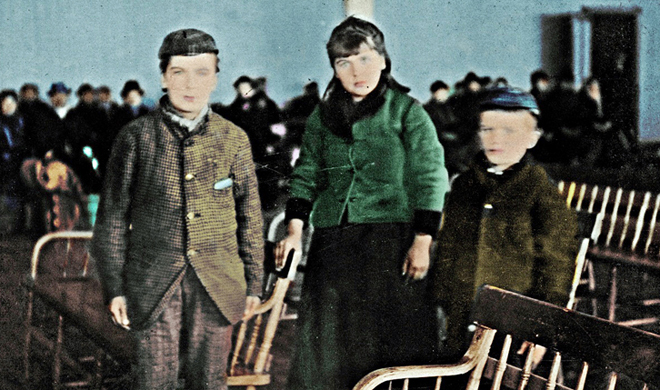
All last week the employees at the Barge Office had been moving their effects from the old to the new station, and when Col. Weber, the Superintendent of Immigration, entered his office at the old quarters yesterday morning he could not find a chair to sit on.
It was 8 o’clock yesterday morning when Supt. Weber stepped on board the ferryboat J.H. Binkerhoff at the Barge Office slip. Charles M. Hendley was with him. Mr. Hendley was private secretary to the late Secretary Windom. Like Mr. Windom, Mr. Hendley has always taken a keen interest in the immigration question, so he came all the way from Virginia yesterday to attend the opening of the new station.
He asked Col. Weber to be allowed to register the first passenger to arrive. Three hours afterwards he registered Annie Moore, the little girl from Cork.
The Rev. Thomas Drum, Chaplain of the New York Port Episcopal Immigration Agency, was on the Binkerhoff too. So was Secretary McCool, of the Mission of Our Lady of the Rosary.
On reaching Ellis Island, Col. Weber and his companions took possession of the new building. All the officials were happy. More than a hundred of them were there and they sent up a cheer of welcome when Col. Weber took off his big sombrero in salutation to the starry banner which snapped and fluttered on the towering flagstaff. Then the Colonel declared the new station open. There was no formality, no ceremony. The new Castle Garden was ready for business.
Then all eyes were turned towards the Nevada. She was Iying at anchor, a short distance off in the bay. The flag on the big flagstaff was dipped three times.
This signal had been arranged beforehand and the John E. Moore puffed away blithely from the side of the Nevada. Nearer and nearer the saucy little tender ploughed a feathery track towards the slip where the first immigrant stepping ashore was to be given a three times three [?] and a ten-dollar gold piece. Hundreds of the friends of the immigrants were there. They all bad heard about the ten-dollar gold piece. But the immigrants were utterly ignorant of what was in store for the first to land.
“There’s little Annie!” shouted Matt Moore as the tug came near. “There’s little Annie, and little Tom and little Joe!”
The tug was alongside! The gang plank was adjusted. Col. Weberand Charles M. Hendley stood one at each side of the plank rail.
A big German with a shawl rolled thirty or forty times around his neck had one foot on the gangplank. He was about to earn fame as the first foreigner to set foot on Ellis Island.
But a spark of Celtic gallantry changed the scene and spoiled Herman Zipski’s chance of being talked about for many a day to come.
“Ladies first!”
This shout came from the lusty lungs of Mike Tierney, who stood near Annie Moore.
He accompanied the words with a vigorous pull at Mr. Zipski’s coat collar.
“Step out, little girl,” said Mr. Tierney to Miss Moore. And then Miss Moore stepped onto the gangplank.
Col. Weber took off his hat to her. Charles M. Hendley took off his hat too. They caught the little lady, one by each hand, and welcomed her to America. Then big Matt Moore gave such a shout as he never gave before in all his life. Everyone shouted, and the little girl wondered if she was not dreaming about the fairy stories which she often heard among the groups around the fireside when the evening shadows fell in the old home near Shandon steeple.
“Silence all!” said Col. Weber.
Then he handed Annie Moore the glistening $10 gold piece and he patted little Tom and little Joe on the back and wished them luck and a happy new year.
Father Callahan, of the Holy Rosary, came on the scene at this juncture and he gave his blessing to the little girl and the two little boys from Cork.
After that Matt Moore and the three little Moores started for No. 32 Monroe street.
The second immigrant to land was a little Irish girl, too. Her name is Ellie King. She came from Lismore, County Waterford, Ireland. She went last night to friends in Rochester, Minn.
The third to land was a protege of Dr. Drunt, the Episcopalian chaplain. His name is John Hayley and he hails from Belfast, Ireland.
The newcomers trooped into the big depot. Everything worked like a charm, and the prediction was general that under the new conditions the comfort and safety of the immigrants will be all that can be desired. Col. Toffey and Major Anderson, who have charge of the subsistence department, spread a New Year’s feast for the employees at the station. Col. Weber was a guest.
Lifetime Achievement Award
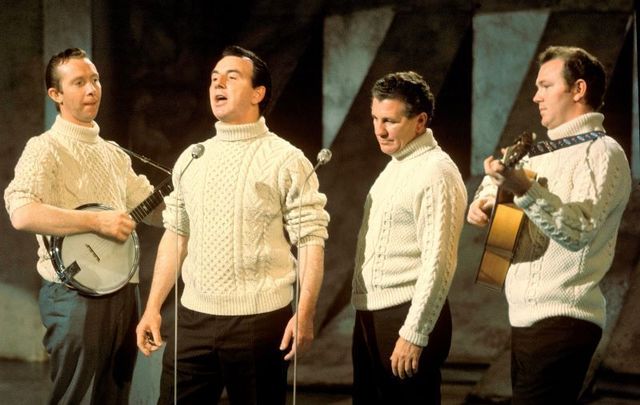
Tommy Makem, the folk music legend received a Lifetime Achievement Award from the “Irish Voice” newspaper at their first annual Community Awards at the Plaza Hotel, New York, on February 28, 1992. The following are his remarks.
“I’m very touched and delighted to receive this award, an award for living a life that I have enjoyed so thoroughly. A life that has given me the opportunity and led me in the right direction to discover the enormous wealth of the culture to which I am lucky enough to be one of the heirs. Even luckier to discover within myself some inner chord that connects me to this culture, that nurtures my spirit and enriches my soul every day. I’ve received so much from it that I feel a great need to help bring about an awakening to and enjoyment of this vast cultural heritage, not only in Ireland, but in the Irish American community as well.
Nineteen ninety-two is a propitious and exciting time to urge the expansion and reinvigoration of Ireland’s cultural identity at every level. It is imperative to ensure that that cultural identity is not lost in a unified Europe. Herculean effort—no, make that a Cuchullian effort— should be made by Ireland to send forth the writers, poets, musicians, painters, craftspeople, actors, dancers, and athletes as cultural missionaries to bring Ireland’s gifts to Europe. Just as the Irish monks in the early centuries brought Christianity to Europe, cementing the position of leadership already established by our ancient Celtic forbears. Arthur O’Shaughnessy, the 19th-century poet, wrote, ‘One man, with a dream at pleasure, shall go forth and conquer a crown, and three with a new song’s measure, can trample an empire down.’
I believe that rather than telling the people of Ireland that they are the New Europeans— ambition should be made of sterner stuff – they should be reminded that they are the descendants and natural heirs to the Celts, who were the Old Europeans – the dominant people of Europe. Today’s Irish are—and should be, the natural cultural leaders of the New Europe. Each and every one of us here tonight can do our part to promote this and make it a reality.
Receiving this award gives me tremendous impetus to do all 1 can to this end, and I thank all of you sincerely and deeply for the honor you have bestowed on me in giving me this award.”
An Irish Homecoming
OId red books, piles of them, surrounded me in the records office of Cavan town. I had arrived with embarrassingly little information.
My grandmother’s name, a possible maiden name for my great-grandmother, and a maybe date of birth. Mrs. Sheridan, the registrar, should have thrown me out. But she didn’t. Instead we turned page after page of these red purple books reading entry after entry in copperplate handwriting.
Plenty of McCabes – the name I sought — but which was mine? This was 1977. I had visited Ireland three times before, first as a backpacker, then more affluently with my mother and sister, and finally to attend the Yeats’ summer school. While I’d marveled at the landscape, the Book of Kells, Newgrange, the Abbey, I had never once sought to place myself here. It seemed impossible. The Kellys had been famine immigrants as had the Irish in my mother’s family. I knew vaguely that my father’s mother had actually been born in Ireland, but she died when my father was five and I only knew her from the picture of a beautiful women with bobbed hair in a twenties-style chemise dress with long pearls.
She seemed more connected with flappers than with Ireland. So when Irish people asked me “Where is your family from?” I would shrug and say, “Oh it was a long time ago.” My Irishness had deeper roots in Bridgeport and Austin and the Northwest side of Chicago. But after enough shrugs in enough pubs I had to try. I knew the Kellys came from Galway so I arrived one morning at the Galway City Hall saying, “Hello, my great-great-grandfather was Michael J. Kelly.” “So was mine,” the clerk replied. And there were thousands more Kellys. I left his office deflated. My connection to Ireland seemed fated to remain a vague adherence to a tradition with which I had no living links or factual groundings. Then that night I had a dream. My grandmother, beads and all, came to me asking, “What about my side? What about the McCabes?” So here I was in Cavan.
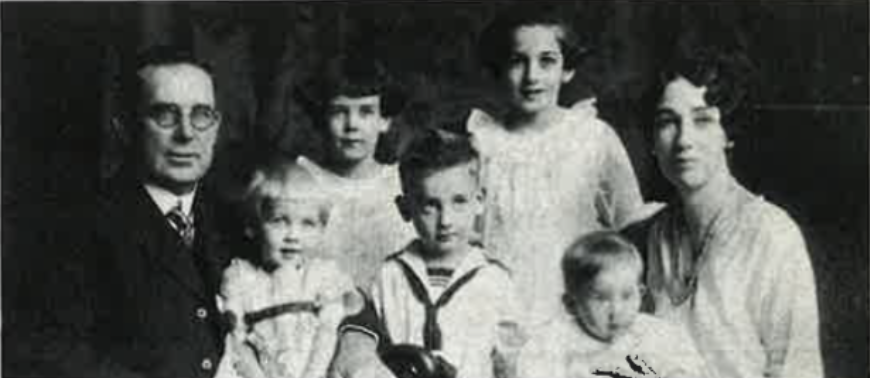
“My grandmother and aunt went to America with their mother as young children after their father died,” I told Mrs. Sheridan.
“That will help,” she said.
“Most families had more than two if we find only two daughters named Mary and Rose you’ll be away in a hack.” Well, we did. At the end of the day I held my grandmother’s birth certificate-complete with an official stamp and a warning against “altering this document” or, with a nod to the oral tradition, “uttering it so altered.” With this in hand, a whole other Ireland opened up to me I had my own townland now — Tievenass. When I needed directions, producing the birth certificate changed everything. Before I’d met puzzlement, “What’s this American woman doing bouncing along the back roads with no idea where she was going?” Now I’d take out my document. “Hughie McCabe”, they’d say, “Oh yes,” and then solicitously, “But he’s dead.” I found myself being consoled for a century-old loss and pointed in the right direction. I found the cottage, empty now, but the neighbor next door seemed unsurprised to see me.
He remembered stories about the two little girls who went to America. And wondered had I come “to claim the farm?”
“No, no,” I assured him.
“Well then,” he said, “welcome home.”
The last 15 years have made the process of connecting with past ancestors much easier. Not only have the birth records been computerized but so have many parish records. These are the real gold for those whose families left before 1865 when the civil birth records begin. And now as part of the Homecoming Festival sponsored by the Irish Tourist Board and the Northern Ireland Tourist Board, you can begin your search at home. The Irish Genealogical Project and the Irish Professional Genealogists are in the process of indexing all records countrywide. Our own genealogist Dr. James Ryan is involved in the effort.
There’s much to be done, but in preparation for the Homecoming Festival two special offices have been set up which will combine the records already computerized to provide detailed genealogical research.
All you have to do is fill out this form and send $25.00 to the IGP Research Service. They will provide an assessment and send you leads. Don’t worry if you don’t have all the information Ray Cawley, director of the Irish Homecoming Festival, says, “Even one specific detail may be enough for us to uncover earlier generations of your family.” So good luck. Do it soon, because this phase of the project ends August 1. Write and tell us what you find out. I’m putting them on the trail of the Kellys.
Prepare a fact sheet as per below and mail it to IGP Interim Research Service, c/o Project Manager, IGP, 1 Clarinda Park North, Dun. Laoghaire, Co. Dublin, Ireland or IGP Interim Research Service, c/o Project Manager, GP, Ulster American Folk Park, Omagh, Co. Tyrone, N. Ireland.
— By Mary Pat Kelly
Editor’s Note: The above contact information may be out of date.
This article was originally published in the April 1992 issue of Irish America. ♦
Leave a Reply