
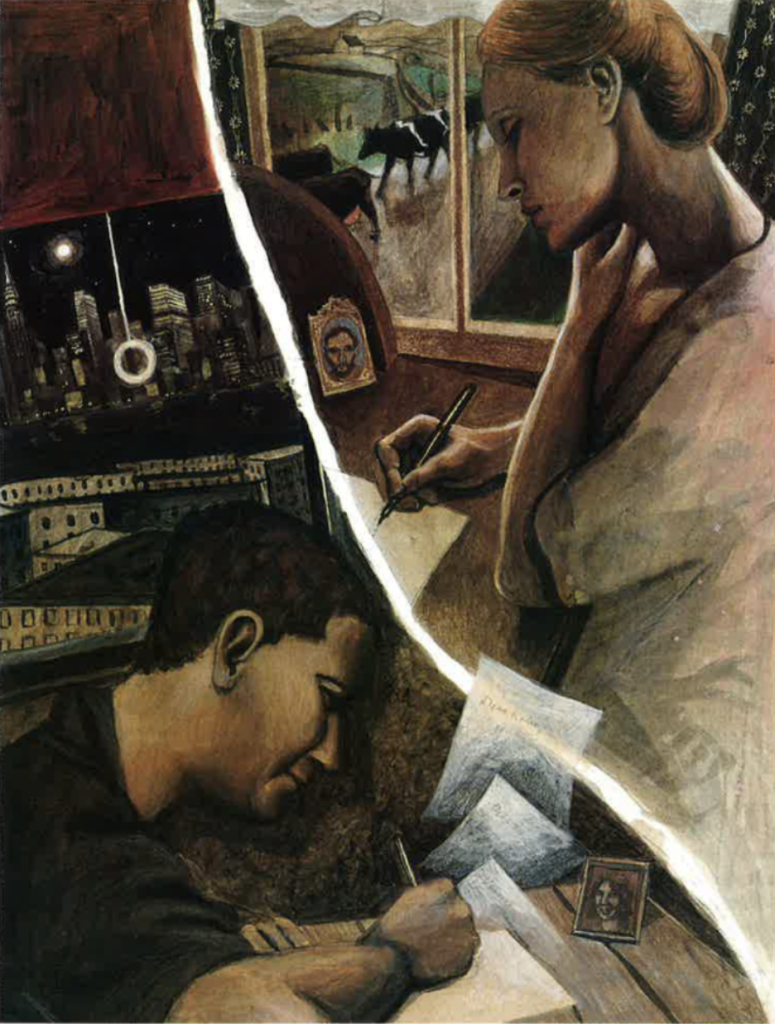
The Understanding
A short story written especially for Irish America by best-selling Irish novelist Maeve Binchy.
Liam’s mother came to see him for a week in New York every year around Memorial Day. He thought this was a good time to invite her, hot enough to be a bit exotic, not so hot that it would make her think he lived in a furnace. He planned the visit very carefully.
He booked theater tickets well in advance, he reminded himself of the times of Mass in St. Patrick’s Cathedral so that she would think he was a regular attender.
He always managed to set up a meal at a local Italian restaurant where Gino and his wife made a huge fuss over Liam’s mother, and a breakfast at a marvelous noisy New York Diner where the service was like a first class cabaret. He took his mother on a boat trip on the Circle Line every time, and loved the way she now recognized the buildings and the bridges.
Always she told him that his father would love to have made the journey, but that his nerves were bad. Not strong enough to make the journey. Always Liam nodded gravely as if he believed it. His father would not have crossed a pond to see him, let alone cross the Atlantic Ocean.
Every year Liam went home to Ireland to see his mother for a week in September, he chose that time of year because Ireland looked green and contented after the summer. The millions of school children on their bicycles had gone back to school rather than remain roaming the highways and byways with their freckled faces and smiling hopes for a future in a world that was running short of futures.
There were race meetings to go to in September when his father’s face had grown long and sour and Liam had felt he should leave the home for a day or two.
Every May his mother told him that Katie was looking the picture of health, Katie was his first girlfriend, one of the reasons he had left home when he was twenty and come to work in New York.
Katie was a wonderful girl, Liam didn’t need to be told that, he knew it, he just didn’t want to marry her. That was all. He felt that there was this amount of time between the cradle and the grave and he didn’t want to suit everyone else’s long term plans by marrying the only daughter of the adjoining farm of land. It was medieval, it was feudal, it had nothing to do with real life.
Every September when he returned to Ireland he met her, relaxed and confident, calm and in control of her life. She gave no sign of languishing after him as his mother always reported. She always seemed to have a new car.
“Hey, where’s this recession we hear about?” he would laugh.
“I work for a bank remember, there’s never a recession in a bank,” she would reply.
“You should ask Katie out here to New York,” his mother said every year in May.
“That fellow wouldn’t ever have the courtesy to do the right thing,” his father resaid when the matter was raised by his mother every September in Ireland.
This went on for ten years.
And then Liam met Nikki the beautiful Greek girl and asked her to marry him. He planned to take her to Ireland to meet his folks.
He tried not to read the thunderous disapproval feebly disguised in his mother’s letters, he tried not to imagine the ferocious glare there would be on his father’s face.
He didn’t believe that Katie would be upset.
And of course there was no question of letting anyone down. Katie couldn’t still have any soft spot for him like his mother always said.
By chance he had a letter from Katie just as he was making plans to take the lovely Nikki to Ireland.
Katie, too, it turned out was engaged. She was going to marry Alec, a Scot whom she had met on a bank conference. They would be married and then she would go to live in Edinburgh. She said that it was a wonderful coincidence that two such good friends should find happiness at the same time. Perhaps Liam might come and visit with Nikki when he was next in Europe.
Somehow it disturbed him, Katie knowing a different world. Scottish art galleries and scenery. He would like to have taken her just once to the Frick, to the Museum of Modern Art, upstate in New York when the leaves were turning…just to show her that Ireland didn’t have all the scenery, America had a lot of it too…Scotland seemed a poor substitute somehow.
But he wrote back warmly.
This was the first time in a decade that they had exchanged letters. Just as they were about to set out on different lives.
To his delight Katie wrote back, she wrote with some impatience about the wedding. Her Scottish in-laws wanted to travel to Ireland, they wanted to make a huge event of it. They had given a list of forty people on their side of the family.
Katie hated it all. She wanted something quiet, peaceful, just family and a few friends. She had even hoped that Liam might have been home for it, and Nikki of course.
Liam wrote that Nikki wanted something even more ridiculous. Two ceremonies, one in the Greek Orthodox Church one in the Catholic Church, she was expecting half of Ireland to travel over for the event.
Their letters flew backwards and forwards; how absurd that people who loved each other should be dragged down by such differences of opinion over ceremony and ritual. Perhaps it was because of different races and cultures and expectations.
Several times Liam though to himself how easy things would have been if he and Katie had been getting married. A small gathering of neighbors and friends in Katie’s house. Only a stone’s throw from his parents home.
His heart gave a lurch. What would happen to her land now when she married this cracked Scot? It would be sold of course.
There was nobody left but Katie, she let out the grazing anyway.
She wouldn’t want to keep it now. No. This would form her dowry. New people would come in,
new people with new ways. His father’s thin mouth would be a narrow hard line for ever more.
Katie wrote saying that Liam’s mother was in an agony over what to wear at her son’s wedding, she said there was no one to advise her. If she was going to travel all that distance to say goodbye to her boy then the least someone could do was to tell her what to wear for the farewell. Liam wrote back in a temper. What did his mother mean, goodbye? Hadn’t he been living in New York for ten years, one third of his life, one half of his adult life? Katie’s reply was curt.
“Don’t fight with ME about it,” she wrote. “I’m on your side, I want to get out and get away too. You’re not the only one who can be adventurous.”
His tone softened. He asked her what she would have liked in an ideal world, and Katie wrote back that in an ideal world she would like to have had both Ireland and America in her life.
She wrote and told him that she had once thought of applying for a job in one of the New York branches of her bank, but then she hadn’t like to. Mainly because it might look as if she was going there after Liam.
Afterall they once had had an Understanding. People would have thought…maybe even Liam would have thought…Her letter trailed away.
He wrote by return, Katie was right they DID have an Understanding, they always understood each other. Never more so than in these times, in the months leading up to their marriages.
People who had such an Understanding could never have taken things up wrong he said. What a pity she hadn’t come to New York he said. He said it several times in the letter. That was the week when he and Nikki talked about having a family. Liam wanted three, immediately, Nikki wanted two, in ten years’ time.
“I’ll be forty,” Liam cried. He thought of his own father fifty years older than him, light years away, always.
Nikki had shrugged. She was twenty, she wasn’t ready for motherhood yet.
He didn’t write it to Katie, it would be disloyal but his upset seeped into the letter.
Katie was upset 100, Alec said she shouldn’t write so much to this friend in America, not now that she was engaged to marry him.
Liam was out-raged. There was no harm in their letter writing, did this man not understand an Understanding? Apparently not. Katie said she had better write no more.
It coincided with Nikki saying that he seemed more interested in those letters from Ireland than he was in the wedding plans.
He telephoned Katie. It was a Sunday morning in Manhattan, he had his New York Times unopened on the dining table in his apartment, his plate of smoked salmon and cream cheese uneaten. It was afternoon in Ireland.
When she answered the phone they found that they didn’t need to say much, because if you have an Understanding you have a sort of shorthand. You don’t need to define that there are a lot of things that have to be unpicked and that somehow you will get the courage to unpick them. And that when you have, well, everything will be all right in the end.
If you have an Understanding you won’t waste any time regretting the years in between. They were necessary. And now they are over.
Collen Quinn in “Loving”

If you’re ever driving around the Upper West Side of Manhattan early one morning, and catch a brief but stunning vision of a dazzling Irish beauty gliding gracefully through traffic down West End Avenue on Rollerblades, it’s not your imagination: it’s Colleen Quinn on her way to work. By day, Colleen plays Carly Rescott, the angst-ridden madonna of Corinth on ABC’s daytime drama “Loving”. At night she dashes downtown for rehearsals of a new Off-Broadway play in which she has a small but crucial role. It makes for sixteen hour days: an exhausting regimen that calls for both insane dedication and intense physical stamina, but Colleen believes that “I thrive on that kind of energy and work.”
Energy and work, both of them in exuberant abundance, have characterized Colleen ever since she grew up, on Long Island, the second daughter in a family with an “insane passion” for Notre Dame (“We were two years old and my father had us lined up in front of the TV. We couldn’twalk, but we watched Notre Dame football”). Colleen entered talent shows and dreamed of winning gold medals as a figure skater, but realizing in high school that her dreams of Olympic glory were just a little impractical (“You have to have beaucoup bucks”), she overcame her teenage inhibitions about peer pressure and discovered a passion for acting that “has never left.”
Making the painful decision not to attend Notre Dame (“My dad went there, my older sister went there, and my younger sister went there… I applied, and I was put on the waiting list, but I also did a reality check and said, ‘Colleen, you want to go here just because you’re obsessed with the place. They are not known for an especially astute drama program’”), she went to college in North Carolina, majoring in theater. Out of school, after acquiring representation (“She chased me like hell,” her manager Brian Glass recalls, laughing. “She’s quite fierce. I would not want to come between her and something that she wants”), Colleen learned her craft the hard way: on stage, in regional theater.
Now of course, after landing the role of Carly Rescott, Colleen has the best of both worlds: the chance to stretch doing the occasional role in an Off-Broadway play, as well as the relative security of a steady paycheck on “Loving.”
In the nearly two years since Colleen’s been on the show, her character has nearly drowned, rediscovered after a painful and protracted search the child she abandoned as a baby only to discover that he has a potentially fatal heart condition, and fought endlessly with her sister Ava (bewitchingly portrayed by Lisa Peluso) over the love of Ava’s fiancé, Paul, Carly’s high school sweetheart and the father of her child who after surviving a terrible explosion is, at least temporarily, in a wheel-chair. The endless internecine warfare between Carly and Ava, which culminated in a catfight at Ava’s engagement party that was retaken so many times it left both actresses in tears, is easily the most entertaining part of the show. “Ava and I will always be at each other’s throats,” Colleen acknowledges, and quickly adds, “but we haven’t beat each other up in a while.”
To say that Colleen is proud of her Irish heritage is like saying that James Joyce can be a little obscure. A “humongous” Irish flag hangs in her dressing room at ABC (“I’m violently passionate about being Irish. I think it’s the greatest thing you can be”), and having visited Ireland once, ecstatically, she years with Hibernophilic fervor to return as soon as possible, possibly to work.
There is after all a surge in film production in Ireland these days (“Tell me about it,” she says eagerly when reminded of the fact), and to go back to Ireland with a part in a film would be, for Colleen, the best of all possible worlds.
“The thing about a soap,” Colleen’s manager explains, “is that you can be incredibly popular for four years and then never work again. Just fall right off the face of the earth.” When new writers are hired on a soap opera, plotlines and characters can go tumbling into limbo, sending actors screaming into limbo with them.
And when a new producer comes along, it’s not unlike a person buying a house: the first thing they want to do is tear down the walls and rip up the floor. Which is fine, unless you happen to be the floor. But this prospect doesn’t faze Colleen in the least. “It’s dangerous I think in this profession to get too settled into anything because maybe then you’ll stop some growth.”
“I really believe you should be passionate about what you do,” Colleen insists as she prepares, after a hard day at work on “Loving,” to head off for a long night of rehearsals for her play. “I actually like this business for the instability. Most people say they hate that, but I really like not knowing what’s going to happen.” Colleen Quinn’s future is as uncertain, as unstable, as exhilarating, and as exciting as a race down West End Avenue on Rollerblades. And she likes it that way.
By Tom Moran
At Weddings and Wakes
Phyllis Lindsay reviews Alice McDermott’s latest novel about a year in the life of an Irish Catholic family living in New York in the 1950s.
“Aren’t you glad that you only have to see your relatives at weddings and wakes?” says a cousin to the three Dailey children at their beloved Aunt May’s wedding. The irony of those words hits home just three days later when the family is summoned to Aunt May’s funeral.
Those two outstanding occasions in otherwise predictable lives are foreshadowed and looked back on with haunting persistence in At Weddings and Wakes, Alice McDermott’s captivating new novel accounting a year in the life of a close-knit Irish-Catholic family living in New York in the 1950s.
Almost Joycean in its stream-of-consciousness quality and wealth of exquisite detail, this account of the life of the Dailey family paints a vivid portrait of domestic life and its cycles of joy, discontent, bitterness, and lasting affection. The family’s complex and rigidly established dynamics are viewed through the eyes of the three children. McDermott, author of That Night, masterfully registers their initial confusion and gradual comprehension of the adult world.
Twice a week during the summer and on Sundays the rest of the year, Lucy Dailey takes her three children on a journey by bus and subway from Long Island to her native Brooklyn to visit her ailing stepmother and three unmarried sisters.
The sisters have followed different paths: Lucy is a mother of three and is unhappy in her marriage; Veronica is an alcoholic who has lost hope; Agnes is a career woman who relishes control; May, a middle-aged ex-nun, is simply loving and generous.
But in their own way they have all succumbed to the “easy misery of daily life” and reinforce that misery with lament, indulging their tears and discontent in “stifled and frustrated tones.” Lucy, who feels exiled in Long Island, makes these journeys to resolve her unhappiness but comes away each time empty-handed — without solutions to or even reasons for her frustration.
The women also depend on routine to soothe their discontent. Each visit to the aunts’ dark, stifling apartment is the same: The women cook the same dull, heavy meal, murmur the same sorrows and consolations, and sob behind closed doors at moments the children can now predict with unerring accuracy.
The children submit readily to this “still and predictable” life of relentless routine and “stunned hopeless.” Yet, seduced and comforted as they are by ritual, they fantasize about abandonment, only to be jolted back by fear and uncertainty to the tight confines of their world. Their mother and aunts never venture even that far.
At Weddings and Wakes is extraordinary on several levels. It’s an accurate portrayal of everyday life because it is overwhelmed by detail and sparse in action.
Every happening is either a foreshadowing or a remembrance of the pivotal events of that year, May’s wedding and wake. And the wake, it turns out, is only alluded to throughout the book; it is not actually part of the action.
McDermott’s playful manipulation of time is as fascinating as a clever puzzle.
The story takes place within one year, but because ritual makes the family’s days and years so similar, and given the characters’ tendency to live in the past (and McDermott’s to hint at the future), it is often difficult to determine whether events took place before May’s weddings or after. Most often, they seem to have occurred both before and after, again reflecting the sameness of the Daileys’ lives.
It’s the older generation that lives in the past and is obsessed with the dead. The aunts’ stepmother cannot fully enjoy happy occasions knowing the family is “dancing on the graves” of her sister and husband.
Lucy and her sisters succumb to this blind worship of the dead, leaving the children’s father to try to distract them from their determined mournfulness.
He engineers the Dailey vacation each summer, the yearly “antidote to the easy misery of daily life as his wife and her family … lived it.” Despising routine, he takes a different cottage each year, where the past and its ghosts cannot disturb them, where there is only the blissful present.
In a scene toward the end, as Lucy at last begins to appreciate her husband’s need to stop time for just two weeks a year, her husband realizes that he is well suited to his wife’s family after all. “There was something they gave him, too, with all their ghosts, something he couldn’t deny: they provided his ordinary day … with an undercurrent that served as some constant acknowledgement of the lives of the dead.”
In At Weddings and Wakes, McDermott has created a charming, tender, and often heartbreaking portrait of the joys and dissatisfactions of everyday life. Each sentence gathers the everyday events, details, and images of the life of this very ordinary Irish-Catholic family and elevates them to the universal. As the story unfolds the reader is left feeling, like the children’s father, distanced from the family yet carried away by their passions and sorrows.
Editor’s Note: This article was originally published in the April 1992 issue of Irish America. ♦
Leave a Reply