
The O’Briens are one of the great Gaelic families of Ireland, and were the rulers of the ancient kingdom of Thomond, which takes in much of the modern county Clare and also the adjacent parts of counties Limerick and Tipperary.
The family name is derived from Brian Boru (925-1014 A.D.) who was King of Thomond and rose to become High-King of Ireland. Brian Boru is best remembered as the leader of the Irish army which finally defeated the Vikings (i.e., the Scandinavian invaders of Ireland) at the Battle of Clontarf in 1014. Brian Boru was himself killed in this battle. Since this time many O’Briens have been prominent in Irish history. The Annals of the Four Masters, which is a 17th-century chronicle of important events in Ireland from 1055 to 1616, record the activities of over 300 individual O’Briens. There are several O’Brien castles still in existence in their ancient territories.
The most famous, and the one recommended to all O’Briens for a visit, is Bunratty Castle, an O’Brien stronghold from 1353 until 1712. The castle is now a museum and banquet center. Another, more recent, O’Brien property in Clare is Dromoland Castle which is now a luxury hotel. One of the colorful O’Brien residents of Dromoland was Sir Lucius O’Brien, who was such an avid fan of horse-racing that he changed the name of the local town to Newmarket after the English horse-racing center of the same name.
The O’Brien name is still very common in Ireland, the fifth most common. It is notable that the name almost always occurs complete with its “O” prefix, unlike some other names which historically had this prefix but later dropped it. It is occasionally also spelt O’Bryan or O’Brian.
During and after the period of the Elizabethan conquest of Ireland several O’Briens were made peers of the British Crown in order to encourage their allegiance. The three hereditary titles they were granted are: Earl of Thomond, Baron and Earl of Inchiquin, and Viscount Clare.
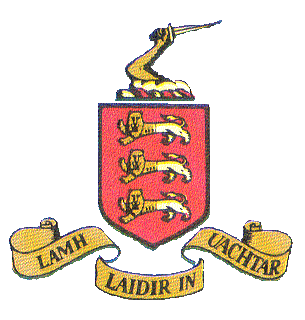
The first of these two lines have historically favored the British Crown, whereas the Viscounts Clare have been prominent in several attempts to reduce British domination of Ireland. Daniel O’Brien, the 3rd Viscount Clare was the founder of the famous Irish Brigade in the Army of France. it was mainly composed of the Irish Jacobite army which left Ireland after the Treaty of Limerick (1692). The Regiment was also known as Clare’s Dragoons. His descendant, the 5th Viscount Clare, was killed at the Battle of Ramillies in 1706 while in command of the regiment. The 6th Viscount Clare (1669-1771) led the Brigade in the famous battle of Fontenoy when the French defeated the English and allied armies. The Brigade and their exploits are commemorated in many ways but most notably in the poem by Thomas Davis which includes the famous lines: “In far foreign fields from Dunkirk to Belgrade. Lie the soldiers and chiefs of the Irish Brigade.”
In more recent times William Smith O’Brien (1803-1864) was one of the founders of the rebel Young Ireland Movement.
In 1848, when most of the leaders of the movement were arrested, he led a minor and ill-fated insurrection. His statue stands in Dublin’s O’Connell Street. His daughter Charlotte O’Brien (1845-1909) was a writer on various social issues whose articles on conditions aboard emigration ships resulted in a Board of Trade investigation into the White Star line and stricter control of emigrant ships.
In the cause of American freedom the O’Briens are no less notable. There were 231 O’Briens in the American Revolutionary Army. These included the O’Brien brothers, led by Jeremiah O’Brien (1740-1818) who were among the party of volunteers who captured the British ships Margarita and Union in Maine. This was the first naval engagement of the War of Independence. Jeremiah was later the Captain of the Machias Liberty. Other rebel O’Briens include William O’Bryan, the “Rebel treasurer of Georgia” who was one of the first patriots to be imprisoned for his pre-revolutionary activities.
Fitzjames O’Brien (1828-1862), who was born in Limerick and emigrated to the United States, wrote extensively for Harpers, Atlantic Monthly, and many other literary magazines. One of the Bohemian set of New York, he was killed in the American Civil War as a soldier in the New York National Guard.
Frederick O’Brien, born in Baltimore, in 1869, was a world traveler and writer and editor of several newspapers. His novel White Shadows of the South Seas (1919) was a popular work of its time.
Other literary O’Briens include Kate O’Brien (1897-1974), who was born in Limerick. She wrote many novels including Land of Spices, Without My Cloak and That Lady (1946), which was subsequently dramatized and played on Broadway. Her works have recently regained popularity in Ireland, particularly due to the efforts of Virago, the Irish women’s publishing house.
Edna O’Brien, a County Clare-born author, since the publication of her first book, The Country Girls, has enjoyed worldwide critical success. As has Tim O’Brien, the author of The Things They Carried, a book of short stories about the time he spent in Vietnam.
Other prominent O’Briens include Edward O’Brien (1860-1927) who was a merchant and diplomat and a world authority on shipping and inland navigation.
Morgan O’Brien (1852-1939) was an eminent lawyer and jurist who became a justice of New York Supreme Court at a record age of 35. His son, Kenneth O’Brien also served in this capacity.
Editor’s Note: This article was originally published in the April 1992 issue of Irish America. ♦
Leave a Reply