
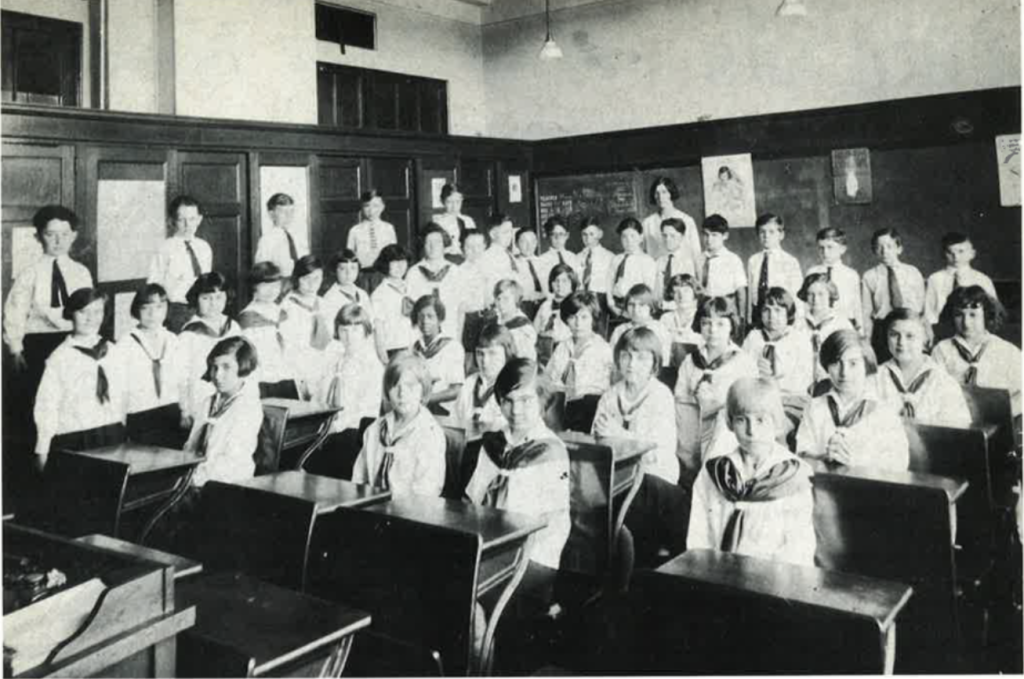
When we decided to focus on the Irish American contribution to education in this issue we found we needed a wide lens indeed. On every level, from pre-school to the universities, Irish Americans have left their mark.
Religious orders sent representatives from Ireland who in an amazingly short time founded schools and colleges. Young Irish women became the backbone of the public education system and many times it was a Miss Ryan — or in our article a Miss Nolan — who taught the lessons of America to the new immigrants. We all know the names of the institutions most associated with the Irish American tradition — Notre Dame, Manhattan College, Iona, Fordham, Loyola, Boston College — these were mentioned often as the alma maters of our top 100 business leaders. But did you know that Seattle University and its president, William Sullivan, SJ, continues a proud Irish American tradition where the first students and faculty shared an Irish heritage. And what about St. Peter’s College and Georgian Court, two of the finest private colleges in New Jersey with their strong Irish connections?
But these schools as well as Salve Regina and George Washington University have brought their message to our pages not because of the past but the present.
Did you know, dear readers, that you are a very educated group? Our demographic studies show that you place a high value on education – your own and your children’s. We would like this to be the beginning annual look at education and welcome your ideas.
We hope too that colleges and universities might use our pages to tell you their story.
So here’s a start — an affectionate memoir of Miss Nolan and a journey back to the source of it all — The Isle of Saints and Scholars.
Miss Jane Nolan
She was my aunt, my godmother, my fairy-godmother and my first teacher. She would have loved it if I had become a teacher, but that was not to be. I never called her “Aunt.” To me, she was always, simply, Jane. To her, I was “M.M.,” “Puddin” or “Revelli”.
The last pet name never made much sense until I saw “A Night at the Opera” when I was in my twenties. In that film, Chico Marx played a character named Revelli. She wouldn’t acknowledge the connection but, even then, I guess she knew that I was not destined for a career in the classroom.
Jane was my mother’s sister and the second oldest girl in a family of eight. She was devoted to my grandparents who had immigrated from County Kerry at the turn of the century and settled in the Highbridge section of the Bronx.
Jane was the kind of daughter a parent dreams about. A brilliant scholar, a gifted athlete and, if I might add, quite a glamor girl. While still in High School, Jane played on two women’s semi-pro basketball teams sponsored by the Metropolitan Life Insurance Company. To quote the New York Times’ coverage of one victorious game, “Miss Jane Nolan, playing right guard for Hamilton, caught the ball on about the center line and made a perfect, breathtaking shot, dropping the ball clean through the net without so much as touching the rim.” That’s the way I remember her doing everything effortlessly and perfectly.
“Jane Nolan graduated from Evander Childs High School in 1922 and went on to New York Teacher’s Training. In 1926, she would begin a career as an elementary school teacher that would span forty years. One of her first assignments was in the “Sugar Hill” area of Harlem. From the beginning, she would insist, she always had the smartest children in her class. If Jane was dedicated to one educational idea it was “High expectations bring high results.”
Eventually, she was transferred to a school near home, P.S. 26 on Burnside Avenue in the Bronx.
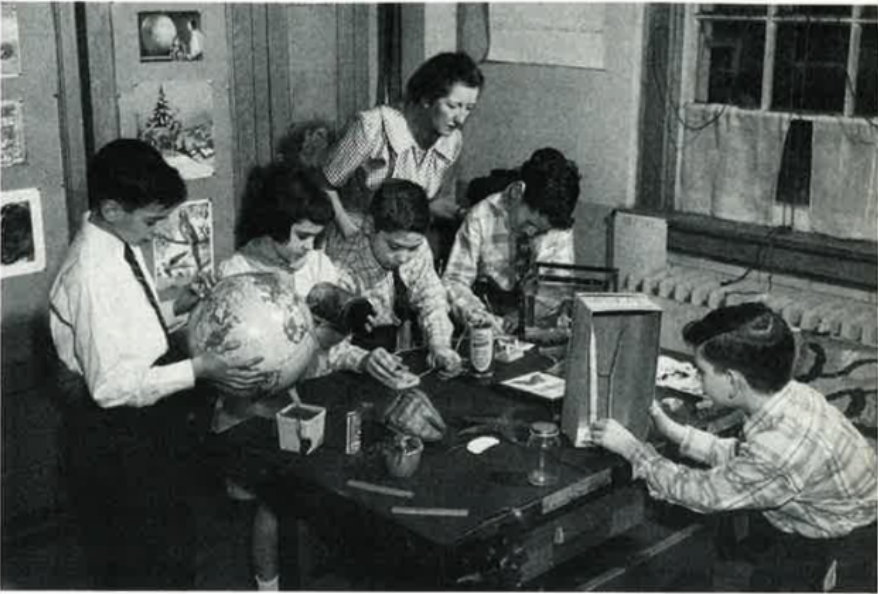
Jane felt that, as a teacher, she had to set an example with the way she behaved and the way she looked. She was a stunning redhead and bore a marked resemblance to Barbara Stanwyck. Going off to school every day, she was impeccable. In “off hours” she wore slacks and tailored jackets, an indelible fashion influence on me.
I would spend endless amounts of time rifling through her jewelry boxes and waltzing around in her fur coats. Perhaps her most impressive credential, for me, was that she had a driver’s license. There was also the convertible roadster.
She was particularly interested in her students’ achievements in math and science. You can imagine the excitement when, in the mid 1950’s, one of her former students, eleven year old Robert Strom, a science whiz, was a contestant on the “Sixty Four Thousand Dollar Question.” We watched avidly as Robert astounded everyone, show after show, and in the final contest, he won it all. Jane’s response was typical of a teacher. She said, “I had his brother Stephen before him and he was twice as smart.” Both boys went on to Harvard on scholarship.
Although she never married, being a teacher gave Jane a lot of children who adored her. I’ve kept a note from one of her former students who also went on to work in television. Dated 1965, and signed Bette Ann Moskowitz, it said: “Just last Sunday, my mother (Mary Solomon) gave me a yellowed newspaper called The Traveller, done by our fourth grade class so those many years ago, under the distinguished direction of one Jane Nolan…. Believe me, the name still makes me think of nice perfume, and the pride of having the prettiest teacher in the school.” When she announced her retirement in 1966 there was surprise and disappointment among her colleagues and students.
She was as energetic and professional as ever and, God knows, she still looked great. She would be missed. What would everyone do without “Miss Nolan”?
One of her “pupils,” as she sometimes referred to the children in her class, gave her a large drawing of a little girl with a big tear falling down her face. It said: “You’re leaving and I’m grieving.” I suddenly thought about the years of thank you notes from parents, the influence this special teacher had on so many students, the kids we would meet on the street on weekends who would stop to talk to “Miss Nolan” and say, “I made sure my brother got into your class for next year.” This was the result of the genuine joy she took in teaching.
My aunt’s tenure with us lasted until she was in her eighties and saw Janie my daughter through college and her first employment. I wish I could say that my daughter had become a teacher. What a perfect ending that would be. My aunt, however, being much smarter than I am, would say, “You know M.M., I could write a book, I knew she would take after you.”
Jane Nolan died in September of 1990.
School must have been starting somewhere and she was always on time.
By Margaret Murphy
Memories of the School of Irish Studies
Of the thirty-six American students attending the School of Irish Studies in the spring of 1980, thirty-four were of Irish descent, one was named Lieberson — and then there was yours truly. Even before I had mailed my application off to Dublin, dozens of friends and strangers felt the need to wonder out loud why someone bearing a very German surname (and equally Teutonic looks) would choose to go live and study in Ireland. Although I was quick to report that my mother had, indeed, had one great-grandfather named Dunham, I could not pretend that my minuscule drop of Irish blood qualified me as a native son. No, I had to admit that the only Irish names that interested me were Yeats, Joyce and Beckett.
So, I suppose you could say that I went to Ireland for the poets, but ended up staying for the poetry. For like any young college student who enrolled in Dublin’s School of Irish Studies, I was soon immersed in an integrated curriculum of Irish history, Irish literature and Celtic civilization so all-embracing, that no subsequent visit to any country, much less Ireland, will ever be able to rival that sojourn.
Concurrent with their academic program, it was suggested that School of Irish Studies students board with a Dublin family, thereby garnering a less rarified sense of Ireland and witnessing firsthand those most renowned of Irish traits — generosity, familial warmth and insufficient central heating. I lived with a wonderful family named Reynolds in the Ballsbridge section of Dublin. Being the only student housed within walking distance of the school, I was uniquely fortunate in being spared both the expense and the vagaries of the public bus system.
But, those buses did provide quick and frequent trips to the quays along the Liffey, a jumping off point for visits to the National Museum and Gallery, shopping on Grafton Street, tin whistle lessons at Trinity College, seeing an O’Casey play at the Abbey or, with less frequency than I should admit, studying in the National Library reading room. Either alone or with one or two of my fellow students, I scoured every corner of dear, dirty Dublin from the rugged beauty of Howth on the northside to the tamer seaside village of Bray to the south. Kilmainham Jail, Christ Church Cathedral, the General Post Office — the entire city was our history classroom.
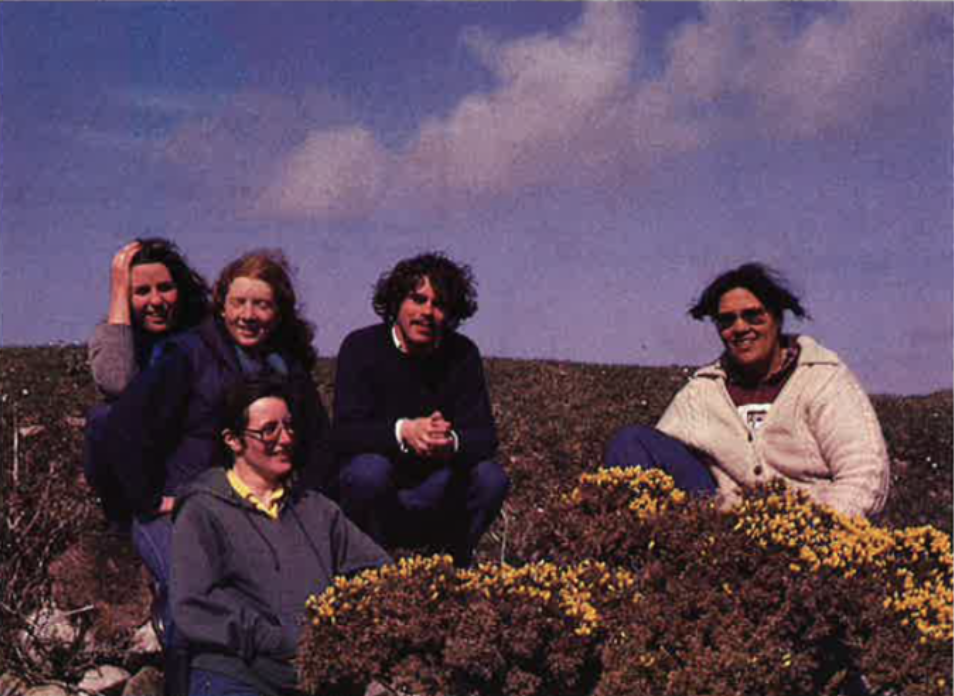
In the actual classroom we were privy to some of the finest scholars and writers in Ireland. Renowned poets Eavan Boland and Seamus Deane taught Yeats and Contemporary Irish Poetry, respectively. A course with archaeologist Barry Raftery included a weekend field trip to the early Christian ruins of County Sligo. There was an Irish language class for the intrepid, and courses spanning the entire history and politics of Ireland from the Celts and the Vikings up through Irish independence and the government of then Prime Minister Haughey. Seamus Heaney came to the school and gave a memorable reading, and students during other semesters were graced with performances by the Chieftains, De Danann, Andy Irvine, and readings by poets and writers too numerous to list.
If I had not gone to Ireland to study, but had chosen to stay at my small college in Pennsylvania, there are countless stories I would not have heard, many of which I carry with me to this day. I would not have those indelible pictures etched in my mind of the Dingle Peninsula, singular in its heart-stopping beauty, or still hear in my ears the haunting sound of the western wind outside a Ventry bed-and-breakfast window (which some insist is actually the wailing of the legendary ghost of Sneem).
I would not have seen the house in Foxrock where Samuel Beckett grew up or Yeats’s grave at Drumcliffe or Joyce’s Martello Tower in Sandycove, and irrevocably connected those temporal places to the enduring magic of each genius’s writings.
I would not have delighted in meeting those old people along the roads in the west of Ireland who spoke an English as foreign to me as Swahili, yet managed to understand every word I said. I would not have felt the marvelously schizophrenic sensation of simultaneously living in a place as an insider while maintaining an outsider’s eye for the absurd detail. I would not have acquired my lifelong love for the literature and culture of Ireland, or my lifelong Irish friends.
The School of Irish Studies ceased operation after twenty years, and now functions solely as a foundation in support of the study and promotion of Irish culture. Recent financial grants have helped support the research of Irish historic settlements, of 20th century Irish artists and the publication of The Field Day Anthology of Irish Writing.
Numerous opportunities exist for American students who wish to pursue study in Ireland. The Foreign Studies office at any college or university, as well as the Irish Consulate in New York can provide up-to-date information on programs and application procedures. Information on the School of Irish Studies Foundation Awards can be obtained by writing The Secretary, School of Irish Studies Foundation, P.O. Box 2663, Dublin 4, Ireland.
Editor’s Note: The above contact information may be out of date.
By Robert Weibezahl
Bishop George Berkeley
The selection of a name for the University of California and the town that was to grow up about it is explores by Mary Pat Kelly.
He placed before me an early work of George Berkeley. When a variety of bells struck the half hour before one I finished a paragraph and rose. He said, “We may be interested in seeing the inscription on the title page.” I reopened the book and saw that it had been inscribed by the author to his esteemed friend Dean Jonathan Swift. It took me some time to recover from my astonishment and veneration. Dr. Bosworth asked me if I had heard of Bishop Berkeley previously. I told him that at Yale University I had roomed in Berkeley Hall, that all Yale men were proud that the philosopher had left a part of his library to enrich our own—the books had been transported by bullock cart from Rhode Island to Connecticut; that moreover I had spent much of my boyhood in Berkeley, California, where we were often reminded that the town was named after the Bishop. We were pronouncing ‹ne name differently but had no doubt that Lat was the same man. – From Theophilus North by Thornton Wilder.
Bishop George Berkeley the 17th-century Irish philosopher whose statue stands in the courtyard of Trinity College, Dublin, gave his name to the University of California and indeed it should be so, for Berkeley’s dream was to set up a new kind of university “where men shall not impose for truth and sense/The pedantry of courts and school.” Its purpose would be, as the title of his poem on the subject says, “Planting Arts and Learning in America.” Berkeley was born on March 12, 1685, at Dysert Castle, on the banks of the Nore, not far from the city of Kilkenny. He matriculated at Trinity College, Dublin, in 1700. In 1713 he visited England and was presented at court by Swift. The following year he spent in France and Italy and was absent from Great Britain for five years. In 1721 he returned to his old academic home, Trinity College. Berkeley had become disenchanted with both England and the continent where he had studied. His “An Essay toward Preventing the Ruin of Great Britain” written that year bemoaned a present full of new villainies. Berkeley attributed much of the trouble to the influence of philosophers who questioned the existence of God. His own thought emphasized the spiritual dimension to reality.
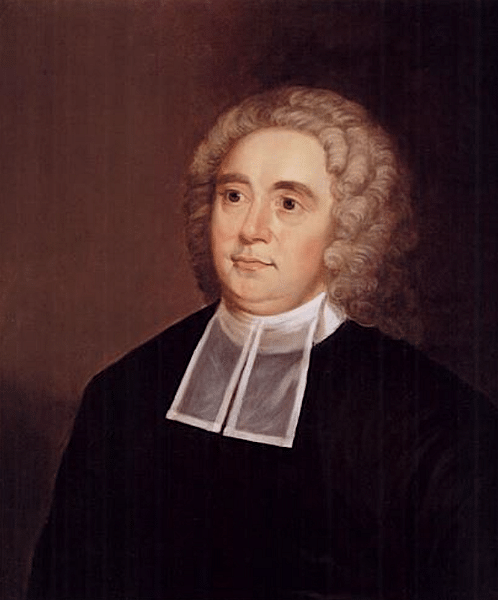
For Berkeley saw “spirit was the only real cause or power.” Material things speak to us of the spiritual. He rejected dualism in a way akin to what Seamus Heaney calls the “doubleness” of Irish consciousness – a preference for both, and though as a member of the Anglo-Irish ascendancy, Berkeley would probably be surprised to see his philosophy placed in a continuum of a Celtic world view, the evidence is there. In fact the editor of his collected works finds that while Berkeley’s “clear, clean language” and the “synthesis of weight and lightness” in his thought might have sprung from “his natural genius … the perfecting of it came about from living with the pure speech of Dublin.” Though Berkeley might not have really understand the Catholicism that so many of his poorer countrymen and women clung too, still he advocated programs to aid them.
It was the unjust economic and social conditions of his country that inspired him to choose America as the place to implement his dream. Young men would come from all the colonies to Bermuda to “be educated in such sort as to supply their churches with pastors of good morals and good learning.” It would be a classical education full of the wisdom of the ancient Greeks and Romans but reborn on the Summer Islands under palm trees. Instead he ended up on Rhode Island. Berkeley waited three years for the funds promised him by the British Parliament. They never came.
He donated the farm he had bought and his books and returned to Ireland. He served as Dean of Derry and then Bishop of Cloghan. During this final period of his life in his work, Siris, his thoughts took a more transcendental form. Now he viewed the distant land and summer islands from the coast of Ireland.
But almost 200 years after his birth, Frederick Billings one of the founders of the College of California chose Berkeley as the name of the new town and university.
Berkeley had seen Bermuda as “the wad of passage and union between two hemispheres.” Now his name “was written across the eternal hills that look through the Golden Gate” — a new passageway and place of learning perhaps finer than the bishop could have dreamed but on the continuum nevertheless.
Editor’s Note: This article was originally published in the April 1992 issue of Irish America. ♦
Leave a Reply