
Writer Mary Pat Kelly and photographer Martin Sheerin visited the Ulster-American Folk Park at Camp Hill, County Tyrone, in the North of Ireland which houses the ancestral home of the Mellon family.
“At the end of the day” can be an ominous phrase in Northern parlance, used by politicians and media commentators to sum up the difficulties of ending “the ancient quarrel” that lies like a fault line under the landscape. Yet it’s at the literal end of the day when a golden light pours over the fields and hills that the North looks its best. During our Spring trip through the countryside, no matter how many showery spells or dark clouds curtained the day, at twilight the skies cleared and all the colors— yellow windbushes, pink and white cherry blossoms, many-hued wildflowers and the fabled shades of green-brightened and shimmered in the sun. The light never failed us. If we lost faith and started to pack away the camera gear, just then the sky would shift and transform the scene.
And so it was early evening when we came to the house of Thomas Mellon—a cottage built by his father and uncle with their own hands. Here on February 3, 1813, Thomas was born to parents who expected to spend their lives farming the 23 acres Thomas’ grandfather had given his son. But in 1818, economics and the restrictions the Established Church placed on the practice of their Presbyterian religion prompted the Mellons to join the stream of emigrants from the North headed for America. The family settled on the Pennsylvania frontier. With his mother’s encouragement Thomas worked his way through Western University (now the University of Pittsburgh). He became a Professor of Latin, went on to study law, and was appointed a judge. In 1870 he founded T. Mellon and Sons, a bank that grew to be one of the largest in the U.S. and become the foundation for a fortune that made the Mellons one of the richest families in the world.
Thomas Mellon’s sons Andrew, William, and Richard would serve in Presidents cabinets, found multinational corporations such as Gulf Oil, endorse universities, most notably Carnegie-Mellon and in Andrew’s case, create the National Gallery of Art in Washington, D.C., buildings, pictures and all. And yet, when Thomas’ grandchildren Ailsa Mellon Bruce, Matthew Taylor Mellon, Paul Mellon, Richard King Mellon, and Richard Mellon Scaife wanted to honor his memory, they chose to go back to their homeplace in County Tyrone.
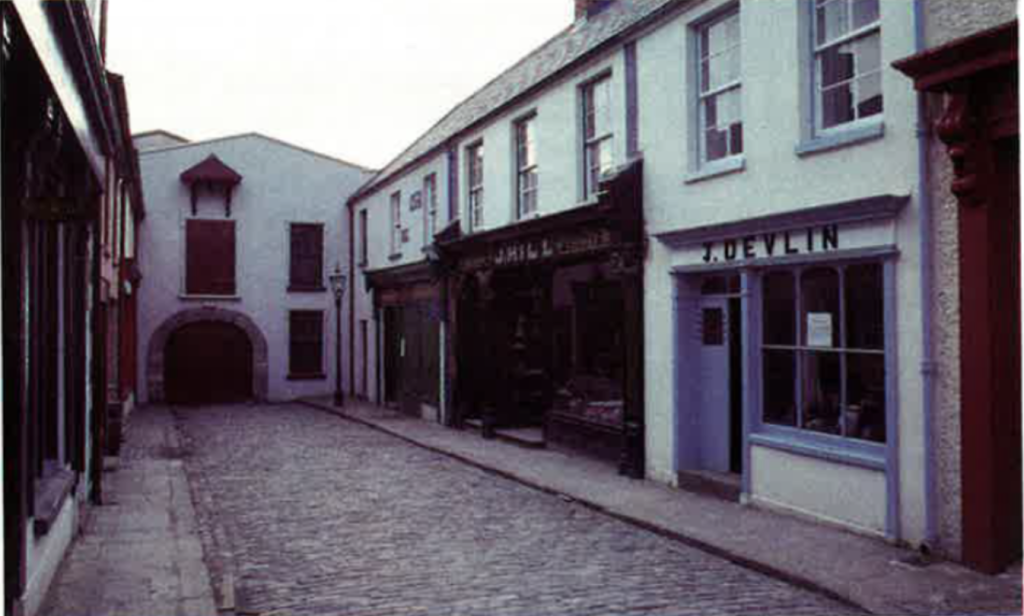
They restored the Mellon cottage which has become the centerpiece for the Ulster-American Folk Park. The 19th-century Irish village that grew up around the farm includes blacksmith’s forge, a weaver’s cottage, a school-house, a replica of the Presbyterian church, and a row of shops, saved from demolition and reassembled stone by stone. At the end of the street a dockside gallery has been built.
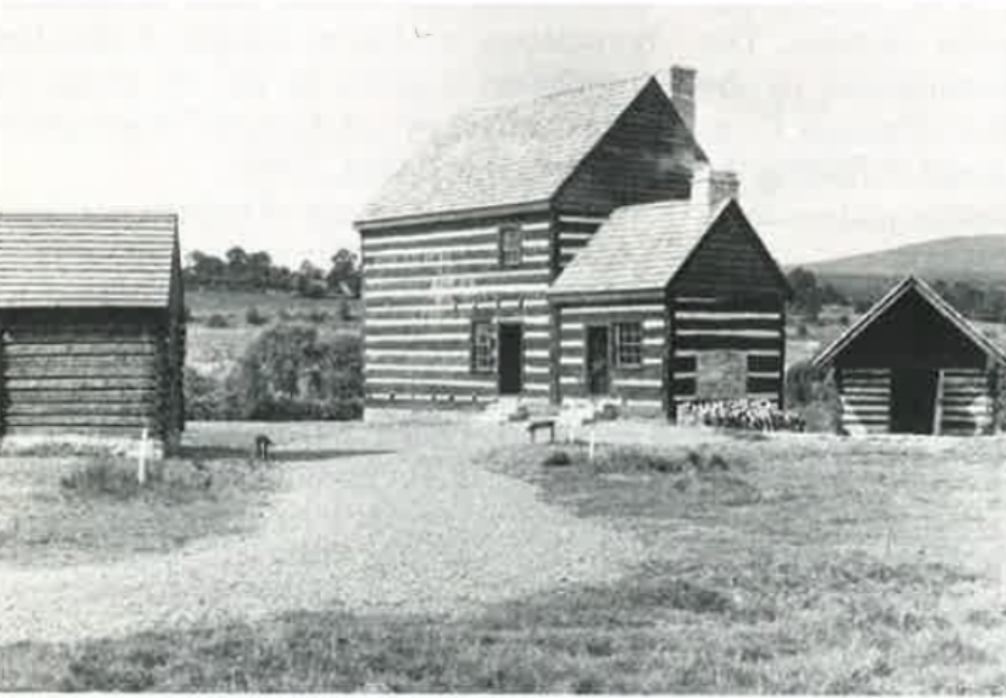
It houses the shipping office and the wharf where a replica of a 19th-century ship waits to transport the emigrants. A path from the ship leads to a section representing the New World. Here the buildings are constructed of logs, and represent the architectural styles of the Western Pennsylvania frontier including the farmhouse young Thomas and his father built near Pittsburgh in 1822.
Thousands visit the Folk Park each week to experience both their own past and that of the emigrants. During the September Homecoming Festival, the descendants of those emigrants are invited to return and trace the paths of their ancestors.
In the exhibit hall a bronze tableau shows John Dunlap learning his printer’s trade in Strabane, 15 miles from Camphill. He took his skill to America and printed the Declaration of Independence. Cyrus McCormick lived nearby; his reaper would transform American agriculture.
Twelve American presidents can trace their roots to this area. History is captured not just in the exhibits but in the costumed guides who represent townspeople and craftsmen and women in the New World and the Old. But when we arrived that first night the guides were not at work. The official opening of the park was a few days off and this evening only one man was working, painting the trim of the Mellon cottage. As we walked into the farmyard, a black horse stretched his head over the half door of a small shed and whinnied.
Paul Mellon titled his memoir Reflections in a Silver Spoon knowing that enormous wealth is what his name conjures up for most Americans. Yet his family story begins in this modest whitewashed cottage and this shed is the first of the famous Mellon stables. The MelIons wanted this small place to live again and Paul Mellon begins his memoirs with an account of his visit to Camp Hill in 1986. Perhaps he climbed the hill behind the house and looked across the River Strule to the Sperrin Mountains and Bessie Bell, the highest peak, just as his ancestors had.
Here his great-grandfather made the hard choice to leave this valley. As if to underline the difficulty, just as we reached the best vantage point, the evening show began and the countryside became a patchwork of light and dark. How painful to leave so much beauty—what contradictory emotions every emigrant must feel?
At the Information Center a community group was holding a flower arranging class.
The formal tours were over for the day but arrangements had been made for us to stay and take photographs of the buildings.
Mickey, the security guard accompanied us. Did he mind being kept after hours?
Oh, no, he often worked late-sometimes until dawn. Dawn?
Yes that was his favorite shift.
“It’s great to walk these paths alone, especially at sunset, the light is so beautiful and everything is peaceful, “he explained. “It feels as ifI’m really living in those days, both here and in America.” He has imagined himself building a log cabin in the American Wilderness or raising a substantial barn in Pennsylvania. “Ilove my job and the park,” he said, “I’d like to live here.” And in a way he does. The Mellons had left, so had my ancestors, so probably did yours and Mickey’s had stayed. But as we followed him through the Park, both of us could imagine life if the roles had been reversed. That’s the unique gift the Mellon family and the other supporters of the park give to both the people of Northern Ireland and those of us who visit.
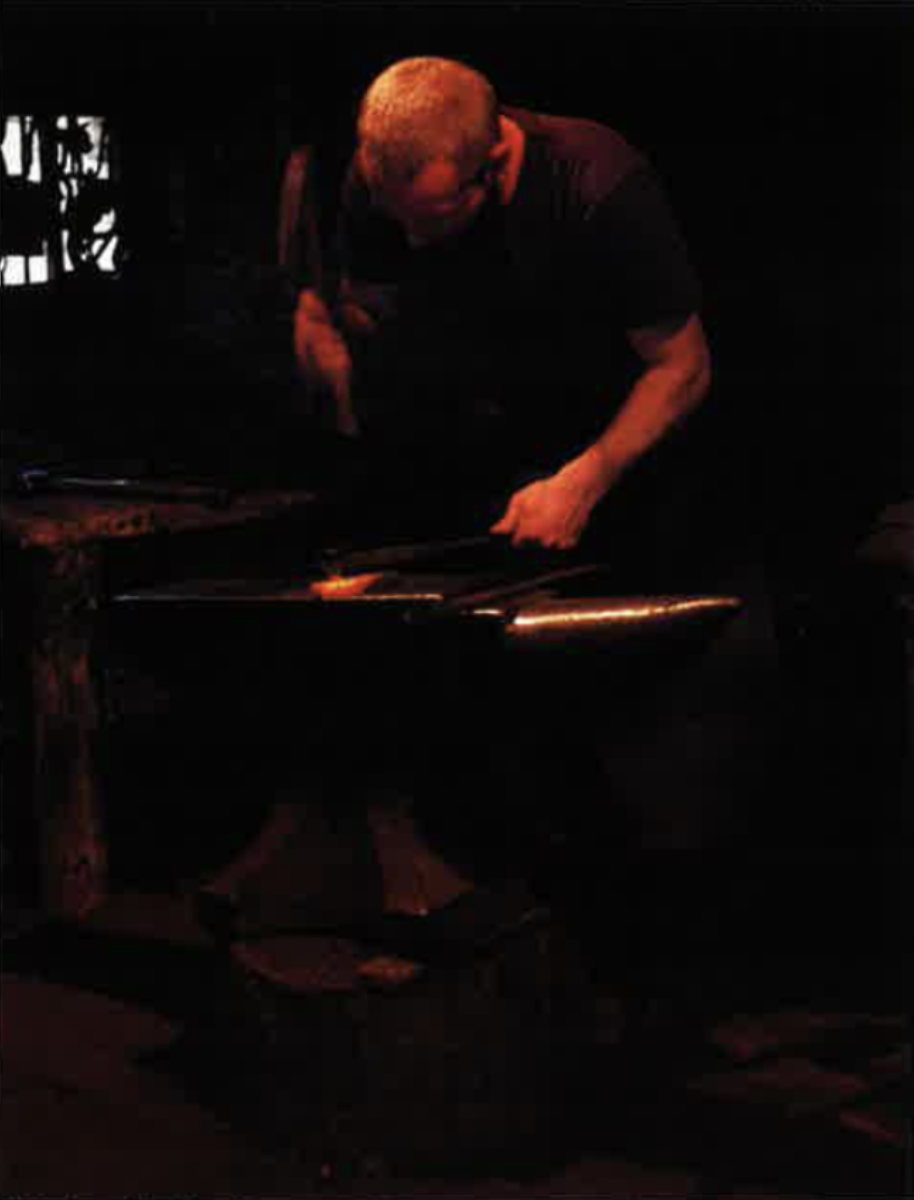
The next day we came back and watched a local man at work at his forge he shod the local horses and used authentic 18th-century bellows to make his fire.
At dockside a woman dressed in period style led us below decks of the America-bound ship. “Most of those leaving had never even seen the sea, let alone been on a boat,” she said. “Two hundred and fifty people were confined down here for 10 to 12 weeks.””‘Here” was a lower deck measuring no more than 75 feet. Each family had one of the plank beds that lined the sides. Buckets provided the only sanitation. “The people were only rarely allowed on the upper deck,” the woman explained. “There was no privacy and little air. Can you imagine what it was like for all the little children? Any kind of disease was devastating. Few records were kept but there must have been many terribly sad burials at sea. The survivors helped build your nation.”
We few back to the U.S. on Aer Lingus comfortable and cosseted. The flight attendants provided special cribs for the babies and wonderful meals for us. I looked out my window at the Atlantic and pictured small ships pushing their way through the waves. I thought of Mickey and the Mellons and that never-failing northern light.
Editor’s Note: This article was originally published in the June 1992 issue of Irish America. ♦
Love the Ulster American Folk Park – the Ulster Folk Park near Bangor in Co. Down is also worth a visit. It has amazing row houses from Belfast and has the home of John Joseph Hughes. Born in County Monaghan, he emigrated to the U.S. in 1817, eventually becoming the first Catholic Archbishop of New York and laying the cornerstone for St. Patrick’s Cathedral on 5th Avenue in 1858.