
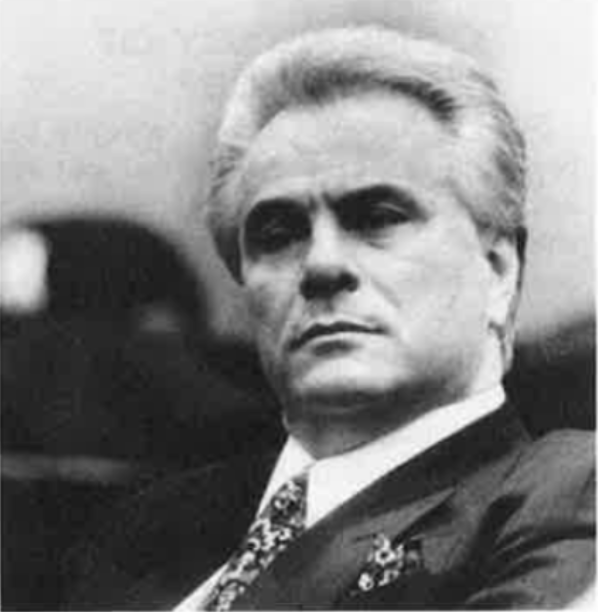
John Gotti blazed onto the criminal scene in a 1986 bloodbath outside a steakhouse in Manhattan, the result of which left him the boss of the most notorious mafia family in the United States. Ever since, he’s won folk-hero status as the “Teflon Don,” operating freely in the spotlight of the otherwise shadowy underworld, brazenly daring the government to stop him. Many charges were brought before him; none could ever stick.
None, that is, until this past April 2, when Gotti was convicted on 13 charges of racketeering and murder.
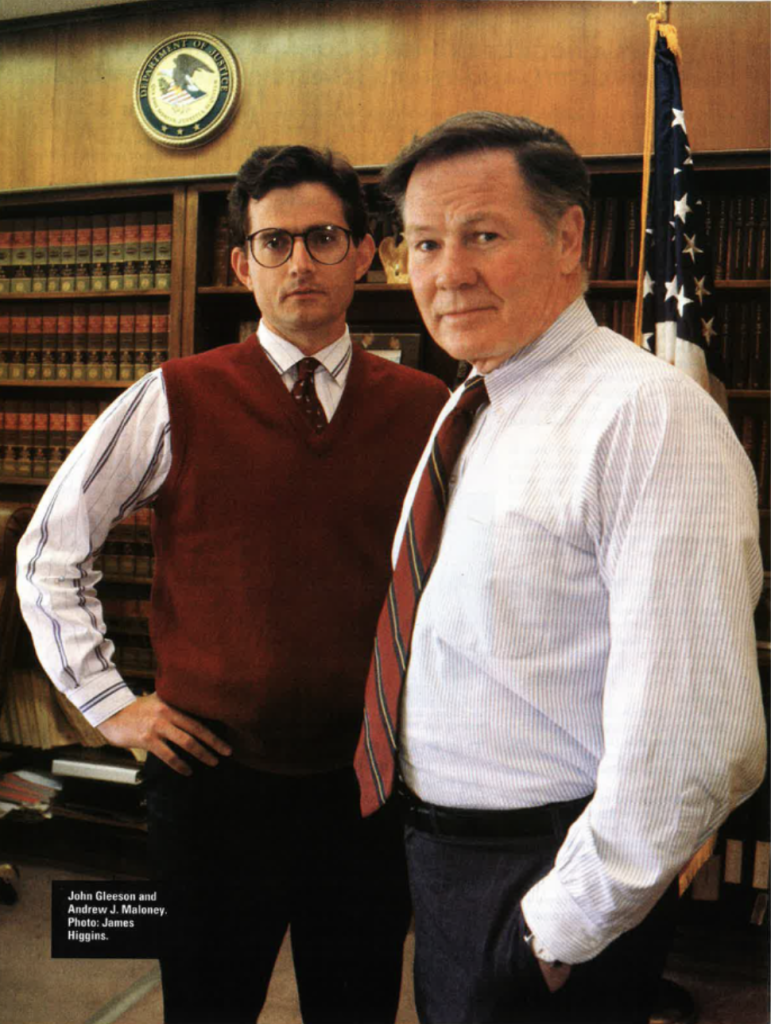
At the fore of what was seen as both a highly heroic and highly controversial prosecution were two men, Andrew J. Maloney and John Gleeson, who had all the right stuff to more than likely put away Gotti for the rest of his life.
Maloney, whose mother was from Roscommon and whose father was born in Hell’s Kitchen but raised in Glenamaddy, County Galway, has a wife and six children. Above his desk in his Brooklyn office is a picture of his mother’s homestead, a country cottage in Roscommon. Gleeson, who was born in the Bronx, has his family roots in Counties Cork and Kerry.
The case against John Gotti was straightforward and businesslike. Sure, the government had been humiliated over the years by a seemingly untouchable Gotti, but there was nothing personal about the prosecution; assured Andrew Maloney and John Gleeson, it was just a job they had to do.
For 10 weeks Maloney, the U.S. Attorney for New York’s Eastern District, and Gleeson, head of that district’s organized crime unit, presented formal arguments why Gotti should be convicted on charges of racketeering and murder. The manner of the prosecution, as directed by the 38-year-old Gleeson, was sober, in direct contrast to the perennial flamboyance of Gotti and his defense.
However, once in a while, there was a slip-up.
Maloney, a burly, garrulous bear of a man with the gruff demeanor of a Saturday matinee gumshoe, leaped into action during the prosecution’s opening statement.
With impassioned flair, the 60-year-old Maloney told the jury that Gotti was nothing more than “a mafia boss being brought down by his own words, his own right arm [his sidekick-turned-government witness, Salvatore Gravano], and in the course of it perhaps bringing down his own family.” Slowly, Maloney raised his hand and pointed an imaginary pistol finger at Mr. Gotti, the reputed head of the powerful and deadly Gambino crime family. Gotti looked back curiously, unflinching, and as Maloney delivered the words “bringing down his own family,” he squeezed the trigger.
Surely, this was to be no ordinary case.
Maloney and Gleeson are as different in style as they are effective in terms of prosecuting gangsters. Maloney, the former army paratrooper and college boxing champion, and Gleeson, the Phi Beta Kappa graduate who’s been nicknamed “Clark Kent” around the Brooklyn federal courthouse, have together formulated the most effective and famed mob-busting team since the days of Eliot Ness’ “Un-touchables.”
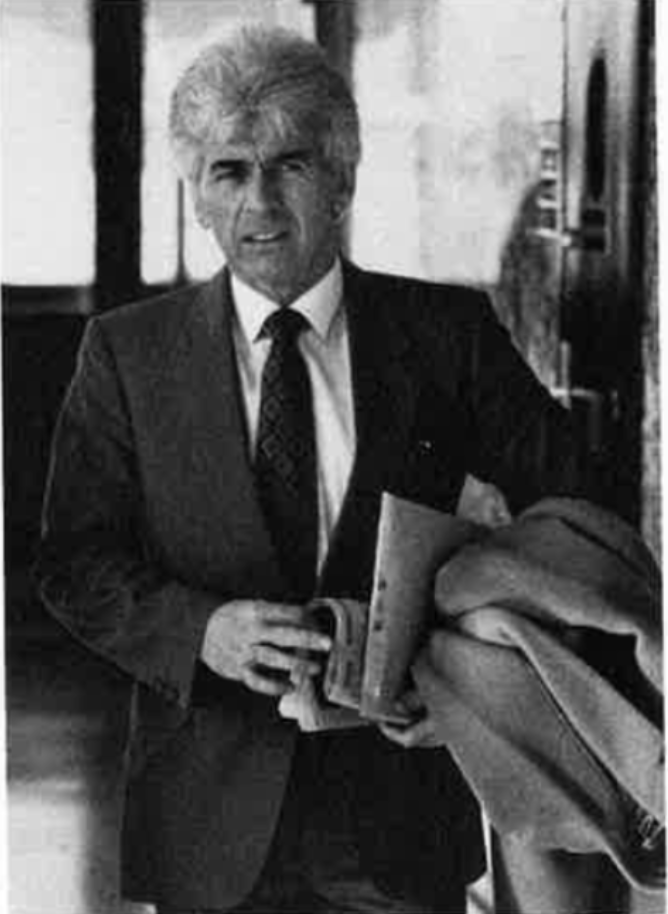
Together, they have all five mafia families of the New York area in a stranglehold. They are the toast of the law-enforcement community following their successful April 2 prosecution of Gotti, the most notorious gangster the world has seen since Al Capone, and Gotti’s consigliere, or counselor, 59-year-old Frank Locascio.
And although the men readily deny it, observers say that the battle against Gotti, hardened by the fact that Gotti had evaded prosecution three times since 1986, had reached a personal level. The Dapper Don was openly ridiculing government lawyers, and he seemed to have the sympathy, if not the support, of a great deal of the public.
People loved his brash, street-smart attitude, his stylish, $1,800 suits, and his brazen disregard for the law, as best exemplified by his much-publicized Fourth of July fireworks displays in Ozone Park, Queens. Gotti never bothered to pick up permits for the displays, and every year dozens of cops stood by, powerless to intervene.
He was a modern-day Robin Hood, although federal prosecutors were quick to point out that, through the Gambino family rackets, the fortunes he pilfered were paid for by the very people who adored him.
For Maloney and Gleeson, it was a conviction that was hard-earned. It was won from years of tedious surveillance, sifting through hours of bugged conversations, and back alley meetings with mob informants.
Said author Gay Talese: “It was a courtroom battle between white men – law school graduates versus high school dropouts.”
The conviction was also not without controversy, as the defense charged repeatedly that the prosecution was simply hell-bent for a conviction, and the law was conveniently skirted, when necessary, along the way.
Also evident is the perception that the conviction of John Gotti was a watershed of sorts for the underworld in the U.S. Observers are saying that the conviction heralds the death of the mafia, or Italian-controlled mob, and the coming of newer, possibly even more violent mobs from the U.S.’s newest immigrant communities, the Colombians, Vietnamese, Jamaican and Chinese. It was no coincidence that at the same time as the Gotti trial, Maloney’s Eastern New York division was arguing cases against the Vietnamese gang BTK (“Born to Kill”) as well as the Chinese gang the Green Dragons.
THE RISE AND RISE OF JOHN GOTTI
For a man who never got beyond the eighth grade, Gotti seemed to be doing pretty good for himself. As opposed to his predecessor at the helm of the Gambino crime family, Paul Castellano, Gotti was known for his expensive suits and relentless nightclubbing. He was a definite throwback to the days of 1930’s mob glamour.
After he led a gang of Gambino family insurgents to violently overthrow the regime of Castellano, Gotti ruled with an iron fist, making the Gambinos the most powerful mob family in the country.
In 1990 Gotti beat charges that he commissioned members of the so-called “Westies,” an Irish-American gang operating in Hell’s Kitchen, on the West Side of Manhattan, to shoot carpenters union official John O’Connor.
O’Connor, who was born in Athlone, County Westmeath, was a business manager for the predominantly Irish Local 608 of the Carpenters’ Union. On May 7, 1986, Kevin Kelly, a member of the Westies, shot O’Connor six times in the lower back as O’Connor walked into the union’s Manhattan headquarters.
Law enforcement officials had secretly recorded Gotti demanding action against the 50-year-old O’Connor, as O’Connor had allegedly ordered the trashing of the Bankers and Brokers restaurant in Lower Manhattan, because they were using a non-union remodeling crew.
Unbeknownst to O’Connor, the restaurant was owned by a Gambino associate. “Put a rocket in his pocket,” ordered Gotti, and that’s exactly what happened.
Gotti defeated the charges that he ordered the hit on O’Connor mostly because O’Connor, who lived, was reluctant to testify strongly against him.
Also, the soon-to-disbanded Westies, which were the last remnants of the Irish mob in New York City, proved to be unreliable witnesses against Gotti. The don’s lawyers ripped them apart by saying that they were “nothing more than a bunch of lowlifes, drug addicts and drug dealers who want to get out of jail.”
THIS TIME, IT WAS PERSONAL
After a seven-month trial that heard more than 90 witnesses and 30 hours of audio tapes, John Gotti defeated Andrew Maloney when he was acquitted on murder, racketeering and conspiracy charges on March 13. 1987.
It was the second time in two years that Gotti had beaten prosecutions, and Maloney had learned from an informant that he had done it this time by allegedly bribing the jury foreman. The defeat left him fixing for a rematch.
Days after the loss Maloney assembled a team of prosecutors which he was to head personally. In charge of day-to-day operations would be John Gleeson.
To avoid the disjointed defense which had crippled previous mob prosecutions, Maloney reportedly went to Rudy Guili-ani, his counterpart in New York’s Eastern District, which includes Manhattan, the Bronx and Staten Island, and begged him to let his office handle the next crack against Gotti. Giuliani ceded, and Maloney and his team set to work.
When Giuliani retired to run for New York City mayor in January 1989, his successor, Otto G. Obermeier, sought to try separately the case of the 1986 killing of Gambino family boss Paul Castellano, which Gotti was reputed to be responsible for. (That killing cleared the path to the head of the Gambinos for Gotti). After all, Castellano had been killed on East 46th Street in Manhattan, and it seemed only right that Obermeier should get it instead of Maloney, whose district covered Brooklyn, Queens and Long Island.
However, Maloney fought off Obermeier’s advances and at a high-level meeting before Justice Department officials in Washington D.C., it was agreed that Maloney should handle the case.
The strategy was to use federal anti-racketeering laws against Gotti, by compiling a series of otherwise unrelated criminal incidents such as racketeering, murder and tax evasion to prove a pattern of offenses.
But what was not part of the on-paper strategy was the perception that Maloney, the West Point Military Academy and Fordham Law School graduate, had a personal score to settle with Gotti, and that his team, with Gleeson at the point, would work relentlessly for years to put the Don behind bars.
THE BUGGING OF THE МOB
Bugging the Don has never been an easy task. Previous charges have disintegrated thanks to audio tapings which crackled with the sound of uncertainty. Defense attorneys could effortlessly convince jurors that what they heard was not a discussion about mob rubouts but actually a chat about baseball games.
However, Maloney and Gleeson’s biggest ally this time around was their technology. There were well-placed bugs in both of Gotti’s haunts, the Bergin Hunt and Fish Club in Ozone Park, Queens, and the Ravenite Social Club on Mulberry Street in Manhattan’s Little Italy.
As New York Daily News reporter Jerry Capeci said, the difference between this and previous prosecutions against Gotti was that “they had evidence – lots of it.” However, the notoriously paranoid Gotti figured he was being bugged, and started taking a lot of his more intimate discussions to an apartment directly above the Ravenite, the home of an elderly widow of a Gambino family soldier. For months Maloney’s team waited, until finally the widow decided on a vacation. It was only then that agents could sneak in and plant the bug from which some of the most damning evidence was made.
Even then, however, the prosecution was not beyond the reach of the mob. New York City police officer William Piest has been charged with telling Gotti about the bug in the widow’s apartment; a trial is pending.
THE FLIPPING OF THE BULL
It was one o’clock in the morning on November 8, 1991, when the prosecution team got the call. There was a secret motel room meeting in a suburb of New York City which to this day has yet to be revealed. It was there that Salvatore “Sammy the Bull” Gravano would be “flipped” into becoming a government witness.
Gravano had been Gotti’s most trusted ally for years. A squat, powerfully built man of 46 years, he rose through the ranks with Gotti to become Gambino family underboss. It was he who handled a great deal of the collecting of “tributes” which associates would bring down to the Ravenite. The money came in for John Gotti, and if it didn’t, the Bull could prove to be a very effective one-man collection agency.
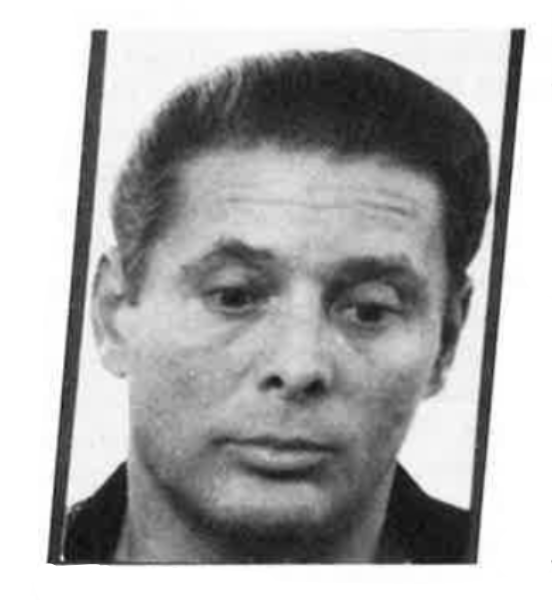
Among other things, Gravano admitted to 19 murders during his years as John Gotti’s personal enforcer.
On the witness stand Gravano admitted that he Gravano admitted that he was “a good, loyal soldier.”
“When John barked,” said Gravano, “I bit.”
On December 11, 1990, federal officers stormed the Ravenite, arresting Gravano as well as his boss, John Gotti, a Gambino family consigliere (“counselor”) Thomas Locascio, and a reputed capo and the grandson of former family boss Carlo Gambino, Thomas Gambino. (Gambino was later severed from the case and plea bargained his way out of a separate racketeering case in Manhattan).
Discovery laws were to provide the prosecutors with all they needed to flip Gravano. When the Bull heard the crystal-clear quality of the tapes, and realized there was enough on there to land him in jail for life, the mafia code of silence was beginning to unravel.
To make matters worse, it was being made clear to Gravano that he was expected to continue playing the perfect soldier. He was expected to submerge his own interests in a common defense with the boss.
For Maloney and Gleeson, the tapes were probably all they needed. However, the government had been beaten before, and they knew better than to underestimate the cunning of a Gotti defense. That’s why they could barely believe their own luck when they were told that Gravano wanted to make a deal.
In early November, Gravano sent out word from his Metropolitan Correctional Center jail cell that he wanted to talk. He, Gotti and Locascio were removed from the MCC on the pretext of having to have their fingerprints taken. During all of this, Gravano was separated from the other two and secretly brought before Federal Judge I. Leo Glasser.
Soon after came the November 8 motel room meeting, which was set up under the ruse of relocating Gravano to the Otisville prison in upstate Orange County. It was there that he was “flipped” over to the side of the prosecution; it was there that he met with Maloney, Gleeson and his new government-appointed lawyer, William Cunningham Ill.
The news that Gravano was going against his lifelong partner in crime was a shock to both the criminal and law enforcement communities.
Never before had such a high-level mafioso broken the ancient code of omerta, or “silence.”
“He was stunned,” said attorney Albert J. Krieger of his client, John Gotti. “He couldn’t imagine he could be betrayed in that fashion.”
Gravano’s own lawyer at the time, Benjamin Brafman, couldn’t believe it either when he was thrown off the case after Gravano turned against Gotti. Brafman called Maloney’s office from out of town to inquire about his “purported” dismissal as counsel. Maloney assured him, “It ain’t purportedly.”
Fliers portraying a cartoon of “Sammy the Rat” were plastered throughout New York City.
Gravano’s own wife denounced him as a traitor. And when the time came, when he wasn’t busy informing on his old friends, Gravano paused on the witness stand to admit that he was “a rat.” For Maloney and Gleeson, it was a huge victory. Their case was now watertight, as here was a man who was going to interpret and confine the tales of murder and extortion overheard on the government tapes.
Yet the flipping of Gravano was a controversy onto itself. Because of his cooperation, Gravano will most likely be on the street in less than twenty years. As wrote Peter Maas, author of Serpico and The Valachi Papers, wrote, it was “the deal of the century.”
“When, after all, did you last hear a fellow admit on the witness stand to nineteen murders and walk away?” wrote Maas in Esquire.
“Sammy’s leverage was that the Feds, having twice before suffered Gotti thumbing his nose at them on the network news after failed prosecutions, would now do anything to nail down a conviction. So Sammy not only won’t have to worry about serving much time, but he gets to keep all his considerable cash, however ill-gotten.”
Was Gravano’s freedom too high a price for Gotti’s head? Not to Maloney and Gleeson. “Those are the sort of value judgements that have to be made all the time,” explained Gleeson. “These things are carefully judged and thought over.
Gravano will leave a heavily-guarded prison cell, sometime in his mid-60’s, and enter the federal witness protection program for the rest of his days. The code of the mob has been broken, perhaps forever.
The image of Sammy Gravano, with 19 murders under his belt, sunning himself in his retirement years is sure to weigh heavy in the mind of John Gotti, rotting in a federal pen. For Maloney and Gleeson, it’s just a price they’re willing to pay to bust the mob.
CONSPIRACY OF JUSTICE?
Flipping Sammy Gravano was just the beginning of the prosecution’s all-out war against John Gotti. Equally controversial was the decision to strip Gotti of what had become his best weapon over the years — his attorneys.
Bruce Cutler seemed to be a mirror-image of Gotti. Tough-talking, flamboyant and infallibly affable, Cutler had charmed his client out of scrape after scrape, and together with partner Gerald Shargei had managed to outfox and publicly humiliate the government at every turn.
Which is all the more reason why there was such an uproar of disbelief when Judge Glasser announced that he was dismissing Cutler and company from the trial. Cutler had overstepped the line between counsel and defendant, argued Maloney and Gleeson, and Glasser agreed. To many, it was further proof that Maloney and Gleeson were going to haul in Gotti by any means necessary.
“Unfortunately that [the Cutler dismissal] got a lot of negative spin,” said Gleeson. “The dismissal of lawyers is one of the most widely misunderstood actions of the courts. There are lots of ways in which lawyers can have a conflict of interest.
You could’ve done something wrong, or you could’ve been used by the client….”
“It’s like this,” interrupted Maloney, eager to explain the legal controversy in layman’s terms. “If a lawyer is standing on a street corner, and let’s say some guy got hit by a car, and the lawyer is a witness, then there’s no way that he can be a lawyer for that case. He could be called upon as a witness, and you can’t be both a witness and a lawyer.”
Cutler apparently made the mistake of appearing far too often on the government’s audiotapes. To the prosecution, it seemed as if Cutler was part of so many conversations regarding mob business so as to be seen as something of a consigliere himself. He was present at the Ravenite, as well as at the Bergin Hunt and Fish Club, at the same time that his client was discussing such delicate matters as guys getting “whacked.”
“A popular misconception was that we [the prosecution] were pretending that we were interested in calling him [Cutler] as a witness, and we were using this as a way of getting him dismissed.” continued Maloney. “But we never had any intention of calling him. However, under the law he should have been available as a witness for the defense.”
“This kind of thing is done all the time,” assured Maloney.
“It would’ve made a mockery of the trial if Bruce was let in.”
Critics, however, aren’t so sure.
“Of course Cutler talked with Gotti about crimes,” said T.J. English, author of The Westies. “That’s what lawyers do. They [the prosecution] simply didn’t want Bruce allowed in. It was part of their strategy to demoralize the Gotti defense.
Gotti was forced to hire Kreiger, only to find out that Judge Glasser was further handcuffing the defense by disallowing all of the defense’s witnesses to appear, saying their testimony on behalf of Gotti’s good character was irrelevant. As a witness, the defense was left with Gotti’s personal accountant, who had little more to say but that he had advised the Don against filing income taxes out of fear of self-incrimination.
There was one more blow to the defense, and that was the holding of John Gotti, without bail, for the sixteen months preceding the trial. Gotti was held on the same cell block in Manhattan’s Metropolitan Correctional Center as IRA prisoner Joe Doherty, with whom he developed something of a friendship. Gotti was quoted in interviews saying that Doherty was “a nice guy, an honest guy,” who deserved his freedom.
Doherty wasn’t the only one who deserved his freedom, said many others who argued that Gotti’s sixteen months in prison while the government built its case was unfair and unconstitutional treatment. Even though he was a reputed mob boss with an alleged five murders under his belt, Gotti had no record of personally being a violent threat to society. Civil libertarians joined the chorus of working-class Gotti sympaticos in Howard Beach, Ozone Park and Little Italy who said that the Don should be out on bail.
To the prosecution, the mere suggestion of bail was lunacy.
“Here’s a guy [Gotti] who was being charged with five murders and by the end of the trial we proved an additional six,” said Gleeson. “When he was held without bail everyone all of a sudden was saying. ‘Poor John, he shouldn’t be in jail without a trial for 16 months.’ But people forget, John Gotti is a killer. Gotti and Frank Locascio are two major killers. Gotti’s not a movie star, he’s a killer, and people forget that. If somebody else was picked up on the street and charged with five murders, there never would’ve been any question of that guy getting bail. Why should it be different for Gotti?”
Some speculation persisted that the real reason why Gotti was being detained was the realization that he had become a major liability to the mob. Boss or no boss, Gotti was bad news, and a rubout, such as the one that Gotti himself ordered on his predecessor Paul Castellano, would’ve spared the mob a lot of grief. After years of hard work, the government was damned if they were going to let their star go down in the gunsmoke of a mob war. They were protecting him so as to do him in themselves.
What some saw as a sort of unholy collusion between the prosecution and the judge will undoubtedly play a huge part in Gotti’s upcoming appeal. A sprawling team of star attorneys, including Michael Kennedy, lawyer to both Ivana Trump and alleged IRA gunrunners, and civil rights activist William Kunstler, is currently preparing a massive assault on Gotti’s conviction. Some think they have a good shot.
“They [the prosecutors] definitely stretched the boundaries,” said English.
“They changed the rules, and I don’t know if they played fair.”
However, says Maloney, “We know what John Gotti was and is, and this case warranted this kind of effort.”
TAKING ON THE UNDERWORLD
Reportedly security for the prosecutors and their families has been tight, although according to Maloney and Gleeson, retribution from the underworld was never a major fear.
“No,” says John Gleeson flatly when asked if he ever feared for his personal safety. “Not at all. We never thought they would do anything like that, There’s no history of that in the mafia.”
Added Maloney, “There have been reported threats of an undetermined source, but we’re sure they’re just a bunch of kooks. I’ve handled people a hell of a lot more violent than John Gotti.”
There was considerable fear however, for the jury.
In 1984, Gotti, then a rising star in the Gambino family, was accused of assaulting and robbing one Romual Piecyk. On the witness stand, Piecyk refused to identify Gotti, who was acquitted. Prosecutors said that the case’s result had less to do with Piecyk’s sudden amnesia than it did the strongarm of Gambino henchmen.
In Gotti’s 1987 federal racketeering trial, Maloney found out that Gotti was trying to reach the jurors. He knew that bribes had been offered to jurors, but decided against going public out of concern for the highly-important informant who had supplied the information. It wasn’t until Gravano turned government witness this year that the plot had been fully revealed. On February 25 of this year George H. Pape, the foreman of the ’87 jury, was indicted for allegedly selling his vote for $60,000. Pape’s trial is due to start this summer.
Maloney and Gleeson cited these incidents, as well as the fear of the 1992 jurors, as reasons for requesting an unusual step.
Not only were the jurors kept totally anonymous, they were tightly sequestered in hotels for the duration of the trial. For 10 weeks they could only occasionally see their closest of relatives, and even then they were escorted by federal marshals.
Not even Judge Glasser knew their names, and all correspondence by phone or mail was meticulously monitored.
At the end of the trial Maloney hailed the jury, of which three members dropped out even before the deliberations, as being “very courageous.”
THE FUTURE OF THE MOB
Convicting the Gambino hierarchy, as well as the hierarchies of the other mafia families in New York, has had a devastating effect on the mob as it is known today.
As he explains it, Maloney’s strategy has been to cut at the tree from the top down.
“These continued prosecutions on the top echelons of mob families has a definite effect,” said he. “It will not immediately wipe out the mafia, but if you keep replacing the top men with greener troops, that means a whole lot of confusion. If we can wipe out the mob’s biggest source of power, that is, their influence in racketeering and corrupt unions, then all they’ll be left with is gambling and loansharking.” And as speculated by Talese, we could be witnessing the end of the Italian mob not just at the behest of government prosecutors, but also because of the simple logistics of U.S. immigration.
“Will the mafia’s dominant status in the underworld, cared during the Prohibition era by outsmarting and outshooting Jewish and Irish gangs,” wrote Talese, “now be gradually usurped by gangs of Asians and Latinos?”
Maloney admits that there is a change-happening in the makeup of the underworld.
“The Colombian coke gangs make a lot more money than the mafia,” said Maloney. “Right now, other groups, such as the Chinese gangs and the Vietnamese gangs are into smaller stuff, mostly just picking on their own immigrant communities, but there’s a danger that they could grow.” An aspect of that “danger,” according to English, is that the old-school, predominantly white law officers won’t know how to deal with the new ethnic gangs.
“The Irish guys could understand the Italians,” said English, “but what about the newer breeds? What about the Jamaicans? Or the Vietnamese? Will they be able to be even half as effective with them?” As for Maloney and Gleeson, they say that, however enticing retirement or even the idea of a run for political office might be, they’re staying put for now, fighting gangsters in the Brooklyn federal court.
Maloney, who has a wife and six children, may soon take a trip back to visit his mother’s homestead, that country cottage in Roscommon that is pictured above his desk in his Brooklyn office. “I haven’t been back to Ireland in a long time,” he said, “maybe 12 or 15 years. Maybe l’Il go back sometime soon.”
Gleeson, who is married without any children, has never seen Ireland, but he too says that it is something in store for the future. He is widely thought to be Maloney’s successor as head prosecutor for the U.S. Eastern District.
As for Mr. Gotti, the man who was the subject of their relentless attention for the past six years, he is scheduled to be sentenced on June 23. His appeal is in the works, but on the 23rd, he, as well as his associate Mr. Locascio, is expected to receive a life sentence.
Editor’s Note: This article was originally published in the June 1992 issue of Irish America. ♦
Leave a Reply