
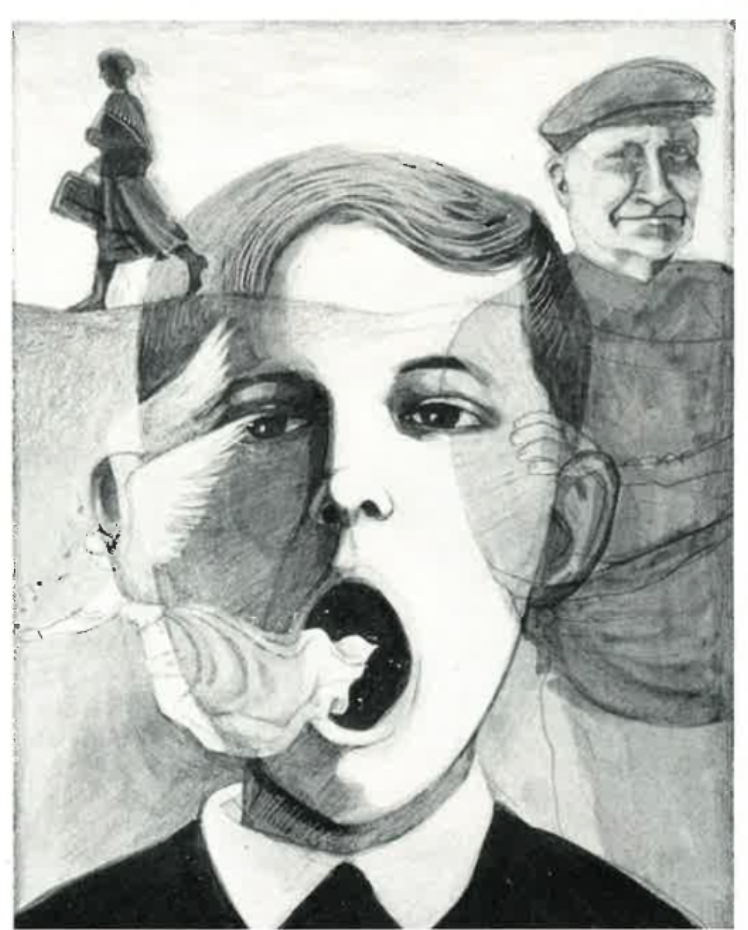
Danny Treanor looks and acts like all the other Treanors now. But once he was the best boy soprano in Ireland. You would not think it to look at him now. But once an angel lived in his throat, for such a short time, the lifespan of a lark maybe, and then the angel went away and the following evening Danny’s mother went away too, in the winter darkness, taking the brown leather suitcase, the shawl they were all christened in, the four sons, and taking nothing else at all. She never came back.
When Danny Treanor gets drunk, and he gets drunk once a week at least, he stands up in the pub, all thirteen rough stone of him, the belly spilling over the waistband, the big red face flushed, and he bellows songs like “The Fields of Athenry” and “The Rare Ould Times”.
He has a big rough pub voice, where once the angel lived, when he was the best boy soprano in Ireland. And when Danny Tre-anor gets very drunk he does not sing at all but he will take you by the arm, not letting go, and slowly tell the story of the morning his voice broke. And he is puzzled, and very puzzled, that it was more than his voice that broke before the Stanley range in the kitchen that morning. The Treanor men would not be great at working out that kind of delicate thing.
When you hear the story twice or three times, and you will, it is easy to put the pieces together into a mirror. The only good family years the Treanors’ mother ever had, in more than twenty, were the three years when her youngest son Danny was the best boy soprano in all of Ireland. The music of him, you could say had charms to soothe much of the inherent coarseness, rather than savagery, of the father Joe and the older brothers. It must have been an almost magical thing for a small quiet woman I only saw once in my life. Even when Joe came home late after a cattle mart, Danny will tell you, “and him well oiled” the golden voice of the child summoned from his bed could create a maudlin calmness in Joe Treanor rather than the ugliness…and maybe more…of earlier years. “Sing Danny Boy for your Dad.” And Danny will say, in the telling of his slurred story now, that his father and older brother Stephen, who would probably otherwise have fought with his mother, or “broken a few cups and things,” would sit at the table, “awful quiet altogether, not a stir out of them” and sometimes the tears would run down his father’s face. “You are a great lad, my own Danny boy” and if the mart had been good he would get a shilling. And his mother would carry him to bed in a house quieted and still echoing with the notes of an angel.
It was even better than that, you can deduce from the things he says, because his picture was often in the papers, even in the national papers. “The mother saw to it that I was never photographed without my father along with me, the oul fella loved that.” Danny still has some of the cuttings in his wallet. There is the young boy, the mother to one side, the big powerful cattle-dealing father standing behind with his huge hands on the shoulders of his singing son. Danny sang in the Cathedral in Dublin on Christmas Day, even, and broadcast regularly on Radio Éireann, the whole country listening to him, and was even brought to London to the Palladium. His father always went with him on the travels, his mother only sometimes. “You might not believe it but the oul fella would hardly drink at all on those trips.
He looked after me like I was a bargain calf. Sure he always loved the oul songs. The one my mother liked best was Little Boy Blue, do you know that one? The musket moulds in his hands. Time was when the little Boy Blue was new and the Soldier was passing fair. You know it? That was the one my mother liked best.’ He was to sing in a radio broadcast that evening. When he came home from school, on early leave, he saw his brothers and his father dipping sheep in the back yard. His father waved at him. He went into the kitchen and said to his mother that his voice, he thought, had broken. It was sometimes high and sometimes low, he said, just like his father’s. She was ironing Joe’s white shirt for the night out and she had her apron on. When he told her she stopped ironing and held the iron up from the shirt. “Try a few bars of the song for me, nice and easy,” she said.
He tried “Mary, the Queen of the May,” the Canon McEwan version, and it came out all rough and quare, the voice was broken in bits all right.” She came over to him, his own mother did, and ruffled his hair, and kissed him on the cheek and she said, “It’s all over now, Danny, isn’t it.” She was gone the following evening. Something broke. Danny still does not know what it was.
Editor’s Note: This article was originally published in the May 1992 issue of Irish America. ♦
Leave a Reply