
“Pray for the dead. But fight like hell for the living.”
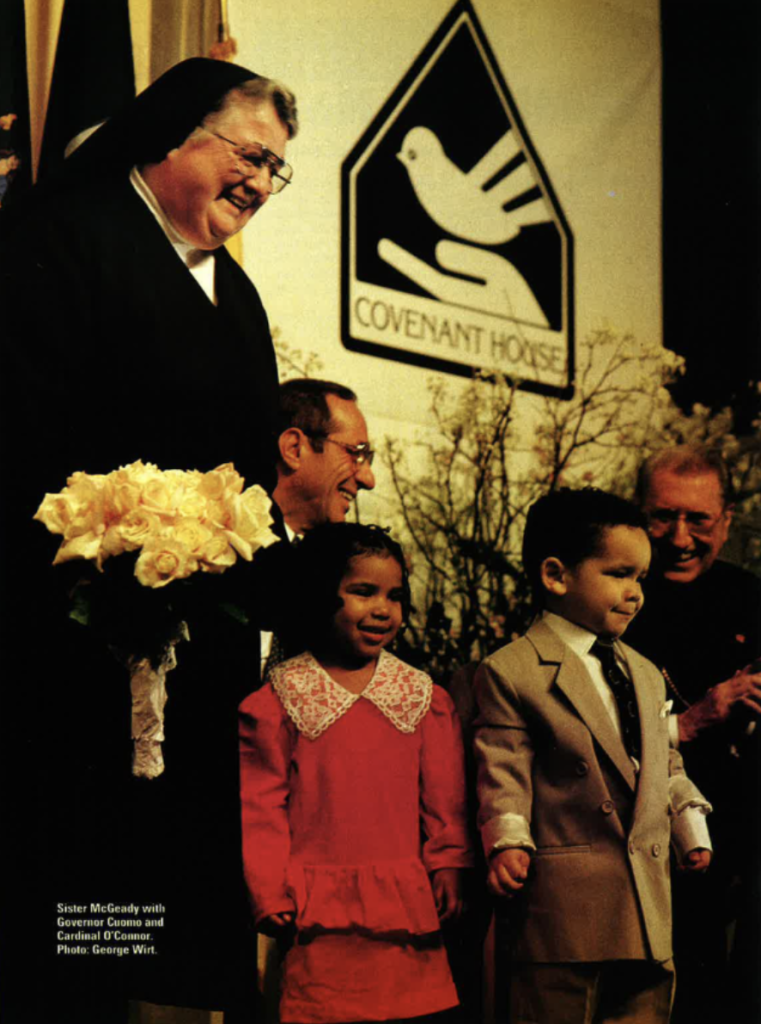
These are the words of Mother Jones, the gutsy labor leader, but they could easily apply to another Irish American, Mary Rose McGeady, the Sisters of Charity nun in charge of Covenant House, Runaways, and troubled teens. Kids whose worlds have crumbled around them. For many, Covenant House is their only sanctuary from life on the street. Founded in New York in 1969, the organization now operates in nine cities throughout the United States and Central America. Two years ago, Covenant House itself almost crumbled when Father Bruce Ritter, the founder, was accused of sexual and financial misconduct. Ritter resigned amidst a huge public outcry. It was an enormous blow. Covenant House appeared perched on the edge of ruin and financial failure. Donations, which fund 95 percent of the organization’s operating costs dropped by half. Incredibly, just two years after the crisis donor confidence has been restored to 80 percent, due in a large part to the new broom wielded by Sister Mary Rose McGeady, (64) a warm, caring nun with a good head for business.
Patricia Harty talked to Sister McGeady at her New York office about Covenant House and about her Irish family that laid the seeds for her vocation.
Sister Mary Rose McGeady: Well, let me talk about my Irish heritage first. My ancestors on both sides are from Donegal. My father’s great-grandfather came over during the potato famine. I’ve been to Ireland twice. We had a family reunion and 387 McGeadys showed up, 200 of them from the United States. It was thrilling to meet people who are legitimate ancestors. We actually went to the farms up on the Donegal coast right on the Irish Sea, with the cows walking on the beach. Patrick McGeady, who is still working one of those farms, told us that, as far back as they can count, their ancestors have been working that land.
Patricia Harty: And where are you from?
Sister: I was born in Hazelton, Pennsylvania, in the coal region. I left there when I was six years old. We went to Washington during the Depression, where my father found a job, thank God.
Harty: In terms of your vocation, was there something early on in your childhood that pointed you in this direction?
Sister: I grew up in a wonderful family. My parents were faith filled people who prayed and went to church. So I guess that laid the seeds for me. And then I went to high school to the Daughters of Charity and they really inculcated in us a love for the poor. I graduated from high school in June and entered in September. It was in 1946 right after the war. When my brother got home from the navy, then I was allowed to leave. (Laughs)
The community has been very good to me. They educated me in psychology. I have a bachelor’s degree in sociology from Emanuel in Boston. Then I went to Fordham and did my master’s in clinical psychology. And then I did doctoral work at the University of Massachusetts.
Harty: How many of you were in the family?
Sister: Just three of us. I had a brother, Bill, who is dead now. And my sister, Kathryn, who lives in California. Between them, they had nine boys. So I have this whole little army of wonderful nephews that I love dearly.
Harty: It seems that your home life was very loving and caring, a different experience from that of the kids at Covenant House.
Sister: I was born in ’28 and the Crash came in ’29. In a lot of ways, we were Depression kids. So we knew what it was to live in a family that was managing very carefully. But my family was a great family.
And we also enjoyed the beauty of having a wonderful extended family. Both my mother’s and my father’s family were very close to us.
Harty: Tell me about Covenant House.
Sister: Our major program is shelter for teenagers and young adults under 21. We get them from all over the country.
We’re in nine American cities and in Toronto. And we have four programs in Latin America. The one thing that all of our kids have in common is trouble at home.
In Latin America they’re younger. Our kids down there come in at maybe nine, 10, 11 years of age. In the States it’s mostly between 16 and 20. A lot of our kids grew up in foster care. When they’re 18 they get sprung. They go live with this friend for a while, and that friend for a while.
And, almost invariably, it falls through. They have a little job, but it’s not enough to make it. And they end up living on the street.
And then the terrible reality is that it’s so easy for the pimps and the drug dealers to recruit them. We get kids all the time who have been into prostitution. They hate it, and really want to get away from it. Our vans cruise through Manhattan at night. We try to meet the kids and talk to them. And tell them that there’s another way to live.
At the big crisis center on 41st Street, we have about 180 kids a night. In this building, [17th Street], we have 130 kids who are in what we call the Rights of Passage Program. These are kids who are 18 or almost 18, emancipated minors, who are going to school and working and saving their money to go independent. The name comes from the idea that kids have a right to be accompanied on the passage to adulthood.
So we make a covenant with them. We’ll take care of them and do certain things for them if they Il do certain things for themselves. We’ll provide food, clothing, shelter, medical care, if they go to school and go to work and keep the rules. They can stay with us up to 18 months, as long as they’re earning. We let them spend a certain number of dollars per week for clothes and carfare and everything.
The rest they lay away so that when they’re ready to go, they have this nest egg that helps them to pay the rent and get a little bit of furniture and get a new start in life.
We did a follow up study on the Rights of Passage Program – it’s only four years old — and found that 18 months after they left us, 85 percent of the kids were living in the same place and working in the same job.
Harty: What kind of job skills do you teach them?
Sister: We have a culinary arts program here. The kids vie to get into that program. We can only take 12 at a time. They’re in for five months. They have classrooms where they actually cook, prepare food.
And they love it. And when they finish, they take the Food Handlers Exam. Every kid who’s been through the program has passed it. They walk into good jobs. Into restaurants and hotels and clubs and colleges, and places like that.
Harty: What about teenage mothers?
Sister: We work very hard with teenage mothers. We educate them to the possibility of adoption and so forth. But it’s rare that a girl chooses to give up her baby. So, we say to them, “Well, if that’s your decision, to be a mother, then you have to be a good one.” We do parenting classes. We also do job training classes with them.
Teach them the keyboard so they can learn the computer. We work very hard to keep them from thinking that, because they’re a teenage mother, they have to go on welfare. It’s a very interesting psychological phenomenon to listen to teenage mothers talk about their babies. What they’ll say to us, uniformly, is, “This baby loves me. This is mine.”
In so many ways they see this child as really being the love that they crave so much. It speaks about their own deprivation. And they’re going to be the perfect mother. They’re not going to holler at their kids. And, yet, we see them doing it — the only models they have were their own mothers. And we see them doing all the same kind of things. That’s why we work so hard with them. Because we feel that when we win with a teenage mother, we win double.
Harty: What has happened to the American family?
Sister: I am deeply, deeply concerned about what’s happening in the American family. The extended family is just not there any more. Families are scattered all over the country, and it’s more unusual for grandparents to live in the same house now.
And, you know, with a 50 percent divorce rate — and do you realize that the divorce rate for second marriages is 70 percent? I know that number, because so many of our Covenant House kids come out of that reality. Honestly think that it’s a very painful thing for a couple to get divorced. And I think they never really get over it. But the kids never get over it either. Also, I think there’s a real problem with fidelity in this country.
Tom Brokaw did an hour long program on the American family and at the end he said the American male is failing in his responsibility to his family and his children. And though he didn’t say it, the implication was that a lot of men, when they’re not satisfied with their marital relationships, begin looking outside.
There’s something like a 59 percent failure rate to pay child support. In other words, there’s an enormous amount of failed commitment, even after the divorce. The number of kids that are growing up in single parent families is now about 25 percent. And it’s estimated that it will be 50 percent by the year 2000. So, the failure of the American marriage and, therefore, the failure of the American family, is a very big thing.
I tried to pull together the statistics of what’s happening in this country with school dropouts and the drug problem and the kids that are failing educationally. When you put all these things together, and you ask “What happened?” almost invariably there was a broken marriage.
Harty: Do you feel that the school system is also failing these children?
Sister: Well, it’s really a double-edged sword. The kids are coming to school, many of them, ill prepared to sit there and do their school work because of the trauma that they’ve come from at home. And the school people will say, “We’re here to teach. We’re not here to be social workers and handle all these psychological problems.” But the reality is that the school is the second line of defense and it’s failing in that role.
With the kids who come into Covenant House, it is rare, even if the kid is 18, 19. 20 years old, that they’ve graduated from high school. I think the dropout rate in the ghetto — where I live, in Brooklyn — is something like 56 percent These kids are doomed. You can’t get a decent job in this economy without a good education.
I think that we need a lot of creativity in the educational system to entice kids into school, such as our work study program in which, after they’re 16 years old, the kids begin to get prepared for work. They spend so many hours in school every day and so many hours at work. So that they begin to see the importance of learning as it applies to the world of work. Because, by and large, when you ask kids, “What did you learn in school that helped to prepare you for a job?” they’ll say, “Nothing.” Now, there certainly are things they’ve learned, but they don’t recognize it.
Harty: How is the AIDS crisis affecting Covenant House?
Sister: Well, it’s not affecting us too much yet, because we only take kids up to 21. And it’s very, very rare that we get a kid that has an active case of AIDS. We get some kids who are HIV positive, but symptom free. We know of two or three kids that we had in the past who died after they left us.
But we do educate the kids. Especially if we know a kid is HIV positive. So that they’re aware of the dangers of infecting others. We try to raise their consciousness in that regard.
But right now, if we get a kid that knows he or she is positive, we’ll give them a private room. Try to get them linked to a good treatment center in the city. But it’s tough, because there’s no hope for them. I asked one of the doctors a few weeks ago how many of these kids are going to die. He said, “Sister, they’re all going to be dead before they’re 27.” It is so sad.
You know, because of AlDS, all the pimps are recruiting younger and younger kids for prostitution thinking, well, the younger they are, the less likely they are to be infected. And customers will pay high prices, if you can tell them you’ve got a 13 year old girl who’s very attractive. It’s terrible, but it’s the truth.
Our kids tell us they get $40 a trick for prostitution, $60 without a condom. So the kid who’s working for this pimp or John who wants them to bring in loads of money, of course is going to say they will do it without a condom. There’s so much jeopardy for kids in this, it’s absolutely frightening.
Harty: Where does your funding come from?
Sister: The vast majority of our donors are ordinary working-class Americans. Our typical donation is $26. I write a letter every month telling one youngster’s story. What was their background? What brought them here? What did they say to us when they came in? And I send it to over 600,000 Americans all over this country.
At Christmas time we make a special appeal to corporations and foundations.
They’re usually generous to us at that time. And we have some wealthy people who give us money, or leave us money in their will. But what really keeps Covenant House afloat are the thousands and thousands of Americans who send us a small donation, maybe monthly, or three or four times a year.
Harty: Do you get any government money?
Sister: A little bit. Not very much. Because our philosophy is “Take every kid that comes” and when you get state funding, you’re going to have to file 25 pages of background material and the kid has to be tested and all that. One of our objectives is immediacy of service, to be there for the kid when the kid needs it.
When the kid walks in and says, “Can I stay here?” we want to say yes.
Harty: How difficult is it to do that? It sounds great in principle. But I can imagine that when a child is coming off the street, there are a lot of psychological problems.
Sister: Well, the work we do is tough.
But the fact that they come asking is what makes the difference. They were not sent here by the court. They were not sent here by the Department of Social Services. They came and asked to come in.
And at that point we say we’ve got four rules. No drugs. No weapons. No alcohol. And you respect the other kids in this house. If you don’t keep those rules, you can’t stay here. So if a kid is really nasty or starting fights, or if they’ve got drugs or drink in this house, we just say to them. “You have to leave.” So that they know that they are our guests. Actually, we don’t have that much trouble with them. It’s so different from court-committed kids who feel like they’re in jail and you are their jailer. Instead, we’re in the role of being their host.
A lot of kids are hungry when they come in. We really try to feed them up so that they feel kind of satisfied. A lot of the kids are sick or don’t feel well. We have a good clinic that takes care of them. And we have a staff that cares about them. That’s the most critical thing.
And after they’re here three days, they must sit with a Case Manager and do a Case Plan. We don’t let them just sit around. They have to go get an ID if they don’t have one. Or they have to get back into school. They have to begin to work with the concept of “Where are you going next?” There’s a constant need for the kids to respond to their own Case Plan. And if they don’t, then we tell them they can’t stay.
If worse comes to worst, if we feel the kid is abusing Covenant House, like using it as a revolving door, coming in and staying two days and walking out, and then coming back and staying two days more, we say to them, “You know, this is a place for kids who are serious about turning their lives around. And we’re willing to help you as long as you’re in that same mode. But we think you’re abusing Covenant House. We’re not just a revolving door. You can’t just drop in here for a good meal and go back on the street and sell drugs.”
The hardest thing for us to say is, “We think you should go up to the shelter, to the public shelter. Go up to the men’s shelter in Washington Heights. Go over to the women’s shelter in Queens. And see how you like it there.” See, because life here is much better.
It’s a challenge, I’ll tell you. Every kid is a new challenge for us. The easy cases are kids who ran away. Maybe there was a serious reason, but not enough reason to permanently sever the relationship and the family wants to try again.
Harty: What do you do if you get a 14-year-old who really can’t go back home?
Sister: Then we have to call the Child Welfare authorities. Three weeks ago we had a 10-year-old walk in at night, late at night. He wasn’t brought in. He came in on his own and he waited his turn for Intake. When we sat with him, he took his little coat off and dumped 10 vials of crack out on the desk. And he said, “I’m sick of selling this stuff. Even for my mother I’m not selling any more of it.” He said, “It’s worth a lot of money, but you can have it.” And then he laid a 9-millimeter automatic on the desk. “You might as well have this, too,” he said. Ten years old.
So, of course, we had to call the Child Welfare authorities.
Harty: Are you confident that the Child Welfare authority is going to follow through on the case?
Sister: Well, I’ll tell you, the Child Welfare system in this town is so over-stressed. They used to come right away and pick kids up. But they don’t come promptly anymore. They have way too many kids to place. I’ve heard the statistic that three years ago there were 18,000 New York City kids per case worker.
Today, three years later, there’s 67,000.
So the workers are overstressed. And to find a good home, especially, to find a home for a 16 or 17-year-old black boy in our present Child Welfare system is almost impossible for them. They’Il say to us. “We can’t find a home for him.”
Harty: So where do these kids end up?
Sister: They stay here with us. Sometimes there might be an older brother or somebody we can talk into taking them until they’re 18. Or if they’re close to 18 they can apply and become emancipated minors and go into the Rights of Passage Program and we can help them get a job.
Harty: There’s probably a good chance though that this 10-year-old kid is back selling crack, back with his mother.
Sister: Hopefully he’s in a foster home.
But the chances are that he’s back with his mom; that’s the sad part. Although sometimes the problem in the child can be instrumental in addressing the real problem in the family and in parents getting the help that they need. Right before Christmas we had a 10-year-old come in. He’d been badly beaten.
And he wouldn’t tell us who he was or where he was from. We called Child Welfare and we said, “We have this kid. But we don’t know who he is.” So, they said, “Well, keep him until you can find out who he is.”
Eventually, after three days, he said, “I’ll make a deal with you. I’ll tell you who I am if you swear you won’t send me home.” He told us that he’d been beaten by his two parents while they were drunk. He was a white child. He went to a foster home in Nassau County. And I think Nassau County brought charges against his parents and now they’re getting drug treatment.
Harty: How Catholic is this organization? Is there religious instruction?
Sister: We’re Catholic. Our Articles of Incorporation state very clearly that we abide by the teachings of the Church.
Most of our children are essentially unchurched and uneducated. They’re poor in almost every sense. We don’t try to proselytize when kids tell us that they’re in another religion. But we have prayer every morning in the chapel. It’s voluntary. But kids come. And they stand in a circle and sing, “Wind Beneath My Wings,” and they pray out loud. Really, we try to teach them to pray.
That’s the clearest link that we have to say to them, “You’re praying to a God who really cares.”
Harty: Is it ever hard to keep your faith in that God?
Sister: Oh, no. Not for me.
Harty: No matter how bad the case you see?
Sister: Well, the reason is that a lot of the evil that I see is not the result of God’s work. It’s the result of people’s work. I think what’s happening to kids is really because of what’s happening to the parents. I think it’s kind of a tragedy that the one thing that you can do without any preparation, the one job you can get without any training or knowledge, is parenting. And I just wish there was more priority given to helping parents know what they’re getting into. Wouldn’t it be great if there was some way that parents could learn more about how to be good parents?
Because the quality that’s going on in parenting now is getting poorer, and poorer, and poorer. I would love to see family policy developed in our country. We don’t have any youth policy.
Children’s programs throughout this country were cut to smithereens in the last year and a half because of the fiscal crisis. Kids are not a priority in this country. Kids don’t vote. It wasn’t always so. When I was in my 40s, I was running a psychiatric treatment center for disturbed children, called the Astor Home in Queens. They were wonderful days. There was tremendous interest in learning how to help children with problems. We had White House conferences on children in Washington, where all the best thinkers and educators and practitioners came together to talk about what we could do to help the children. That’s all gone. All the better programs for kids with problems are all gone.
We need to get back to that point where we have an appropriate concern for what’s happening to children. Because, I’ll tell you, what’s happening is terrible.
I estimate there’s a million kids a year that are thrown out of their families or who walk away from their families. And on any night in this country, there’s at least 100,000 or more children walking the streets, or living on the streets. We have a crisis hotline, 1 (800) 999-9999 — we call it the 9 Line. That’s been operating three years now. We’ve had more than four million calls.
Covenant House last year served 28,000 different kids. Picked up in nine different American cities. And we could open nine more houses tomorrow and pick up 28,000 more. If we don’t get the kids off the street when they’re still kids, teenagers or under 21, the likelihood is that they’ll become the next generation of street people.
Harty: What’s the toughest thing about your job?
Sister: The toughest thing about my job is that what we do is so dependent upon voluntary donations. We don’t have a dollar that is guaranteed to us. I mean, we watch the mail every day. And we are dependent upon what comes in.
Now, I find that people’s hearts are so good. And people really make sacrifices to us. I had a 77-year-old man write and tell me he’s been smoking since he was 10.
He’d been sending money to Covenant House for five years, and the money was getting tighter and tighter. He decided he either had to give up sending money to Covenant House or give up smoking. So he gave up smoking. I think that’s courageous, you know. [Laughs].
There’s a lot of good people out there.
But the need is so great. And there’s so much to do. And it costs money for what we do. So, I guess that’s the hardest part — seeing so much to be done, and realizing that we can’t do it.
Harty: Thank you Sister McGeady.
Editor’s Note: This article was originally published in the May 1992 issue of Irish America. ♦
Leave a Reply