
The Day I Saw JFK
One of my earliest and most vivid memories is of the summer day in 1963 when I saw the President.
He was arriving at Idlewild Aiprort, which would shortly be renamed in memory of himself, and his route into Manhattan would take him within a short distance from the house where I grew up. My father walked with me and five of my brothers the two blocks from the house to the expressway, and down the grassy slopes to the main roadway, where we joined the throngs lining the route.
The crowds on the east of the expressway were mostly black, those on the west, mostly Irish-American. Perhaps what the President represented to the two groups diverged at points-on our side, the triumph of our kind after years of struggle, on the other, the promise of the same for their own. In any case, it was clear that he was champion of both, and the atmosphere as we waited was electric.
My father hoisted me up on his broad shoulders, and my brothers gathered around us on the curb, and we began straining our eyes to the south, to catch the first glimpse of the motorcade as it left the airport.
Traffic had been cleared from the route, and the broad black ribbon was empty as we vied to be the first to catch sight of the approach. As my father was a very tall man, and I was more than head and shoulders above the crowd, I reveled in the advantage of my perch. Suddenly, from the south, came a sound which would become familiar to all alive in the 1960s, the thudding of a helicopter as the pilot checked the route. The downwash from the blades sent papers swirling through the air as the helicopter swooped so low over the crowd, it seemed that, had I reached for it, I would have been able to touch it. The performance of the helicopter brought the supense to the point where it was almost a palpable reality, for we all knew the President could not be far behind.
His appearance was heralded by the roar of the crowd to the south, as his motorcade slowly came into view. It seemed to my young mind that time slowed as the procession neared. The sounds, in my memory, of the whooping and hollering of my brothers, the cheers of others and the noise from overhead, seemed to be distant and distinct from the scene I was witnessing. I was enthralled by the approach and stared, wide-eyed and silent, amidst the commotion.
I had thought that the best I could hope for would be a glimpse of the familiar face, but as the car slowly passed in front of us, there he was, and he was magnificent. His head seemed as large as a lion’s, and as his glance fell on my family, his face brightened in the widest grin I had ever seen. The smile grew in my vision like a beacon. He looked straight at us, waving, and my eyes met his own. All at once, the roar of the crowd again joined the experience, and my father raised his great hands high over his frame, with my hands in them, and I felt on the verge of tears. In that moment, the image of John Fitzgerald Kennedy became fixed in my mind forever.
You see, he wasn’t like one of us, he was one of us. Most likely every person in the crowd felt the same way, such was the magic of the man. My father in later days would fondly recall that day, and insist that the President, when he saw us, recognized a large Irish family similar to his own, and this was what brought that dazzling smile to his face. I fervently hope so.
Another motorcade, not long after, brought an end to the romance of childhood, and I began to grow up amid the accelerating tragedies of the times in which I live. I often feel, when reflecting on the President, a sense of loss for my own children, for I doubt that we will again produce a man that will inspire them the way Kennedy inspired me. Even today, almost thirty years on, 1 still feel the loss, and occasionally conjure what might have been, but despite the gossips and ghouls, the revisionists and profiteers, and despite the viewing of Zapruder ad nauseam, my memory is of that golden day when myself and those I love made a brief connection with a forever young and vibrant John Fitzgerald Kennedy.
Writer Brian McCabe is a detective with the New York City Police Department.
Carrying on the Legacy
Caroline Kennedy speaks with Editor Patricia Harty
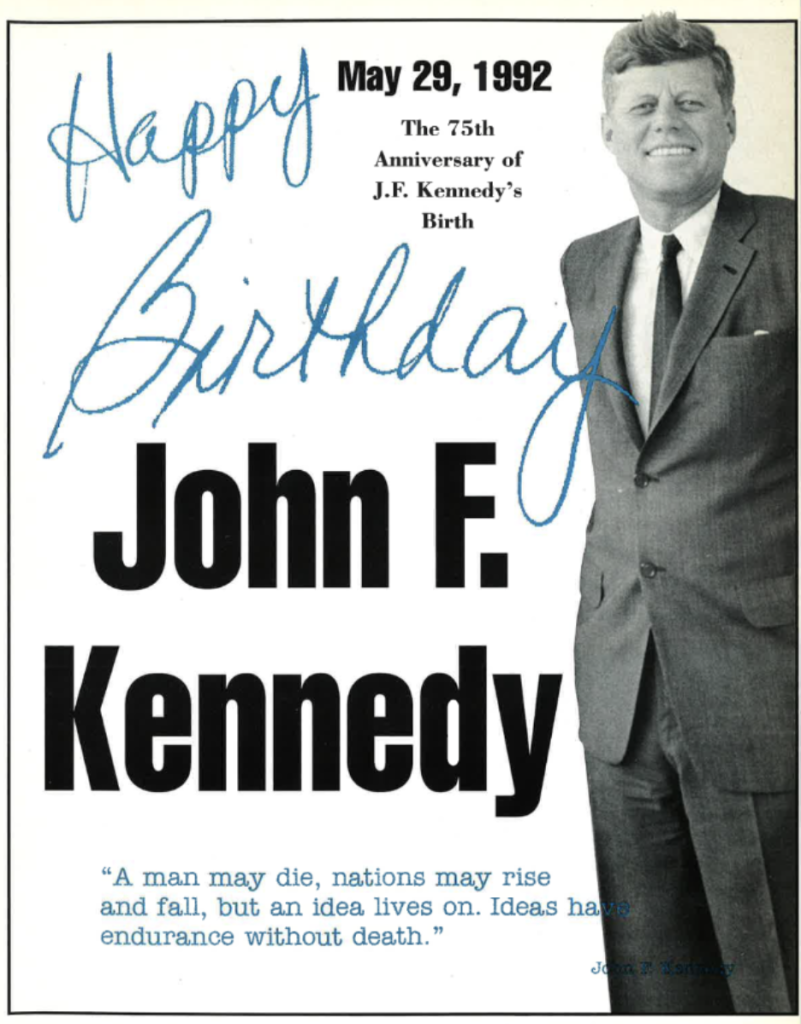
Patricia Harty: If I might quote your father: “A man may die, nations may rise and fall, but an idea lives on. Ideas have endurance without death.” What was your father’s idea for the world?
Caroline Kennedy: For me, and my brother too, one of the best things about growing up was how many people came up to us all the time to tell us that our father inspired them to do any number of things.
So one of his best ideas, his legacy, is the number of people who he inspired to go out and try to make their community better.
That was really one of the most outstanding things about him. That’s something we are incredibly proud of, and it’s something we try to continue at the library.
Patricia Harty: How do you think your father would like to be remembered on his birthday?
Caroline Kennedy: I think he would like us to remember that he loved life and that his life really was a joy. And for making a contribution and making things better.
He also had a great sense of humor. His birthday was always over the Memorial Day weekend. It was always the kickoff to summer at the Cape and a real family time.
Patricia Harty: In a photograph of your wedding I noticed shamrocks on your dress. Do you feel an identification with your Irish heritage?
Caroline Kennedy: I feel tremendously proud of being Irish and our Irish heritage. I haven’t spent a lot of time in Ireland but we did spend a summer there when I was young, and I look back on it as one of the best summers I have ever had. I would love to go back with my own children when they are a little bit older.
Patricia Harty: Where does all the Kennedy dedication to public service come from?
Caroline Kennedy: We have had the tremendous example of our family—what they believed in, their ideas on how to try and make things better. And you will find a number of quotes from my grandmother [Rose] and my father and uncles about feeling that way. I think that we have all been very fortunate in having been given a strong family and opportunities and a good education, and I think we want to give something back.
Patricia Harty: As president of the Kennedy Foundation, can you tell me about the Profile in Courage Award which is presented on your father’s birthday?
Caroline Kennedy: The idea behind the awards comes from my father’s book Profiles in Courage. And it’s a way of celebrating his life and achievements and his birthday, which is when we give out the award, rather than focusing on the loss.
Political courage and inspiring public leaders is something that my father cared about and that he embodied. So the idea behind the award is to recognize others who carry on that tradition, people in public life who do act courageously and do the right thing even at a cost to themselves. We hope these awards will encourage young people and others who are not involved at the moment to do something, so that they too can make a difference.
Patricia Harty: Your own book, In Our Defense, The Bill of Rights in Action, also focuses on some pretty courageous people.
Caroline Kennedy: One of the interesting things about it was that the people in the book never expected that they were the ones who were going to have to fight for freedom. Most of them had never been involved with politics or the law before, but when their rights were violated they stood up and fought back. I think that kind of example is good, and that is what we tried to get across that some of them paid a high price for it.
A couple whose home had been ransacked fought for 17 years to vindicate their rights and prove that what happened to them was unconstitutional. They devoted their adult life to fighting for the Bill of Rights, which is a lot to ask. Another woman who was targeted by the FBI fought for 12 years. She said something to us that we tried to get across in the book. “It is up to cach of us to create a government that is close to our heart’s desire.” And it’s only if we understand the Bill of Rights and the freedoms that we have, and if we get a little more involved, that we will have the kind of country that is close to our heart’s desire.
Patricia Harty: What was the hardest part in writing the book?
Caroline Kennedy: It’s a big subject and picking the cases was the hardest part, because my partner and I wanted to show that the Bill of Rights is really something that anyone can understand and it actually does affect you every day. The book is about ordinary people whose lives have been affected by something that many people think is boring or complicated, and it really is not.
Patricia Harty: Would you ever consider running for public office?
Caroline Kennedy: Right now I’m very happy doing what I’m doing. I think politics is a noble profession, and I’m proud of all the people in my family who have been in it. But I really enjoy writing and researching, and I hope I can make a contribution that way. I’m not sure what I’ll do in the future, but right now I like to be able to work at home, especially with two small children.
President Kennedy’s Irish Visit – June 26-29, 1963
Dublin was in a gay, holiday mood as President Kennedy returned to Ireland after a triumphant tour of West Berlin. When the President’s jet plane landed, after a two-hour flight from Berlin, 80 year old President Eamon de Valera was on hand to greet him, as was Prime Minister Sean P. Lemass. During the drive into the city, President Kennedy stood in the car and waved to the tremendous crowds who had come out along the route to see him pass.
His picture was in every store window with the Gaelic words: CEAD MILE FAILTE – A HUNDRED THOUSAND WELCOMES. In Dublin 500,000 citizens waved, jumped and shouted to the President as he rode to the American Embassy, where he stayed during the four-day visit.
From my car, directly behind the Presidential car, I had a full view of the entire route. I have never seen such a greeting in all my life. People who had waited quietly for hours, suddenly gave vent to their feelings with shouts of: “Welcome Home Jack” and “Failte.” All along the way, right up to the gate of the American Embassy, there was one solid mass of people, filling the air with an almost deafening roar. All monuments, rooftops, and three-decker houses were draped with flags, pictures of President Kennedy, and people vying for the best vantage points.
On O’Connell Street, President Kennedy was given an American-style, ticker-tape reception, as workers in the office buildings showered paper cuttings and homemade confetti from windows.
Four of the happiest days of President John Kennedy’s life were spent in his homeland of Ireland. As he moved through New Ross, Dunganstown, Wexford City, Cork, Galway, Limerick and finally, Shannon, he became more Irish by the minute.
In speech after speech there was a fierce pride and a glowing joy in his Irish blood, and the Irish people back home were wakened to a new appreciation of their nation. He told me he felt: “it is the quality of the Irish — that remarkable combination of hope, confidence and imagination – that is needed more than ever today.” At New Ross President Kennedy said, “it took 115 years to make this trip and 6,000 miles, and three generations. It was from New Ross Quay that my great-grand-father, Patrick Kennedy, embarked for America in 1848. When he left here to become a Cooper in East Boston, he carried nothing with him except two things; a strong religious faith and a strong desire for liberty. I am glad to say all of his great-grandchildren have valued that inheritance.”
At the John Barr Memorial in Wexford, I stood ten feet from the President as he laid a wreath, and stared at the bronze sculpture of the man whose exploits wrote the first enthralling chapters of the American Navy. Here was a link of two men of Wexford stock — John Barry, founder of the American Navy, and the American Navy hero who was now the Commander-in-Chief. It was a scene that brought to me the memory of John Barry’s sword and pennant at that time hanging in the President’s office in Washington, and portraying the real meaning of sentiment by linking these two figures, and events, across the span of time.
We also visited Arbour Hill to lay a wreath on the graves of the executed leaders of the Easter Rising of 1916. Here in this quiet graveyard, there was obvious pride in the bearing of the young cadets as they stood before President Kennedy paying tribute to their great predecessors. Asked on leaving Ireland what was the highlight of his visit, the President replied, “The highlight? That was the memorial service at Arbour Hill.”
On the day of his assassination, his wife, Jacqueline Kennedy, planning the funeral arrangements recalled his enthusiasm for the Irish Army Cadets, and at her special request a detachment of 26 cadet officers few to Washington and performed their ceremonial drill during his burial at Arlington Cemetery.
On his last day in Ireland, I’ll always remember his final remarks in Limerick when he said, “This is not the land of my birth, but it is the land for which I hold the greatest affection, and I certainly will come back in the Springtime.”
No words can ever really recapture the atmosphere of those four days when all the Irish poured forth their hearts in waves of love and respect in what was to prove to be their last opportunity to see this great man.
The writer Dave Powers was a political aide and close friend to John F. Kennedy. Their association went all the way back to the 1946 election for the eleventh Congressional District in Massachusetts. Powers is currently Curator of the Kennedy Library in Boston, where he serves as a living link with the Kennedy political legacy.
Editor’s Note: This article was originally published in the May 1992 issue of Irish America. ♦
Leave a Reply