
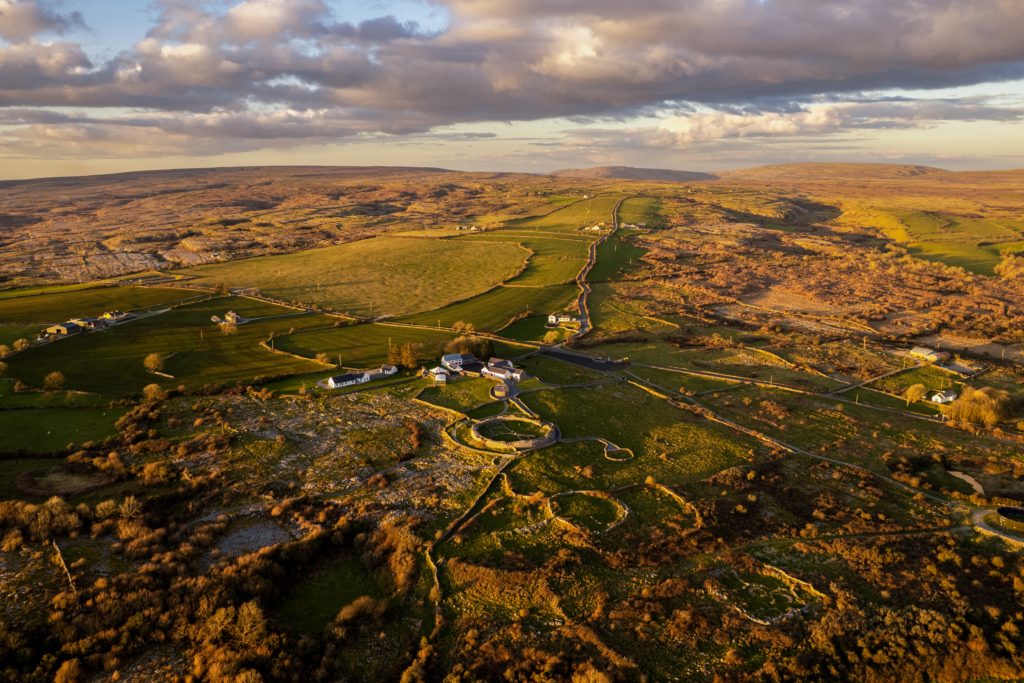
On the Other Side of the Galway Bay from where I am sitting now, on the Connemara shore, a single sturdy Spring sunbeam escaped from the clouds. It’s out for a morning walk along the edge of The Burren. It is a magical March march across a real fairyland. Nine miles away, across the manes of sea horses, I am riveted to the view. I wish I were where the Sun is. The Burren, where plants from the Mediterranean and from the Arctic families live side by side in the cracks of a warm limestone face, is a very special place. It is as if a warm throbbing fragment fell from the moon onto the West coast of Clare. Watching the straying of the sunbeam over the lunar-like landscape behind Black Head I think that the rare wild orchids will already have their heads raised there, in some crevice of this Celtic mystery.
The sunbeam strolls towards Black Head itself, and there is some place, near Ballyvaughan, under the eyebrows of the Head, where I can picture it jilting the friendly roof of Paddy Nolan’s cottage near the Ailwee Cave. I can see the warm kitchen now in the mind’s eye, almost a time-warped place where all the cliches have real substance of flesh. There is certainly a teapot on the range, its spout pluming the strength of its brew. There is certainly all the warmth and welcome one associates with Clare.
There may be a young kid from Paddy’s half-wild goatflock recovering from its arrival in this world in a wooden crate near the fireside. The kid’s magic eyes, ringed, green, mysterious, I see them clearly, are counterpoint to the fractured reality of the Burren’s forehead rising up behind the back door of the farmhouse. Rock, rock, everywhere gray rock, splintered and sundered in all directions, hiding its wealth of plants and flowers, cupping them warmly in its fissures.
Running away past the dolmens of Poulnabrone and the ruins of ancient churches and castles to the peaks of goatslands and the home of the Sun.
It is the pure gold of the Sun, just now, that reminds me of the almost wistful look there still is in the sharp eyes of Paddy Nolan. It was Paddy who, as a boy, coming back from the mountains to this very cottage, who, by a glinting sun, saw this answering glint in one of the ten million cracks in the rockface. He put in his hand, and the crack was just big enough to allow this, and there, folded in half, he found the Torc Collar of Gold, one of the brightest treasures of the National Museum now. There it was, the front disc neatly bent in half, the bracelet undamaged, moulded over just a little, darkened and dulled a bit, but as intact as the day some hand placed it there centuries before.
Paddy tells the story of bringing it home, in muted excitement, and showing it to his family. Later his father showed it to some fowlers who called, professional gentlemen from Lahinch down the coast. One of these wanted to bring it away with him but Paddy’s father said the boy wanted to keep it. Later they contacted the Museum in Dublin, and the man from the Museum, when he saw it, his eyes blazed more brightly than gold with the excitement of a rare discovery. The authorities gave the family 100 for the Torc Collar, which was little enough, but strong money enough in the Thirties, and the Nolans bought some more land with the money. They were glad to get it, Paddy says, and I think his eyes are always wistful since because, all his life afterwards, he has been watching to see the special sun shining into some other fissure in this rocky wonderland. And it never has.
Five years ago the postal authorities brought out a stamp featuring the Torc Collar. It was one of the best-designed and most striking stamps of recent years, that stamp, and Paddy must have felt a bit special every time he got a letter. And still, every day, when he goes out to check on the goatherd, or to walk his rocky magical acres, his eyes flicker sharply up and down and right and left, missing nothing.
It would have been a prince or a king who owned a collar like the Torc Collar. There was a wild battle fought near where Paddy found it, a battle between two great clans. Watching the sunbeam stray out of my ken behind Black Head, I can see the princeling clearly. His people have lost the battle and he is alone in a hollow in the bleak hills. He would maybe have a better chance of escaping if his neck bore no gold. He takes off the Torc Collar and bends it in the middle and slips it into a crack in the rocks. And soon he was probably killed. For he certainly never came back for his golden badge.
And then, centuries later, on a March morning like this one, a young boy went out herding goats. And a sunbeam like the one I’m watching dying now went out a-walking too over the fairyland of the Burren. And the twain met.
Editor’s Note: This article was originally published in the March 1991 issue of Irish America. ♦
Leave a Reply