
They left Ireland more than 150 years ago, seeking to escape starvation and disease in their native land, hoping to find a new life in New York. Many went on to build a new life in the United States, others were less fortunate.
Thousands died before they could rebuild their lives in the New World. Some died aboard ship, some in a quarantine station in what is now the St. George section of Staten Island.
Many were buried in a mass grave in a field near today’s Borough Hall. There they lay for decades, forgotten until recently, when construction of a new courthouse uncovered some of their remains. A portion of the site was left undisturbed after the initial remains were found.
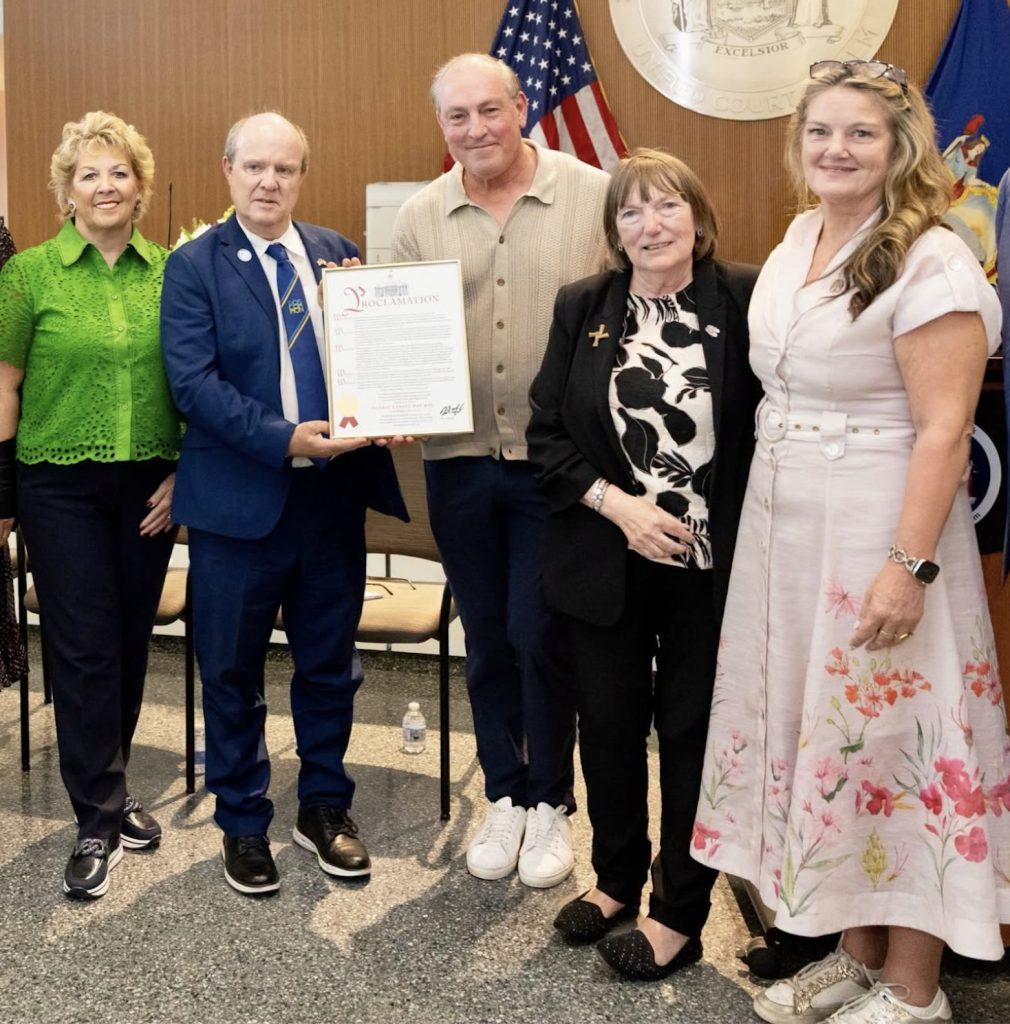
On Sunday, Sept. 20, these immigrants received what was denied them in death: A solemn ceremony of remembrance, a blessing, and a pair of monuments dedicated to their memory. The ceremony also honored the journey undertaken by hundreds of thousands of Irish immigrants who left home during the Famine years, so many of them settling in and transforming New York City.
Speaking at the unveiling, Ambassador of Ireland to the United States of America, Geraldine Byrne Nason said: “As America marks the 250th anniversary of the signing of the Declaration of Independence we reflect on our relationship together, and particularly on the story of Ireland in America.
“One of the most defining moments in that story was the experience of Ireland’s Great Famine during which some two million people fled Ireland to the United States in search of hope and opportunity. That dark period in Ireland became a pivotal time in Ireland’s relationship with the United States. Irish people found shelter and purpose in the USA. It became a foundational time in building the strong friendship and bilateral relationship that we enjoy today.
“The Irish Government is proud to have contributed to the installation of these monuments as a reminder of the distinct and extraordinary contributions made by people from the island of Ireland to the United States and to its development over the past 250 years.”
The two monuments face a walkway leading to the courthouse whose construction led to the discovery of the old cemetery.
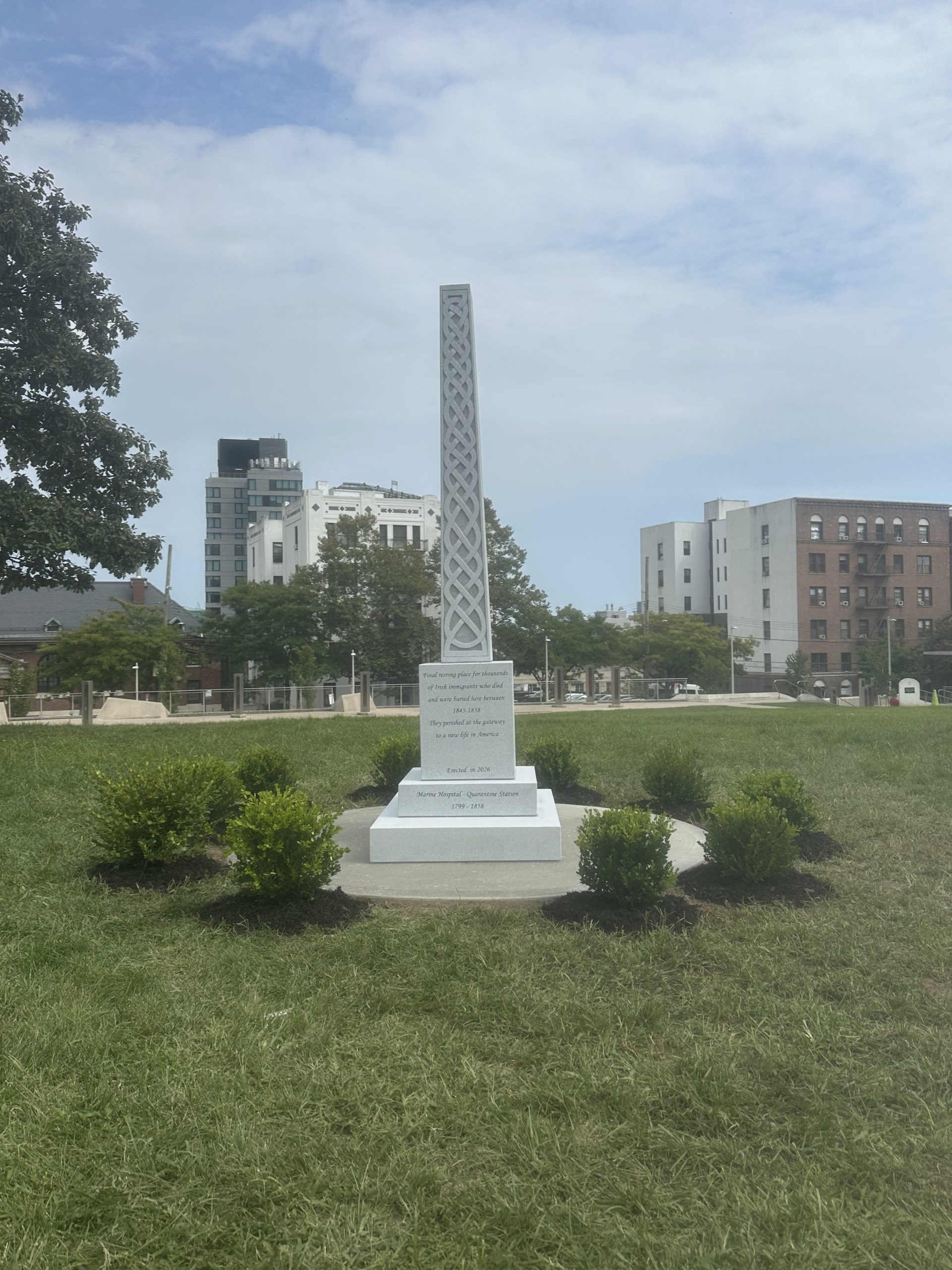
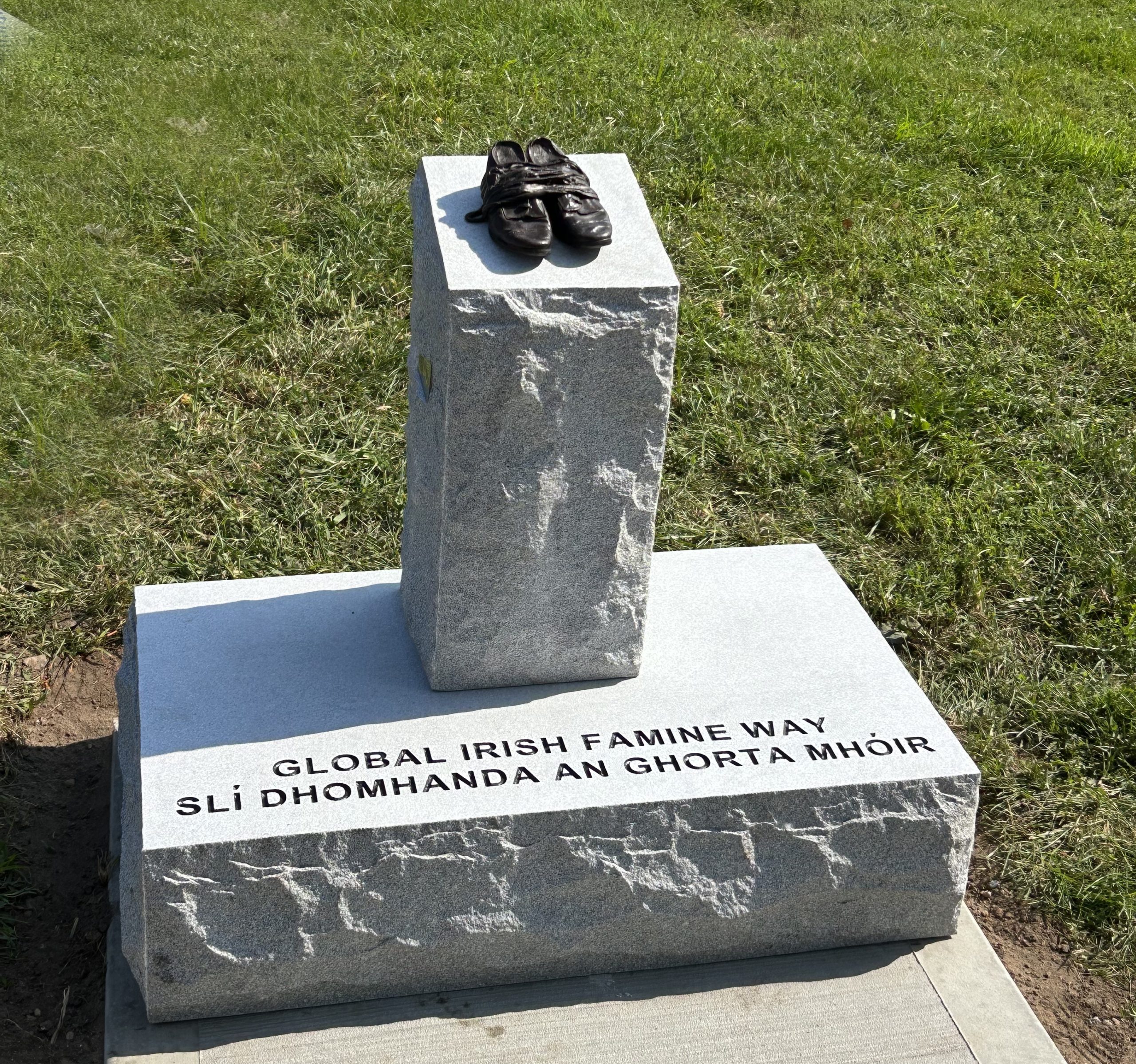
One of the monuments, based on a traditional 19th century cemetery obelisk, memorializes the lives of all those buried at the site. Robert Flood of Staten Island Monuments offered his expertise in creating the design. A second monument consists of two bronze shoes on a pedestal, reminders of the journey of Irish Famine immigrants and an official representation of an initiative known as the Global Irish Famine Way. This is the first site recognized by the Global Famine program in the United States.
Years of research and advocacy, spearheaded by the Friends of Abandoned Cemeteries under the leadership of its CEO, Lynn Rogers, culminated with the ceremony and dedication, which began at 2 p.m. Speaking of the men, women and children buried at the site, Rogers said: “Their fate was tragic, but now, 180 years later, they will receive the recognition and benediction they never received in life.”
In addition to Ambassador Byrne Nason, other local political, cultural and religious leaders are expected to attend. The ceremony will include a presentation of flowers on the monument site by several local children and music performed by local pipe bands.
The Global Irish Famine Way extends from the National Famine Way in Ireland to follow the journeys of Irish Famine emigrants around the world.
The international leaders of the Global Irish Famine Way, Caroilin Callery of the National Famine Museum at Strokestown Park and Irish diplomat Eamonn McKee, appointed two well-known individuals from the Irish community as national American Co-Convenors: Professor Christine Kinealy of Quinnipiac University and Roscommon native Hilary T. Beirne, former chairman of the NYC St. Patrick’s Day Foundation and Founding Director at Irish America 250.
The Staten Island committee is chaired by Lynn Rogers and includes Mike Cusick, president and CEO of the Staten Island Economic Development Corp., Civil Court Judge Mary Kavanaugh, local historian Pat Salmon, Dr. Timothy Lynch, president of the College of Staten Island, Irish activist Kathy O’Keefe Burke, and Dr. Terry Golway, adjunct professor of history at the College of Staten Island.
The Circle of Giving
Taoiseach Micheál Martin emphasized that the Famine’s lessons of compassion, solidarity, and humanity would permanently resonate with future generations, at the annual National Famine Commemoration that took place on May 17, 2026. This year’s ceremony took place the Irish Workhouse Centre in Portumna, County Galway, honoring those who suffered, died, or emigrated during the Great Famine (1845–1852).
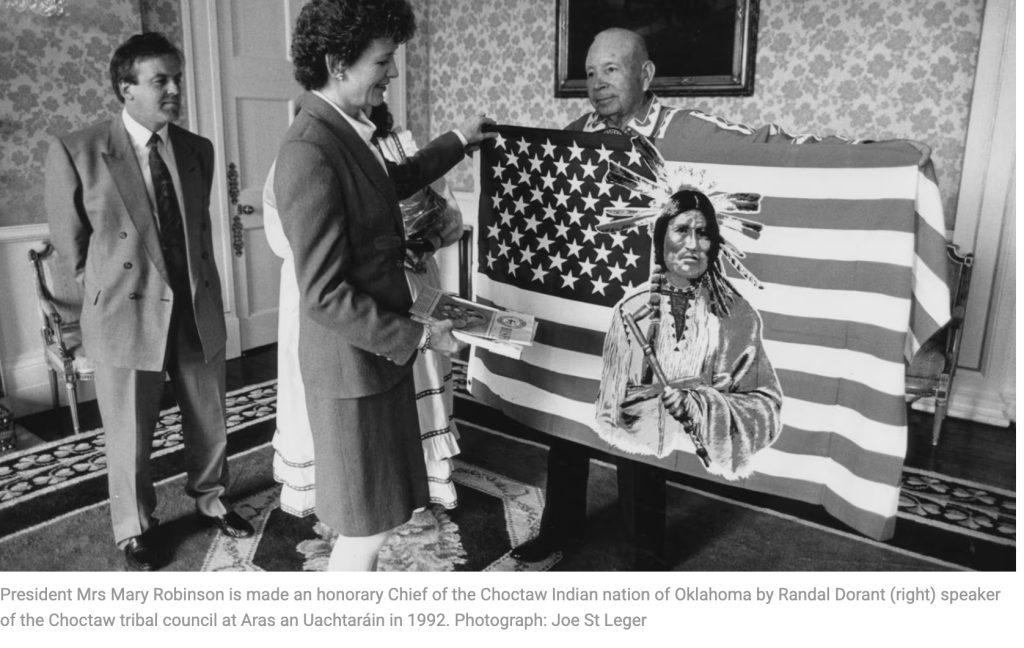
To mark the 2026 National Famine Commemoration, the Irish Heritage Trust released a new video documenting President Mary Robinson’s visit to the Choctaw Nation, and the National Famine Museum, at Stokestown Park, Co. Roscommon.
This act of modern remembrance illuminates the enduring legacy of Robinson’s presidency (1990–1997), which fundamentally transformed how Ireland engages with its past. By linking the then 150th anniversary of An Gorta Mór to contemporary global hunger and the Irish diaspora, the former president argued that Ireland’s historical trauma had given the nation an “informed consciousness” and a profound moral obligation to support developing countries facing modern crises.
Central to that global vision was her landmark visit to the Choctaw Nation in Oklahoma on May 14, 1995 – the first by an Irish head of state – to personally thank the Choctaw people for their extraordinary Famine relief donation of 1847.
“I first learned about the gift of the Choctaw people to the Irish famine victims when I was president,” she recalls recently in the video. “I was very pleased to have the opportunity to travel to Oklahoma and thank the Choctaw people for that incredible humanitarian generosity. They didn’t know who the people were on this island.”
Robinson was also inspired by Irish donations to the Hopi and Navajo GoFundMe campaigns during the Covid-19 pandemic – a gesture of return for the Choctaw gift of 1847. “I was very glad that during Covid, when Irish people learned of other tribes in the United States particularly suffering, that they contributed. There was a return gift at that time. I thought that was very moving.”
In the video Mary Robinson reflects not only on her experiences with the Choctaw Nation but on two further defining moments of her presidency. “I was very pleased when I was invited to open the National Famine Museum at Strokestown Park House,” she said. “I felt that was a very fitting way to begin the commemoration of the 150th anniversary of An Gorta Mór.” In 1994 she also visited Grosse Île and the Irish Memorial National Historic Site of Canada – twinned with Strokestown – to honor the generosity of the Canadian people, particularly the people of Quebec, who adopted Irish orphans whose parents had perished on the coffin ships. She notes that some of those orphans, among them Thomas and Patrick Quinn, not only survived the voyage but returned to Strokestown as adults, completing “that circle.”
It is the theme of the circle of giving to which Robinson returns most powerfully. Paying tribute to the Choctaw Nation, she recalls thinking at the time “that I was closing a circle – that it had involved the suffering of the Irish people in An Gorta Mór, and ten years before that, the suffering of the Choctaw people in being moved from their tribal land on the Trail of Tears.”
Yet she resists the notion that the circle is complete. “The way in which the Choctaw people have become part of our story, the way in which it has led to generosity during Covid towards other Native American tribes in the United States – to me their generosity is a gift that goes on giving. The circle is not closed. It is somehow enlarged and enlarged.
– By Turlough McConnell
Video title: President Mary Robinson’s Visit to Choctaw Nation and the National Famine Museum, Strokestown Park. You can watch the video HERE:
Leave a Reply