
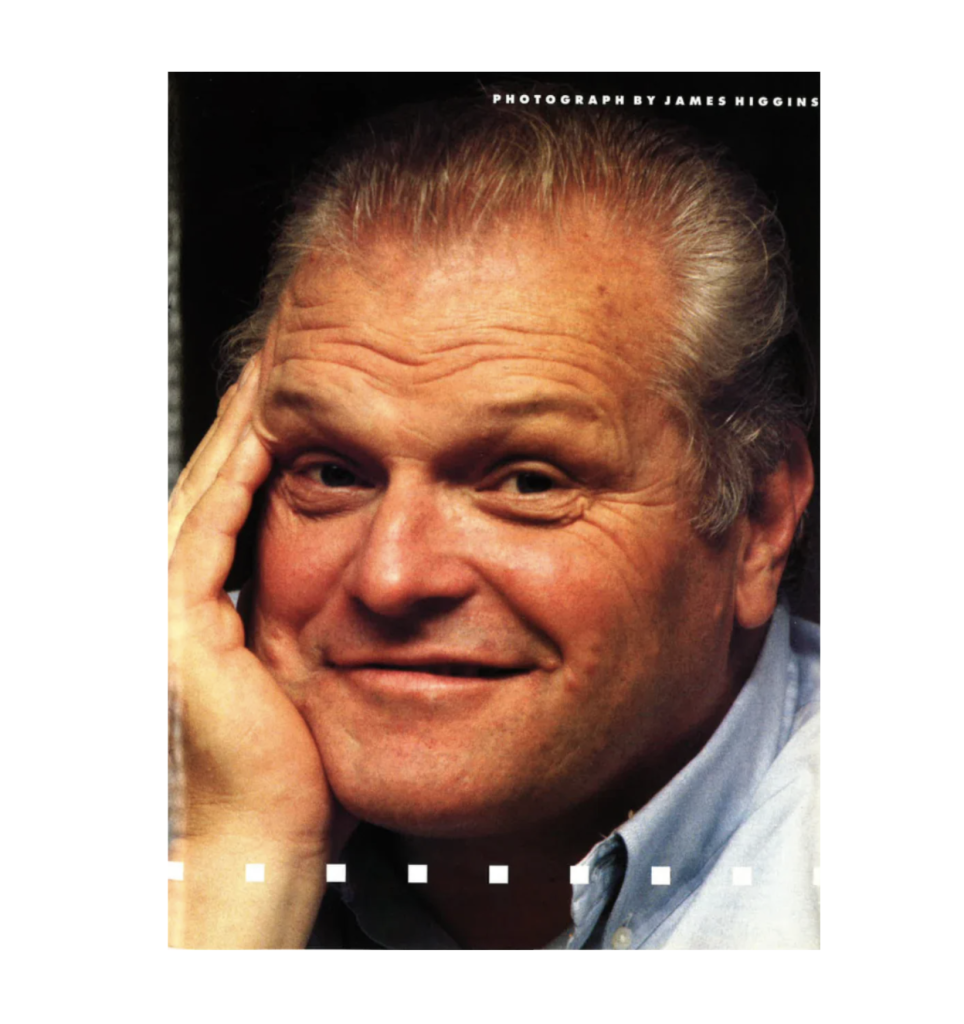
There is more to Brian Dennehy than meets the eye. Frequently the tough-guy or cop in his screen roles, he is also an accomplished stage actor. Patricia Harty met the New York star who \ came into acting late, but quickly made his mark.
Glade’s is a dusky old bar with lots of wood and a great air about it. The jukebox doesn’t quite fit in, but the records do, Frank Sinatra, Dean Martin, the Dorsey Brothers. Frank has just started into the first line of “September Morn” when I hear the door open and there he stands. I swear McGlade’s has those swinging western doors. Maybe not.
Brian “The Sheriff” Dennehy has made his entrance. God, he’s big. He has on jeans and a leather jacket and he looks very, very good.
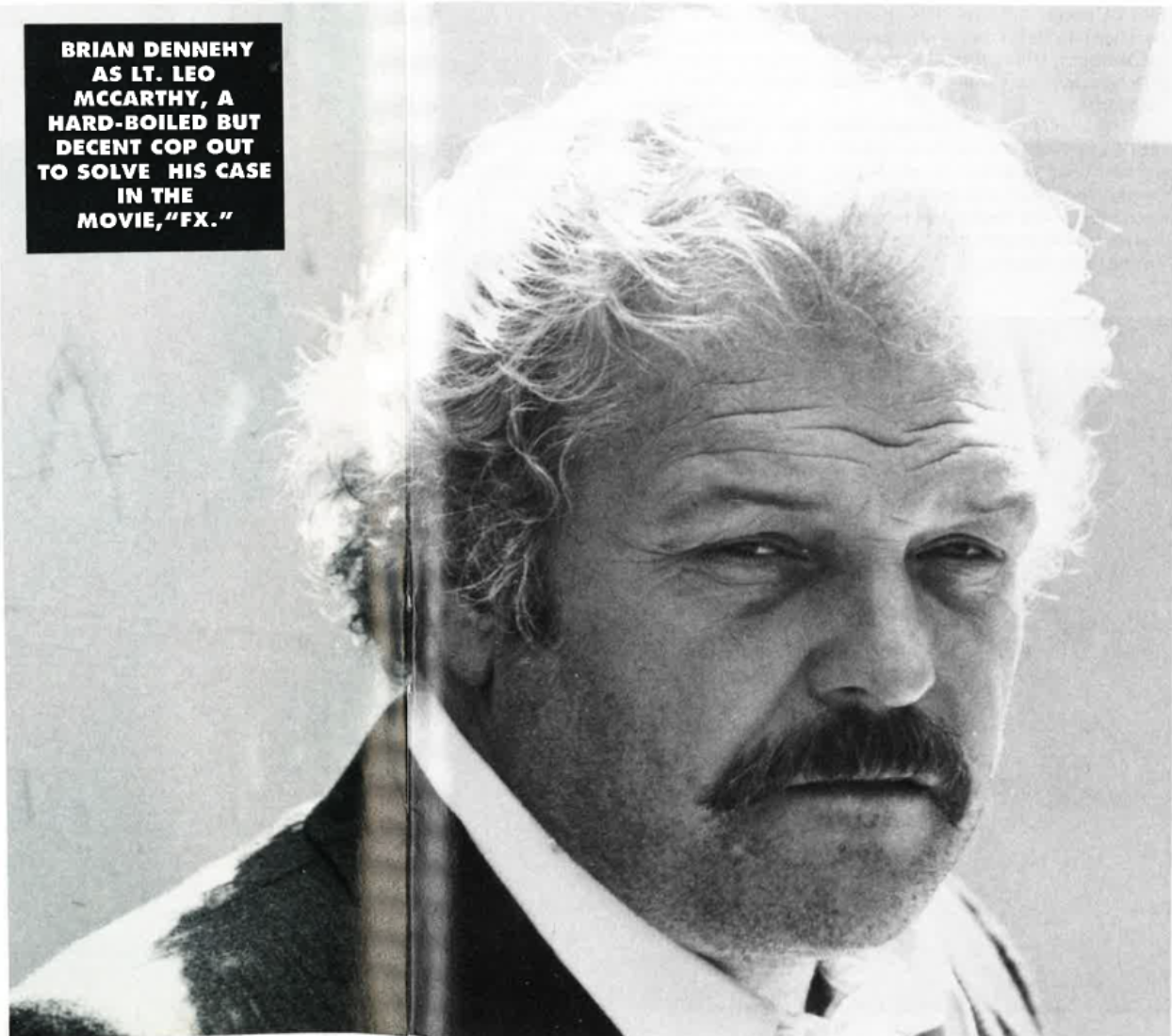
Who is Brian Dennehy? Well, he’s the sheriff who gunned down Kevin Kline in “Silverado.” the cop who won’t be corrupted in “Street Legal,” the writer who is persecuted by James Woods in “Best Selleri He has appeared in a host of movies and television productions since his first movie role as a football player in in “Semi-Tough” in 1977, the most notable being “F/X” and “Cocoon,” He’s a big guy 6’3″ 225 pounds and he usually plays roles that fit that mold-the D.A., the uncorruptable cop, the Marine sergeant.
Dennehy can look vaguely uncomfortable on film, his great bulk and weight hemmed in by the screen. But on stage his presence can fill the theater and his talent as an actor really comes through. Most recently he starred opposite Linda Hunt as Lopakhin in Peter Brook’s production of Chekhov’s “The Cherry Orchard” at the Brooklyn Academy of Music, a role which won him rave reviews from the New York Times. He also appeared as the sergeant in David Rabe’s “Streamers,” a play about life in the army, which was a hit on Broadway a few years ago and played the lead role in “Galileo” at Chicago’s Goodman Theater.
I first saw Dennehy in a Ron Hutchinson play called “Says I Says He” in Marymount College in Manhattan in 1978. It was an Irish play, set in a rooming house in London. Dennehy’s Irish accent was impeccable. The next time I saw him was when he made a brief appearance as the bartender in the movie “10.”
Over the last eleven years, he has found bigger and better roles. He is liable to turn up in the most unlikely places. True, many of his characters have made late entrances and early exits and many of the movies haven’t exactly been box office hits-“The Man From Snowy River, Part II,” for instance-but more recent movies and juicier roles like that in “Best Seller” are at last bringing him the recognition he deserves.
Dennehy was in town filming “Presumed Innocent for Warner Brothers and had just completed a HBO movie Perfect Witness. The reason for our early morning meeting in McGlade’s is that it’s just across from the ABC studios and Brian was on “Good Morning, America.”
We sit at one of the many empty tables and he jokes as I test my tape-recorder. To show that I’ve done my homework I ask him about “Saoirse,” (the Irish-language word for “freedom”) the title of his production company. He says that it’s “a lot of bullshit really, because when you become successful the one thing you don’t have is freedom….I guess it’s something for my grandfather who was an immigrant, who had nothing when he came here and he built a life for himself. So ‘Saoirse’ is for my grandfather and all those firemen and cops and factory workers and all those bakers in Millstreet in Cork.
“Big Dennis’ Dennehy. He was a real Cork man, loud and very sure of himself, very funny and physically very strong. He used to take me up to Gaelic Park when I was a kid to see Christy Ring,” [the legendary hurling star.]
“Gaelic Park,” he continues, “the longest bar in the western hemisphere!” Talk of his grandfather leads to talk of his grandmother from Waterford who came over in 1912 to work as a cook for a Protestant family in New Haven. “She had to be a cook for a Protestant family because she was the worse fuckin’ cook that ever lived. Only a Protestant could swallow her food. Her name was Nell O’Reilly.”
His father was “A real Gael, he introduced me to the exotics like Joyce and Flann O’Brien, who is one of the most extraordinary writers. What is interesting about O’Brien is that he never left Ireland. The rest of them all bailed out, but not him, and he may have been the best of them all. Certainly the most Irish writer. I love his stuff, especially The Third Policeman. He had that wonderful Irish thing, he was a civil servant, stayed on to get the pension. He wrote for the Irish Times for years, and wrote all those wonderful books…but never gave up the job.”
One of three sons, Dennehy was born in Bridgeport, Connecticut in 1940. The family later moved to Brooklyn. His father worked for Associated Press for 30 years.
“They dumped all over him but he loved it, because as he used to say, ‘When I’m 65, there’s the pension.’ It’s an Irish thing. He used to say, ‘Why don’t you get on the police force, Brian, a good job, a good pension?”
A good job and a pension. To an Irish Catholic kid in Brooklyn in the 1940s that was where it was at. Dennehy was a good enough football player to gain a scholarship to Columbia University and he emerged in 1960 with a degree in history.
At 21, still not sure of what to do with his life, he joined the Marines and after a five-year stint, marriage and three daughters he returned from Vietnam to a job as a truck driver.
Over the next ten years he had a series of jobs, truckdriver, salesman, bartender-real life roles that he would later bring to the big screen. It was tough servitude, his marriage crumbled under the strain, but Brian was getting more and more work off-Broadway; and, in 1977, he landed his first movie part, that of a football player in “Semi-Tough.” With the part came some real recognition at last-and money, “$1,000 a week for ten weeks.” Brian Dennehy was on his way.
Dennehy has made many visits to Ireland and seems alternatively to be frustrated and intrigued by the country. “I love the Irish, they are the most extraordinary people, they’ve got the most extraordinary talents, God knows, all I am is Irish, but all you have to do is look at James Joyce and O’Casey and all the rest of them, the minute they had two bob they got the fuck out because of all that life-demoralizing shit that goes on. My grandfather loved Ireland but he would never go back. My father used to say, ‘Come on, pop, I’ll buy you a ticket,’ and he’d say, ‘I busted my ass to get out of there and I’m not going back.’”
“They make it that way, not just the IRA but the church and all that horseshit. There are young people all over New York who have had to get out to live. Now that’s crazy. It’s a wonderful country, a wonderful people, but with limited potential, live yone has to get the fuck out of there to The ex-Marine abhors violence and the talk turns to Northern Ireland. “My grandfather was a real believer and I believed, too. I bought it all, the songs, the myths, and now it’s death time. I’m talking about the philosophy of it all. Those guys [the IRA] don’t want peace, the last thing in the world they want is some kind of a solution. They want the same old kind of bullshit because that’s where they live. They live in pain and anguish and fear and extortion. And they feed off the Irish Americans in this country. There’s no question that there’s discrimination. The UDF and Paisley are no better. They want murder and madness and mayhem. When you ring someone’s doorbell and you gun down an RUC guy with his 12-year-old daughter watching, you’re wrong! I wouldn’t give a nickel to any of them. All that stuff is wrong. There is no justification for it, none at all.”
The jukebox which I knocked into life seems to have set off a nostalgia morning in McGlade’s.
Frank is belting out another tune and I worry that it’s drowning us out.
I ask the bartender to turn it down “a bit.” He refuses. We move to another table.
Dennehy was in town to film “Presumed Innocent,” from the best-selling book by Scott Turow. “It’s a great book, beautifully written. It should be a good film, Harrison Ford is a great guy who wants to be a real actor, not just a movie star and I think he is. It should be interesting; we’ll see. I play the D.A.”
Dennehy is quick to heap praise on others in his profession. He has the highest regard for Aidan Quinn, another Irish American, who starred last year with Dennehy in the HBO movie, “Perfect Witness.” “He’s a wonderful actor; I’m just a big fan.” He also mentions the actor Gabriel Byrne, and the playwright Ron Hutchenson, in whose plays “Says I Says He” he starred in New York and Los Angeles, and “Rat in the Scull,” which he did in Chicago. “I love Hutchinson. He’s a Protestant from Bangor [County Down]. He’s an enormous talent, this guy is going to win an academy award. He’s going to do it all.”
His enthusiasm for Ireland is back momentarily and he expresses a wish to work in the Abbey. He’d like to play Big Daddy in Tennessee Williams “Cat On A Hot Tin Roof.”
“Yeah, I’d like to work over there for a while.”
He adds: “The best thing about Ireland is the people, and the tragedy of it is they want to get out and you can hardly blame them. I don’t know when it’s going to change, I don’t know when it’s going to be a country where the young people want to stay.”
Dennehy is now remarried – to Jennifer, an Australian costume designer – and his home is in Santa Fe. “I’m too old for this city,” he says.
He invites me to come and visit. You’ll really like my wife,” he says checking his watch as he prepares to leave. “She’s probably on the plane right now. I must go and clean the apartment.”
In typical Irish style, he insists on paying the check. That done, he rises, all 6′ 3″ of him. “I’m outta here,” he says, giving me a wink, and is gone.
Editor’s Note: This article was originally published in the January 1990 issue of Irish America. ♦
Leave a Reply