
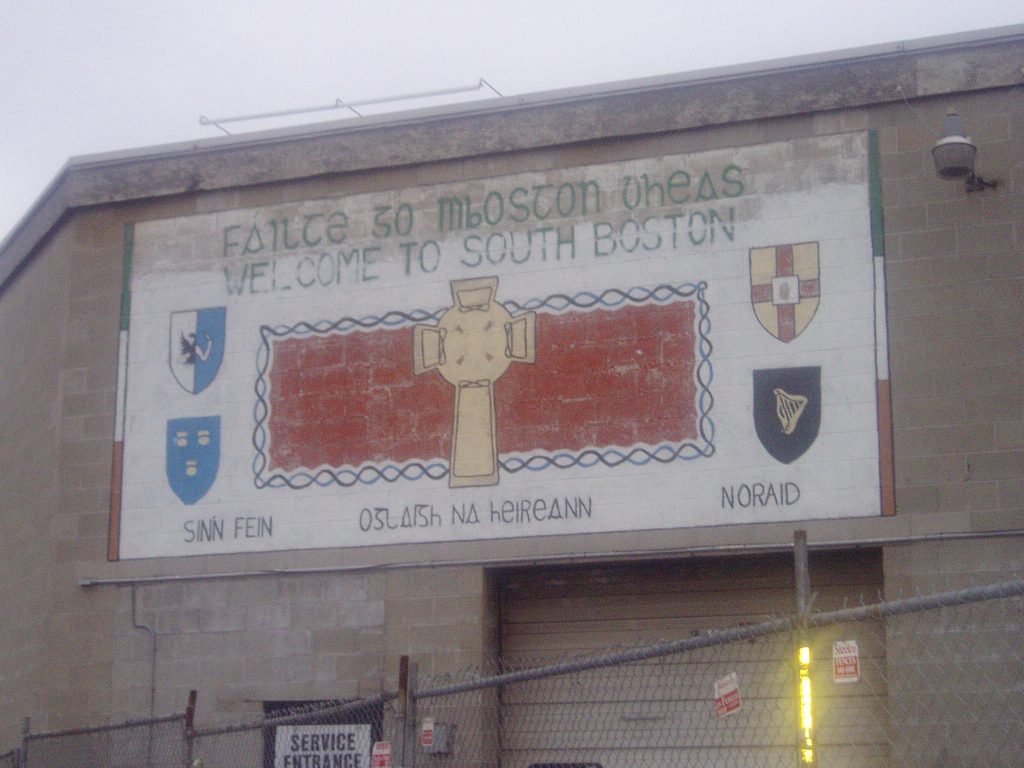
On Saturday, July 15, Martin Galvin, the 39-year-old lawyer who, in the past decade, has become the most prominent spokesman for Irish republicanism in the U.S., arrived at the Bronx headquarters of Irish Northern Aid (Noraid). Galvin found that he no longer had an office.
Not only were the office equipment, files and check books missing but the phone was disconnected. Callers to the New York office heard a recorded message referring them to another number, located in the Riverdale section of the Bronx.
The night before, Pat O’Connell, the Irish-born chairman of Noraid, had, with a help of a number of supporters, unilaterally moved the office contents to a new location. By doing so, O’Connell had laid the basis for a split in the organization. At the same time, the midnight raid would immediately precipitate the kind of changes in the organization that O’Connell and his supporters were hoping to sabotage.
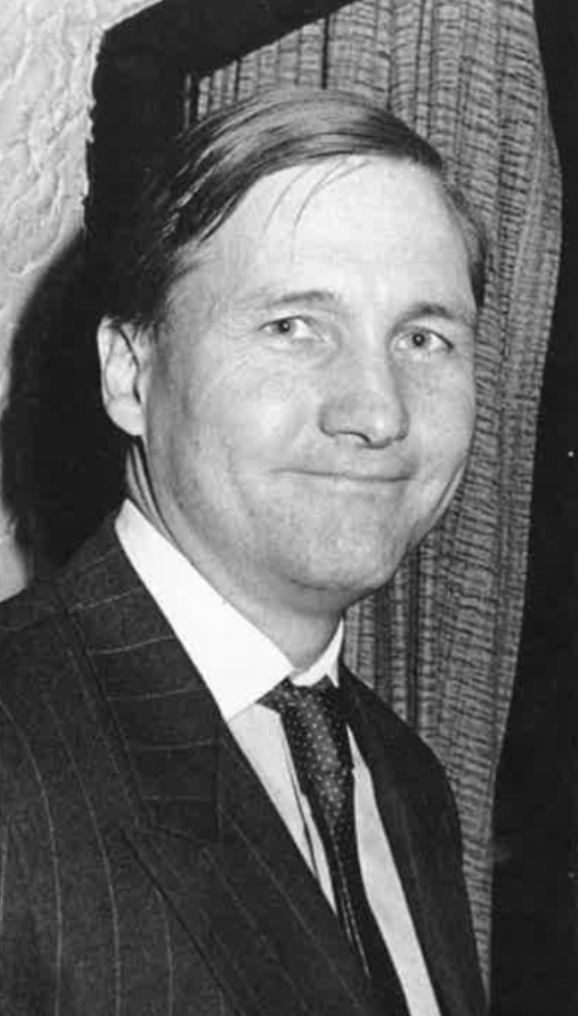
By the time the smoke had cleared, there was a new organization, the Friends of Irish Freedom, and the leadership of Noraid was transformed. Gone were three of its most prominent leaders-Michael Flannery, Pat O’Connell and Jim Maunsell.
Out of that crisis Noraid would emerge as an organization with a new leadership and a new direction.
The crisis in Noraid originated from political changes in both Ireland and the United States. The deadly 1981 hunger strike, which cost the lives of ten IRA prisoners in the H-Blocks of Long Kesh, brought in its wake a major reassessment of policy by the IRA and Sinn Fein leaderships.
While those deaths resulted in a wave of support for Irish republicans unseen since Bloody Sunday [when the British Army shot dead 14 civilians in Derry], the bottom line was that the leadership of the IRA or Sinn Féin did not have the political wherewithal to prevent the prisoners dying.
The war, they decided, couldn’t be won in the ghettoes and country lanes of Northern Ireland. They needed to break out from their isolation.
The solution that was arrived at was described by Danny Morrison, publicity director for Sinn Féin, as winning British withdrawal with “an armalite in one hand and a ballot box in the other.”
Concretely, it demanded a political offensive that would operate in tandem with the IRA’s war of attrition. The strategy paid dividends with major electoral success in the North that culminated in the election of Gerry Adams as a member of parliament for West Belfast in 1983. To attempt to reproduce that success in the Irish Republic demanded the elimination of the party’s traditional abstentionist convention in November, 1986.
The leadership that devised this new strategy was very different from the group that had formed the Provisional IRA and Sinn Féin in 1970. While still products of the popular republican tradition, people like Adams, Morrison and Martin McGuinness were radicalized by Northern Ireland’s prisons in the 1970s. Here the legacy of Che Guevara and Franz Fanon was distilled with the republicanism of Wolfe Tone and Patrick Pearse. The increasingly radical direction of the Northern leadership caused tensions in the organization.
Eventually, the uneasy alliance with the more conservative leadership of Rory Brady and David O’Connell, both based south of the border in the Irish Republic, came apart over the question of abstentionism.
At the 1986 convention, a minority group around Brady and O’Connell walked out and formed Republican Sinn Féin (RSF).
The IRA, however, remained intact, throwing its support behind Adams, Morrison and McGuinness. Without an armed organization and with a middle-aged profile, RSF would be doomed to the sidelines.
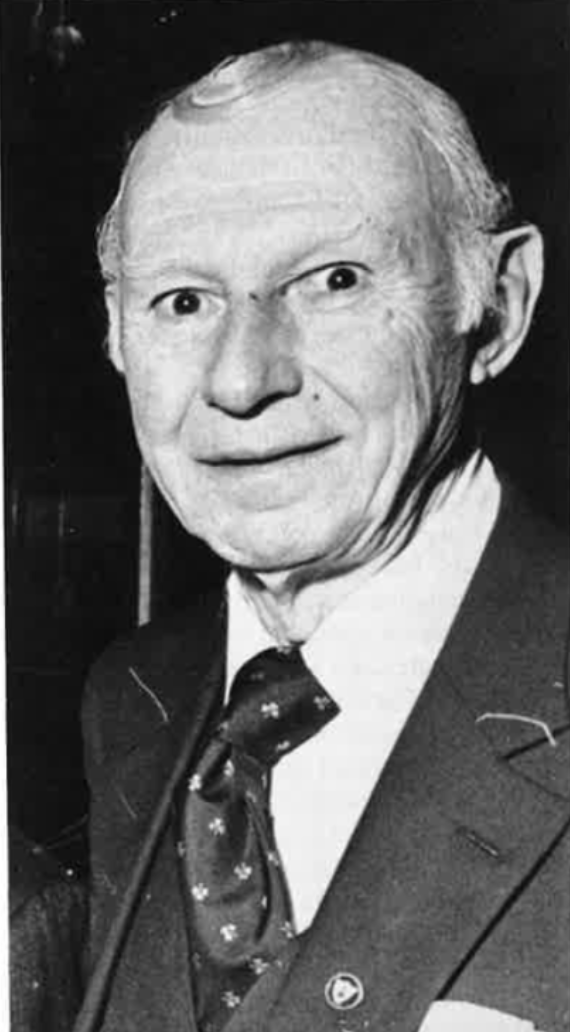
In the U.S. these developments were watched with intense interest. For Noraid founder and elder statesman, Michael Flannery, they were especially disturbing.
His affinity lay with the RSF leaders.
When Noraid was founded in 1970, it was David O’Connell who travelled to New York to shepherd the new organization into existence.
For Flannery, a Tipperary native and a veteran of the Irish Civil War, to countenance taking seats in the Dublin parliament was akin to swearing allegiance to the British Crown. Along with two other veterans; Dan McCormick in San Francisco and the New York-based maverick George Harrison, he pledged his allegiance to RSF. More importantly, Flannery secretly resigned from Noraid.
In founding the Irish Northern Aid Committee in 1970, there were very clear objectives. There was no doubt about what we were doing, giving aid to those whose sons were active in the Irish Republican Army and comfort to those whose sons were arrested, ” Flannery said.
The appeal for its formation came from the leaders of the Provisional IRA and Sinn Féin who had just emerged from a split with the “Official” republican movement. While that split was ostensibly the result of a disagreement over the question of abstentionism, its real roots lay in the perception that the Official IRA and Sinn Féin leadership were abandoning militant republicanism for some Irish version of Eastern European Stalinism. Subsequently, Official Sinn Féin evolved into the Workers Party, a left-wing party which eschews republican politics.
With the Provisional IRA campaign in full swing and the jails beginning to fill up, Noraid-with many activists in traditional Irish community, labor and sporting organizations – set about the task of collecting money for the Provos. In the heady days of the early 1970s, Noraid units sprung up across the U.S. There was no formal membership roll and little coordination from the head office in New York.
“It was created in an emergency situation, with the civil-rights marches quickly followed by pogroms, riots, internment and Bloody Sunday. People in Ireland thought that we were seeing the final stage of the conflict; that it was only going to be a matter of a few years before the British would be forced out,” says Martin Galvin, who joined Noraid in the mid-70s.
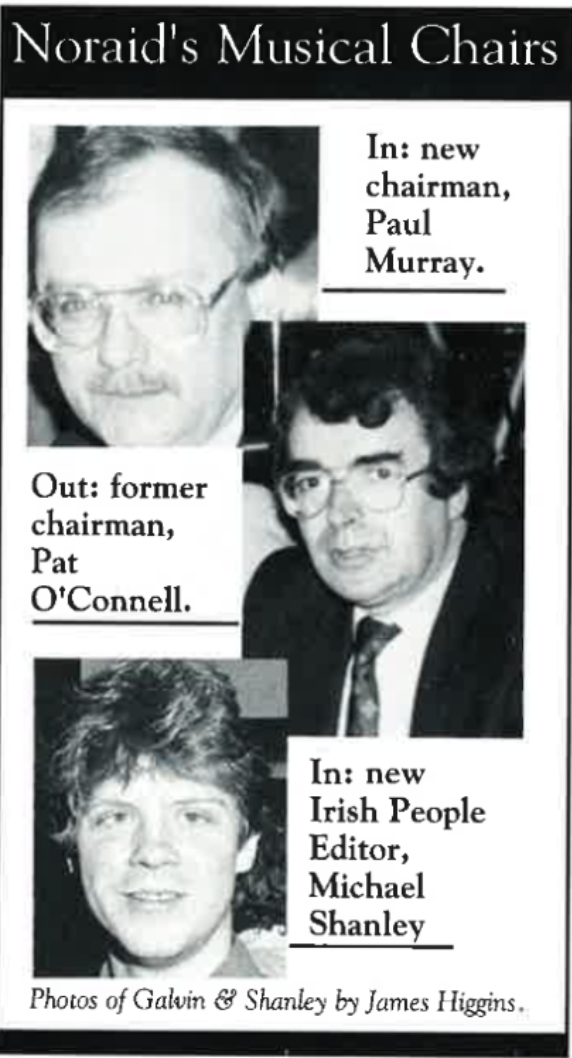
Throughout the 1970s the work of Noraid continued, collecting money mainly through socials in bars and community halls. The monies it collected, rarely more than $250,000 a year, were sent back to the IRA’s prisoners’ welfare fund, An Cumann Cabrach. Noraid also put out a propaganda paper, The Irish People (which is now under a new, young editor, Michael Shanley), and mounted pickets against visits by British politicians and royalty.
For the Provos this was fine as far as it went. The money raised in America helped them maintain the war effort, while providing financial support for their 800 or so prisoners in Northern Ireland, the Republic and Britain. Also, Noraid could turn out significant numbers for political demonstrations and had influence over a number of U.S. politicians-very useful factors on the propaganda front.
The 1981 hunger strike was also to have a major impact in the U.S. According to Galvin, thousands of young Irish Americans were drawn to Noraid activities during that period. Some stayed. “In the 1970s, the majority of the membership was elderly, middle-aged and Irish born. After the hunger strike, the American-born element was equal to the Irish. Similarly, prior to the hunger strike I would have been one of the youngest members of the organization. After it, that was definitely not the case.”
An Albany, New York-based insurance man, Paul Murray, joined Noraid in 1978.
But he could see that the organization seemed incapable of capitalizing on the upsurge of interest among younger Irish Americans. The Flannery/O’Connell leadership wouldn’t allow the young ones to come forward. They simply weren’t interested,” he says.
A symptom of the problems Noraid was having in this regard was the development of groups like the American Irish Political Education Committee and the Irish American Unity Conference. According to Murray, “These were people who had no real political differences with us. But Noraid simply didn’t seem to have room for them.”
The growth of the MacBride Principles, a set of fair-employment principles for American firms operating in Northern Ireland, into an important nationwide campaign seemed to emphasize the potential for growth. But while Galvin threw himself into the campaign, O’Connell, Jim Maunsell in Boston and Pat O’Connell paid little attention to it. “They didn’t want people involved in political action – and their attitude was, ‘do things our way or forget about it,'” Murray says.
But the Provos in Ireland were paying very close attention to the MacBride Principles. As they re-evaluated the position in Ireland they also began to see America in a different light. According to Galvin, the MacBride campaign, more than anything else, emphasized for the republican movement that the political potential in this country was massive.” In April, 1986, the Noraid leadership was called to Dublin for discussions. One Noraid delegate who was present summed up the message from the Provos as follows: “While the first priority is to raise money for the prisoners, it is vitally important to us that you build popular American support for a British withdrawal. It is not your job to sell the IRA in America but to argue for self-determination for the Irish people.”
From the meeting there developed what Galvin described as a “much more structured relationship with the republican movement in Ireland-in terms of information, resources and also requests to us from them.” As a result of that meeting Noraid held the first national conference in its history.
A high-ranking North American Committee was set up, composed of Sinn Féin president Gerry Adams, veteran Belfast republican Joe Cahill and Sinn Féin’s foreign affairs director, Ted Howell. This committee kept in constant contact with the Noraid leadership and became the final arbiter of any internal differences within the organization.
Another meeting was held in Dublin in December, 1988. At that meeting the findings of a detailed report that the Provos had commissioned on the state of Noraid were discussed. It was proposed that Sinn Féin supply the New York headquarters with a full-time worker who would oversee the development of Noraid into a more efficient and politically able vehicle. It also proposed the expansion of the Noraid executive council to bring new blood to the leadership.
Pat O’Connell and Jim Maunsell attended the meetings and voiced no disagreement with the proposals but, to those close to them, it was clear that they were becoming uneasy. In March, 1989, the full-time worker arrived and set about implementing the decisions. It was the first real sign that the Provos meant business.
It was in that context that Pat O’Connell moved the contents of the Noraid office. It was a gamble on O’Connell’s part to force Belfast to back down and leave things as they were. Publicly, O’Connell said that the new Sinn Féin worker had caused so many problems there was no alternative but to move the office. “He was supported by Jim Maunsel, who said that the problem arose over “frustration in the New York office.” But O’Connell was also saying that Noraid had changed for the worse. Noraid was set up to raise funds for political prisoners. In the last few months it has gone more for political purposes,” he said. Maunsell and O’Connell then re-signed.
In early October the group that was to become the Friends of Irish Freedom took out an ad in the Irish Voice and Irish Echo newspapers declaring that Noraid had deviated from the original ‘Statement of Principle’ on which it was founded.” Michael Flannery told the Irish Voice that he hoped the 40 signatories to the ad would “eventually result in a new organization hopefully one that would support Republican Sinn Fein.”
The Provos in Belfast moved fast to stay in control. Gerry Adams and Joe Cahill issued a statement condemning the ad.
“Regardless of the motivation behind it, it is in its effect at best, a diversion, at worst a provocation.” Coincidentally, they also had a man on a visit to the U.S. who was to become an important player in this crisis.
Brendan “Darky” Hughes was a former officer in charge of the IRA prisoners in Long Kesh. He also had led an unsuccessful IRA hunger strike in 1980. Hughes travelled throughout the country reassuring waverers, telling them that the IRA prisoners were depending on a unified Noraid.
This was followed by a statement from the IRA prisoners in Long Kesh supporting the Noraid leadership. To add further weight, Joe Cahill was burning up the phone lines from Belfast telling people that the republican movement was solidly behind these changes.
At the end of the first week in October, Noraid held a conference in Queens. While O’Connell had returned the contents of the Noraid office, from the beginning it was clear that the moves by Flannery, O’Connell and Maunsell, were the only issues on the agenda. The atmosphere was tense and stormy.
Pat O’Connell put it to the delegates that if Galvin and Murray were removed and the Sinn Fein worker sent home, his group would come back to the fold. Apart from the signatories to the advert who attended the conference, he found little support.
In the midst of the debate Murray, the first American-born chairman of Noraid, asked the delegates to indicate whether there was any support for Flannery’s call for affiliation to RSF. Not one hand went up to support Flannery. It was a decisive moment both for Noraid and the veteran Flannery, who had earlier told an RSF public meeting in Dublin that it was only a matter of time before he would deliver Noraid in New York to the new party.
In late October, the Noraid dissidents met in Boston at the home of John Hurley, the Charlestown longshoreman and former president of the Boston unit. The Friends of Irish Freedom (FOIF) was officially formed with O’Connell as president, Maunsell as vice-president and Flannery as a trustee. The objective, the founders said, was to raise money for the dependants of Irish political prisoners. But one of the messages that emanated from Belfast was that monies collected by FOIF would not be accepted by anybody associated with the prisoners.
Despite the defection of its veteran organizers it seems clear that the new Noraid executive, in conjunction with the Provos in Belfast, had managed to limit the effectiveness of the dissidents. As Sean Cronin, the Irish Times correspondent in the Washington, who has written extensively about militant Irish republicanism in America, explained: “At the end of the day, those who have the connection to the IRA and the prisoners are the people who will probably win.”
In the meantime, members of the Prisoner of War Department, Sinn Féin’s liaison with the IRA prisoners, were dispatched to the U.S. Among them were Gerry Adams’ cousin, Sean Adams, and Siobhan O’Hanlon, a niece of Joe Cahill.
In the company of Paul Murray, they visited Noraid veteran Dan McCormick in San Francisco.
McCormick, a key player in the Bay Area, assured them that while his political allegiance lay with RSF, he would continue to support Noraid as long as the link to the IRA and the prisoners remained.
With his acquiescence Noraid was reorganized in San Francisco and 30 to 40 young activists were added to the fold.
Eventually O’Hanlon, Adams and another P.O.W. Department member, Richard May, were arrested by the FBI and forced to leave the country. However, all three had already put up a lot of mileage.
Of added benefit was the fact that their arrests in Los Angeles, Chicago and Albany received extensive local media attention.
In January, 1990, the Noraid annual testimonial dinner in Queens will be followed by a national conference that will reportedly, among other things, present a “comprehensive financial report” to the membership. “There is no reason for the books to be closed. The membership should know what money is being sent home,” says Murray. Under Flannery and O’Connell that would have been unthinkable.
Primarily we want to spend a long time hearing what the units have to say about things. We also want to open part of that conference to the media. It has to be made clear that we have nothing to hide,” Murray adds.
“The clandestine conspiratorial image is something that we want to get rid of,” Galvin says.
“While that tradition has deep roots in the historical experience of Irish American solidarity organizations-the whole concept is obsolete.”
Murray also makes it clear that Noraid wants to develop a campaign in the United States around the single issue of the need for British withdrawal. He looks at the “Time To Go” campaign in Britain as the concept which they would like to develop.
According to Galvin, such a campaign could grow logically through the activists who have been mobilized by the MacBride campaign. Apart from the obvious potential for such a broad-based campaign in the U.S., “It would help Irish republicans to break out of the kind of isolation that the British try to impose on the struggle for self-determination,” Galvin says.
In the meantime, it is far from clear where the FOIF is going. Soon after its formation, Noraid activists claimed that the hand of RSF was becoming more and more obvious, especially after party leaders like David O’Connell and Joe O’Neill were visiting the U.S. With the group’s link to the Provos now severed, RSF might just be the only place left to go.
Despite its recent internal problems, Paul Murray says that there is an air of optimism in Noraid. “So many opportunities were lost in the past. There was no room for so many people. We want to change all that.” Whether Noraid can break out of the ghetto it has inhabited for so long remains to be seen.
Editor’s Note: This article was originally published in the January 1990 issue of Irish America. ♦
Leave a Reply