
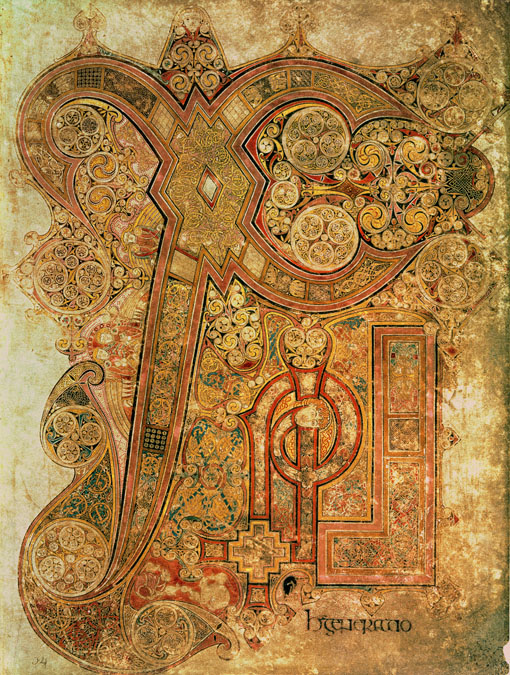
The Book of Kells is Ireland’s Greatest national treasure. Now a Swiss company is launching a fine art facsimile of the 1100-year-old historical artifact. A report by Sean O Murchu on the making of a book believed to be “the work of an angel.”
“Here you may see the face of majesty, divinely drawn, here the mystic symbols of the Evangelists…. You will make out intricacies, so delicate and subtle, so exact and so compact, so full of knots and links, with colors so fresh and vivid, that you might say that all this is the work of an angel, and not of a man.”
So wrote Giraldus Cambrensis or Gerald of Wales in what is believed to be one of the first “reviews” of The Book of Kells from Typographic Hiberniae, Ca. 1185.
The Book of Kells is, perhaps, Ireland’s finest national treasure as well as one of the most beautiful books from the early Middle Ages.
A work of art as well as scholarship, the manuscript is now kept in Trinity College Dublin, where it is displayed under light- and climate-controlled conditions. Bound in four volumes, two volumes are normally on show with the pages turned once a month.
In January, a Swiss company, Fine Art Facsimile Publishers, will launch the first-ever fine art facsimile limited edition of the book. The culmination of eight years of delicate and dedicated work using the latest in electronic reproduction techniques, these limited editions will cost $18,000 a copy – and are expected to increase significantly in value thereafter.
The Book of Kells-named after the town of Ceannanus Mor or Kells, County Meath-may not have been written in Ireland at all. Some scholars believe that all or part of the historic artifact was written on the Scottish islands of Lindisfarne or lona, the sites of famous monastic settlements.
It, nonetheless, found its way to Kells, where it was stolen from St. Colmcille’s monastic foundation in 1006 and buried in a bog. It miraculously survived and, although its whereabouts for the next six centuries are uncertain, it found its way to the Bishop of Meath, Henry Jones, who presented it to Trinity College Dublin in the 1660s.
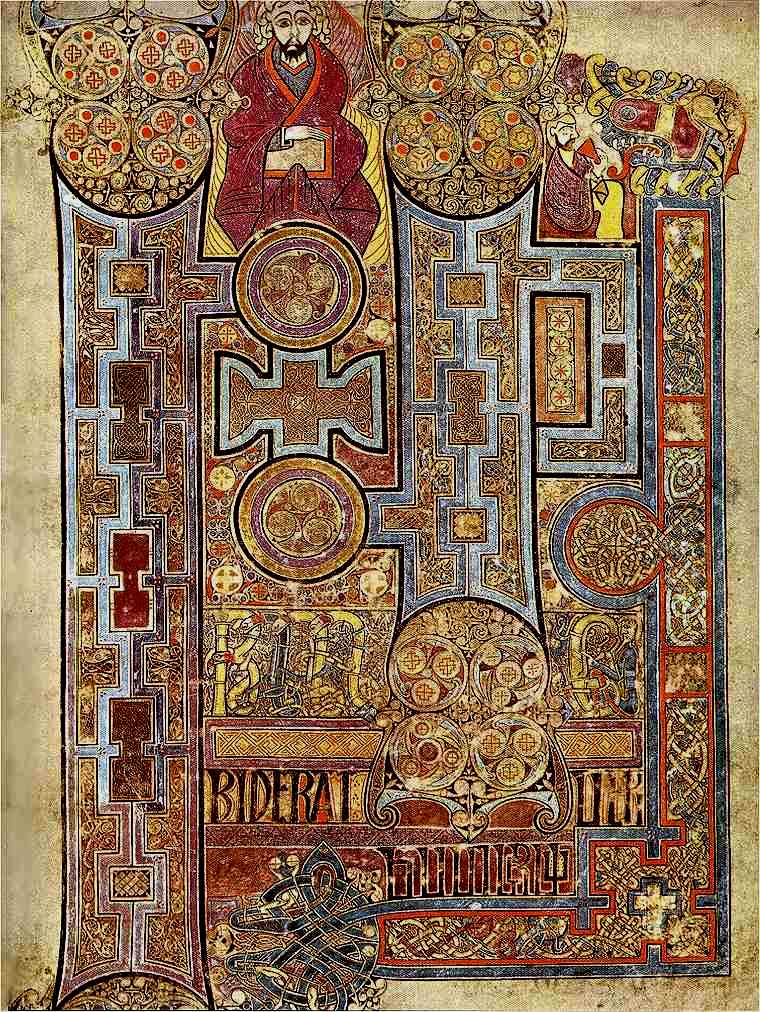
The book is written in Latin and contains the four gospels of the New Testament, along with the preliminary matter found in such documents, including the Eusebian tables – an attempt to correlate parallel passages in the various gospels- summaries or topic headings for each of the gospels and an argumentum for each gospel.
The book contains 340 vellum pages- there were originally several more-and all of them have some color, although the majority contain mostly text. Only about 30 contain the ornamentation and illustrations which have made the book famous.
The script, written in Latin, is in the style known as Insular (or Irish) majuscule or as half-uncial (a transitional stage in lettering history between the capital letters of ancient Rome and later medieval lower case). The pigments used for the colors hail from the Middle East. This is seen as another example of how Ireland was one of the acknowledged centers for learning (“the isle of saints and scholars”) as well as trade in the known world during the Middle Ages.
THE “NEW” BOOK – STEP-BY-STEP
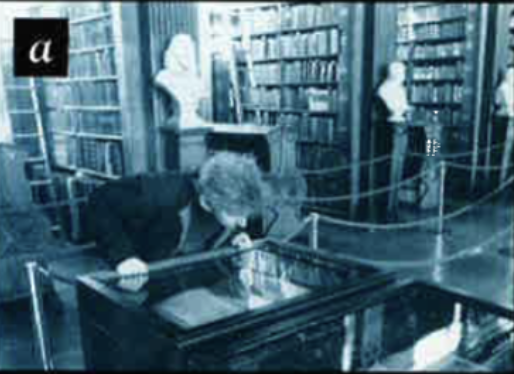
A) A visitor to the Long Room of the Old Library at Trinity College Dublin pores over The Book of Kells, which is on permanent display in the library. About a quarter of a million scholars and visitors from around the world view the original manuscript each year. The book is housed under glass in light and climate-controlled conditions to preserve the fragile volume.
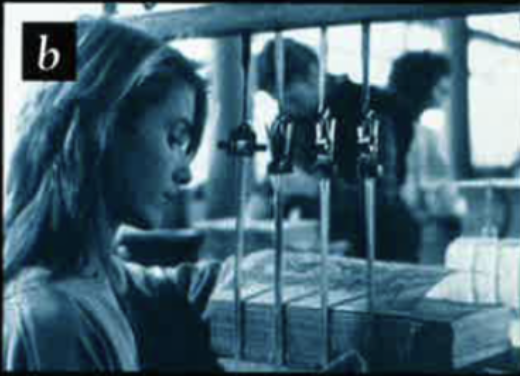
B) An expert bookbinder stretched thick cord over a sewing frame. Echoing the labor of centuries ago, hours of handwork went into fastening the quires (sets of 24 pages) made from the fine art facsimile sheets. The bookbinder next passed a needle through the quire, around the cords and along the spine. The contours of individual pages that were cut precisely to match the original are clearly recognizable.
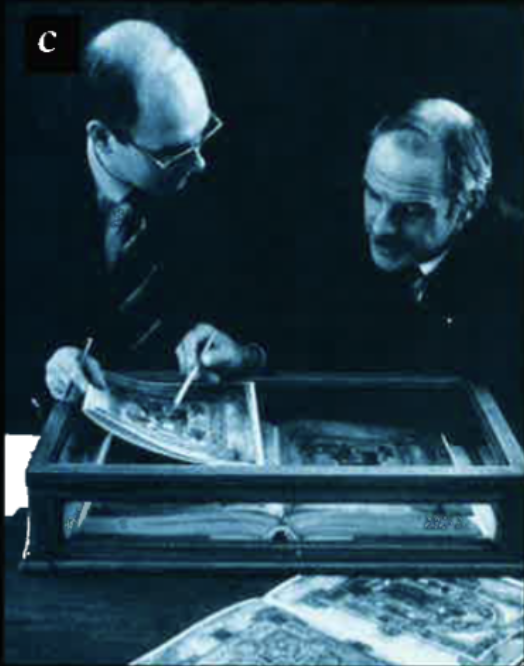
C) During lithographical operations for this carefully wrought limited edition of The Book of Kells, countless test prints were made and compared with the original, down to the finest detail.
This took place under strictly controlled levels of humidity and light. Then color corrections and additional printing operations were determined. Further lithographical work followed until the effect and the radiance of the original was achieved. Peter Fox, (left) librarian for Trinity College Dublin, and publisher Urs Duggelin of Fine Art Facsimile, approved a final test print of The Book of Kells
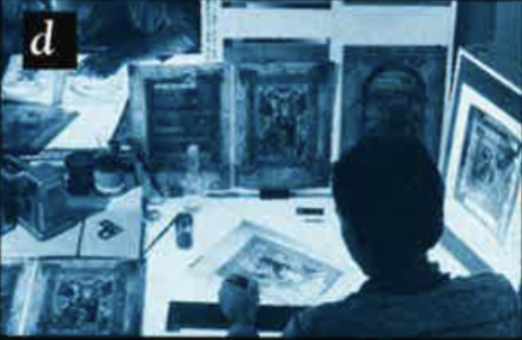
D) At the point where electronics reached the limit of its powers, the lithographer took over, making full use of his artistic skills. He produced additional colored films by hand and made partial corrections to colors in the final detail. As many as 10 printing inks were necessary to achieve this faithful fine art facsimile limited edition of this exquisite manuscript.
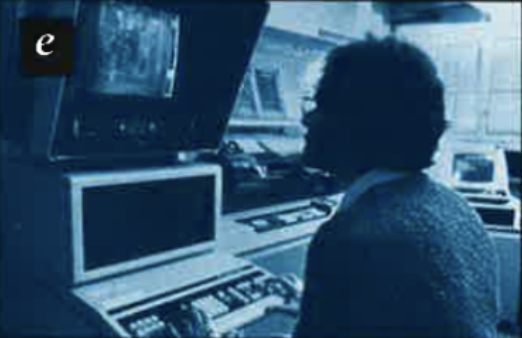
E) Ektachrome color transparencies produced by a special camera for The Book of Kells were processed in Switzerland. They were electronically analyzed on a Crosfield Magnascan 6451E computer and displayed on a color monitor of a Scanview 600. Control and correction commands given by the operator could be directly visualized. Each corrected page was then exposed by a laser light source onto films. These films served as the basis of the new limited edition book.
Editor’s Note: This article was originally published in the January 1990 issue of Irish America. ♦
Leave a Reply