
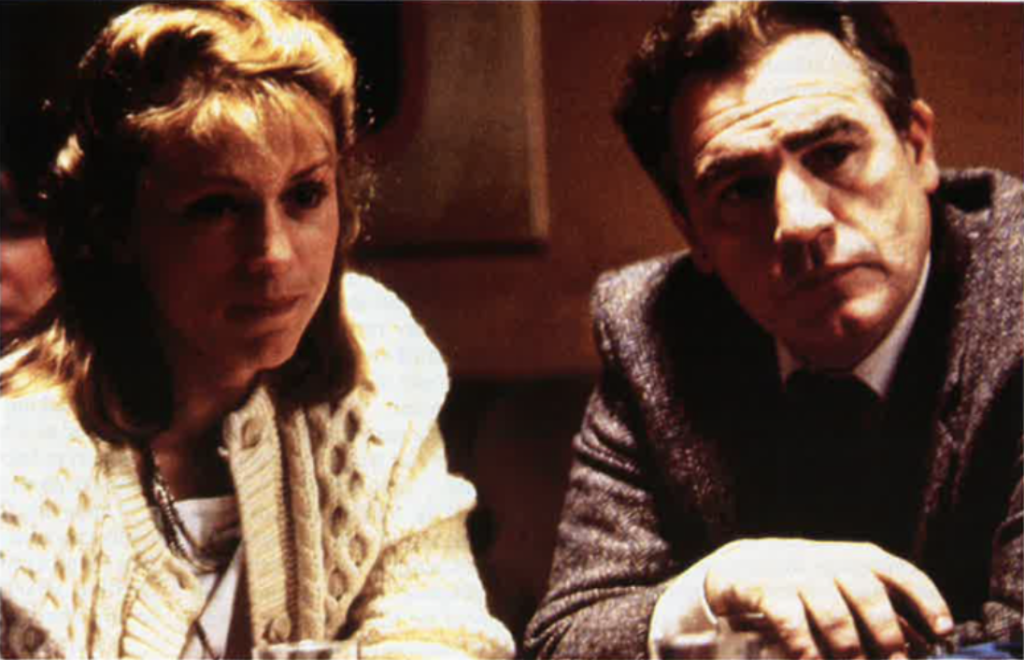
John Daly has reason to be happy. As the chairman of the Hemdale Film Corporation and executive producer of Hidden Agenda, their latest release, he seems once again to be a step ahead of the filmmaking world.
Hidden Agenda ventures into Northern Ireland to tell a political story based on truth. Well, three truths: The alleged RUC shoot-to-kill policy, the Stalker Affair and an MI5 plot to bring down a British Labour Government.
The film goes something like this: A human-rights group goes to Belfast to investigate allegations of abuses by British security forces. One of the group makes contact with a Republican source who has evidence of a shoot-to-kill policy.
However when the human-rights observer is murdered by undercover British agents, the group comes face to face with an official cover-up.
Then, amid international publicity, Peter Kerrigan, a reputable British police investigator, is sent over to sort out the mess.
He discovers that there’s more to the incident than meets the eye and as he gets close to unearthing what is really going on, he meets up with Harris, an ex-British army officer on the run. Harris knows about the cover-up policy in Northern Ireland but also has proof that MI5 and the CIA are involved in a joint operation to dislodge a British Labour Government in favor of a Conservative one. Kerrigan is shattered by the magnitude of the corruption. Much to the dismay of the human-rights observer who participates in the investigation, Kerrigan gives up the fight.
It’s a tense political drama but its setting and the film’s resemblance to real/alleged events is what makes it a surprise theatrical release and an even more unlikely hit.
It was awarded the Special Jury Prize at the Cannes Film Festival, and on its first weekend in New York, Hidden Agenda grossed $70,000 at the box office while showing in only three cinemas.
Daly is satisfied. “They are really excellent figures,” he reflects. “If the business continues and we can make it into a small hit film or even a big hit film, it would be wonderful. It would encourage other filmmakers to tackle issues that relate to Northern Ireland and other political issues which really, as far as the big entertainment corporations are concerned, are given rather short change.”
And certainly the story of Northern Ireland has fared poorly at the hands of film producers, with a staple of dismal offerings like Prayer for the Dying (which actor Mickey Rourke subsequently disowned) or A Quiet Day in Belfast, presenting the conflict as a surface-level action flick.
The idea for Hidden Agenda actually originated when highly-respected British producer David Puttnam who produced Pat O’Connor’s Cal among many others—contacted director Ken Loach about doing a film on the RUC’s shoot-to-kill policy. Loach and his screenwriting partner, Jim Allen, began to work on the idea.
However, by the time their script was ready, Puttnam and Columbia Studios had gone their separate ways.
Loach and Allen were unable to find financial backing for Hidden Agenda for not only does it approach an issue increasingly avoided by film producers but it draws on political truth instead of conventional fiction. Daly read the script and approved it immediately. Hemale was the light at the end of the tunnel for the writer/director team.
So what was the appeal of the project?
“The hypocrisy of things is what grabs one’s attention,” Daly begins. “I would not have made the film if I did not know the facts to be true. I certainly wouldn’t have made a diluted or a glamorized version of the situation. It was so honest and the integrity of the filmakers gave me no hesitation in backing the film.”
Hemdale put up $4.5 million production money, a commitment which drew sceptical grunts from industry sources. But scepticism is a familiar tune to Daly. “They reminded me exactly of what was said about Platoon, “he recalls.
“Oliver Stone, who had previously won an Oscar with Midnight Express, was rejected by every studio and every filmmaker throughout the world. Hemdale supported Platoon, made it and saw it achieve major critical success so everything that they were saying was wrong in making a film about a subject like Northern Ireland was music to our ears. Because we had been down this path before.” Indeed, controversy is a path well worn to Hemdale’s door, In addition to Platoon, the company backed Salvador, a film highly critical of U.S. involvement in Central America.
“Hemdale makes a diverse number of films. Some of them are political, some of them are for the under-dog, some of them are entertaining —we have less success with the ones intended as entertainment so maybe we should stick to the others,” Daly says with a laugh.
“On Salvador I asked Oliver Stone to at least acknowledge the many people who carried placards in Washington to protest American involvement in Salvador. So he wrote in a speech for Jimmy Woods to say that Americans do care about what happens to the country, and do care about U.S. involvement, so not everyone is your Yankee war-mongering lunatic wanting to drop nuclear bombs all over the place. There are people who care about peace and I wanted to encourage those people.”
When he speaks about Hidden Agenda, the producer gives the impression that he wants the film to succeed on a number of levels. Although unsaid, there is the business of making money-Daly was once described as a “cuddly barracuda” by the Wall Street Journal. He is more forceful, however, about the film’s political agenda.
“I hope this film will be a landmark to really encourage independent companies like Hemale to continue to make political films, whether they relate to Palestine or any other issues around the world.
“It’s up to the independent filmakers to get these matters put on the screen. I don’t think you can rely on the big American corporations to do that. They’d rather make Sylvester Stallone, Schwarzenegger, Mel Gibson, Goldie Hawn, Barbra Streisand type films, which really are non-political and are as entertaining as they feel they are.”
With the entertainment industry under increasing Japanese control, he feels the major studios will tend to shy away from political themes. “So it will be even more important for the independent filmaker to make films about matters that should be considered by the public at large.”
Frances McDormand, Mai Zetterling and Brad Dourif appear in Hidden Agenda but big names in big lights are not Daly’s style. “The subject matter is our biggest star,” he remarked.
He also sees Hidden Agenda performance in the U.S. as the key to its wider chances. “If this film is successful in this country, it will play everywhere in the world,” he says simply.
“If it’s not, you’ll have other filmmakers saying, well, why make a film about Northern Ireland because Hemdale had Hidden Agenda and that was a failure? But if it’s a success, you’ll get other filmmakers who will want to make strong stories about Northern Ireland and there are some great stories to be told about it and about Ireland itself.
“If in America it isn’t seen to be successful, they will have every reason to say: it wasn’t a success in America, therefore it won’t work in our country. If you’re in the film industry, that is a popular excuse-and I’m making a broad reference, as to whether the film is political or non-political. England is 2.5 percent of the worldwide cinema-going audience. The secret is to get the other 97.5 percent interested in this film. A great proportion of the 97.5 percent happen to live in America.”
Based on random samples of its New York screenings, Irish-Americans made up 38 percent of the audience, a statistic which heartens the executive producer. “I find the American Irish are much more passionate about a united Ireland than they are in the Republic of Ireland, where they seem very complacent.”
He does not accept that Irish people are war-weary, nor does he accept the suggestion that Irish-Americans see things differently because of their distance from the conflict.
“If you start to have conditions, if you start modifying everything, then nothing is going to happen,” he contends. “The stone-throwing children of twenty years ago are now either in prison or plotting with guns and explosives; and the same thing will happen in Palestine, where the stone-throwing children of today will be the freedom fighters of tomorrow. There’s got to be a better way.”
He cuts a youngish 53, his jaw firm and his nose only slightly disjointed by years in the amateur boxing ring.
Daly is dapper but casual, he speaks slowly in a measured tone, his voice croaking from the accumulated wear of innumerable interviews.
“I think the Irish have been extremely forgiving to the English. Incredibly forgiving. They seem to be the most forgiving people I have ever come across. They encourage them [English people] to come for a vacation. I would have nothing to do with them, If they did this to my family, I would want to have nothing to do with them. I would just tell them they are a useless bunch who came across here, pillaged, raped, wiped out everything Ireland was proud of. And now you would just like us to go along and have us all dance around the maypole as though nothing happened. It’s outrageous. No wonder they think the Irish are stupid. ‘Our lovely Irish friends,'” he intones sarcastically.
“It’s like having a burglar or a murderer or a rapist still sitting in your house. The Irish have ancestry and when you have had your ancestors slaughtered, wiped out, that’s a lot to swallow. But you’ve got to learn to swallow it.”
At this stage it is unclear whether he is encouraging conciliation or condemning it. As a step towards peace he would set a date for reunification. “I think that would do away with a great deal of the bigotry and hate and all the reasons that are put out by the British Government for having soldiers in Ireland.
“We’re approaching the year 2000 and I find it unbelievable, staggering, I can’t believe for a moment that the British want to occupy Northern Ireland. I find it staggering. Why do they want it? I keep saying it’s like a blister on the foot and they won’t just take the shoe off.
“Why won’t they allow the Irish to be Irish? Do you think the British would enjoy it if the Irish had six counties in England? Do you think the English would sit there and say, well, isn’t this wonderful? They bloody well wouldn’t!
“It’s costing millions to carry that out. It’s madness. There’s a wonderful country, Ireland, that’s got a lot of history with England, so let’s do away with hate. Let’s replace it with something better than hate. Let’s encourage them to live in peace. What’s being done can’t be right.
“And there certainly can’t be peace when you have a divided Ireland. I find the hypocrisy of it staggering. I’m against violence but I feel people only resort to violence when they feel frustrated with everything that’s been achieved. And they see their mothers and brothers and sisters pushed around, bodily searched, questioned, as though they were prisoners in their own country.
“Then they’re locked up, given trial without jury, taken up for interrogation, see their brothers and cousins killed by plastic bullets. Don’t you think there’s enough to make them angry? If that was happening in London or England, the place would be in uproar. We’re about to go into Iraq to punch them on the nose for what they’ve done to Kuwait. What’s the difference? Not much.
“It seems to me that the Birmingham Six, the Guildford Four, ten men who have done over 150 years in prison, mainly because they have an Irish accent, are a terrible reminder of injustice. Terrible. And it continues.”
Sections of the British press labelled Hidden Agenda an IRA film. When it won the Cannes award, there was heated debate between the filmmakers and British journalists. But the film has not yet been released in Britain or Ireland and Daly feels that official pressure everything short of an actual ban, has been applied against it.
“When a film wins an award, normally it’s out in three to four months in the country of origin. But instead of the great British press saying how its film industry won this important award, it was given no press in Britain whatsoever. And the ambitious release plans we had in October were squashed by the theater chain withdrawing the support of its cinemas.” Does it surprise him?
“No, of course it doesn’t surprise me. Rather it just makes me more determined to carry on. My big desire is to make it a success in America which means they will have great difficulty in hiding it in the rest of the world.”
Hemdale films—The Last Emperor and Platoon–swept the Academy Awards in different years. Is there any possibility Hidden Agenda, a political docudrama, could make an impression there?
“I think it would take a very, very brave Academy Board Committee to vote for this film. It’s the most serious film out there today—the rest are all candy floss and popcorn. There’s nothing as serious, as gripping, as real as this film; and on those merits alone it deserves to be recognized. But it would take a very brave group of people to vote for it.
“We will do our bit. We will promote the film as vigorously as possible for Academy attention. We will point out all these things to them and they can ignore them at their peril-which they probably will! But we’ll tell them. Again, the main thing that can influence them is how successful the film is theatrically.”
But he is encouraged by the reception in New York. Hidden Agenda will go on national release in the new year.
“There is a desire to see the film,” he says.
“And there’s no doubt in my mind that we will be in 250 cinemas by the end of January and I hope that will be increased to 500 by the end of February.”
Looking ahead, he is interested in producing a film about what he calls “the thorniest of issues: Palestine.” He would also be drawn to the 1981 hunger strike in Long Kesh, during which ten IRA men died. “Any man who’s dedicated enough to give his life for his country deserves attention,” he adds.
When asked if he would be interested in doing a film about Loyalists in Northern Ireland, he demurs. “Loyalists? It would be interesting to examine that if they wanted to live in peace without hate. IL would be an interesting exercise if there was a story that was good enough.” He pauses.
“Whoever thought the Berlin Wall would come down? But it’s down.”
Editor’s Note: This article was originally published in the February 1991 issue of Irish America. ♦
Leave a Reply