
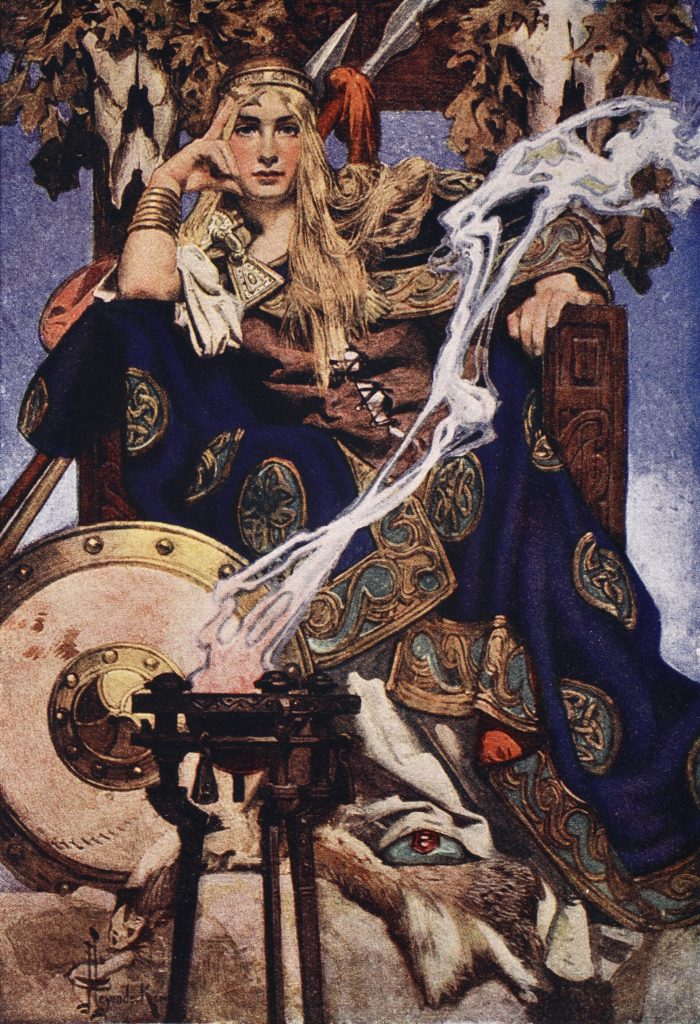
A woman at marriage passed into her husband’s fine and was accorded half his worth in honor-price, but she also had status in her own right.
Some historians believe that the high status of women in ancient Ireland was part of the pre-Celtic culture that was absorbed by the invading Celts. One thesis is based on the fact that invaders of all countries were accustomed to taking as booty the women of the land they conquered. The pre-Celtic women, having been accustomed to comparative liberty, would not accept marriages that took away their freedom. The Celtic men realized that rape and force might subdue a woman, but would not make her a good wife. Thus, a man who wanted a permanent wife, booty or not, to rear his heirs, to protect his home and property in his absence, and to live congenially and loyally with him, had to accept the woman’s conditions.
Another explanation of the position of women comes from the 14th century Book of Ballymote, which cites as its reference the Book of Leinster which in turn takes as its source the pre-Patrician Cin Droma Snechta. This story begins when the sons of Milesius found in Eriu, their Island of Destiny, female Hebrew exiles. These far-from-home but independent women had been driven by a fierce tempest from the Tirren (Mediterranean) Sea into the ocean and thence to the shores of Ireland. In response to proposals by the Milesian leaders, the ladies agreed to marriage on the condition that the men recognize their worth by pairing only those of equal status and by giving them a dowry. From this came the ancient Irish custom, rare among the world’s cultures, of the husbands providing the price or dowry to purchase the wives.
From the Táin Bó Cúailnge (Cattle Raid of Cooley) comes another tale of a woman’s insistence that her personal status be recognized. Queen Maeve (Medb, Medhbh) represents the liberated, outspoken, free-spirited, free-minded heroine of the ancient Irish people. The story has elements of the mythical, but modern historical research has indicated a legendary base which brings it close to what is now known as historical fiction. Maeve became angry with her third husband, Ailill, because he boasted that it was his status that gave honor and worth to her. She presented arguments to prove that she had her own status that was as good as, if not better than, his. She reminded him that she was Queen of Connaught not through him, but through her father, the High King, who selected her because she was the best warrior of his four daughters (although she may have acquired her solid title to queenship through her second husband). She enumerated her victorious battles and the fighting men that she had in her own right. She also claimed freedom to do as men did and take lovers, something Ailill should have understood clearly when she chose him as her husband on the basis of his lack of jealousy. The inheritance or allotment of the land for use or sharing was tied to the military duty necessary to protect one’s fine, tuath, or a greater kingdom. Since men were considered physically stronger than women, they were given preference in inheriting land-use and also given responsibility for military service. If there were no son, however, a daughter could inherit or be assigned the use of land and the corresponding requirement of going into battle if there was a military levy. In the Ist century A.D., Bridget Brethra of the Judgments, a great woman lawmaker, had the law revised so that an exemption was granted by which any female land inheritor could provide and pay a substitute male warrior to fulfill her military obligation. Some women, nevertheless, felt duty-bound to fight their own battles or to fight alongside their husbands, brothers, and sons.
In the earliest records of Ireland, mythological, legendary and historical. freeborn women are portrayed as emancipated individuals and slave women are portrayed as more valuable than male slaves. Women were warriors, druids, physicians, poets, lawgivers, and scholars. Brehon law gave women equal standing with men, although it is likely that only firm and powerful women could enforce the law. Women, like men, were subject to the decisions of their fine and the male cenn fine.
Marriage was a voluntary contract in which, for purpose of order, the man was made head of the household. His wife, nevertheless, retained rights sufficient to prevent her husband from ever owning her. She could not be a chattel as in other ancient societies. She received part of the marriage portion (coibche) that her husband paid to her father. She retained sole ownership of any property that she had acquired before her marriage. She could pass on her property by will. She had equal rights with her husband in joint ownership of properties; both had to consent to sale or leasing. A wife could appear and appeal in Brehon courts on equal terms with her husband. She could go to court as an individual to collect a debt or ask for a judgment. If she had a legal separation for good cause, she was entitled to the marriage portion, to the marriage gifts from friends, and to the homemaking articles that she had brought with her to the union.
The coming of Christianity confirmed the high position of Irish women. The pre-Christian Irish had a mythological goddess, Bridget, patron of wisdom and poetry and a human Bridget, expounder of law and judgments. The Christian Irish had St. Bridget, founder of the famous school, church, and monastery at Kildare. St. Bridget was no cloistered mystic, but was an active trail-blazer who journeyed throughout Ireland to teach, to counsel, to spread the faith, and to direct about thirty religious houses.
Such a role could have been possible only in a country in which women had long commanded the respect that made them eligible for rank, education, leadership, and the professions.
Christianity is credited with influencing one change, although this might have resulted anyway from an evolving culture. The pedestal on which Christianity placed women was not that of Maeve, sexual adventuress and ruthless warrior, but that of Mary chaste virgin and merciful refuge of sinners. Women, despite lawgiver Bridget’s exemption, were still taking up arms and marching into battle.
This became a major concern of St. Adamnan (Eunan).
At the Council of Birr in present-day County Offaly, Adamnan convinced the assembly to recommend exemption of women from all military engagements.
In 697 A.D., at the Synod of Tara, he succeeded in having legislation passed that became known variously as the Canon of Adamna’n, Adamnan’s Law, Law of the Innocents, and the “law not to kill women.” Women were not to take up arms. Women were not to participate in warfare. Neither women nor their children were to be killed or taken prisoner. Whether all the ladies who followed their lords and their lords’ liegemen into battle appreciated their exclusion from demonstrating their superiority on the field is not known, but one can be certain that all appreciated the ban on their being carried off as prisoners after attacks on their homes and settlements.
St. Adamnan won for women the status and privilege of being classified as non-combatants. Women were still prey, however, to the pagan Viking raiders, who were not party to the “Adamnan Convention” until they were Christianized. They also may have been prey to their own passions or preferences, as in the case of the beautiful Devorgilla, wife of One-Eyed Tieran O’Rourke, King of the Breifne.
According to both Irish and Norman accounts, Devorgilla invited ambitious Dermot MacMurrough, King of Leinster, to carry her off, along with her jewels, cattle, and marriage portion.
Some minority accounts do say that Devorgilla, age forty-plus, was forcibly abducted by MacMurrough in a power play. All accounts admit that she and her serving women cried and screamed during the capture, but some versions, such as that of historian Geoffrey Keating, claim the protests were a pretense. Devorgilla later was forcibly re-abducted or happily rescued (depending on which version is to be believed) by the High King and returned to her husband.
Whether Devorgilla was a willing collaborator or a reluctant victim is not as significant as the after-effect of this breaking of the laws of Adamnan and the Church. Several years of struggle between the sub-kings of Ireland resulted in MacMurrough’s banishment.
One charge brought against him was that he had broken the law of God and man by abducting Devorgilla.
Ironically in 1169, MacMurrough subsequently made a similar accusation, at the court of Henry II, against the Irish.
They were, he claimed, breaking church law. Reform was needed. This was welcome news for Henry, although no serious historian believes that either Henry or Dermot was interested in religion. Henry, constantly at odds with the Popes over rights in his own dominions, now had an excuse to appear as a defender of the rights of Rome while he was satisfying his acquisitive and marauding instincts.
MacMurrough hoped to gain more than he had lost and Henry hoped to help himself to the whole of Ireland.
Although Devorgilla entered the convent at Mellifont, she has no pedestal or altar in Ireland. She is the symbol and the scapegoat for the beginning of centuries of English subjugation, misrule, and persecution.
From The Uncounted Irish by Margaret E. Fitzgerald and Joseph A. King
Editor’s Note: This article was originally published in the April 1991 issue of Irish America. ♦
Leave a Reply