
Brian Brown, dubbed The Ninth Earl of Ballyportry, by the citizens of Corofin, County Clare, takes the stage in the small Greenwich Village club.
It is “open mike” night. Brown follows three other stand-up comedians who wait hours to perform five minutes of material.
There is no pay.
“In fact,” says Brown, beginning his act, “this club has a two-drink minimum for performers.”
This gets a laugh, perhaps because the audience consists primarily of other comics; those who have performed or those waiting to go on.
“Other comics are the toughest audience. They are either preoccupied with their own material or bent on stealing yours.”
With regard to the audiences in Queens, he goes on, “You don’t have to be funny, just nice. I mean these people are paying babysitters, they have decided to have a good time. There are clubs in Manhattan where if the audience just ignores you that’s a good night. If they’re not overtly hostile to you that’s a successful evening. Take Downtown Beruit on the Lower East Side, for example.”
Downtown Beruit??? Before we go any further, let’s find out what a man who inherited (with three others) one of the finest Norman keeps in Ireland is doing in a place like Downtown Beruit, or the Triple Inn or any one of the comedy clubs he frequents.
To complicate matters further the Ninth Earl, or technically, one-quarter of the Ninth Earl, has turned to comedy after a 28-year career at Time Magazine, where he served as education editor and director of public relations.
“My comedy comes out of current events,” he says. “Often the truth can be funnier than fiction but I always thought journalists were too literal. I really felt I couldn’t contain myself in the straight world of journalism. The world I’ve entered of comedy showcases fascinates me. I think possibly what I’m doing may be funnier than my doing it, if you know what I mean.”
We do. Brian Brown is right. Solidly built, fond of tweed sports coats and caps, and the father of four grown-up children, he grew up in Scarsdale, New York. He does not seem the typical comedian. You would wonder about his presence on the stand-up circuit even if you didn’t know that his second home was an Irish castle.
Yet he was inspired to perform because of evenings spent at Ballyportry and in the pubs of the neighboring village of Corofin.
“My cousin Robert Owen Brown was living in the castle and every time I was in London or Paris for Time I would stop and see him. The publisher kept saying to me ‘Why do you always come back through Ireland?’ I’d say ‘Because it’s the only way to get there.’ I loved those visits. I remember once I had spent a month in Belfast doing a piece on the children in the North and the toll the troubles were exacting on them. I had collected poems and stories the children had written, beautiful and very sad. Yet the children had a resiliency and were extraordinary in their insights. I took the train to Dublin and Bob met me. ‘You’d better have a story. They’re waiting.’ He meant our friends in the pub of Corofin. Believe me I spent as much effort working out the story for them as I did on the piece for Time. The level of story-telling in the pubs is just so high. It’s not really comedy-obviously there was nothing funny about Belfast-it’s more a shaping of experience. My cousin loved the talk in Ireland. He said that his three greatest vices in the United States, that he loved to talk, to drink and to smoke, became almost virtues in Ireland.
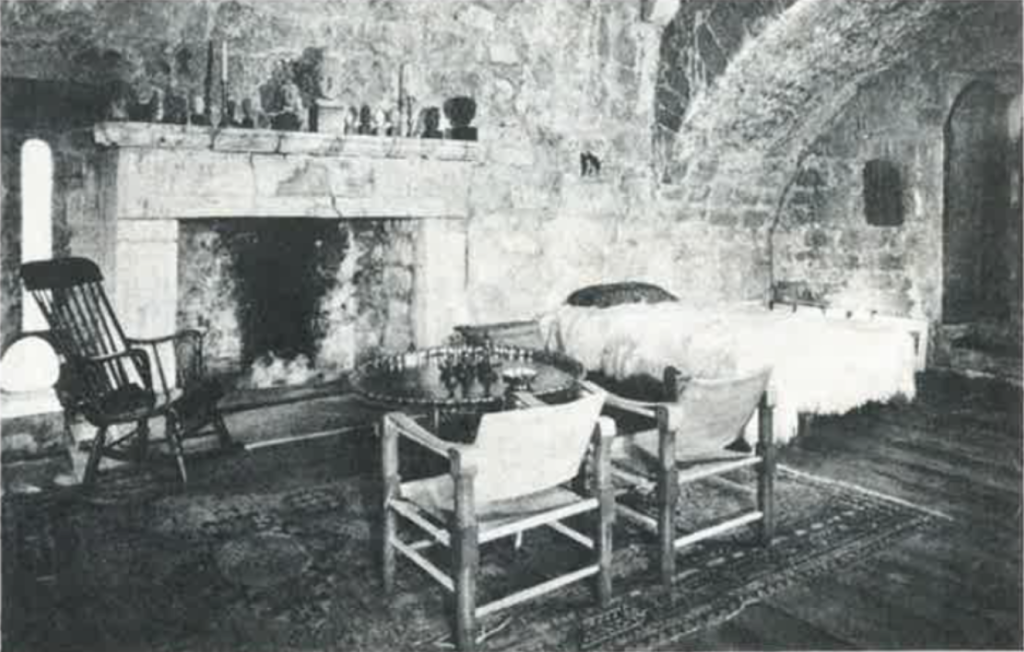
“Bob was a very well-known architect. He designed things like the U.S. Embassy in India and the international airport in Riyad. He liked big buildings. I accused him of having an edifice complex. He found this Norman keep in the Burren and had to have it. He spent ten years doing an absolutely authentic restoration. And since the title passed on with the land, the local genealogist in Corofin decided that Bob was the Eighth Earl of Ballyportry. When I inherited the castle with three others the locals decided that we should share the title. So at least in Corofin I’m entitled to me title. The keep is fourteenth century and probably belonged to the O’Briens. When he bought it in 1950 it was just four walls sticking up to the sky. A herd of wild goats lived in it. It hadn’t been occupied since Elizabethan days but 1o have four walls standing was unusual.”
Brian Brown says the people of Corotin liked his cousin because he was a true eccentric. It didn’t matter that he was not of Irish descent. “I am Irish on my mother’s side,” Brown says, “but Bob believed he was Irish and the people accepted him.” The whole village was involved in the restoration of the keep.
“Bob had a bathtub the size of a swimming pool. It was Lady Gregory’s horse trough from Coole Park. He brought it from Galway and used a hoist to drop it through a hole in the castle wall.”
“There are four levels,” Brown says. “Each has a baronial hall with small bedrooms adjoining it in all. There are two kitchens. Bob put one on the top when he first moved in. Before he put the roof on he actually dropped the appliances in from above. Everything had to be very durable because once you got it in you would never get it out again.”
Aside from the modern kitchens and the water bed from Bloomingdale’s, Brown says that his cousin “took no liberties at all. It’s a true restoration. The architecture is fascinating. The keep is built totally for defense, and the staircases spin up. If you were going up the stairs, trying to get to the top, where the Earl was hiding out, you’d have to hack your way up with your left hand. The defenders had all the advantages. Coming down you can fight right-handed. Of course, we have a ghost, a very benign spirit—if you don’t wake him too early.”
Brian Brown’s children spent summers in the castle.
The youngest, Duncan, was required to wear a hurling helmet and press against the wall while climbing the staircases.
“His first words were “Wall, Wall’,” Brown says.
The castle’s greatest contemporary glory came in 1980 when Richard Burton and company used Ballyportry as the castle in Burton’s penultimate film, Tristan and Iseult.
“I arrived in Ballyportry and my elderly neighbor said, ‘Oh, Brian, you won’t recognize the place. It looks like Duffy’s Circus.’ In Corofin, people were sporting sunglasses. The local bartender said, ‘Everyone’s gone Hollywood.’ People were running up to me, saying, ‘Are you going to the rushes, Brian?’ The last film anyone had seen there was Going My Way, and all of a sudden now, we were going to the rushes.”
But the most dramatic incident of the filming involved not a display of Burton temperament but the escape of the rare falcon imported from Germany who played a role in the film.
“I was sitting on the wall with some of the local farmers,” Brown recalls. “In the middle of this scene, the falcon goes up, and there was a freak lightning storm. The falcon took off and went straight up. Old Tom, who I doubt had ever seen a falcon before, said, “They go up like that and they don’t come down.’ He was right. The bird just disappeared. The film company went crazy! They broadcast on Radio Eireann and put out a reward for the return of the falcon. But they forgot to mention ‘alive.’ And some farmer brings this thing in and lays it down, full of buckshot. He’d shot the falcon dead.”
There was one last disaster. “Iseult was to commit suicide by jumping off the cliffs of Moher. There had been raging storms for weeks, but they just couldn’t put the scene off any longer. We were all over at the cliffs. Kate Mulgrew, who played Iseult, wore this kelly-green cape. She runs toward the cliffs and then they cut. A dummy dressed in her cloak was to be thrown off the cliff. But that day you couldn’t have thrown yourself off the cliffs. The wind was coming up from right off the ocean like a wall. They threw the dummy and we saw the cloak disappear. But the next thing we knew, this dummy came flying back 20 feet in the air with this down-draft! So they loaded the dummy up with rocks and did it again. But the same thing happened. The director, getting furious, said, ‘Weight the thing down!” Finally they stuffed it with every rock they could find and threw it off.
It went down like an anchor.
“I never saw the finished film, but Geraldine Fitzgerald and Cyril Cusack were in it. Paddy Maloney did the music. I heard Brown attempted to tell the story of Ballyportry in a novel. “I called it Bally-beyond, the village beyond which Ireland runs out of land. I worked on this thing for years,” he says. “I carried it around like needlepoint, and I’d add pages and I’d subtract pages. I got to about 100 pages. I kept leaving it in taxicabs. When I was with Time, I’d take it when I’d go to the West Coast or when I’d go to Europe. I was always hauling it around, leaving it in places, and it kept coming back to me. Finally, I decided I just had to go ahead and, if I couldn’t finish it, get it far enough along to see if a publisher would be interested.” Ballyportry seemed the logical place to work on the opus.
“So this one summer (it was in the carly 80’s), I went over to Ireland, and found what I thought was the most creative corner of Ballyportry. I was up in the Elizabethan chamber, and I thought it possible that all the late muses would talk to me up there. But one day I left the windows open and when I came back, all the pages had blown out the window. Iremember feeling totally relieved. It was just the perfect solution. Ireland had claimed this novel, and I was finished with the damn thing. What a perfect ending!”
But maybe that wasn’t the ending. Maybe one night at the Rock and Roll Club or The Triple Inn or even Downtown Beruit the Earl will start telling stories about the Castle and the Ghost and Lady Gregory’s converted bath tub and the day the falcon went straight up. Let’s hope so.
Editor’s Note: This article was originally published in the June 1991 issue of Irish America. ♦
Leave a Reply