
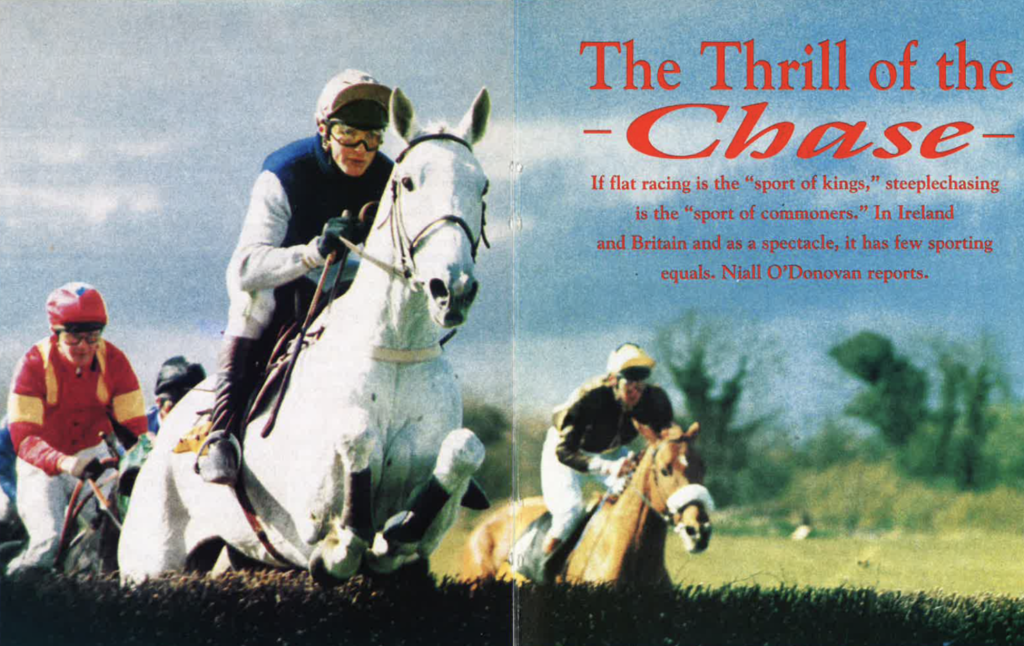
If flat racing is the “sport of kings,” steeplechasing is the “sport of commoners.” In Ireland and Britain and as a spectacle, it has few sporting equals. Niall O’Donovan reports.
Hanafin, Milligan, Mulligan, McManus, O’Mahoney, O’Mara, O’Rourke. Great Irish writers? No, just the lyrical impression that a line of bookmakers made on a visiting English writer to a little country race meeting in Ireland.
You won’t find the Maktoums or the Sangsters, or indeed, any of the international cartel of billionaire racehorse owners at such meetings, much more likely you’ll find the local lads, small trainers, permit holders, and plain people who consider horseracing, first and foremost, still a sport, not a money-making venture.
Read how James Reid in his excellent book Emperors of the Turf (MacMillan 1989) describes the charm of Clonmel races, a little rural track, nestling at the foot of the Comeragh mountains in South Tipperary.
“Five days before the Budweiser Derby there was an extraordinary run-of-the-mill evening meeting down in Clonmel in Vincent O’Brien (famous Irish trainer) country in Tipperary-except that you could never describe something but a few steps from heaven as run of the mill.
“To get to the race track, you first have to walk out through the town, past the pink and blue and yellow-wash walls and doors and old shop fronts of the newsagents, the tailors, the bakers, the bookmakers, the chip shops and the bars. Along the animated streets beside the River Suir, with the bunting strung up between the lampposts for the spring festival, and with the sun shining down between the dark trees.
And out to the racecourse in Powerstown Park… the chairs scrape on the wooden floor, littered with empty Smithwicks bottles and glasses of Guinness. The air is thick with the smoke of Carrolls Majors (cigarettes) and alive with the talk of horses.”
Reid has captured the essence of the Irish racing experience, the umbilical chord between the small rural community and their racecourse, the connection that makes their race days as important to them as the Kentucky Derby is to Lexington.
The Irish take few things scriously, some might argue only two, their religion and their horses, and their love for the latter is proof of the old Irish adage, “What is bred in the bone will out.”
Down the centuries the love affair has flourished. One of the great Irish dirges “Caoineadh Art O’Laoghaire” (The lament for Art O’Leary) tells the tale of a brave Irish chieftain, who was shot for refusing to hand over his gallant steed to a British officer as the law obliged.
The modern sport of steeplechasing was invented in Treland when two horsemen decided on a race from under one church steeple in a small town in Cork to another, jumping obstacles on the way. Out of that was born one of the great sporting spectacles of the modern era.
A variation on that earlier race, called “Point to Point” racing still continues in Ireland and Britain. Many of the obstacles are unorthodox, the jockeys are all amateur, but the purists say it is the undistilled spirit of what is now officially known as national hunt racing.
Paradoxically, to see steeplechasing at its very best, one has to go to England, to the great racing festivals at Cheltenham and Liverpool where the Irish descend in their thousands every year to watch the best steeplechasing and hurdle racing in the world.
At Cheltenham, the big race is the Cheltenham Gold Cup, a race that will be forever immortalized in Irish hearts as the showcase of the legendary Arkle, the Irish equivalent of Secretariat, Kelso and Man O’ War, rolled into one.
When Arkle was racing in the mid ‘sixties, he was so far ahead of his contemporaries that the official handicapper had to invent an entirely new category for him. Thus, when he raced in handicaps, he gave away as much as 42 pounds in weight to his rivals.
But the Gold Cup was at level weights and featured the best steeplechase horses in Ireland and Britain, and Arkle turned it into a procession several years in a row, winning by unheard-of margins each time, before injury prematurely ended his career.
In the first of those years, an English horse, though Irish-bred, called Mill House, was rated on a par with Arkle, and their meeting in the 1965 Gold Cup was the stuff of legend. Dominic Behan, brother of Bren-dan, even wrote a song about the clash, while a film documentary was made about it. Arkle crushed the English challenger and the famous “Irish roar,” as he raced away up the hill to the winning post at Cheltenham, has never been louder.
The Grand National meeting at Liverpool, or more precisely, at Aintree, a race track just outside the Northern English city, is the other great racing festival, where over three days the best in the business clash again.
The Grand National itself is one of the greatest spectacles in all of sport, over four miles and two furlongs, jumping some of the toughest fences in creation.
Many of those same fences have become legendary. Beecher’s Brook (though they have now eliminated the brook), called after a young English rider who tumbled into the brook and almost drowned after his horse fell there; the Chair Fence; Valentine’s Brook; and the Foinavon Fence, which is called after the horse who won the race in 1967, because he was so far behind that he managed to avoid a huge pile-up at the obstacle now named after him.
Every year, the Irish come in their thousands to Aintree. There is even a special Irish bar area set up for meeting and greeting old friends. Irish winners here, though few and far between in recent years, are greeted with the same “Irish roar” as at Cheltenham.
The atmosphere of anticipation before the start of the Grand National is unique to steeplechasing. There is not only the anticipation of victory or defeat, but also the contemplation of clear and present danger, which hurdling over the huge obstacles at breakneck speed will induce.
That is why many of the great horses will never compete in the Grand National; their owners prefer not to risk them. Arkle, for instance, never entered, nor did present-day legend Desert Orchid, a gallant grey who has won his way into the hearts of all steeplechasing fans with his daredevil jumping and gutsy spirit.
Because almost every steeplechase horse is gelded, there is no long-term breeding consideration with the stars of the sport except for the occasional mare who makes it to the top. Unlike their flat counterparts, who usually stay around only two or three seasons before being hustled away to stud, a steeplechaser in Ireland or Britain can last eight or nine season or more, usually starting out as a hurdler, before taking to the steeper fences.
Thus the public’s endearment to a steeplechase star can be of far longer duration.
Desert Orchid is a legitimate star in Britain. Known universally as “Dessic,” he has captured the sporting imagination in a way unseen probably since the great Arkle.
But it is not the big names that make up the life and blood of the sport, rather it is the countless ambitions, hopes and dreams of the smaller fry—like the trainer who firmly believes that in his barn rests the next Arkle.
Or it may be the jockeys, who throw everything into their dice with the tough steeplechase fences over three miles of galloping, often for little or no reward. Or indeed, it may be the small punter, or bettor, who firmly believes he is about to land the biggest bet of his life, by combining the 2.30 race winner at Clonmel, with the 3.00 winner at Hexham in Scotland, the 3.30 winner at Devon in Southern England and the 4.00 winner at Chepstow in Wales.
All the stuff that dreams are made on, but steeplechase racing, being such a game of chance for everyone concerned, allows more dreaming than almost any other sport or business. If an Irishman is “nothing but the sum of his imagination,” as George Bernard Shaw once remarked, it is little wonder that horseracing and, indeed, steeplechasing has remained so popular.
Editor’s Note: This article was originally published in the June 1991 issue of Irish America. ♦
Leave a Reply