
I am in the Mayo town of Ballaghaderreen on a June day, l am here because this town has more pubs, it is said, than any other town in the West of Ireland. For a drinking population of about seven or eight hundred people there are 42 pubs and one hotel, which has a bar, and two off-licences where you can buy takeaway booze.
It is the Court day in the town and one of the cases on the list is against a local publican. The police called at nearly one o’clock in the morning and they found four drinkers still under the publican’s roof. The publican pleads guilty and he is fined fifty Irish pounds. The four men found on the premises are fined half that amount.
The fines have been stiffened recently in this area of illicit trading but there is still a lot of it about. A pint after hours, say wise men, is the sweetest pint of all. The illegal corner of my soul, and my tongue, is driven to agree with them.
There is nothing logical, sensible, or economically sound in having nearly fifty pubs in one small Western town. The publicans’ own conference, recently, said that there were too many pubs in towns like Ballaghaderreen and not enough in the City of Dublin. They said, for example, that there were 11 pubs in the Cavan village of Kilnaleck for a drinking population of less than one hundred.
But then an Irish pub is, in itself, an illogicality. By any sane standards the most popular of them should have been driven out of business long ago. These, almost by definition, are poorly designed, poorly lighted, poorly maintained, with doubtful enough standards of hygiene sometimes, without sufficient space or comfort for drinking, with frequently terrible acoustics, with uneven standards of service. Yet, in any town or city, Irish drinkers may be seen passing well-run, well-maintained and well-serviced pubs to cram themselves, somehow, impossibly, into premises which seem to be unsuitable for anything short of demolition.
If push comes to shove why do we go to pubs at all? A group of friends could buy a few bottles and bring them home to the fireside at infinitely less expense. Pub music sessions, except for pure traditional music sessions, are usually dire.
Anyway few seem to bother to listen. The air is invariably nicotined beyond redemption at the end of the night. There is always at least one drunk. Often enough, nowadays, there is the amazing sight of people in a pub riveted to the T.V. set in the bar which in turn is locked on to the very programme they would have been watching at home. And nobody is talking to anybody else.
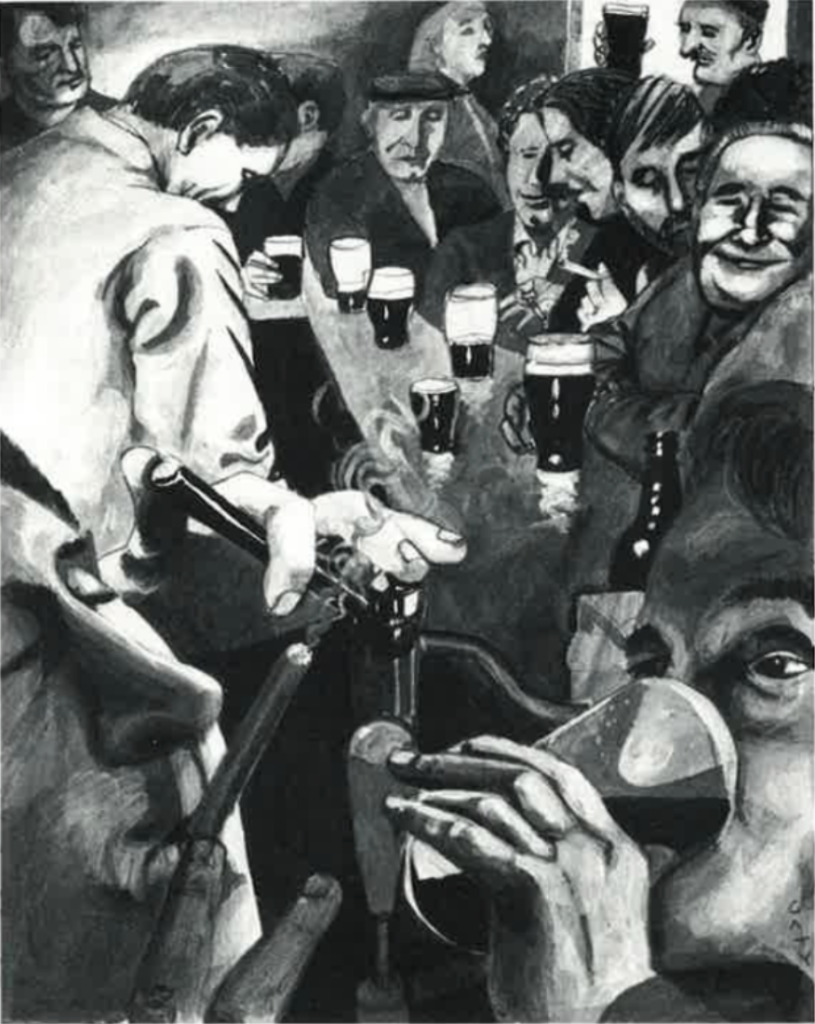
But a pub crawl of a restrained, professional nature in Ballaghaderreen is enough to reinforce one’s faith in the genuine Irish pub. Here, in a town with streets jammed with pubs, the genuine pub lives; the genuine publican; the genuine, slow, hazy settling pint; the genuine drinker.
Not one of the establishments, especially of the older traditional type, but has its own special flavor, its own charm and character. In one pub Pat Sherlock, who is 85 years young, talks to me about the old fairs in the town, the great greyhounds of Gurteen, the set-dancing he saw here on the floor of Regan’s. In another a man talks about the great political rallies, of De Valera drawing thousands of supporters to this town that was the homeland of the Dillons. In yet another, still on politics, a man speaks of the even more ancient political practice of “moaning” at local elections.
Candidates, it seems, paid people to moan and groan loudly in disgust as they passed the homes of opponents. Pub crawling through the bars of this Hidden Ireland, along a single staggering street, I hear ballad and story, rann and song.
There is a penal relic outside the town. It is called the Four Altars. It is constructed so that the hunted priest could say Mass in shelter “No matter from which direction the wind blew.” In the end I think 42 bars is not too many at all, maybe too few indeed, no matter from which point the commercial winds blow.
Editor’s Note: This article was originally published in the July/August 1991 issue of Irish America. ♦
Leave a Reply