
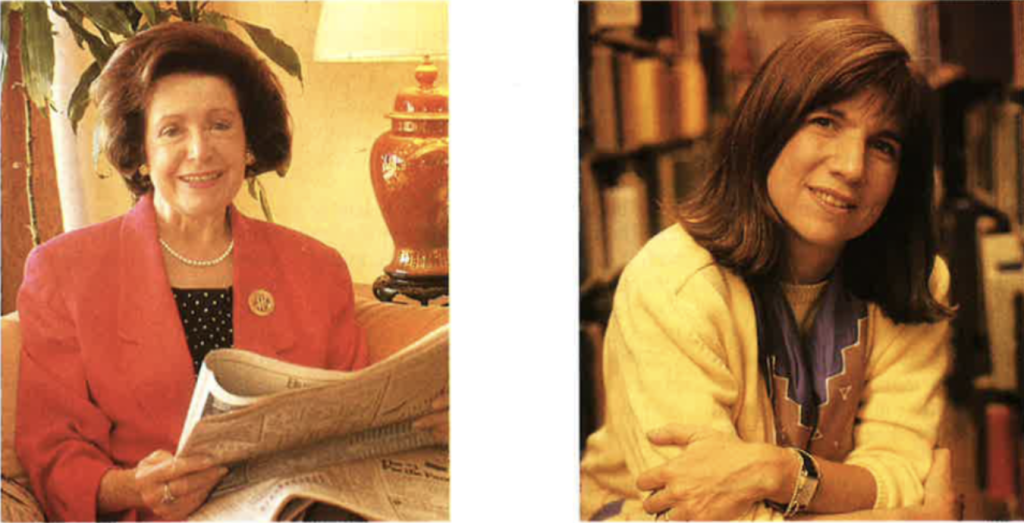
Mary Higgins Clark
Publishing’s favorite adjective is “best selling.” But two authors on June’s New York Times best sellers list had more in common than the success of their books. Both Mary Higgins Clark whose suspense novel Loves Music, Loves to Dance entered the list at number one and Anna Quindlen, whose coming of age story Object Lessons has been climbing steadily, connect strongly to their Irish roots and find inspiration in their heritage. Mary Pat Kelly talked to both of them in New York recently.
Mary Higgins Clark’s $10 million deal with Simon and Schuster a few years ago made publishing history.
As one book after another passed the million mark in sales, the arrangement begins to look like a bargain. Mary Higgins Clark always wrote but it was the untimely death of her husband, Warren, that made selling a necessity. She still belongs to the same writing group she formed over thirty years ago and still reads every new suspense novel aloud to them. She never gives away the ending though.
Mary Higgins Clark: All four of my grandparents were born in Ireland. The Higgins were from Frenchpark in Roscommon.
My grandfather Higgins worked on Lord French’s estate. I took my three oldest children to Ireland in 1963 and we visited the site of the Higgins house. I’ve been there a dozen times since then. And now I have my Irish citizenship.
I have dual citizenship. My father would be rolling with joy in his grave if he saw me carrying an Irish passport.
Irish America: And your parents?
MHC: My mother worked as a department store buyer. She married at 40 and produced three of us. I grew up in the Bronx. It was very rural then. We lived off Pelham Parkway going towards City Island. We used to go sleigh riding where the Einstein Medical Center is now. But we lost our house after my father died. My mother couldn’t keep up the payments, and we ended up in a three-room apartment about ten blocks away. It was over Romano’s Tailor Shop. Once I let the tub run over and flooded the poor man’s kitchen.
IA: How old were you when your dad died?
MHC: Eleven.
IA: Fathers are very important in so many of your novels.
MHC: Yes, I think that when you lose anyone out of time, it makes a great impression. My mother died at 81, and I had a sense of a life span, and life inevitably coming to a close. But when you lose someone out of context, out of time, when it ought not to be, I think that’s what hurts.
Every emotional experience you have contributes to your understanding of relationships, whether the emotional experiences are good or bad. My brother lost a child the baby fell out of the window when it was 15 months old. So I can understand the lost child, which was essential to my book Where Are The Children?
IA: Your books are so frightening because there is a sense of danger intruding on ordinary life.
MHC: Well, it can. That’s what I write about the fragility of life… For example, I’m so sick of hearing about generation gaps. I got along with my first family, I got along with my husband beautifully. I get along with my children. My grandchildren like me. There are millions of people like that. For all the people who are having problems, there are so many who are thoroughly happy with their families. The trouble comes from the outside.
One critic wrote about While My Pretty One Sleeps, “Who would believe that a 27-year-old girl would live with her father and go to church?” But people do. They live together as adults, as friends.
I got a great response to the character of the father, Miles, in While My Pretty One Sleeps. One girl said, “I want to meet Jack Campbell. “He’s the love interest. But her mother said, “Forget it, I want to meet Miles.” I said, “I’m saving him for myself.” He’s the kind of guy that you’d like to have walking in the door, that’s all — a nice, bright, sharp, good looking Irishman with a sense of humor and also that certain cutting edge that makes him interesting.
(At this point the car that would take Mary Higgins Clark to the airport arrived. She has been touring continually since Loves Music, Loves to Dance was published. I remarked at how exhausting this must be.)
MHC: No, I really don’t mind. I started out as a Pan American stewardess. In one way or the other I’m still working a flight. I was 21. I flew to Europe, Africa, and Asia. This was 1949. The war had ended and I was seeing the whole world. They were still cleaning rubble out of London. I was in a revolution in Syria. India had just gotten its freedom, but it was still a colonial empire.
To become a stewardess you had to either be a college graduate or have worked with the public. I had been to secretarial school and worked in advertising.
IA: Did you use your experiences on Pan Am in your writing?
MHC: Absolutely. We flew very small planes, the Constellations, they held 62 people. There was one stewardess with a crew of eight men. At the time they seemed to be lovely little planes… I get in them now and they look like cigars. It’s hard to believe we flew across continents in them.
Of course, you walked across the Atlantic.
It was a 14-hour flight. You would be serving meals and hit such turbulence you’d be hanging on with one hand. Remember that the first flight across the Atlantic was in 1927? This was 22 years later, not that much later.
I flew until I got married, and that’s when I said, “I’ve got to learn how to be a writer.” I was keeping journals from the time I was seven. I was editor of the school paper at St. Francis when I was 12. I was always in hot water with the math teacher, because I was always writing short stories or poetry in her class.
I said, “I’ve just got to learn how to do it right.” Warren, my husband, said, “Sure, go — just don’t break your heart. There are Ph.D.’s trying to publish, and they don’t make it.” And he said, “As long as you think of it as a hobby.” I said, “Let’s see what happens.” So when I started to sell I called his office and said to the secretary, “Would you kindly tell him the writer, Mary Higgins Clark, is on the phone.”
IA: Where did you go to learn?
MHC: Bill Mallary. He was a short story writer who sold a lot to the Saturday Evening Post. He said, “Write what you know.” He told me to write so that an editor would read three paragraphs and say, “’Another Mary Higgins Clark story.’ He said to “put your signature on your stories.” It was wonderful advice.
He said, “Take the most dramatic incident that occurred to you as a stewardess and ask yourself, what if?” I had been on the last flight going to Czechoslovakia before it was closed to Wester planes. We went in with no one on board. The Soviets were having an air show. There were a couple of thousand people at the airport, and they turned from watching all those military formations to wave and cheer for our American plane.
When we landed the terminal was empty except for seven Americans huddled together, the men we had come to pick-up.
There were soldiers all over with guns.
The captain said to me, “Don’t wander around. I’m going to fuel up and get out of here—I don’t like it.” When we left, the people watched us go in total silence. One of our passengers was weeping and he said, “There’s no one in that crowd who wouldn’t give half of the rest of his life to be on this ship.”
I thought, suppose a stewardess goes to the back of the plane and there’s an 18-year-old kid trying to hide. He’s a member of the underground. And they’re searching the airport, coming towards the plane, and he says, “Help me.” She has to decide whether or not to turn him over or try to help him. She knows that even if she succeeds, she’ll lose her job. It’ll be an international incident. ‘Then you throw in a little love interest. Of course, she tries to save the kid, and does. It’s called Stow-away.
When I turned in that story Bill Mallary said, “This is professional, it’s a story that will sell.” It did-six years later. It went out 40 times before it found a home.
Sometimes people say to me, “I’ve been rejected twice so I suppose I’m not a writer.” I say,
“You’ve got it, you’re not.” Because you just can’t give in. You’ve got to keep sending your work out. You don’t sit and wait for it to sell. You start the next book, the next short story, the next screen-play. And then you send the other one out when it comes back. The other thing is to know your market.
IA: Where did Stowaway sell?
MHC: To a Catholic magazine called Extension. I have the letter framed right up on my shelf. I had three kids by then. I was expecting my daughter Carol when we moved to New Jersey, and I sold it about six weeks before she was born. I got $100.
Then Extension bought my second story, which I had called Deadlines In Paradise.
Ellery Queen magazine retitled it Milk Run.
It was reprinted last year and a German magazine bought it for $1,600. 1 got $100 for it 30 years ago.
Then I went onto the family stories, the home stories — the magazines did When The Bough Breaks, The Place In The Family, The Quiet Partner, and Journey Back to Love. I really was selling between ’56 to ’64. And then that was the year my husband Warren died.
IA: Tell me about him.
MHC: I had had a crush on Warren for years. But he was nine years older. He lived on the next block from us in the Bronx. He was kind of the glamor boy of the neighborhood. He had given blood to my brother Joseph who had osteomyelitis.
It was at Christmas time. I remember Warren drove us home and he put up the Christmas tree for us.
I was 12 to his 21. I said to myself, “I’m going to get him. I just hope nobody else gets him before I grow up.” I had my eye on him all those years. He was a load of fun, absolutely a load. When I was 21 I invited him out. Our families knew each other. So I called him up and told him I was going to Pan Am and that I’d been invited out to a farewell dinner at work and I needed to bring someone.
He said, “When?” And I said, “Friday night.” And he said, “Gee, this Friday night?” “I can’t.” I said, “No, a week from Friday.” And he was telling all his friends, “I’m robbing the cradle. I’m taking this kid out.” He proposed that night.
After dinner we went down to the Village to Ernie’s Three Ring Circus. And he started to write names on a paper napkin.
I said, “What’s that?” He said, “The people I’ll have at the wedding.” And that was my proposal. I flew all over the world and then we married and had five children and I began to write. After he died that was how I supported my family.
IA: Writing?
MHC: Yes, for radio. It was also the year that the short story market collapsed.
Women’s Home Companion went under, Collier’s went under, the Post changed its format. There was no market left.
I had subbed for a friend doing four-minute radio programs for $20, but I didn’t want to do it full-time. But I had called her on Saturday, September 26, 1964 and 1 said, “Liz, Warren just came home from the hospital. He’s had a second heart at-tack. He’s never going back to work. I don’t think he has more than two years.” Well, he had ten hours. He died that night.
My friend came out to the funeral. She said that one of the writers was leaving and there was a show available. I said, “I’ll take it if they’ll have me.” I started a week later. I would write spots like these — “He was a tailor from Tennessee who became President of the United States. Do you know who he is?… He was the best dancer in the Colony of Virginia. Do you know who he is? George Washington. ” I wrote that show for nearly three years. After that I wrote one called Driving Time News.
Then I did a fashion show, a food show, a celebrity interview show. It was good experience, but I missed the printed word.
I decided if I wanted to get published I’d have to write a book. And I did one on George Washington, because I had done three shows on him. It was published, but it was remaindered as it came off the press.
But at least it proved I could write a book.
That’s when I said, “Now I want to write something that will sell.”
At this point I had two kids in law school, one in Dartmouth, one in Mount Holyoke, and one in Immaculate Heart Academy. So obviously the pickings were poor. One of the hints I give new writers is to look at your bookshelves and see what you like to read. I looked at mine and they were full with Sherlock Holmes, Agatha Christie, Ngaio Marsh. I thought, “I wonder if I could write like this?” And that was Where Are The Children? came from — and I was on my way.
IA: How long did it take to write that book?
MHC: Three years, because I could only work between five and seven in the morning. Then I had to get the kids up.
And the boys had seven slices of French toast each — they were on the track team.
They ran ten miles every day, so they were always like starving maniacs. Marilyn could never find anything. Carol was asleep with her face in the oatmeal. And Patty always had a stomachache. Then the car pool would pick me up. The other passengers said it was indecent to look in the back seat of the car until we hit the George Washington Bridge, ’cause I was still dressing.
For Where Are The Children? I got $3,000 from Simon and Schuster. Two other publishers had turned it down. They said children in jeopardy might upset their women readers. It is now in its 70th printing. Dell bought the paperback rights for my second book for $100,000. But your hardcover publisher gets half of it, and your agent gets ten percent. So now you’re down to $45,000 which you got over three years. But it was wonderful. It took the choke collar off. It kept me from literally second mortgaging the house. But then for A Stranger is Watching. Simon and Schuster offered $500,000 and Dell a million.
My agent called and said, “Are you sitting down?” And I said, “Yes.” “Well,” she said, “In essence, you’ve made a million dollars.” She said to think about it. I said, “Think about it! Call them right back up and grab it!”
I was going to Fordham at night. I went there that night and never heard any of the classes. I was just writing a million dollars, in roman numerals across the page, with all these little twirls. Driving home that night, I got on the West Side Drive when the muffler and tailpipe fell off. The car had 146,000 miles on it. The next morning I called a friend, and I said, “Agnes, what are you doing?” She said, “I don’t know.” I said, “We’re going car shopping.” And I bought a Cadillac.
And that was the beginning.
The others have all done very well. Loves Music, Loves To Dance is the ninth suspense – the tenth book – if you count George Washington. And I’m working on the eleventh now.
IA: Where do your stories come from?
MHC: I take something that happens. I heard an FBI agent lecture to a Crime Writers Convention. He showed pictures of seven sweet young women before they were shot. Their mouths were taped, their hands were bound, their eyes terrified.
And their common denominator was they had all answered the same personal ad.
It just walked through my head, “loves music, loves to dance.” And I started studying. I didn’t answer any ads, but I talked to people who had answered them. And I was getting the letters that people were getting.
I studied serial Killers, how they operate. I read their interviews to get a feeling of them, the coldness, and how they often talk about themselves in the third person, or how they will use another name.
IA: What would you say about your women characters?
MHC: They’re strong. They are often self-made. They are intelligent. They are the main viewpoint character, even though I use multiple viewpoints. And they always solve their own problems, even if in the end they get a little help.
(The final boarding call was sounded. Mary Higgins Clark told me about her children.)
MHC: Marilyn is a judge, Warren is an attorney and a municipal prosecutor, David is the president of Celebrity Radio. Patty’s on Wall Street. Carol is an actress and writer who has her own suspense novel coming out in the fall.
She waved and was off, working the flight… a woman whose verve cannot be contained by any one of her damsels in distress.
Anna Quindlen
Anna Quindlen whose op-ed column appears twice weekly in The New York Times and is syndicated in other papers has turned her remarkable talents to fiction in her first book Object Lessons, a tale about the Scanlans, a large Irish-Italian family in the late 1960s. Just before publication Anna Quindlen’s husband wondered out loud, “Does Random House think many people will buy this book?” Many people have. The story of Maggie Scanlan’s 13th summer is currently on the New York Times best seller list.
Mary Pat Kelly spoke to Quindlen at her New York Times office.
Irish America: Do you have much connection with the Irish tradition?
Anna Quindlen: Do I! In my family you can’t just say, I’m Anna Quindlen. It’s very, very important to say. “I’m Anna Quindlen. I’m Irish.”
My father is doing a whole family history now. We came over, it looks like, in the early 1800s. My great-great-grandfather fought in the Civil War. I mean, we’re a very entrenched American family. But a very strongly Irish family.
IA: Do you know where the Quindlens come from?
AQ: The area around Dublin.
IA: And your father’s mother?
AQ: My father’s mother, Kitty O’Donnell, was second-generation—her family had just come over. She’s from a very large family and was born after her father was already dead. So I don’t think she knew that much about family history.
My grandfather, obviously, was a Quindilen. And my husband’s last name is of some unknown Slavic derivation, but his mother is a Daugherty and his grandmother is a Boland. My grandmother worked our wedding reception, saying to everybody, “Don’t worry, he’s mostly Irish.” Just in case anybody was saying, “Oh, she married a non-Irish person and blackened the family name!”
IA: What about your mother? How did she handle all this Irishness?
AQ: Well, my mother was the daughter-in-law who was not Irish. All the rest of my father’s brothers are married to Rileys and Kellys and so on and I think it was a little bit of a shock to their system, but it wasn’t anything like what’s in the book.
IA: Does Object Lessons reflect your own experience? Is Kenwood analogous to how you grew up?
AQ: I did grow up in an old suburb of Philadelphia, in a neighborhood that was mainly populated by second- or third-generation Irish Americans. My father is Irish, and my mother was Italian. But none of the people conform directly to any real people, and none of the situations conform to anything that ever actually happened to me.
IA: Did you decide to change the location to New York for a particular reason?
AQ: Even though I grew up in a suburb of Philadelphia, New York was the place that I knew best. Also, because I knew that everyone was going to assume that this was the story of my life I figured in those ways in which it was easy for me to deviate, I might as well do it.
IA: The structure of the Italian and the Irish families are very interesting. Can you talk a little about what distinguishes the two groups?
AQ: Well, I think the Italian family in this story is very vivid and true-to-life, and contrary to stereotypes. They are not these happy, wonderful, family-oriented people eating red sauce every Sunday night. They are taciturn, self-contained, very introverted and almost hostile to the outside world. For every ethnic stereotype, you have your ethnic counter-stereotype. For every perception of the Irish as ineffectual, you have a man like John Scanlan who never lets alcohol or anything else affect him, and who is about as effectual as a man can be.
Ethnicity is two-edged. On the one hand, it’s incredibly embracing. On the other hand, it’s totally suffocating. It’s the family that’s there for you every Sunday afternoon, and it’s the family that wants to decide how you’re going to live. And I think so many of our most pervasive institutions are like that — a double-edged sword. You have to take the smothering with the enveloping.
That’s John Scanlan’s great genius, he tries to make you do the things that you dreamed of — sending your kids to private school or having a big, beautiful, new house. Except that since he engineers them, they always come with strings attached, and the strings are powerful.
IA: What does John Scanlan see in Maggie and what does he want?
AQ: He sees what he could have been if he hadn’t been poisoned and controlled by fear of poverty. Maggie is a lot like John Scanlan. She is incisive and smart and a very directed person. But she doesn’t have to claw her way to the top to get out of the tenement milieu that John is from and remembers so indelibly. There’s that moment when he’s lying back in the hospital bed and thinking of all the guys he knew in the tenements who didn’t make anything of themselves. And the book says, “And then he began to work like a man possessed, as indeed he always had been.”
Maggie is not possessed the way that he is. So I think that, as opposed to anybody else in the book, except maybe for his daughter, Margaret, the nun, who has managed to elude him in some way, that John has respect for Maggie. I think that comes through in their relationship. He tries to dictate to everybody else. He tries to teach her.
IA: That’s a very good distinction. I thought it was interesting that the conservative Catholicism that he represents….
AQ: But see, he doesn’t represent conservative Catholicism. The great fallacy about those guys, was that this was their life belief. When it really was their life boundaries. It was the ultimate cultural Catholicism because it was a way for things to remain the same. It was a way to give shape to the world. This is not about religion; it’s about a way of life. And of course, when the Church starts to crumble and these extended families start to move apart—the whole way of life starts to change, and that’s what’s causing him so much pain.
IA: Do you see it [the church] as crumbling?
AQ: I think it came apart and had to be put back together again. People are going back, but it’s the Church on their own terms. It’s the extended family and the close-knit neighborhood on their own terms. And it’s never again going to be the way it was.
IA: Do you think that there is as much analysis of every single moment in the Italian family as there is in the Irish family?
AQ: No. There is a very much “what-you-see-is-what-you get” aspect to life in Italian households that’s not at all true in Irish households.
Again, every time I make a blanket generalization like this, I think that the opposite is true, too. But some of that is the is the gender roles. Irish fathers are full of bluster but Irish mothers basically run things. And while there is this Italian tradition of matriarchy, it’s much more “your mother is on a pedestal, isn’t she?
And tell her that the next time she comes out of the kitchen….
My mother used to say to me, “I don’t have any strong opinions about what kind of man you should marry, except don’t marry an Italian man. Because you’ll have to wait on him hand and foot for your whole life.” Today I would say to her, “Mommy, why are Italian men different from German or Irish or Polish men?” But in a way, I understand what she meant. I understand about the culture of the prince–the elevation of the son— which I saw in a lot of the Italian households when I was growing up. I don’t find it as clearly in the Irish family, although there are still traditions– the boys get to go to college, the girls don’t – that kind of thing that we’ve finally shaken off at the fourth or fifth generation juncture.
IA: Do you think there’s an element that you almost have to be an outsider on some level to be a writer?
AQ: Maybe. Obviously, I’ve made a profession of being the observer.
IA: How did that start with you?
AQ: I just was looking for a way to earn a living while I wrote fiction. And so I became a newspaper reporter. But then, once I got into it, I found out how much I loved it. I’m 38 now. And I started working in newspapers actually right out of high school. I was a copy girl at a paper in New Jersey called The New Brunswick Home News. I parlayed that into a job at The New York Post while I was still in college, then I worked for the Post for two years out of college. My city editor came over here as an editor so eventually he persuaded them to hire me. And I’ve worked here at the New York Times since 1977.
IA: How did “Life in the 30’s” start?
AQ: I started doing a column called “About New York.” I did that for almost three years. Then I was Deputy Metropolitan Editor for about two and a half years, during which time I had one baby, got pregnant again and when I had the second, I just thought two little kids under the age of two and a full-time job was not going to be do-able. So I quit the paper, but then Abe Rosenthal came up with this idea of “Life in the 30s,” and that’s how I wound up doing that. And during most of the time that I was writing “Life in the 30’s,” I was working on Object Lessons.
IA: Were there any Irish writers that you sparked to when you were studying literature?
AQ: Actually, most of the writers that have had the most indelible effect on me are English writers of the Nineteenth Century. Jane Austen, Dickens, George Eliot. But the Irish writer who has had the greatest effect on me, and still does, is Yeats. I am just an enormous Yeats fan, and he has really affected my work a lot, just in terms of not being afraid of passion.
People ask me all the time is there anybody in my family who’s a writer. And the literal answer is no. But the figurative answer is yes, because I come from one of those stereotypical Irish families of great raconteurs who don’t just tell stories— they act stories. I mean, the meter is there, the rhythm, the accents if need be that kind of thing. I think I learned some of that from Yeats, but a lot of it from them.
It does my heart so good to read fiction by Mary Gordon-fiction about families and ethnicity and religion and about what’s going on in our heart of hearts.
IA: Does ethnic identity get passed down, even if the traditions aren’t there?
AQ: In the book, James wants to join the Episcopal country club and sort of wants to be Waspy. But actually, the family don’t really want to be Waspy. They want to be the Irish ideal of Waspy —they want to be Grace Kelly. But the fact of the matter is (it’s a little like Catholicism in this way) there is certain stuff that you can’t lose. I won’t say it’s bred in the bone, but it’s imprinted so clearly on.
IA: What kinds of things?
AQ: Well, I can affect Waspiness all I want, although I don’t do a hell of a good job at it. But I mean, I’m going to be a gregarious, extroverted person until the day I die. A lot of that comes from being Irish.
I’m also going to be a gregarious person who you might afterwards feel like you sort of got to know on a surface level, but that there was a black pool beneath that you’re never going to get to touch. That comes from being Irish. There are things like that that I just think come with the territory, and that your parents hand down not as part of being Irish but as part of who they are.
But the great thing is my kids have an Irish sitter, Elaine, who comes from Mayo.
So we do a lot of talking about where she comes from. Because now they’ve got this really polyglot ethnic history. And we point out places on the map and that sort of thing.
We talked a lot about St. Patrick’s Day this year, in a variety of ways, because I have a lot of negative feelings about St. Patrick’s Day. It has a little bit too much to do, in my experience, with drinking, and if the Irish want to show that “drink as the curse of the Irish is a stereotype!” they should stop reinforcing it every March 17!
IA: Have you visited Ireland or have they?
AQ: No. But we will with the kids. My grandparents used to go a lot. All our house is lousy with Waterford crystal!
IA: About the column. How does it work on a day-to-day basis?
AQ: Nobody knows what I’m going to write about before I do it and nobody reads it before it goes in except for the copy editor who just makes sure it fits.
IA: Is that unusual?
AQ: It’s not unusual for Op-Ed Page columnists. That’s always been the standard. But it’s unusual in the newspaper business by a long shot. I was stunned when I first got the job to find out how much independence we had. I’ve been an editor and a reporter and I knew that things got run around the block before they finally appeared in the paper, and that a fair number of editors knew about them all the time. Even when I was doing “Life in the 30’s” certainly the Style Section editor always knew what I was writing about when my column came in.
IA: What about women in the newspaper business?
AQ: The business is getting better all the time-like a lot of businesses except that it’s better than a lot of businesses because it started out with more women in it. Not a whole lot more but you know when you go through the history of New York’s great institutions at the turn of the century and find no women in the top law firms. No women in the top hospitals as doctors. No women in the City Council.
No women, obviously, as mayors.
You start seeing women in the newspaper business pretty early on — one or two of them. So we were a little bit ahead at that time. Historically it’s been so low caste that to give up a piece of the action to women was not the big thing it might be as to give up a piece of the action at a Wall Street brokerage firm or something.
Ditto, to give up a piece of the action to Irish immigrants or Italian immigrants or African-Americans or Latinos, as opposed to other institutions. This is one of the first places where a lot of Irish boys found a home as copy boys and then as reporters, as opposed to the more stuff and nonsense businesses where it took a long time before those “Irish need not apply signs” came down —at least in people’s minds.
And we’re nowhere near where we’re going to be some day, but we’re still in there plugging.
IA: What effect does motherhood have on a career?
AQ: I couldn’t have written this book before I had kids. I could have understood the broad or predictable emotions that you have about your children, but not the subtler and more problematic ones. Like the idea that as they grow more into themselves there is a kind of a pain of losing the ideal child as well as that wonderful acceptance that this is a totally distinct human being in all the ways that matter. I just wouldn’t have gotten that. I wouldn’t have gotten the difficulty in the relationship between Maggie and Connie. I just don’t think I would have gotten a lot of the emotional content of this book before I had my kids.
IA: Another character I loved in the book was the cousin Celeste.
AQ: I loved Celeste. Celeste was so easy and every time you put her on the page it just came alive.
IA: She was fantastic. Except I wanted her to end up with Joey.
AQ: No-no-no-no. That would never happen. No. Celeste will have a pretty happy marriage with Sol. She’ll have her pool and she’ll move to Florida in a little while… Celeste is one of those people who takes for granted that there aren’t going to be any happy endings and so the best you can do is to have on a great outfit and get flowers on Valentine’s Day. She’s really a realist, a hard-core realist in the way some of the Italian women I’ve known are.
IA: I thought it was great when you said it was hormones and nausea that kept the mother Connie from having an affair. I think it acknowledges how strong that sexual attraction can be.
AQ: But my husband re-read the book and he said, “There’s a lot of throwing up in this book! It’s sort of a woman equivalent of a whole book about jock itch.” And I said, “Oh yeah? Reread Portnoy’s Complaint, buster. That is a whole book about jock itch of one kind or another.” I wasn’t sort of conscious of it at the time. But later I said, gee, there is a lot of throwing up in here. But since we’re in the first trimester during the course of the book, there is a lot of it.
And he said, in deathless words which we are now quoting to one another, “People at Random House really don’t think a whole lot of people are going to buy this, do they?”
IA: How is it doing?
AQ: It was on the Best Seller List yesterday. We just went back for a fourth printing.
IA: Are you doing a lot of touring?
AQ: I just finished. It’s always fun to meet print reporters in other parts of the country because they’re my co-workers.
But it does get really intense after a while.
And having to travel is real hard on me because of the kids.
They really hate it. When I had to go away I tried to explain to them that it was really important to sell the book. That it was something that was really important to me and I had to do this for me. And Quinn was crying and finally he said, “But why can’t we sell it out front?” And I realized that he thought that I was going to these different cities and sitting behind a counter and going, “That will be nineteen dollars.” So I tried to explain it to him more but I still think it’s kind of a hard concept to get.
IA: Is there something you want to say to the readers of Irish America?
AQ: I’m very proud to be Irish. People say to me all the time, “Quindlen, what kind of a name is that?” And I want to say, “Oh, come on! You know, being Irish really is a big part of my life, even when I am placed in a position—as I was when I wrote my St. Patrick’s Day column of criticizing how some Irish Americans celebrate the day.
But you know, better to be inside the tent looking out than outside the tent looking in, as Lyndon Johnson once said.
IA: If it can’t come from people within then what’s the point?
AQ: But it can’t. You know it can’t!
Some gentleman called the New York Times the day that they ran that St. Patrick’s Day column and said, “I’m glad Anna Quindlen’s grandfather is dead, because she would have killed him with this today.”
Editor’s Note: This article was originally published in the July/August 1991 issue of Irish America. ♦
Leave a Reply