
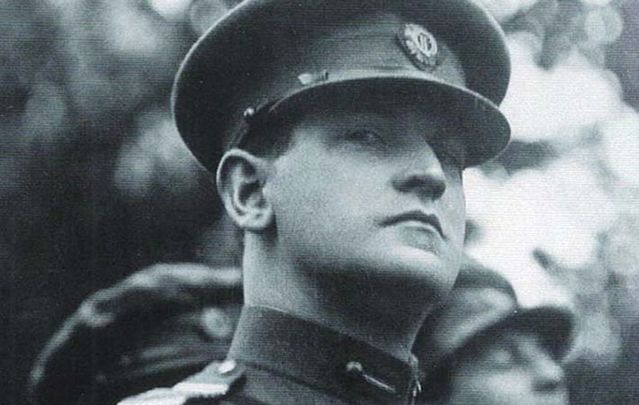
In the Shadow of Michael Collins is an interesting review of the fatal ambush at Béal na Bláth, where the famous Cork rebel was slain. The 1922 shooting has aroused as much controversy among Irish historians as does the 1963 assassination of J.F. Kennedy in Dallas among their American counterparts.
Although the film begins with the assassination, it soon reverts to the life story of its subject. Born the youngest of eight children in West Cork, Collins emigrated as a teenager to work in London. He returned to Ireland after the outbreak of World War I and joined the secret Irish Republican Brotherhood. It was with the I.R.B. that he became involved in plans for the 1916 Easter Rising. During the Rising he served as a captain in the General Post Office (main site of the fighting) and also as an aide to Joseph Plunkett, one of the signatories to the Proclamation of the Republic.
When the Rising was quashed, Collins spent time in British jails (Stafford and Frongoch) but was released as part of the December, 1916 general amnesty. Like thousands of others, upon arrival back in Ireland, he renewed his connections with the republican movement and was actively involved during the 1918-’22 War of Independence. As part of Sinn Fein’s general election sweep in 1918, Collins was elected in South Cork and was duly appointed as Minister for Finance in the renegade Irish parliament, just established in Dublin. Within the Irish Volunteers, he was adjutant-general and director of intelligence.
One of Collins’ best known trademarks was a semi-military division called ‘The Squad,’ which included his personal guard of 12 men, dubbed “The Twelve Apostles.” It was the same 12 men who assassinated a number of British spies living in private quarters in and around Dublin on November 21, 1920, a day that would become known as “Bloody Sunday.” In one of the most imaginative and original segments in BéalnaBlath, the documentary takes one of the surviving apostles, Vinnic Byrne, back to the house where Byrne assassinated two of the British spies.
Prior to the documentary, Byrne had not revisited the house. Now an old man, Byrne explains what happened. Connolly, the narrator, takes the role of one of the British spies, with his arms against the basement wall. “You two men have been sentenced to death and I am here to carry out that sentence,” says Byrne dispassionately.
“May the Lord have mercy on your souls.” It is a remarkable segment in the film, placed in context with archival footage from the troubled days of the War of Independence.
As a reprisal, British soldiers went to Croke Park during a Gaelic football match between Dublin and Tipperary and fired on the crowd and players, killing 12 people and injuring 70.
Although wanted by the British since a brief arrest in Granard, County Longford in 1918, Collins eluded capture several times and masterminded a highly developed intelligence network in Dublin, which outmaneuvered the British administration in Dublin Castle. Interviews, mostly archival, with some of his sources are included in BéalnaBláth.
A bounty of £10,000 was put on his head and Colonel Ormond Winter, known as “The Holy Terror,” was sent over to Dublin from London in 1920 to put their intelligence operation back on track. Winter’s group later became known as “The Cairo Gang,” mainly because they used to congregate at the Cairo restaurant in the city.
BéalnaBláth highlights the growing tension of the age, particularly with footage of the huge attendance at the funeral of Terence McSwiney, who died after going on a hunger strike in an English jail.
Collins remained very active during the War of Independence and when a ceasefire was called, he was sent to London in 1921 as a member of the Treaty talks. Collins, a military man rather than a politician, was reluctant to go but in his capacity as Minister for Finance, he travelled with Arthur Griffith and other cabinet members to face Lloyd George and the British government.
According to BéalnaBláth, Collins was in a quandary over the negotiations as much as he was lovesick for Kitty Kiernan, his Granard-born sweetheart. Although the language of the film – “Collins was waging another battle” – is clumsy and melodramatic, the documentary backs up its story well with accounts from letters between the two.
The talks gave birth to the 1922 Anglo-Irish Treaty, partition and, as we are sorely familiar, civil war. Collins was one of the signatories to the Treaty, regarding it as a stepping stone to unification.
However, he greatly feared its consequence. Collins and Kiernan never married and in the gradual escalation of civil war over the Treaty, it was almost inevitable that Collins would be a casualty of the tragedy.
In addition to his military ability, what added to Collins’ mythical aura was that his death at Beal na Bláth was never fully investigated. Following allegations of a cover-up, there has been- and is- widespread confusion as to whether he was shot by Irregulars (anti-Treaty IRA rebels) or by his own Free State troops because he was reportedly on the verge of brokering a ceasefire with the Irregulars.
BéalnaBláth deals very effectively with the shooting. Using a dramatization of events, the film re-enacts what happened in the hours before the ambush. Original weapons are used as well as Collins’ original armored car, “Slivenamon.” The video runs for almost two hours and there is so much to tell, it could go on for much longer. Although the pace of the film sometimes wanes, Michael Collins is a fascinating subject for any documentary. Despite an unconvincing conclusion- the naming of the man who shot Collins- Béal na Bláth- In the Shadow of Michael Collins is a provocative film well worth a look.
Editor’s Note: This article was originally published in the September 1991 issue of Irish America. ♦
Leave a Reply