
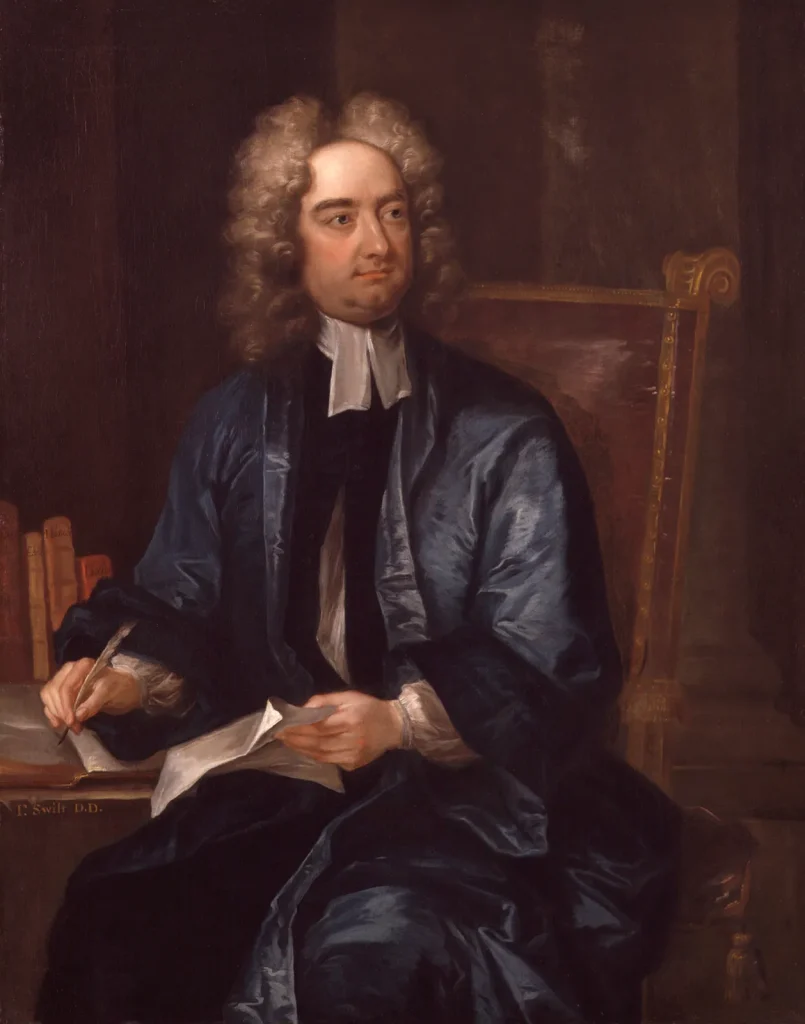
When Wolfe Tone examined the situation of his country in the 1790s, he made what for him was “a great discovery, though I might have found it in Swift and Molyneux, that the influence of England was the radical vice of our government, and consequently that Ireland would never be either free, prosperous, or happy until she was independent, and that independence was unattainable whilst the connection with England existed.” It surprises admirers of Dean Swift’s writings to find him listed as a progenitor of Irish nationalism. It would have surprised the Dean of St Patrick’s himself, for he despised the Irish-the Ulster Presbyterians even more than the Catholic natives. The first he considered bigots, the second slaves. Swift’s birth in Dublin in 1667 was an “accident,” he said. His father, also named Jonathan, a free-born Englishman, died before his son was born. An uncle financed young Jonathan’s education at Kilkenny School, which the playwright William Congreve also attended, and Trinity College, Dublin, where “he too much neglected his academic studies,” he confessed, and was admitted to a degree with little credit to himself.
He fled to England in 1689 during the Jacobite war to become personal secretary to Sir William Temple, a retired diplomat and man of letters, who in 1668 wrote An Essay on the Present State and Settlement of Ireland-a topic for the ages, apparently.
In 1692 he returned to Dublin and a couple of years later was ordained a priest of the Church of Ireland. His first living was Kilroot, a Presbyterian parish near Belfast.
“If I love Ireland better than I did, it is because we are nearer related, for I am deeply allied to its poverty,” he wrote John Temple, nephew of Sir William. He proposed to a young woman who did not bother to reply. He left the North and became Vicar of Laracor in County Meath which had the advantage of being only twenty miles from Dublin.
He was writing A Meditation on a Broomstick and Thoughts on Various Subjects-the latter best remembered now because it carries this nugget of wisdom: “We have just religion enough to make us hate, but not enough to make us love one another.”
In January 1707 the union of Scotland and England was proposed; it was consummated in May. Swift wrote Answer to the Injured Lady, decrying the union and the Scots, who, of course, were to be distrusted because of their Presbyterianism.
“It is his first piece of patriotic writing in which English colonialism is criticized,” Joseph McMinn, the author of Jonathan Swift, A Literary Life, and a lecturer in the English department of the University of Ulster, points out. “Much later on in his career, as Dean and Drapier, he would use identical arguments and proposals….”
That is the part of Swift’s career in which he picks up the argument of William Molyneux, member of the Irish Parliament for Trinity College, who first posed the Irish Question in 1698.
He rejected the claim of the English Parliament to make laws for Ireland. His pamphlet, The Case of Ireland’s Being Bound by Acts of Parliament in England, declared that only laws passed by the Irish Parliament were binding on Ireland. Molyneux’s argument is the thread in Swift’s Drapier’s Letters, which were published anonymously in 1724.
Although he called himself “an old-fashioned Whig,” Swift had passed some years in London as an influential journalist writing Tory propaganda for the press and political pamphlets. These did not appear under his name. He expected to be rewarded with a bishopric, but when Queen Anne’s reign ended in 1714, Swift’s patrons lost office and their liberty as well, and he returned to Dublin where, with the help of the Duke of Ormond, he became Dean of St. Patrick’s Cathedral.
Swift believed himself an exile in Dublin, yet his best work lay ahead. Despite such great satires as A Tale of a Tub and Gulliver’s Travels, Swift’s writings would have little significance for Ireland, a country he associated “with backwardness and barbarism,” according to the author, without the Irish tracts he wrote and published in the decade of the 1720s.
In March 1720, the English Parliament passed the Declaratory Act “for the better securing the Dependency of Ireland,” to which Swift responded,”…the Question is whether the people ought to be Slaves or no.” In May he published A Proposal for the Universal Use of Irish Manufacture, which exposed England’s colonial treatment of Ireland’s trade and commerce.
He recalled the observation that “Ireland would never be happy ’till a law were made for burning every thing that came from England, except their people and their coals.” He wrote: “I must confess, that as to the former, I should not be sorry if they would stay at home; and for the latter, I hope, in a little time, we shall have no occasion for them.”
The pamphlet was denounced as “false, scandalous and seditious” by the grand juries of Dublin city and county; the printer was arrested and put on trial. When the jury would not convict, the judge nevertheless kept the printer in prison.
In the 1720 Proposal, Swift said of Ireland: “Whoever travels this country, and observes the face of nature, or the faces, and habits, and dwellings of the natives, will hardly think himself in a land where either law, religion, or common humanity is professed.”
As this book reveals, Swift knew Ireland well, for he travelled the four provinces in 1722-23 to observe the face of nature and the faces of the people. He was back in Dublin in time to stir controversy over Wood’s Halfpence, coinage imposed on Ireland by an Englishman with a royal patent. Swift published seven pamphlets against Mr. Wood and his backers over eighteen months, using the pseudonym, M.B. Drapier. One letter above all, addressed “To the Whole People of Ireland,” the author writes, “confirmed the Drapier as Ireland’s patriotic hero.”
Mr. McMinn is engaged in literary criticism, not in political analysis. He sets the scene well, but one expects more.
The phrase “the whole people of Ireland” referred to the Protestant colonists only–or, as the Drapier would have it, “the true English people of Ireland.” He told them: “The remedy is wholly in your own hands… by the laws of GOD, of NATURE, of NATIONS, and of your own COUNTRY, you ARE and OUGHT to be as FREE a people as your brethren in England.” This was a call to repudiate the Declaratory Act which Henry Grattan nullified a half century later. His victory was temporary because “the savage old Irish” as Swift called the natives, were not admitted to the constitution.
They understood the significance of Swift’s message, but lacked the power to act upon it.
Swift identified the Anglo-Irish constitutional issue when he said he could find no English or Irish statute “that makes Ireland depend on England, any more than England does upon Ireland.” The book’s weakness is that it touches only marginally-apart from Wood’s Halfpence on the politics of Swift’s Irish tracts. It states, but not as an example of political realism, For in reason, all government without the consent of the governed, is the very definition of slavery: But in fact, eleven men well armed, will certainly subdue one single man in his shirt.” The natives understood the truth of this far better than the colonists: no government sought their consent. They were a conquered people ruled by force.
In the matter of Wood’s Halfpence, Swift was victorious: the patent was withdrawn after a final letter from the Drapier.
The letter was declared “seditious” and a reward of three hundred pounds was offered for information on the author.
There were no claimants. In April 1725 the Councillors of Dublin conferred the Freedom of the City on the Dean of St. Patrick’s. Swift said of his English satires, such as Gulliver’s Travels, that “to expose vice and make people laugh with innocency does more publick service than all the ministers of state from Adam to Walpole.”
The author comments accurately: “It is noteworthy that he never expressed any comparable faith in his Irish writings: England was corrupt but not a hopeless case.
Abuses in the English political system could be exposed, opposed, even corrected by a literature committed to the public welfare. If the writer on English affairs might be viewed as a literary surgeon, his Irish counterpart could be seen only as a pathologist.
Ireland was indeed a hopeless case perhaps it is still a hopeless case. (Is it any more necessary for England to continue to make laws for Ireland than it was in Swift’s time?) There is nothing humorous about A Modest Proposal or A Short View of the State of Ireland. Mr. McMinn hurries past both with a minimum of explanation. They deserve more space.
“This series aims to demonstrate how an understanding of writers’ careers can promote, for students and general readers alike, a more informed historical reading of their works,” its sponsors say. The goal is worthy although the price is steep. And on the whole Jonathan Swift, A Literary Life, reaches that goal.
Editor’s Note: This article was originally published in the September 1991 issue of Irish America. ♦
Leave a Reply