
Celebrating the Celtic New Year
The eve of November 1, the most important feast in the Celtic year, marks both the beginning of the New Year and the beginning of winter.
According to ancient Celtic thought, all existence arises out of the interplay between darkness and light, night and day, cold and heat, death and life, and the unfolding of the years is seen as an alternation between dark periods (giamos, winter) and light periods (samos, summer). But, in the Celtic view, darkness comes before light, night gives birth to day, summer grows out of winter; so the year begins with winter, the dark half. A Celtic calendar from Coligny (eastern France), dating back to the first century A.D., refers to a festival called the Trinoux Samonia (“Three Nights of the End of Summer”) which is undoubtedly at the origin of the many rituals and observances recorded throughout Celtic history in association with November Eve – and still to some extent, alive today in the Christianized context of All Hallow’s Eve or Hallowe’en.
In the modern Celtic world, the Gaelic languages (Irish, Scottish, Manx) still refer to the New Year as Samhain, “Summer’s End.” In Welsh the same feast is called Calan Gaeaf (corresponding to Calan Gwaf in Cornish and Kala-Goan in Breton), meaning “First Day of Winter.” But everywhere the traditions related to the celebration of the feast are similar, pointing to their origin in the common Celtic heritage.
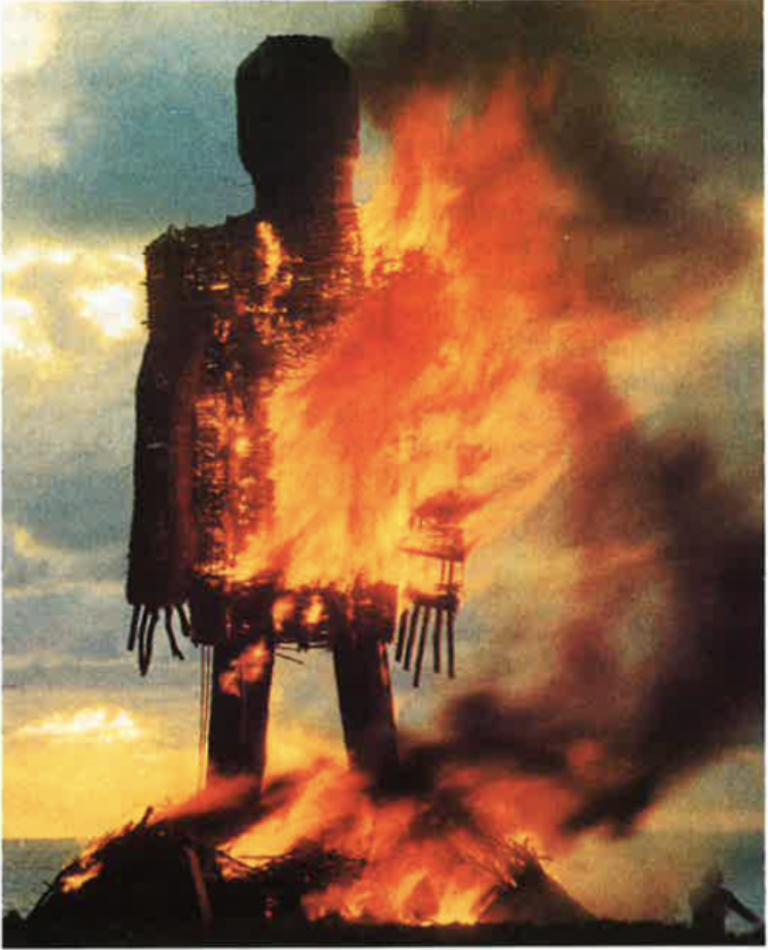
A bonfire served as the focal point for the festivities. All household fires were extinguished and then solemnly relit from this one central fire,blessed by the Druids. In the earliest days animals, and possibly human beings, were sacrificed to ensure that the spark of fertility within the earth would not vanish during the coming dark time.
The most important aspect of the Celtic New Year, however, was the interruption of the time-stream which was perceived to occur then, allowing communication between this world and the Otherworld.
The dead could return to the places where they had lived, and, as a result, many of the New Year rituals focused on the need to provide hospitality for dead ancestors. Food for the dead was put out ceremonially, either indoors or outdoors.
Gates and windows were left unlocked to give the dead free passage. Together with the spirits of dead humans, swarms of fairy beings poured into our world on November Eve, and could be invoked by witches working spells on that night.
Not all of these creatures were friendly: Jack-o’-lanterns were carved out of turnips to simulate spirit-guardians, and were placed at the doors of houses to keep out unwelcomed visitors from the Otherworld.
There was also a much lighter side to the New Year rituals.
Young people would put on strange disguises and roam about the countryside, pretending to be the returning dead or creatures of the Otherworld.
The break in reality which occurred on November Eve was felt to not only provide links between the worlds but to dissolve the structures of society for the duration of the night. Boys and girls would put on each other’s clothes, and would generally flout convention by boisterous behavior and by playing tricks on their elders and social betters.
Divination concerning events of the coming year was another prominent feature of the holiday, and often involved hazelnuts, symbols of wisdom.
Bobbing for apples, also a traditional Celtic New Year pastime, was a reference to the “Paradise of Apples” (Emhain Abhlach or Afallon) where the dead, having eaten of the sacred fruit, enjoyed a blissful immortality.
Behind all these customs and beliefs one can discern a myth expressing the central meaning of the feast. A winter-god and a summer-god (or winter and summer aspects of the same god) compete for the favors of the Goddess of the Land. On May 1, the summer-god is victorious, but on November 1, the winter-god-who is, among other things, the Lordofthe Dead comes back into his own. Often the winter-god is depicted with antlers which, like a stag, he sheds yearly. In parts of western Brittany the coming of winter is still heralded by the baking of Kornigou, little cakes in the shape of antlers, to commemorate the god’s shedding of his cuckold’s horns as he returns to his kingdom in the Other-world.
The Ghoulie’s and Ghostie’s Carver
Hugh McMahon, like the old Celtic turnip-carvers of old, is an artist who shines at this time of the year.
For, without a shadow of a doubt, he is the acknowledged Michelangelo of pumpkin carvers. Indeed, such is the demand for McMahon’s stamp on pumpkins that, come this season of Halloween and Thanksgiving, he enters a frenzied two-month period of cutting and carving, the like of which is duplicated nowhere else in the land.
In the 14 years since this New York-based artist first took a knife to a pumpkin he has become the most sought-after in the art. Not for him mere ghoulies and ghosties.
Certainly, he can etch out an appropriate beastie with the best of them. But he has really carved his reputation (pun intended) on extraordinary pumpkin portraits of such as the Roman emperors, Ronald Reagan, Prince Charles, Princess Diana, Willie Nelson, Sylvester Stallone… And turkeys, too.
It all started when he carved a pumpkin for a party his sister was hosting. It was a devil.
And, what the devil, he thought.
Might as well see if there’s a buck to be turned on this skill.
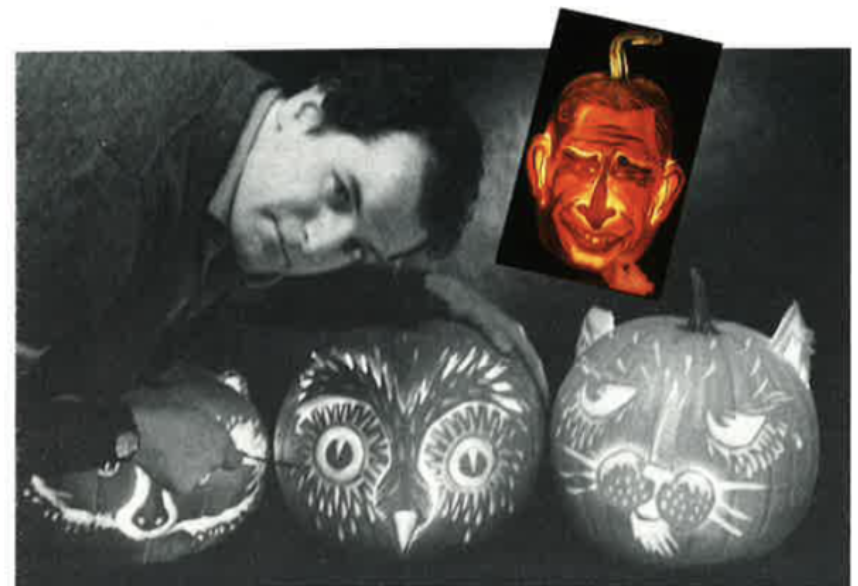
So, with a carved pumpkin under his oxter, he took to the streets of New York, searching for a restaurant that might desire his handiwork for a Halloween display. The refusals were many, and he was beginning to think the venture silly until the people at Ichabod on Second Avenue thought otherwise. He sold his first carving.
Nowadays they sell from $75 for the simplest to $1,000 for the most elaborate. He has been featured on several television shows, had his work displayed in a number of galleries (this season he will be doing work for the Whitney Museum and the Brooklyn Academy of Music, among others), and his work is immensely popular in Japan.
Because the pumpkin season is so short-two months at best-he usually rents out a large studio space, one which has good refrigeration. There he works non-stop, through the witching hours, etc., etc. Assistants clean out the pumpkins; he carves them, and occasionally the assistants help final touch-ups to the work.
Good refrigeration: That’s a must. Otherwise, left to nature and the open air, a carved pumpkin would shrivel and collapse in four to six days. But they can keep in a refrigerator for up to three weeks. Naturally, Hugh McMahon has experimented with ways to prolong the life of the carvings.
He says, “I’ve tried to treat them. I’ve tried to freeze-dry them. The only thing I haven’t done is embalm them.”
In his other artistic life he has worked in stone and wood and clay and seen his work live on.
How does he cope with watching the fruits of his intense Halloween labors collapse before his eyes? Stoically, he explains, “I expect it to die, and it dies.” That’s life for a pumpkin carver. Yet, the work does live on in a fashion, since he has taken the precaution of capturing it on video.
The other thing that Hugh McMahon has done to try and prolong the demand for his skill is diversify into watermelons.
They’re around for longer than the pumpkins. The only trouble is, he explains, there is no tradition in carving them. Nevertheless, some of the most spectacular McMahon carvings, including a range of voluptuous nudes, have been done in watermelons. And there’s no great difference in the art except, he says, that, “The watermelons are messier.”
Like the pumpkins, they succumb to his Exacto knife. The only other tool he uses is a kitchen knife.
When he sets to, he chooses a pumpkin to suit the shape of his subject-Round for things like cats, long for portraits. But you’re carving with the light in mind as well as the shape.” Needless to say, he knows his pumpkins – “I can look at a pumpkin and tell if it will glow poorly or nicely.”
His simplest creations take an hour to carve, the more elaborate can take four times as long. Says the artist, “It’s nerve-wracking when I’m doing it. It’s just such a short and intense period of work.”
Projects already lined up for this season include a series of portraits at the Whitney, including one of Brendan Gill.
Another will take him to his parents’ home town, Chicago, where he is scheduled to carve out a number of local political notables, past and present. Old Daley and Young Daley will be included, with Old Daley “probably as a ghost, or a moon in the background.”
When he is not carving pumpkins and watermelons, Hugh McMahon makes videos. He has also produced a line of greeting cards, and a line of paper witches and ghoulies that fly.
And, yes, he does eat pumpkin pie. He’s also been known to try a glass or two of pumpkin beer. That’s the scoop.
– Maire Crow
“Love ya Jimmy”
“Nobody’s leaving, Jim,” a voice from the crowd shouted to Jimmy Connors. He was down two sets, behind four games to one in the third set of the semi-finals match of the U.S. Open. Skill, heart, experience and a kind of wild joy in confounding critics and igniting normally restrained tennis fans had carried him to this supposedly impossible moment. In a little while the end would come. But right now nobody was leaving.
Jimmy Connors heard the shout. He turned to the crowd, stretched his body backwards, jammed his racquet into the air and held up one finger – finger number one. The crowd cheered and cheered. “We love you, Jimmy,” they had told him earlier and Connors had smiled, aware of the irony.
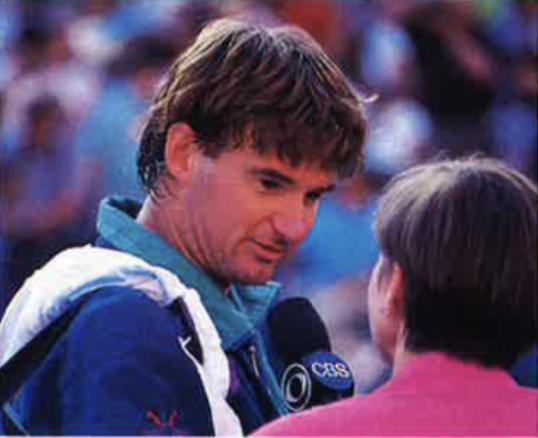
Many a time when he had been winning the fans hadn’t loved Jimmy. But now they were together celebrating a moment beyond winning and losing, beyond sports-a moment of limits transcended and greatness achieved. Connors broke Courier’s serve, and won that game. But the young challenger took the next game and the match. Afterwards it was Connors smiling, marveling to the press. “They stayed. They stayed until the end. He spoke of conditioning his body, of being a force next year. He probably will. But that was to come. Now still the cheers echoed, ‘We love you. Nobody’s leaving.'”
Jimmy Connors can trace his Irish heritage through his two grandfathers, John T. Connors, mayor of East St. Louis for 17 years and Al Lynch Thompson, a champion swimmer and boxer who fought throughout the Midwest under the name Al Lynch.
Connors grew up in East St. Louis, Illinois attending St. Phillip’s Grade School. His mother Gloria Thompson Connors taught Jimmy and his brother John to play tennis.
Gloria Connors had learned the game from her mother, Bert Thompson. When Bert, an excellent player at a time when few women participated in the sport, first moved to East St. Louis, she went looking for tennis courts. She inquired of Al Lynch Thompson, chief lifeguard of the East St. Louis Park District.
‘We have a great swimming pool,” he said.
“But I don’t swim,” Bert replied. “Well, you teach me tennis and I’ll teach you to swim.” They traded lessons.
Marriage followed.
Their daughter Gloria played tennis on a national level and wanted to pass on her love of the game to her children. One day soon after the family moved into their home in a new subdivision being built in East St. Louis, she noticed a bulldozer parked at the end of the street.
She convinced the driver to level the ground in the Connors’ backyard for a tennis court. “We love you, Jimmy,” was the result.
Nobody’s leaving.
A Tale from the Old West: Billy the Kid and the Murphy-Dolan Gang
In the town of Lincoln, New Mexico prior to 1877 most of the banking and commercial interests were controlled by two Irishmen, Laurence G. Murphy, an ex-major of the American Army, who at one time had studied for the priesthood. The other partner was a native of Galway called James J. Dolan, also an ex-Army officer. They built their empire on contracts to supply cattle to the Army and the Indian reservations. They controlled everything in the town including the sheriff, one William Brady who was also of Irish stock.
Their power reached as far as the governor of the state.
Murphy hired many “guns” to back his grip on the town and it was rumored at the time that the Murphy/Dolan gang were stealing cattle from a big cattle baron in the area called John Chisum to fulfil some of their contracts.
In 1875, a lawyer called Alexander McSween, born in Canada of Scottish parents, moved to Lincoln for health reasons. One of his first clients was Murphy who asked him to defend a gang of rustlers who were caught stealing Chisum’s cattle. McSween withdrew from the case when he became convinced that Murphy was in collusion with the gang. The fact that he crossed the Murphy/ Dolan combination led McSween to throw in his lot with Chisum and an Englishman called John Tunstall.
Tunstall had moved to Lincoln in 1876 and had started a ranch on the Rio Felez a few miles from the town. The McSween/Chisum/Tunstall outfit opened in opposition to the Murphy/Dolan enterprise in 1877 with the Lincoln County Bank and General Store. The new venture began to prosper at the expense of the Irishmen, so they decided to find a solution to the problem.

In February, 1878 Murphy pressured Brady, the sheriff, to arrest Tunstall on the trumped up charge of horse stealing and on February 18, 1878, Tunstall was shot to death by Brady’s deputies in a quarry about ten miles from Lincoln. That was the start of the shooting war.
It was around this time that one Henry McCarthy, born in New York on September 17, 1859, the son of Irish immigrants, Patrick and Catherine McCarthy (nee Devlin) was living in and around Lincoln County. He was a shifty 5’3″, bucktoothed youth who, because of misdeeds including rustling, robbing and gunplay was operating under many names – Kid Antrim, William Bonney, Kid Billy, and Billy the Kid. He had been working on Tunstall’s ranch and a bond of affection had grown between Billy and the Englishman. Billy rounded up a few of his friends including another Irishman called Tom O’Fiollard to revenge Tunstall’s death.
In 1878, between March 9 and April 1, Billy and his gang ambushed and killed four or five of Brady’s men, including the sheriff himself. This tit-for-tat killing continued for months.
The Murphy-Dolan gang had the backing of the law and politicians which led the McSween-Chisum outfit to believe that they were to be wiped out by their rivals.
On July 15, 1878, the McSween faction, consisting of some 40 men and three women, including Billy the Kid and his men, fortified themselves in McSween’s General Store in Lincoln’s main street and prepared for a siege.
The new sheriff, George Peppin, arrived with 40 men and warrants to arrest Billy but he was answered with a hail of gunfire. The battle raged for 48 hours and Sheriff Peppin sent to nearby Fort Stranton for help.
On July 17, Colonel Dudley arrived with a detachment of soldiers and two Gatling guns. It was believed that Dudley was backing Murphy and stood by. On the evening of July 18, the McSween store was set on fire. A brief truce was called to allow the women to leave. In the dark of night with flames closing in, Billy and his friends made a run for it and escaped in the confusion. The luckless McSween and several others died or were wounded.
The death of McSween ended the Lincoln County war as Chisum withdrew his funds when his front men lost their lives. Murphy died of pneumonia later in 1878 and Dolan outlived him by some twenty years and amassed more wealth than before.
Henry McCarthy, alias Billy the Kid, was killed by Pat Garrett in the house of Pete Maxwell on July 13, 1881, in Fort Summer, Texas. Billy was unarmed.
– By Dermot P. Duggan
Editor’s Note: This article was originally published in the October 1991 issue of Irish America. ♦
Leave a Reply