
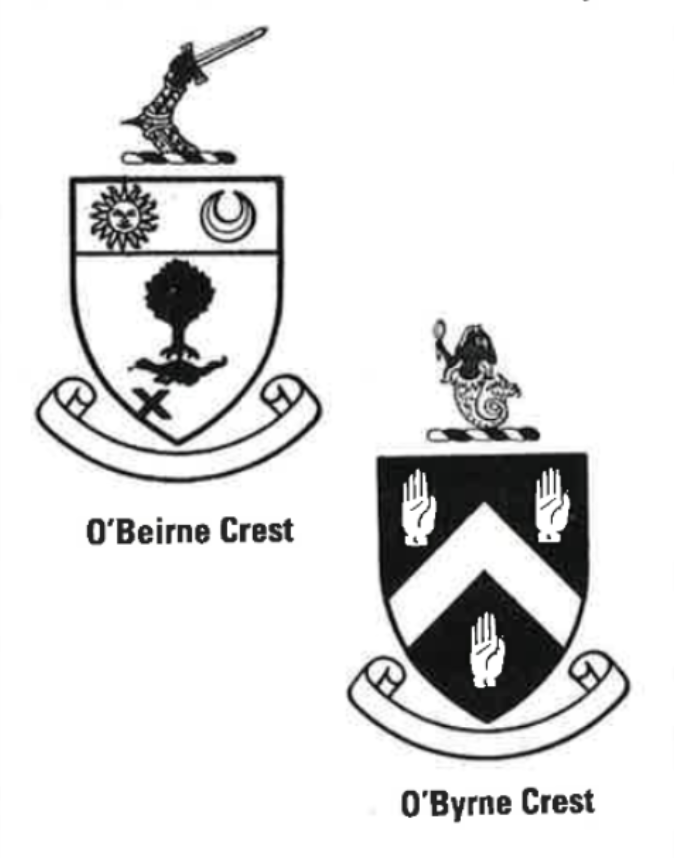
The names O’Byrne and O’Beirne (or Byrne and Beire) often regarded as variants of the same root, are, in fact, totally different. O’Byrne is derived from the Gaelic O’Broin meaning “descended from Bran,” the 11th century King of Leinster. The O’Byrnes were chieftains of what is now County Kildare until the Norman invasion when they were driven from their lands into the mountains of County Wicklow. There, together with their allies the O’Tooles, they successfully resisted Norman and English domination for centuries. The name is now prevalent in Counties Wicklow and Dublin.
The less-common name O’Beirne, is associated with the western province of Connaught, particularly the counties of Roscommon and Leitrim, and is a derivative of the Norse name “Bjorn.” One branch of the O’Beirnes ruled as chieftains on the Roscommon side of the Shannon in the 13th century, while another possessed territories in the adjoining country of Mayo.
Andrew Byrne (1802-1862), born in Navan, County Meath, is among the more interesting O’Byrnes. He became an early pioneer of Catholicism in the USA and the first bishop of Arkansas. Another pioneer, Dr. John Byrne (1825-1902), from Kilkeel, County Down, spent the first year of his medical practice caring for the people of his hometown during the height of the Famine. He later went to the USA, where he developed the use of electrical surgery, specifically the process of cauterising. Thomas Byrne (1842-1910), also made a name for himself.
Born in Ireland, he emigrated to New York where he became Chief of Detectives. He is said to have been responsible for the introduction of the “Third Degree” system used in the interrogation of criminals, that being, the use of mental strain over physical force.
In Ireland, Fiach McHugh O’Byrne (1544-1597), chief of the Wicklow O’Byrnes was perhaps the best known.
From his stronghold at Glenmalure, he successfully resisted English rule and at various times supported his Gaelic allies, including the famous Hugh O’Neill, Earl of Tyrone. He was eventually captured and beheaded. Another rebel, Miles Byrne (1780-1862), born in County Wexford, joined the United Irishmen movement and fought at the famous battle of Vinegar Hill in 1798. He later joined with Robert Emmet and was sent to France to enlist help for the rebel cause. Once there, he obtained a commission in the Irish Legion and served with distinction in the Napoleonic armies from 1804-1815. In 1813, he was made Chevalier of the Legion of Honour. He died in Paris and is buried in Montmartre where there is a monument in his honor.
In America, Byrnes and Beirnes have also played a significant part in the military. There were 187 Bymes (and synonyms) in the American Revolutionary Army and navy. These included Clifford Byrne, captain of the Greyhound of the Continental Navy, James Byrne, captain of the Two Esthers of the Penna Navy, and Captain John Byrne of the Philadelphia City Militia.
The O’Beirnes are a rarer breed but have produced several notables, including Thomas Lewis O’Beirne (1748-1832).
Born in County Longford, the son of a Catholic farmer, he and his brother were sent to Catholic seminary but Thomas instead became a Protestant clergyman.
He served as a fleet chaplain in the British Navy and later became active in English politics as a lecturer and writer of pamphlets in support of the Whig party.
Eventually he became Bishop of Meath in Ireland, a position he held until his death.
Another O’Beirne, Eugene Francis (1809-?), also of Longford, entered the Catholic seminary of Maynooth in 1826. Expelled in 1834, he toured England giving anti-Catholic, anti-Maynooth lectures. In 1850, he went to North America where in 1862, he joined one of the parties traveling overland to the Caribou goldfields of Canada. Due to his quarrelsome nature and insobriety, the group abandoned him in Edmonton. He then became attached to the party of Milton and Cheadle who wrote about his objectionable behavior in their book The Northwest Passage by Land. Despite this notoriety, the Canadian Government named a mountain peak after him in 1918.
Another Irish emigrant, Henry O’Beirne (b.1851), was well known for his writings on the Texas Indians amongst whom he lived.
Further information on famous, infamous or notable O’Beirnes or Beirnes, is being sought by of Anne Beirne, 275 Ralston Avenue, Mill Valley, CA 97941. No Byrnes need apply!
Editor’s Note: This article was originally published in the October 1991 issue of Irish America. ♦
Leave a Reply