
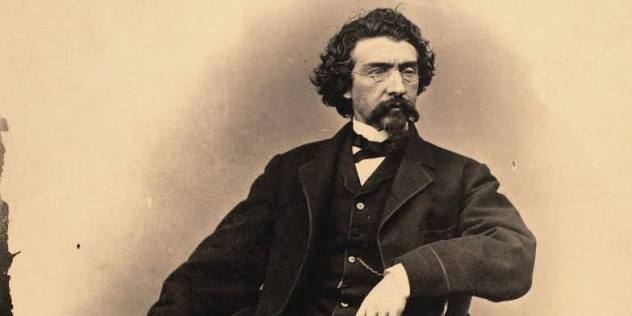
Mathew B. Brady captured the intrigue and frustration, the sorrow and bitterness of “the war
that had to be fought.” In a traveling darkroom wagon, nicknamed the “What’s It” by the
troops, Brady followed the terrible onslaught of the Civil War, recording for history scenes that otherwise would have been lost forever. In effect, Brady became a pictorial war correspondent, though it took his entire fortune and left him to die in an alms ward of a New York hospital.
In Miller’s Photographic History of the Civil War, published in 1912, Mathew Brady is listed as having been born in Cork, Ireland. Brady himself recalled that he was born in Warren County, New York, in “the woods about Lake George, around 1823 or 1824,” but that his parents were Irish. A search of the birth records of that district, however, turned up none for Brady and little is known about his childhood.
In 1940, about the time photography was invented, the young Brady moved to New York City and for a time made his living making jewelry cases. An introduction to Samuel F.B. Morse, the American painter and inventor of the telegraph, however, was to prove fortunate. Morse was an acquaintance of Louis Jacques Mandé Daguerre, the inventor of the daguerreotype whom he met on a trip to Europe. On his return to America he brought the skill with him and taught the process to several students including the alert and ambitious Brady.
By 1844, Brady opened his first photo gallery on the corner of Fulton Street and Broadway, near P.T. Barnum’s American Museum of Oddities. The gallery was an immediate success and was soon referred to in the press as the “Broadway Valhalla.” Brady, consciously and with an eye to business, made photographic portraits which bore his signature, as a mark of social distinction. The fact that Mathew Brady sought you out to take your photograph meant that you were news. You could be notorious, interesting, famous, good or great.
Celebrities from the government, the theater and New York society flocked to his door to have their images impressed on the polished plate of the daguerreotype.
Among his earlier sitters were Daniel Webster and Henry Clay and their portraits were among the first to be mounted in a portfolio in 1850, which Brady entitled The Gallery of Illustrious Americans.
Among the many famous faces that looked down from the walls of his studio were Andrew Jackson, Zachary Taylor, Edgar Allan Poe, James Fenimore Cooper, James Polk, John Tyler, Winfield Scott, John James Audubon, Edward Everett, and later Abraham Lincoln.
Lincoln’s first sitting at Brady’s gallery took place after his historic Cooper Union speech in 1860. Later Lincoln would remark, Brady and the Cooper Union speech made me President.”
Never again in the history of photography would anyone enjoy such a distinguished clientele.
Brady photographed or daguerreotyped every president of the United States from John Quincy Adams to William McKinley, with the single exception of William Henry Harrison, who died in 1841, before Brady began his career. His presidential photographic record remained unbroken for fifty years.
Bret Harte, after a visit to Brady’s gallery observed, “If you saw papa’s picture, as taken by Brady, and tinted at that, you’d never suspect he sold bacon and flour at Poverty Flat.” The Fulton Street gallery prospered and, in response to the demands of his business, Brady opened a huge establishment at 359 Broadway. Il was the finest gallery of its kind in the nation.
By 1860, Brady was a comparatively wealthy man. Against the advice of his wife and close friends, he outfitted and trained 20 war photographers and embarked on a project that four years later would reduce him to financial ruin. Brady did not personally make all the pictures taken during the Civil War. He did, however, make frequent trips to the battle fronts and the great majority of war pictures made in Virginia with the Army of the Potomac were made by him.
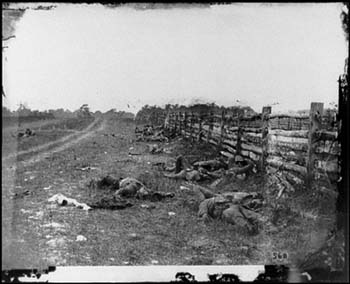
He also recorded the actions at Fredericksburg, Second Bull Run, Chancellorsville, Antietam, and Gettysburg. He was with Grant in the final campaign in Virginia from the Wilderness to the siege of Petersburg and was under fire many times, once almost losing his life. Oddly enough, he was not present at the surrender of Appomattox. The records show that there was no photographer within ninety miles of the area.
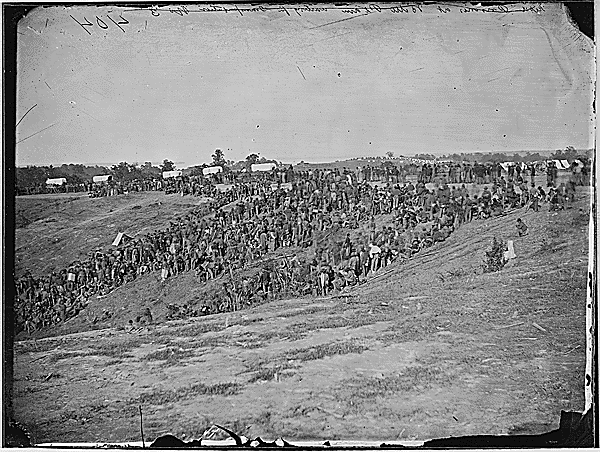
Thumbing through a portfolio of Brady photographs, we can follow him and his photographic wagon on a march to Centreville, Virginia, with General Irwin McDowell’s army – a march preserved in Brady photographs as both fantastic and hilarious, as inexperienced volunteers are shown accompanied by civilians, pretty ladies in crinoline, congressmen and senators. And we see the First Battle of Bull Run as it happened – the triumphs, the terrors and the deaths.
In the fall of 1862, Robert E. Lee fought a crucial battle that marked a turning point in the war. Brady takes us on the battlefield of Antietam where we watch the Northern forces anticipating every move of Lee’s forces, and suddenly we find out why Lee’s secret battle orders, wrapped around a package of cigars, have fallen into the hands of the Northern army.
Up to 1862, most people in the Northern States weren’t directly affected by the Civil War. Not until Antietam and Gettysburg is the war brought home to the North.
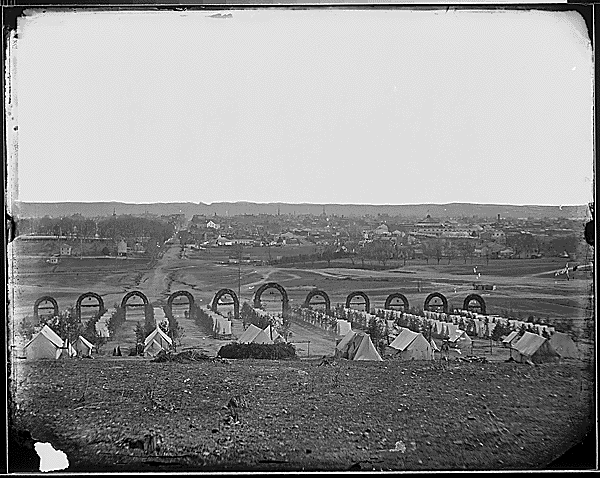
Brady’s photographs take us to the camps on both sides at the Battle of Gettysburg.
The fighting is so fierce neither side has time to bury its dead, and the expression emerges, “We buried our dead,” meaning that the troops held their ground long enough to bury their dead.
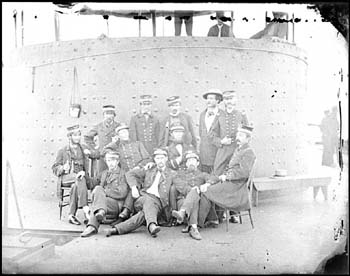
We watch through Brady’s camera one of the most unusual battles of the war on the Mississippi. Brady called it the War of the Turtles; huge, cumbersome gunboats, carrying terrific armaments and called “turtles,” slug it out in the shallow waters of the Mississippi. The boats, ideally designed for this purpose, drafted as little as six feet of water.
Brady shows us the siege of Petersburg, the trench warfare in the Wilderness, and Grant, the master tactician, at work. We see Grant maneuver Lee out of one city and at the same time capture another in a campaign that is now a classic strategy in military history.
Brady’s camera weaves an unforgettable pictorial symphony of the events that led to Lee’s surrender to Grant after the Battle of Five Forks at Appomattox Courthouse. Lee, the gentleman from Virginia, surrenders his sword to the man from the North, dressed in a private’s tunic covered with dust, and sporting a half-smoked cigar. The historic moment is captured by Brady.
The first time Grant came to Washington, it was to receive his commission as lieutenant general, in full charge of the entire military establishment. The Washington press got wind of his arrival and showed up at the railroad station. The problem was, no pictures of Grant existed, and the press did not know how to identify Grant in a group of high-ranking army officers.
Brady was there, and recognized Grant from his filthy uniform and the bullet holes in his hat, and persuaded Grant to sit for a portrait in his Washington studio the following afternoon.
The skylight was prepared, cameras set up, but no Grant. In those days photographers depended on sunlight for illumination. Finally, late in the afternoon Grant showed up accompanied by Edwin Stanton (Secretary of War). Brady instructed his assistant to climb up to the skylight and pull back the shade covering it to get more light. The boy fell through the skylight, and huge glass splinters descended on Grant. Any one of them could have killed him. But Grant sat unperturbed, and just raised an eyebrow. Brady said, “I’ve never seen such an exhibition of nerve.” Later Stanton drew Brady aside and warned him not to speak a word of the episode.
“They’ll think we tried to assassinate him,” he said.
How did Brady, the Civil War’s greatest portrait photographer, shoot pictures in the primitive days of photography? He had three cameras, which used a “wetplate process.” This system involved a glass plate one-quarter of an inch thick that was cut to various sizes. To prepare the plate for use, Brady dipped it into a tank solution of egg albumen and collodion. This he did in a wagon, pitched just out of range of the battlefield. The wagon was a complete mobile lab equipped with developing tanks and sleeping quarters for Brady and his assistants.
The wetplate process, so popular with Brady, had been invented by an Englishman, Scott Archer. Once the glass plate was dipped in the collodion and egg albumen, a sticky emulsion formed on the glass. Brady had to be careful that no draft of air passed over the wetplate at this point, otherwise ripples would appear in the final negative.
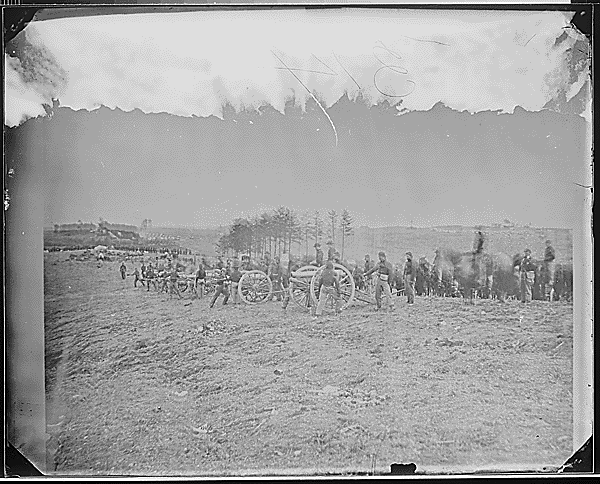
Once the plate was prepared and just before the picture was shot, the emulsified plate was sensitized in a bath of silver nitrate. The plate was then put in the camera holder and Brady rushed to the battlefield to take his picture. The actual shooting was an involved process. The subjects had to stand still. Brady would take a camera cap off the lens, wait anywhere from thirty seconds to a minute and a half to make the exposure (cold days took a longer count; hot days a shorter one), and then rush back to his wagon to develop the glass plate. In order for the picture to come out on the glass negative, the wetplate had to be developed and fixed within five minutes of exposure.
Pictures were never printed on the battlefield. Brady waited until he could transport a large number of them to his headquarters, either at Bealton or Petersburg, Virginia. To protect against breakage of the glass negatives Brady always shot at least three pictures of every scene.
With the ending of the war, Brady’s fortunes went into a decline. His files now contained thousands of plates that told a complete story of the war, but the sale of war pictures stopped almost at once.
Americans turned to the solving of their material problems. No one cared to look at war pictures, and the government was too preoccupied with the problems of Reconstruction to give thought to anything else.
Brady and his work were soon forgotten in the frantic rush of events that followed the close of the war. The last few years of Brady’s life were filled with bitterness and disappointment. The man who believed in preserving his country’s history, enough to invest his own private capital, became ill and despondent.
Although the U.S. government gave him $25,000 for a collection of his war photographs, the money went to pay his creditors and by 1880, he was finally forced to close his gallery forever. Heavily in debt, he forfeited his library of plates to pay claims and legal judgements against him.
The last years of Brady’s life were deeply marked by misfortune, poverty and illness. In 1895, there was an attempt by some of his loyal friends to host a testimonial dinner and a showing of his pictures in Carnegie Hall. This, alas, was not to be, due mainly, to lack of money and Brady’s ill health.
On January 16, 1896 Mathew Brady died in an alms ward of the Presbyterian Hospital, New York City.
Epilogue
On April 17, 1953, the RB-36, the largest photo-reconnaissance plane in the world took off on its first flight from Carswell Air Base near Fort Worth. The name in big black letters stood out: MATHEW B. BRADY, it was a fitting tribute to the man who had given up his fortune to preserve for history the scenes from the Civil War, that otherwise would have been lost forever.
Editor’s Note: This article was originally published in the October 1991 issue of Irish America. ♦
Leave a Reply