
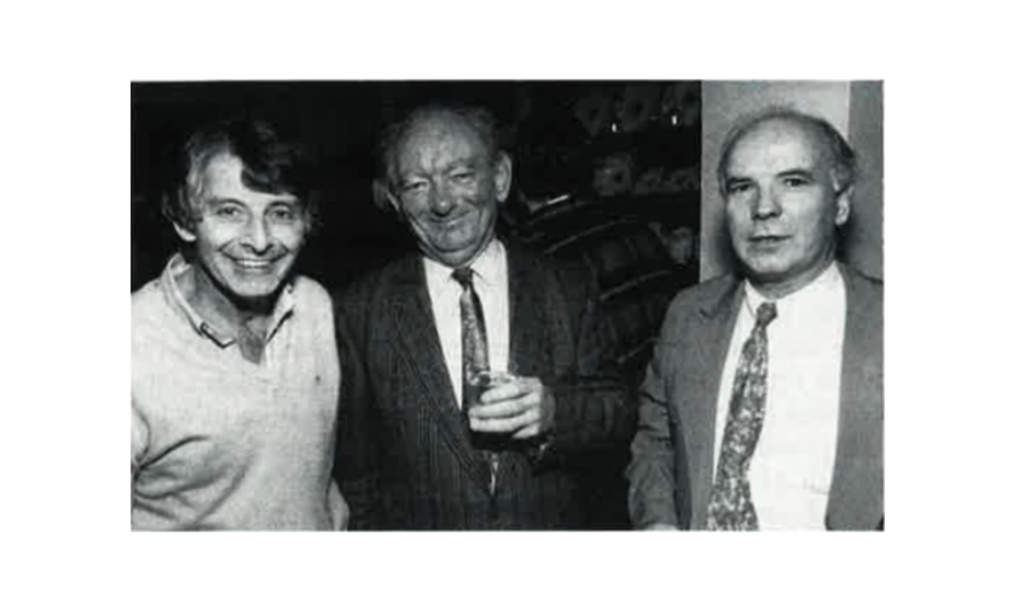
After triumphs in Dublin and London, Brian Friel’s Dancing at Lughnasa comes to Broadway. When the Roger Smith Hotel in Manhattan welcomed Brian Friel, producer Noel Pearson and the cast, talk centered on the power of this story of five sisters in rural Donegal. Supported only by the teacher’s salary of the eldest, Kate (Rosaleen Lenihan), the women, their retired priest brother (Donal Donnelly), and the young illegitimate son of the youngest sister enact a family drama inspired by Brian Friel’s own childhood visits to his aunts in Donegal. John Simon, dean of drama critics, said, “Brian Friel is keeping the tradition going and that’s the best thing a playwright can do. His plays are about human life, not some shadowy facsimile.”
For Noel Pearson, producer also of My Left Foot, both pieces portray family love.
The love of the Brown family for Christy was extraordinary.
There’s that same kind of love here among the sisters and for their brother and nephew. The play has an amazing effect on people. Reading the script it seems a sad story. But the audience leaves really feeling good-like in My Left Foot.
They feel they have witnessed unconditional love on the stage and they want it in their own lives, as we all do. That’s why the play works. “Brian Friel writes of real people and real experiences. Both My Left Foot and his play draw from the real Ireland and that’s what appeals to Americans. It sticks to what’s actually true about Ireland instead of creating an Ireland to satisfy a particular audience.” Actress Rosaleen Lenihan said of her character, “Kate feels a huge and perhaps unnecessary sense of responsibility which is destructive, except that she is also a very human person. She’s very strict. She places strictures on herself which are untenable. Kate is puritanical. This is Donegal, 1936. Duties and responsibilities are her catchwords. My background is very similar to Kate’s. I’m Donegal. I know a lot of Kates. In fact I nearly am a Kate.”
Gerry McSorley plays Michael, the son and narrator. “My character doesn’t say anything about himself all night. He doesn’t betray anything. It’s interesting to play that enigma. I play him as a seven-year-old, because the memories he relates are of when he was seven. That presented a technical challenge. Friel doesn’t give clues. All he says is ‘Narrator enters and stands stage left.’ So there’s room for innovation.
“I’m from the same town where Brian Friel lived for the first ten years of his life-Omagh, County Tyrone, Norther Ireland-so I’ve always had an affinity with him, in addition to admiring him hugely as a writer. I sympathize with his ideas and I think I understand his mind. He didn’t ever say much to me but in that unspoken way, that’s so characteristic of him, he was very supportive. The man in the play tells quite a sad tale of the fracturing of family relationships quite painful-but you can’t get overwhelmed.”
“Friel told me to be re-strained, just tell it and let it be the audience who gets emotional. I don’t interact with the other characters. My relationship is with the audience. Instead of generalizing the gaze, Took directly at people. I make the relationship very direct-one person talking to one person.”
Many, many people will be listening, now that Dancing at Lughnasa is here.
Editor’s Note: This article was originally published in the November 1991 issue of Irish America. ♦
Leave a Reply