
In a small, dimly lit pub in a West Clare village, a group of attentive listeners gather around an elderly woman seated in a corner. The year is 1958 and some of the people gathered have travelled from as far away as Dublin City to sit in the presence of one Mrs. Crotty, who sits smiling but unmoving; except for her nimble fingers, which dance effortlessly across the keys of a tiny concertina cradled in her lap. Born Elizabeth Markham near Cooraclare in West Clare in 1885, Crotty is a virtuoso player by any standards but highly unusual for that time is the fact that she is a woman publicly playing Irish traditional music.
The patriarchal essence of the social mores in which Mrs. Crotty and her fellow women musicians moved, offered stark choices. The rules were simple, and rigid. A woman’s place was in the home. Rarely were women seen in bars and pubs in rural Ireland and rarer still was the sight of a woman traditional player in the midst of a music session. That is not to suggest that there were no women players. There were in fact a great number of superb women musicians and singers up and down the country, but they confined their talents to the privacy of their own homes. These women took down their instruments to entertain at house-dances, seasonal parties at Christmas and Easter time and for weddings, christenings and wakes, particularly for the infamous American wakes. In any house which possessed an instrument, (and there were many in Kerry, Clare and Galway), you were sure to find a woman player. Mrs. Crotty was one such player.
So too were the legendary fiddlers Aggie White from East Galway and Julia Clifford from Kerry.
An equally famous Clare concertina player was Mrs. Brigid McGrath from near Killenora. Mrs. McGrath was rarely heard outside her own home. She never recorded but her tunes have found their way into the general traditional repertoire, and she remains a legendary figure among Clare musicians, especially concertina-players.
With the sixties came the sweeping social changes that saw more and more women players venture forth to join their male practitioner friends in pub sessions and on the concert stage. By the late sixties the great traditional music renaissance was well under way and by the early seventies, the pioneering Irish traditional supergroups had evolved. Three of the leading groups featured women singer/musicians —Maire O’Braonnain with Clannad, Triona Ní Dhomnaill with the Bothy Band and diva of traditional singers, Dolores Keane with the groups De Danann. Mary Black too made her debut at the end of the seventies with the group General Humbert. It was an exciting time for both traditional music and for male and female musicians.
It was also a time of the flowering of such superb musicians as tin-whistle player Mary Bergin from Dublin, whose solo L.P. on the Gael Linn label recorded in the late seventies still stands as a classic of the genre. Since then, Mary continues to both stun and amaze with her awesome abilities on the penny-whistle and is about to release her second solo album. As the eighties dawned, younger women players emerged. Among the most gifted, were sisters Nollaig and Miriam Casey from Cork who play fiddle and harp respectively. Both Nollaig and Miriam are today at the leading edge of the professional Irish music scene. Also from County Cork came Maire Ní Ghrada, one of the first women uilleann pipers to be recorded on commercial disc.
The energy and excitement of the Irish traditional movement in the seventies was keenly felt abroad, especially in America.
There, a generation of young Irish-American players, many of whom had never set foot in Ireland, wholly absorbed the music of their spiritual homeland. The great Liz Carroll from Chicago emerged to high acclaim as a fiddle virtuoso of international standing. Following Liz came Eileen Ivers and many other women players whose dedication and understanding of the music is beyond doubt.
In 1984, in a small commercial recording studio in Dublin, a group of assorted musicians gathered together to make a historic recording. Historic, because the group called Mucalla, were comprised of no less than 23 women, the cream of the young women musicians and singers.
Among those present were fiddlers Edel McWeeney, Roma Casey and Mairead Nf Mhaonaigh, flute-players Catherine McGorman and Clodagh McGrory and Mary McNamara on concertina. The result of those sessions can be heard on the Gael Linn album, “Macalla-Mna Na hEire-annn” Macalla made much more than a musical statement on that extraordinary album.
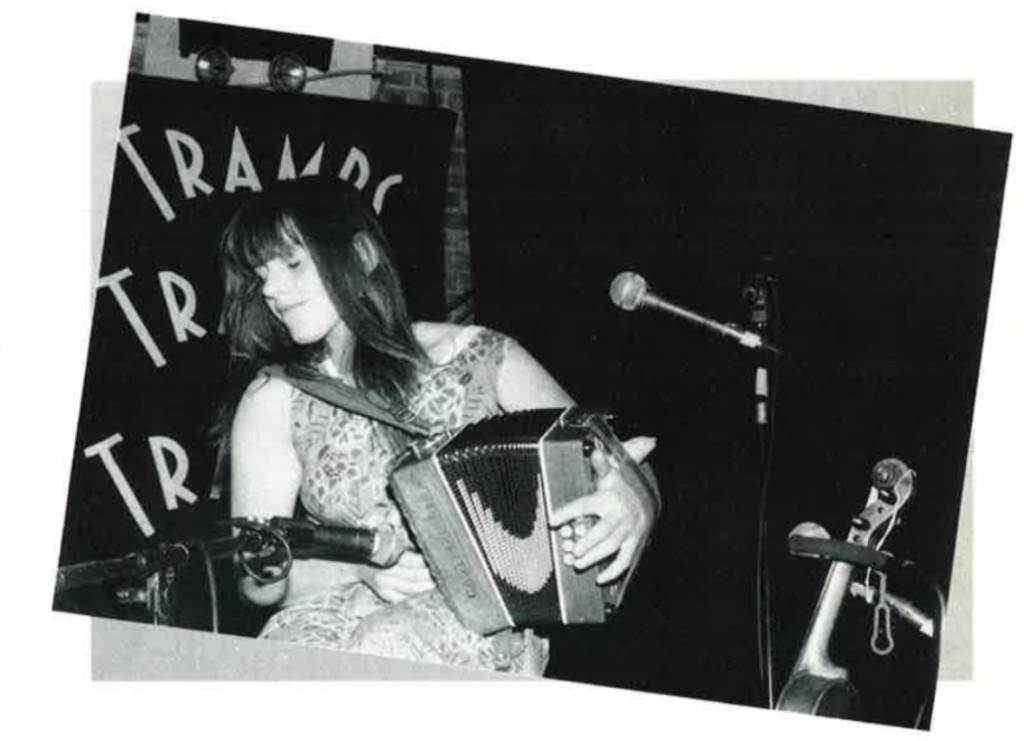
Today women fiddlers, concertina-players, accordion-players, even women uilleann pipers (an almost entirely male discipline), have taken their rightful places alongside their fellow male practitioners at pub sessions, the concert stage and, more importantly, on commercial recordings as professionals making a living exclusively from traditional music.
And so it came to be that Sharon Shannon the new wizard of the traditional accordion from Corofin County Clare, who was not even born when Mrs. Crotty enthralled listeners in her Kilrush pub, departs the stage at the San Francisco Irish Music Festival in March 1992, after accepting several encores and leaving the 4,000 plus audience spellbound, having generated through her music, enough energy and electricity to light up a small-sized town. Sharon’s music, though couched in contemporary rhythms and accompaniment, flows from the same wellspring as Mrs. Crotty’s did back in the 1940’s and 50’s.
On the day following Sharon Shannon’s show-stopping performance the latest irish traditional “supergroup,” Altan, look to the stage to close the festival. Fronting the band was ex-Macalla fiddle-player and singer, Mairead Ní Mhaonaigh, whose barnstorming fiddling and gentle, haunting vocal singing left the audience in no doubt that here was a new star of Irish traditional music in the making.
As Mairead and Sharon take their music to bigger stages and wider audiences, a new batch of women players wait in the wings, fired and fueled by the international acclaim cared by these great young musicians.
It has been a long road for traditional music and the women who play it. Mrs. Crotty, Aggie White and Julia Clifford would be pleased, and perhaps a little astonished at the successes won on concert stages around the world by musicians of the ilk of Dolores Keane, Sharon Shannon and Mairead Ní Mhaonaigh, and at the great strides taken by the music, thanks to the named and unnamed women who fought to keep it alive down the years.
One thing is certain: as long as musicians like Dolores, Sharon, Mairead and younger players such as fiddler Mary Custy, continue to play, the spirit and soul that permeated the music of Mrs. Crotty and Aggie White will continue to heal the spirit and raise the heart.
Editor’s Note: This article was originally published in the July August 1992 issue of Irish America. ♦
Leave a Reply