
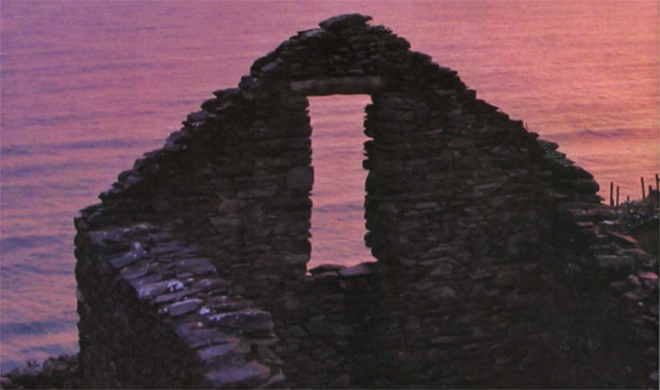
For the last 150 years poor mother Ireland has been casting out her young to the four corners of the world. The country, it could be said, is no more than a spawning pool, a place to be born but not a place to live a life through or die in. Over two million left between 1845 and 1855 leaving behind the Famine in which one million died.
During the nineteenth and into the twentieth century the haemorrhage continued. From 1856 to 1921 a further four million emigrated.
From the twenties to the sixties another two million left. The seventies brought an all-too-brief remission for in the eighties emigration resumed with a vengeance. For the future the prospects look bleak with reports that unless 250,000 can be persuaded to emigrate in the next eight years, half a million people will be jobless going into the next century.
Very few of these emigrants ever return to Ireland to live. In the early part of the century any money saved went to paying the passage of other family members. In the eighties, even with air travel, many immigrants in the United States did not return because they were undocumented and feared being unable to reenter. Though perhaps better educated than their predecessors, these immigrants, because of their status, found themselves in the same labor pool as their ancestors. The girls became waitresses and nannies and the young men worked in construction and bartending.
Irish literature and song of the early part of the century tells the poignant tale of emigration, what it was like to be separated, the loneliness and despair of it, and most of all the finality of it, as parents said good-bye to children they would never see again.
We publish a selection.
Kate Peg was constantly coming to the house now and she and Maura talking of nothing but America.
They would run across to the wall where pictures from Springfield were hanging.
“Oh,” Kate would say, “we will go into that big building the first day, Maura.” Then the two of them would run out on the floor dancing for joy. “You will send home pretty things to me?” said Eileen.
“We will, of course,” said Maura indifferently. Then Eileen too would dance over the floor.
Three weeks later the passage money came.
She was changed that evening, crying bitterly with the letter in her hands.
“What is the good of crying so, you foolish girl?” said my father, who was sitting in his chair with a mournful look on him. Kate Peg came in, her eyes as red as the rose from weeping.
“Well, Kate,” said my father, “what news have you?”
“I have none, save that the passage money came for me today. I hear Maura has hers too.”
“She has,” said my father, “and she has been distracted ever since.”
“Why are you crying so, Maura?” said Kate, raising her head. “Didn’t you see Nora Pats go, with no kinsfolk at all over there, the poor girl? And isn’t it over there all your own people are?”
I noticed his cap far down over my father’s eyes that evening as I had never seen it before.
Eileen was in the far corner crying to herself.
“Faith, it is a fine prospect in store for you,” said my father with a long sigh, bending over the fire to put a live cinder in his pipe. After a while Maura stopped crying, only a sob coming now and then as she put the kettle on the fire.
“Had the King any news when he came in, Kate?” asked my father, crossing his knees.
“I did not hear any except of the crowds that are going across to America this week.”
“God help the old people, there will be none to bury them with the haste that is on the world.”
“There’s no doubt but there is a great change in the times.”
“Upon my soul, Kate, I remember when there was no thought of America any more than the chair I am sitting on, and they were fine happy days.
Maura was crying every day now.
“Musha, I don’t know in the world,” she would say when she washed the plates, “will the day ever come when I will be washing these again.”
It was the same when she would be sweeping the floor. She would look at the broom and the tears would fall. Then she would run across to my dog Rose and catch her up in her arms.
“Musha, Roseen, isn’t it many a day the two of us were west on the White Strand, I throwing stones into the water and you swimming out after them!” and Rose would wag her tail and bark for joy for Maura to be playing with her.
Time was passing and the appointed day approaching. A mournful look was coming over the very walls of the house. The hill above the village which sheltered the houses seemed to be changing color like a big, stately man who would bend his head in sorrow. The talk throughout the village was all of Maura and Kate going away.
On the last night young and old were gathered together in the house, and though music and songs, dancing and mirth, were flying in the air, there was a mournful look on all within. No wonder, for they were like children of the one mother, the people of the Island, no more than twenty yards between any two houses, the boys and girls every moonlight night dancing on the Sandhills or sitting together and listening to the sound of the waves from Shingle Strand; and when the moon would wane, gathered together talking and conversing in the house of old Nell.
The dust was flying from the floor under the heels of the sturdy young men and girls. I went out to the grassy bank. The moon was high in the sky and the Milky Way stretched out to the southeast. I heard the lonely murmur of the waves breaking on the white strand. It made me mournful.
Maura came out to me. “Oh, Mirrisheen,” she cried, throwing herself into my arms and bursting into tears, “what will I do without you?”
“Be easy. Don’t you see everyone is going now, and soon you will see me beyond like the rest of them. Hush now, let us go in and dance.”
She let go of me and sat down on the bank.
“Lift up your heart,” said I again. “Come in with me now and the two of us will dance a set.”
When we went in: “Musha, my love for ever, Maura,” cried Peg Owencen, embracing her and bursting into tears, “my life will not be long after you.”
“Strike up a tune, Shaun,” said I to Shaun Pats, who had the melodium. He began to play. Four of us arose and I called my sister for the dance.
The day was brightening in the cast. We washed ourselves and made ready for the road to Dingle to give Maura a last fare-well. The sun was rising in splendor and the cocks crowing all over the village.
When nine o’clock came all the old men and women were coming down towards the house. All was confusion.
We moved down to the quay, Maura and Kate and Peg in front of us and the whole village following.
The old women were crying aloud.
“Musha, love of my heart, Maura, isn’t it a pity for ever you to be going from us!”
“Oh, musha, Maura, how will I live after you when the long winter’s night will be here and you not coming to the door nor your laughter to be heard!”
We got free of them at last. We were out in Mid-Bay, looking back at the people of the village waving their hands and their shawls.
We spent the night in Dingle. Next morning we went down to the station and gave them farewell and our blessing with sorrow and tears.
The train whistled. In a moment they were out of sight.
Maurice O’Sullivan was born in 1904 in the Blasket Islands, off the Kerry coast. In the following excerpt from Twenty Years a-Growing, he recounts his sister’s departure for America. Twenty Years A-Growing by Maurice O’Sullivan published by Oxford University Press.
Farewell Forever
Peig Sayers was born in a small remote townland in Dunquin in County Kerry. She later moved to the Great Blasket Island where she spent the next forty years. As an old woman in 1935, she recounted her life of tragedy and hardship to her son Micheál. In closing what became a very important part of Ireland’s oral history she says, “Old as I am, there’s a great deal more in my head that I can’t write down here. I did my best to give an accurate account of the people knew, so that we’d be remembered when we had moved on into eternity. People will yet walk above our heads; it could even happen that they’d walk into the graveyard where I’ll be lying but people like us will never again be there. We’ll be stretched out quietly-and the old world will have vanished.” In the following excerpt she tells of a neighboring family leaving for America.
At last the day dawned when Muiris and his family were bidding their last good-bye to the neighbors.
We had a custom at that time for everyone in the parish, great and small, to “convey” the person who was going to America. The excitement and noise wakened me in the morning. Such running and racing! A large number of his relations were calling at Muiris’ house that morning to bid him farewell.
I got up quickly because I had a number of small johs to see after. I had my mind now made up that from the moment my health improved l’d go into service again that is if I got a suitable place. There was nothing to be gained by remaining at home, for however long I stayed there, all I’d get in the end was the road. So I realized that it would be better for me to turn a penny for myself and not to depend on anyone else.
And another thing that forced me to a decision was this: Cait-Jim was going to America with Muiris and she had promised me that she’d send me the passage-money as soon as she possibly could, and it would be advantageous for myself too if I had something put aside towards the fare when my own day would arrive. I told no one what was on my mind but I was ready to accompany Muiris to Dingle. All the morning there was great activity; some people were crying and others were laughing. It’s a sad occasion when a person leaves for America; it’s like death for only one out of a thousand ever again returns to Ireland. Is it any wonder then that the emigrants’ relations are troubled and upset when their own folks are leaving?
We had neither horse nor side-car; all we had was Jim’s horse and common car and that was full of luggage. But whether or no, there was room for Muiris-the rest of us walked.
By the time we moved up the Well Road one would think that it was a funeral procession. The Dunquin people had the custom in those days of conveying whoever was going to America as far as the stone heap known as the Leacht. We moved along the road, some of us downhearted and others in good spirits until we reached the top of the Clasach. Then or never there was a right scene; the parting of friends was a sorrowful sight, for parted they were from that day forward as surcly as if they were buried in a grave, for none of them ever again met the other. Those who were not going to Dingle said good-bye to those who were leaving and then they turned their backs on one another; one band of people faced for home and the other for the Dingle Road.
We had a long walk before us but it made no matter since there was a crowd of us together and we never felt the journey until we reached Dingle. We made straight for Galvin’s for he was the Booking Agent for America at that time. Those who were travelling had to see after a lot of things— travelling cases and various odds and ends for the following day. I remained with them all the while and when night fell a great crowd of people had gathered into the house for those who were going away were to stay there until morning. There was plenty of company in the house that night for Mr. Galvin was a sociable man on his own floor and we had music and dancing and song until midnight so that we never felt the time passing until at last the man of the house said that it was time to go to bed as we’d have to be up early in the morning.
Then the music came to an end and everyone began to think about sleep.
At seven o’clock the following morning the little bell on the alarm clock rang and everyone did his best to get dressed so as to be ready for the breakfast. But not many of them felt like eating or drinking as they were too overcome with sorrow.
About ten o’clock they were ready to leave and we said good-bye to one another.
I was very lonely after Cait-Jim. Why wouldn’t I be, for she was my loyal comrade ever since I was a child! Needless to say, I was crying but this is what she said to me: “Don’t fret one bit, girl, for if God leaves me my health it won’t be long until I send you the fare. Goodbye now,” she said, and then she herself began to cry. Before I had time to wipe the tears from my eyes they were all swept out of my sight. That was the last time we laid eyes on one another.
Kilkelly
Over one hundred and thirty years after his great-grandfather left the small village of Kilkelly in County Mayo, Peter Jones found a bundle of letters sent to his great-grandfather by his father in Ireland. Jones used the letters to write a song which he called “Kilkelly,” and passed it on to musician Mick Moloney who describes it as the “most eloquent and poignant tale of what it is like to be separated … the loneliness and the despair of it.” The letters have been slightly altered so that they fit the song’s rhyme.
KILKELLY, IRELAND,
1860
My dear and loving son John,
Your good friend schoolmaster Pat McNamara so good as to write these words down.
Your brothers have all gone to find work in England. The house is so empty and sad. The crop of potatoes are sorely infected a third to a half of them bad. And your sister Bridget and Patrick O’Donnell are going to be married in June. Mother says not to work on the railroad and be sure to come on home soon.
KILKELLY, IRELAND,
1870
My dear and loving son John,
Hello to your missus and to your four children may they grow healthy and strong.
Michael has got in a wee bit of trouble, I suppose that he never will learn. Because of the dampness there’s no turf to speak of and now we have nothing to burn. And Bridget is happy you named a child for her although she’s got six of her own. You say you found work but you don’t say what kind or when you’ll be coming home.
KILKELLY, IRELAND
1880
Dear Michael and John my sons,
I’m sorry to give you the very sad news that your dear old mother has gone. We buried her down at the church in Kilkelly, your brothers and Bridget were there. You don’t have to worry she died very quickly, remember her in your prayers. And it’s so good to hear that Michael’s returning, with money he’s sure to buy land. For the crop has been poor and the people are selling at any price that they can.
KILKENNY, IRELAND,
1890
My dear and loving son John, I suppose that I must be close on 80. It’s 30 years since you’ve gone. Because of all of the money you sent me I’m still living out on my own. Michael has built himself a fine house and Bridget’s daughters have grown. And thank you for sending your family picture, your lovely young women and men. You say that you might even come for a visit, a joy to see you again.
KILKELLY, IRELAND,
1890
To my dear brother John,
I’m sorry I didn’t write sooner to tell you, that father has gone. He was living with Bridget, she says he was cheerful and healthy right down to the end. Ah, you should have seen him playing with the grandchildren of Pat McNamara your friend. And we buried him along side of mother down at Kilkelly churchyard. He was a strong and a feisty old man considering his life was so hard. And it’s funny the way he kept talking about you, he called for you at the end. Oh why don’t you think about coming to visit, we’d all love to see you again.
Editor’s Note: This article was originally published in the October 1992 issue of Irish America. ♦
Leave a Reply