
Derry was the launch-pad for the upheaval which first gripped Northern Ireland in 1968. But not only has it survived the turbulence of two decades ago, it has erased the physical scars and taken on a new self-confidence. A confidence that is being harnessed to tackle Derry’s major long-term problem, unemployment. Martin Cowley reports.
Combating a jobless rate of 23 percent, which soars to 80 percent in some public sector housing areas, Derry is fighting back. Its weapons are innovation and reconstruction. Its strategy rests on self-help and partnership.
In the mayor’s parlor in Derry’s City Hall, Mayor William Hay speaks confidently about the city’s prospects for progress. “We see a city that in the next five years is going to be the city in Northern Ireland, and that’s what our intentions are.”
“I think there is now greater confidence built up in the city and I think that confidence is growing. There has been a lot more confidence from business people who are now prepared to put their money into the city.”
A few days later in the Guildhall, leisurewear giant Fruit Of The Loom provided the type of moral lift which fuels the city’s hope of a brighter future with the promise of 400 extra jobs and f38 million in investments. This is in addition to the 500 workforce due to flow from a £60 million investment announced 18 months ago.
Fruit Of The Loom, like other U.S. investments in the northwest of Ireland, has proved to be a success story. Having established 2,000 jobs in five plants across the Irish border in County Donegal, Fruit Of The Loom opened the world’s fifth largest open-end spinning mill in Derry a year ago. Construction work starts soon on a second Derry factory, a sewing plant, due for opening in early 1993. The operation is a joint venture with a Donegal family firm, W.S. McCarter & Co., and the expansion into Derry is being assisted by the Industrial Development Board for Northern Ireland.
Partnership, in the form of close cooperation by full-time community organizations, Derry City Council, government, public sector agencies, private business, international funding sources and other elements, are helping to sweeten the sound of “The Derry Air.” It may involve joint spending on projects and/or multilateral cooperation to speed up action, provide advice, or “open doors” with the aim of improving the city and generating crucially needed employment.
In Duke Street, where the 1968 violence ignited, old buildings have been cleared away, replaced by a dual carriageway and a just-completed three-story government office block. It’s being built for the Northern Ireland Department of the Environment (DoE) and will soon have 270 public servants working in it. Many of them will transfer from Belfast, a move which will bring a boost to the local economy, including the private housing market.
Recently, on the cityside of Craigavon Bridge, at another scene of confrontation in the early civil rights era, a new sculpture was unveiled. Two bronze figures ten feet high stand on natural stone plinths in a landscaped garden, seemingly about to shake hands. There’s a new spirit at work in Derry.
Derry is Northern Ireland’s second largest center of population, next to Belfast, and is built on both banks of the River Foyle. In a scenic setting in a valley between the rolling Sperrin Mountains in the east and the rugged Hills of Donegal to the west, the city is 20 miles upriver from where the majestic Lough Foyle flows out to the wild Atlantic.
Its formative roots are traced back to a 6th-century Christian monastic settlement and over the centuries Derry has grown in the footsteps of Vikings, Normans, Gaelic chieftains, Elizabethans, merchants, crafts-men, weavers, seafarers, shipbuilders, shirt-makers, distillers….
It has historic connections with the United States, principally in generations long ago as an emigration port and in sea trading links. Amelia Earhart landed her Lockheed Vega three miles from the city in 1932, completing the first solo trans-Atlantic flight by a woman pilot. Many U.S. servicemen were based in Derry during World War II, and in later years, brought Derry brides back home.
Present day connections have proven successful for Derry and for U.S. investors.
Du Pont has had a major synthetic rubber plant there for 32 years. Another big employer is a car wire assembly operation of United Technologies Automotive. Also in Derry is Perfeseal Limited, a world leader in medical supplies packaging. Its majority shareholder is Paper Manufacturing Company of Philadelphia.
Today more links are being formed by Derry Boston Ventures, a group initiated by John Hume, M.P., and Mayor Ray Flynn of Boston. It promotes Derry in the U.S. as the location for American firms aiming to establish a foothold in the new cross-frontier Single European Market and sets up trade visits to the U.S. for Derry and other export companies.
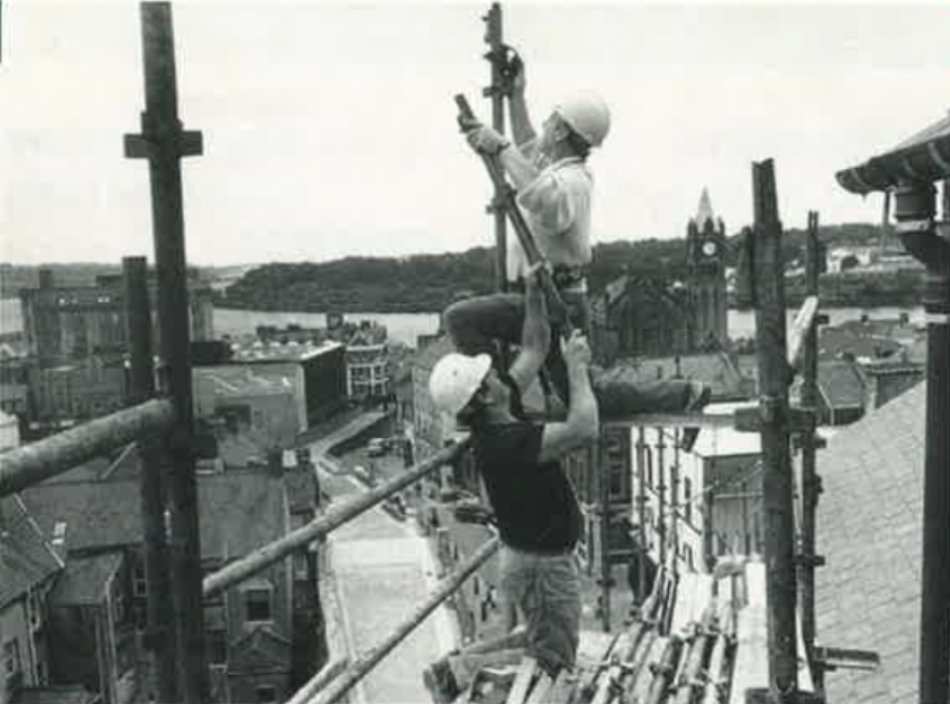
After the commercial bombing campaign in the early 1970s, the center of once proud Georgian Derry was a sad sight. But the scenes of destruction have long since been replaced by brick, mortar and good design. Massive community-led reconstruction of derelict buildings; infrastructural improvements including a majestic sec-and bridge over the River Foyle; government-funded building of the center city Richmond Shopping Center, since bought by the private sector —they all combined to revive the spirit of the city.
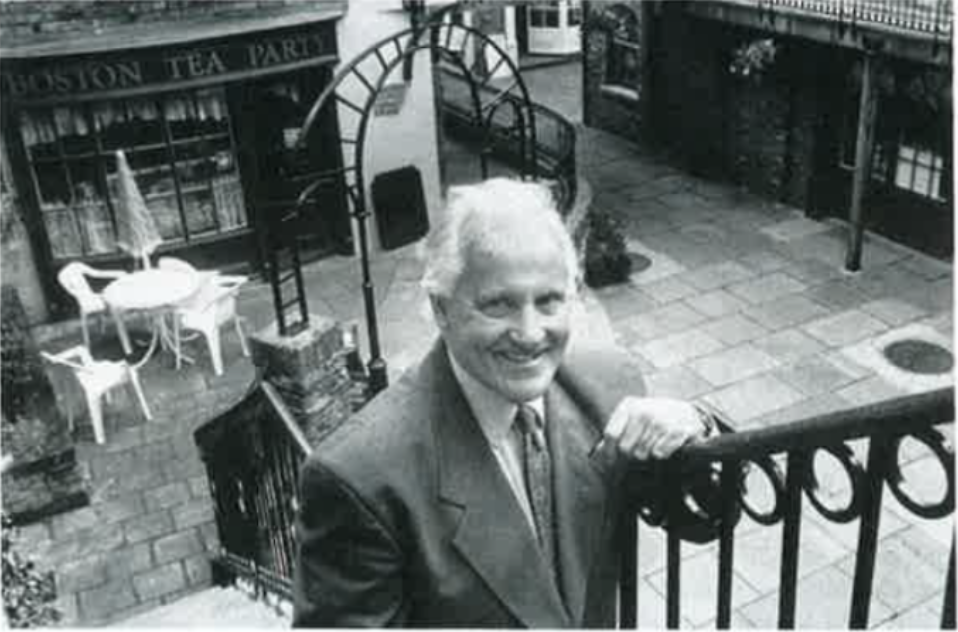
A walk through central Derry with Paddy Doherty, chief executive of the Derry Inner City Trust, is an excursion through history and hope. Casting his mind back to 1981 when the community group was formed, he recalls the scene in the city center. It seemed to have “a death rattle in its throat …we had lost one in three of our buildings, people had fled.”
An Irish nationalist who has the respect of British ministers who administer Northern Ireland, he has been a power-house of activity in helping to regenerate Derry.
The Trust, which has Derry’s Roman Catholic and Protestant Bishops on its board of directors, was set up as a community response to unemployment, a sense of hopelessness and the city center debris of conflict.
With financial support from British Government departments responsible for running Northern Ireland, Derry City Council, the International Fund for Ireland, the European Community and many other sources, the Trust set about rebuilding and restoring buildings within the old walled city and constructing new premises, including residential apartments and commercial units. It put heart back into the city. Its achievements are tangible.
One of its most notable successes is the Inner City Craft Village, a network of 18th-19th-century-styleshops,craftworks and restaurants built on land formerly occupied by old buildings and warehouses.
The Trust has 490 workers in training for full-time jobs and reckons that 100 jobs have been created in the privately run premises it has built.
It is building a five-story 150-bed youth hostel, and has plans for a genealogical heritage center where visitors will trace their roots at the press of a button. The Trust is also securing property for other future uses, including the construction of a multimedia training and music center for young people.
Paddy Doherty says: “The concept behind the work we’re doing is to use the city for the benefit of its people and to use its history for the benefit of its people, particularly in the provision of jobs.”
Under the courtyards and craft shops, Derry City Council is completing work on a 6,600square-foot underground “Siege Center,” designed to be one of Ireland’s leading tourist attractions. When it is fully operational, visitors will enter via the O’Doherty Fort, a 16th-century-style fort built recently on the original site of a castle. The fort will also be an exhibition center for cannon and other objects salvaged more than 20 years ago from the Spanish Armada wreck off the Donegal coast. The council has a target of 100,000 visitors annually for the new center.
Doherty speaks highly of the support from the DoE and the N.l. Department of Economic Development and says the craft village would not have happened without the support of the International Fund for Ireland, which receives major U.S. funding.
He explains: “There is a great surge of energy and a lot of people are shaking the cages all over the place to make sure that Derry has a place in the sun for the future.” Much of the light is being generated by the range of initiatives, involving projected spending of many millions of dollars, which are either under way or in the pipeline.
Chief among them is Derry’s planned showpiece commercial and office complex, Foyleside, a 65-million-pound project to be built by O’Connell Development Company of Boston. It will be a 260,000-square-foot complex overlooking the River Foyle, and the anchor tenant will be Marks Spencer, who will have a 45,000-square-foot store.
Design changes have contributed to the delay on the project since it was first announced more than two years ago, but it is hoped that work will get under way in the near future. The complex is expected to create about 700 jobs. A government office for public servants will also be part of Foyleside.
Work is well advanced on the construction of the new Port of Derry, a £17 million development, backed by EC money from Brussels, to provide a new deep-water port. High-level efforts are also being made to locate a pulp mill industry in Derry.
A £15 million commercial and leisure complex, likely to produce 200 jobs, is planned for Strand Road, one of the city’s many commercial areas. Community-led ventures underway include the present building of a £3 million DoE and IFI-backed new village center for the high unemployment Shantallow area, and a £3 million scheme, backed by government funds, to regenerate the main citywide Protestant housing area, The Fountain. Plans are also on the drawing board for community ventures in the Creggan area of the city.
City Council chief executive John Keanie lauds the energy he says is evident in Derry and he believes that Derry’s year-long festival, IMPACT 92, is helping make the city an international meeting place and a location for major conferences. Six conferences, including one with world figures discussing conflict resolution, are being held in the city in autumn, he says.
He, too, stresses the importance that cooperation between all the various agencies played in getting Derry to where it’s at now and where it’s going in the future.
Chamber of Commerce president Tony Jackson sums up the mood of all the diverse groups which are reasserting Derry’s will to win.
“What we’ve got going for us is that the whole town is playing on the same team.”
Editor’s Note: This article was originally published in the October 1992 issue of Irish America. ♦
Leave a Reply