
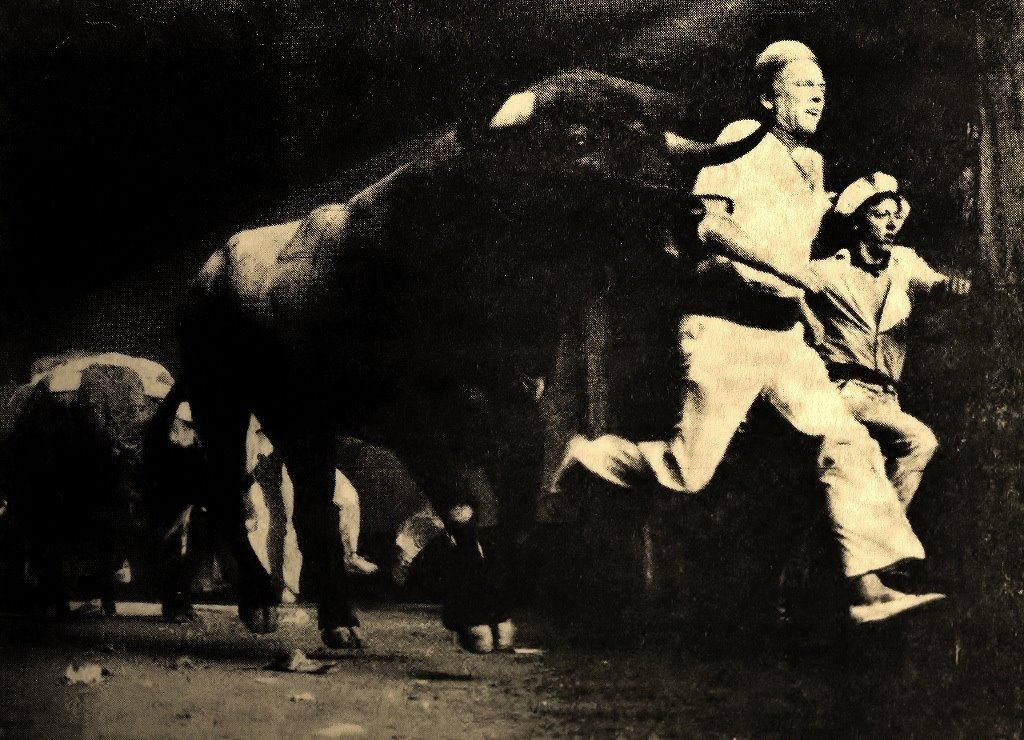
Matthew Carney was one of the most famous foreign-born runners of the bulls of Pamplona. Keith Kelly, on the trail of the elusive legend, discovers the spirit of bravado and romance that drew the Irish-American to Spain.
Under the carnival lights at the feast of San Fermin in northern Spain I first heard of Matt Carney, the California-born Irishman who ran with the bulls every year on their mad, half-mile charge to the bull ring of Pamplona. In the late 1960’s James Michener penned a mighty tome called Iberia and in the chapter on Pamplona he mentions Carney, his run-ins with Hemingway, and his great passion for running with the bulls.
My first knowledge of Carney came not from a long-ago book but from an accidental encounter with Augustin, a local Basque citizen of San Sebastian who temporarily lost his footing after drinking for two solid days. He had scraggly black hair, rotten teeth, a rumpled unkempt shirt that gets that way only after living in the same clothes for a few days. He looked a completely lost soul without a friend in the world. My amigo, Michael Foley, a hydrologist who works with the Navajo Indians in real life, lifted the barely coherent Augustin, propped him up in a chair and melted away into the crowd, joining the tens of thousands roaming the streets, singing, dancing, drinking.
When we returned several hours later to check up on him, we expected to find him semi-comatose. Instead, we found him fully revived, holding court at an outdoor cafe, telling stories in several languages and renewing acquaintances with the many aficionados who flock to Pamplona every year from all over the world.
It was through Augustin that we met Ollie Sandberg, down from Stockholm for the 18th year in a row, speaker of many languages, including English, Spanish, Swedish and Basque.
He was a heavy-set Swede who never roamed too far from his seat – only taking time to migrate from one cafe to the other side of the plaza when the sun got too hot in the afternoon, or slip away just after the evening bullfight to join some of his local dispersed family for dinner. While many of the foreigners seemed to flock to the Windsor Cafe near the Hotel Perla, or the very Basque-sounding Bar Txoko, Ollie and Augustin held court across the street at another outdoor cafe that had the unlikely name of Cafe Chocolate.
Ollie said that one year he met John Lennon at the feast of San Fermin in Pamplona. “Not even my wife believes me,” he said. I figured it was too bizarre to make up. Why bother making anything up in Pamplona?
“All is possible at San Fermin,” a young Basque girl had told me one night. I believed her and so I believed Ollie. On about the fifth day of the festival of San Fermin, Ollie said solemnly, “If you are Irish and from America then you must know of Matthew Carney.” It was my first time ever in Pamplona and I confessed I did not.
“He was the most famous foreign-born runner of the bulls there ever was in Pamplona, said Ollie. “Even the locals admired him.”
“Where is he now?”
“He is dead. He died of cancer in Florida in America.” I said it seemed a shame that he did not die with the bulls.
“He is buried in Ireland,” said Ollie. And that was all I knew.
At one point the next day, we wandered across to the Hotel Perla, an old and honored hotel right on the central plaza. A woman was entering the hotel.
Ollie called to her and she came over. She was the widow of Matt Carney, explained Ollie.
Every year she came to Pamplona. Actually she was not quite the widow in the strict sense of the word because they had divorced. But no matter, every, year she came to Pamplona with the children and nephews of Matthew Carney.
Ollie had the European suspicion of Americans who asked too many questions and so I did not ask too many.
I vowed to learn more of Matt Carney, however, and eventually heard that he had been in the Marines, gone into construction and then made a fortune as a male model in Paris.
That was before they had invented the term “super model” but I don’t think Carey would have qualified even if they had.
Nevertheless, it sounds like he made a good buck from the French who seemed to like his rugged Irish-American good looks. He married a woman in Paris-the woman I had met.
It was not until I was back in New York that the quest for the ghost of Matthew Carney resumed in earnest, and it was to be a twisting and elusive trail.
Ed Crane, the CBS radio broad-caster, put me on to the Club Taurino of New York, a group of bullfighting aficionados who had been gathering for years to cat, drink and swap stories in a Spanish restaurant on the Upper West Side of Manhattan. In the summers they go to Pamplona or other bullfighting capitals around the world. You always shift uneasily in a crowd when you do not know anyone, when it seems most everyone else is an old friend to each other. So I tried to make pleasant conversation at the Club Taurino, knowing that Hooked a rookie who did not know much of the lore.
Leaning on the bar, I bumped into a guy named Joe. I didn’t catch his last name. Don’t think he ever gave it. “Did you ever hear of Matthew Carney in Pamplona?” I asked. “Know him. He was my best friend.” Joe’s last name turned out to be Distler and he carried a picture of a run in Pamplona, Spain, July of 1972—twenty years ago this summer—with Carney gently touching the flank of a bull, matching the half-ton animal stride for stride as they burst into the bull ring.
Carney wore an American USA flag T-shirt and Distler was a few steps behind the master, wearing a Panama hat.
According to Distler, Carney got the shirt from a friend in Pamplona and vowed to wear it in the run the next morning because he was “sick of all the peaceniks.” I would later learn that Carney took many a mad man’s stance defending America in the Vietnam War. The famous photo of Carney gliding into the bull ring made the front page of Diario de Navarra, one of the local dailies, on July 9, 1972. Carney’s fame, which needed little enhancing in Pamplona, was spreading around the world.
“I often wonder how many runners have seen that photo and think that touching the bull is perfectly acceptable,” wrote Distler in Valor y Arte, the journal of the Club Taurino, on the 20th anniversary of the run.
“Of course, it is not. Normally, to touch the animal in any way is terribly dangerous and punished quickly by the pastores. In 1971,” stated Distler, “I had my hand on a bull and was rewarded by a pastor breaking three of my fingers with a stick. If a bull is distracted in any way, he can be suelto and cause all sorts of trouble.”
There have been very few deaths associated with the running of the bulls. But injury can be serious. One fellow spoke of seeing what looked like a purple balloon pop out of a runner’s shirt when he was stabbed by the astas de toro bayonets of the bull-and quickly realized it must be his intestines. Amazingly, the boy was said to survive.
In the first year that I ever ran, there was a wrong way bull that turned back on the crowd and eventually nabbed a Swede named Urban Turly in the kneecap at the Plaza de Toros near the very end of the run. The first day after the injury, they wondered if he would lose his leg. By the second day. he had come out of a coma and it looked like he would not lose the leg. On the third day. the newspaper reporters were let in and they asked Turly if he would run with the bulls again.
He said “yes, but not before the end of the week.”
Through a friend of Ollie’s, I learned that Urban was back in Pamplona in this the very first year after the injury. I do not know if he ran, however. But that is some of the spirit of Pamplona.
The quest for the ghost of Matthew Carney picked up in Pamplona as I tried to find Joe Distler once again. I finally met him at the Windsor Cafe, a great bar with polished wood and mirrors, good cigars and quick bartenders. But it was late and he was in a crowd enjoying himself.
Not the time to make him sad with questions.
“I’d love to do the interview sometime,” said Distler. “I was just to Ireland visiting his grave, earlier this summer.”
The next morning I was planning to run with the bulls once again myself and so was Distler.
Big wooden barricades that line the streets so that the bulls stay on course, and everywhere one looked there were the traditional Basque outfits—white shirt and white pants, red neckerchief and a flowing red sash around the waist. There are too many people trying to run these days and many more lining the barricades for a look. I was waiting for the run to begin at 8 a.m. sharp. I was strangely more nervous in this my second year of the enciero or run than I was in my first run. I think the first year it was a matter of deciding that I must run as some sort of great test. And after you run once and realize what can happen, and also that you have done it safely, the next test is to run again. And again. And that’s how it gets into your blood.
I stood there nervously pacing, waiting for the rocket to fire up in the air signifying the first bull was out. Six bulls run, accompanied by six steers. The steers run to maintain calm and keep the bulls herded.
When the last bull is out of the ring, another rocket fires. Hopefully, the rockets are close together, because that means the bulls are running in a tight pack. It is only when the bulls get separated that they can become dangerous. Even though it looks like dare-devil mayhem to the outsider, the keepers of the bulls actually want them to pass rapidly through the narrow streets down the Calle Estafeta and into the bull ring without distraction.
It costs a fortune to raise bulls and injured bulls are of no use in that night’s bull-fight.
There is no way a man can run the whole length of the half mile with the bulls-since a bull at top speed can run twice as fast as a man at top speed. But men can take the turns better. Especially if it’s wet. The hooves cannot grip the cobblestones and the bulls tend to topple over-generally taking runners with them, as if they were pins in a bowling alley. You think of all these things before you start to run because it is like the time before the start of the marathon. Although not so bad in some respects. You personally do not have to beat your last personal best. All you have to do is put yourself in a somewhat dangerous place and survive.
It is all cunning and survival and that’s really a lot simpler than trying to run faster and faster every year against the clock.
There is always that stray danger, but that is part of the fun. Nobody in Pamplona is too interested in the tale anyway. Waiting in the pack, I saw the back of Distler. “Hey Joe,” I shouted. I ran up and clapped him on the back. He says hello but has no intention of admitting me, the newcomer, into the inner sanctum of the veteran bull runners. “I have to go loosen up,” he said. We exchanged pleasantries, and he was off, pushing through the crowd on the street toward the bottom of the incline, right outside the temporary corral where the bulls come out of the gate. It is where only the best runners go. I imagined it must be Carney’s old territory.
A rocket fires into the early morning air. A great roar goes up from the crowd.
The enciero had begun.
People down on the street strain to look over their shoulders to see if the pounding bulls are in sight yet. This is actually very dangerous unless you have eyes in the back of your head, because it means runners are trying to run while looking backwards. All it takes is for one person to trip and a huge pile-up is underway. The bulls find a good pile-up to be a worthy target for a charge. And there is always the added danger of too many people and some getting trampled. There are new dangers since Hemingway wrote Death in the Afternoon about the matadors. Total chaos can reign on the streets in the morning long before the fine artistry of the bullfight that evening. I generally try to only glance back quickly because I realized that the bulls are all wearing great clanging bells around their necks. The first year I ran, I don’t remember seeing the approach of the bulls or hearing the roar of the crowd. But I remember the clanging of the bells. This year, there is no wrong-way bull and the run is very rapid and clean. But of course, Distler has melted away into the crowd. The huge metal doors to the bull ring slam shut blocking further runners from entering.
The last night in Pamplona approached. The festival only lasts seven days. Joe Distler, heading to the bullfight that night, made arrangements to meet at 9:00 p.m. after the fight just outside the restaurant of the Hotel Orhi, two blocks from the bullring. I began making my way there from the central plaza. It is not far but I ran into one of the roving bands from a so-called pena of Pamplona.
The penas are small social or drinking clubs and each has a roving marching band. They pack into the cheap, sunny, side seats at the bullfights and then roam through the streets all night, collecting great followings of people. It is a good spectacle, usually. But not when you’re in a hurry because the crush of people makes it impossible to pass rapidly.
By the time I reach the Hotel Orhi, Joe Distler is seated inside with friends. “We will meet after dinner,” Distler promised.
This will be the last chance to meet and hear tales of Matt Carney in Pamplona. I joined John Masterton, a freelance writer from New York, and we ate well and enjoyed a bottle or two of vino tinto.
Along about the second bottle came two young co-eds at the next table. They explain that they are from California. “We’re studying on an exchange program,” one said. “We came down from San Sebastian with some friends, but we got separated at the bus depot.” We tell them don’t worry.
We show them maps of the town and before we know it a third bottle of vino tinto is ordered Carney was and is a legend of Pamplona.
And yet he remains as elusive in death as he must have been in life when the wry, tanned, good-looking runner was running more than 100 times, always inches from the bull and most of the time avoiding the horns. I am a little sad that I was not a compatriot of Carney’s so that I might nostalgically recall the good days. But I’m also a little annoyed by people who say it was better years ago. Pamplona was pretty good now and I did not want to think too much about what happened long ago or what might happen in the future….
The night stretched out before us. The crowd from the hotel bar next door banged on the wall seemingly bursting with enthusiasm and two beautiful co-eds sat chatting to us from the next table. The spirit of bravado and romance that drew an Irish-American to Spain years ago lives on and somehow touches anyone who comes to this strange mountain town in early July for the feast of San Fermin. And once that is understood, perhaps I have learned all that I can know or all that I should know on this topic and the quest for the Ghost of Matthew James Carney is over.
Editor’s Note: This article was originally published in the November 1992 issue of Irish America. ♦
Leave a Reply