

John Banville’s first book, Long Larkin, was published in 1970; his most recent novel, Ghosts, has just come out. In the intervening years he has produced nine novels and received many awards. In 1989 he won the Guinness Peat Aviation Award for The Book of Evidence, which was also shortlisted for the Booker Prize. In addition to being one of the most highly regarded writers working in Ireland today, he is the literary editor of The Irish Times. He lives just outside Dublin with his American wife, Janet, and their two sons. On his recent U.S. tour to promote Ghosts, Jane Campbell met up with him at the Regency Hotel in New York.
John Banville’s flight out of Chicago had been delayed so he had called to warn me that he might be late: “They have telephones on planes now; isn’t it amazing?” It seemed fitting that he should say this, as a strong sense of amazement about the world runs through his work. Does he find the world a peculiar place? “It may be that there are people who are at ease in the world. I find it an incomprehensible place to be — I never get used to it. Or just when you are about to, something extraordinary happens. Here I was today on an obscure internal flight in America from Chicago to New York and on that flight there was the head of University College in Dublin. That coincidence is too much. I’ve become convinced that there are about a dozen people in the world and that this dozen people are actually dreaming everyone else. The trouble is I’m never sure if I’m one of the dozen or if I’m being dreamed.”
John Banville’s protagonists share his sense of awe. “They all seem obsessed both with the beauty and the horror of the world that they find themselves in and with the notion that with all this beauty and strangeness there must be order somewhere, some key, some trick. And they all discover that they’re wrong of course.”
His writing is in part an attempt to reproduce what he sees. “When I was subediting in the 1980s I would drive to work at about 5 in the evening, and I was convinced I would be killed because I wouldn’t be able to take my eyes off these ravishingly beautiful autumnal skies. One of the reasons for writing is to reproduce this extraordinary tender beautiful world in another medium. I would like the surface of the books to be so immediate and gripping that you could touch this world that’s being described.”
He lives and works in Ireland. “I can’t live anywhere else because of the light; it changes every 5 minutes and I couldn’t live without that constant shifting. I suppose there must be some creative energy at work in a country like Ireland which is so morally puzzled at the moment. The grip of the Church has been weakened and the country is in a kind of free fall.”
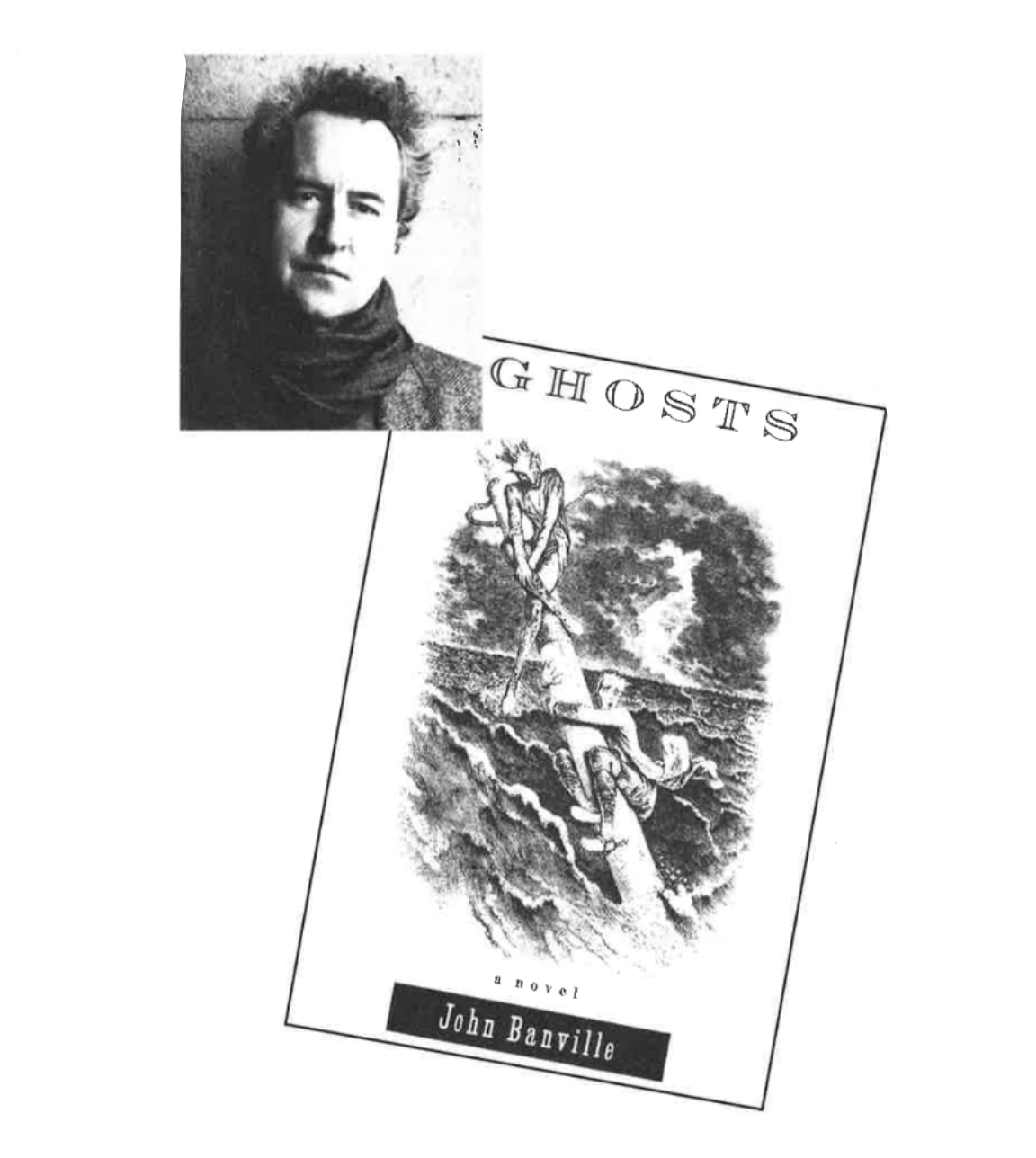
He does not, however, think of himself as an Irish writer. “I feel that a writer should not identify themselves as a particular nationality. One is a writer and one is an Irish person… There is a perceived vision of Irishness, which has always been a danger for Irish writers working in England. There is always the possibility of being misunderstood — being taken for a happy, colorful, innocent child.”
Does Roddy Doyle — whose books top both Irish and English best-seller lists and whose sales of Paddy Clarke Ha Ha Ha have broken publishing records since winning the Booker Prize — fit into this scenario? “Roddy writes what he writes, but the phenomenon makes me a bit uneasy. I suppose I don’t think anyone should have all that much success. Goethe said after the great success of The Sorrows of Young Werther that the one thing he realized is that after a success like that, society makes damn sure you never do it again and one of the ways they do that is by giving you all this praise and money. But if anyone can take the strain and survive, it’s him.”
Banville was raised a Catholic, gave it up when he was nineteen, but says, only half ironically, “I’m grateful to the Church for the wonderful sense of guilt it gave me; I don’t think I’ll ever lose it, and it’s absolute gold for a writer. It also gave me a sense of ritual and of the starkness of the choices that face human beings. The great drama of the death on the cross concentrates the mind on the bloodiness and the complexity of life. The Church of course is one of the reasons psychiatry has never caught on in Ireland. We don’t need it because we have confession. It’s a wonderful thing to go into the dark and tell a bored man the intimate secrets of your life; it is short, and it doesn’t cost anything.”
He loves the U.S. “I’m pro-American. I like the way America will actually do things. Europeans sneer at America for sending troops to Somalia or trying to send a peace envoy to Ireland, but at least they try. Despite everything, they still send their sons overseas, possibly to be killed, for a good cause; that’s amazing in this modern world. Self-interest is a large part of the motivation, but everyone is self interested and it would be foolish and fatuous to pretend we are not.”
He has occasionally been criticized for not being more specifically political. He sees this complaint as misguided. “Birchwood [written in 1974] was a work of art. Years later when I came to do a film script I looked at the skeleton and I realized how much of the politics of the early 1970s was in that book. In the seventies Northern Ireland was falling to pieces — not as badly as it is now but we took it more seriously. I was surprised to see how much of that had crept into the book without my intending it. I think that is how art reflects its time; almost by accident, through osmosis.” Similarly with The Book of Evidence “People complained that it was self-regarding. Here is a book about a man suffering from an acute failure of the imagination who is able to kill people. Is that not a description of Ireland at the moment? We have dulled our imaginations, because the first prerequisite for having a civil war is to prevent yourself from imagining what it’s like to be the other side. I’m not saying I intended The Book of Evidence to point up this moral, but it’s there.”
He is currently working on the final part of the triptych which began with The Book of Evidence and continues with Ghosts. In this one his narrator has an affair with a woman who may or may not be a figment of his imagination. While Banville thinks that if anyone has developed a style to make writing about sex possible it is himself, he concedes that “You have to be very careful. Most sex in fiction is like schoolboy smutty stories, the naming of parts. I’m trying to write sensuously about the ways in which sex affects us, how the physical and the emotional keep sending sparks across the jump leads.” In addition to working on the novel, he was recently commissioned by Neil Jordan to write a screenplay based on Elizabeth Bowen’s novel The Last September.
This evening, however, he is off to give a reading at Ireland House, along with poet Derek Mahon. As he jumps into the car to go and I wish him luck, he worries self-deprecatingly about boring the audience. “To paraphrase Flann O’Brien, There’s no such thing as a large whisky and there’s no such thing as a short reading.” And with that, he is away into the night.
Editor’s Note: This article was originally published in the May/June 1994 issue of Irish America. ♦
Leave a Reply