
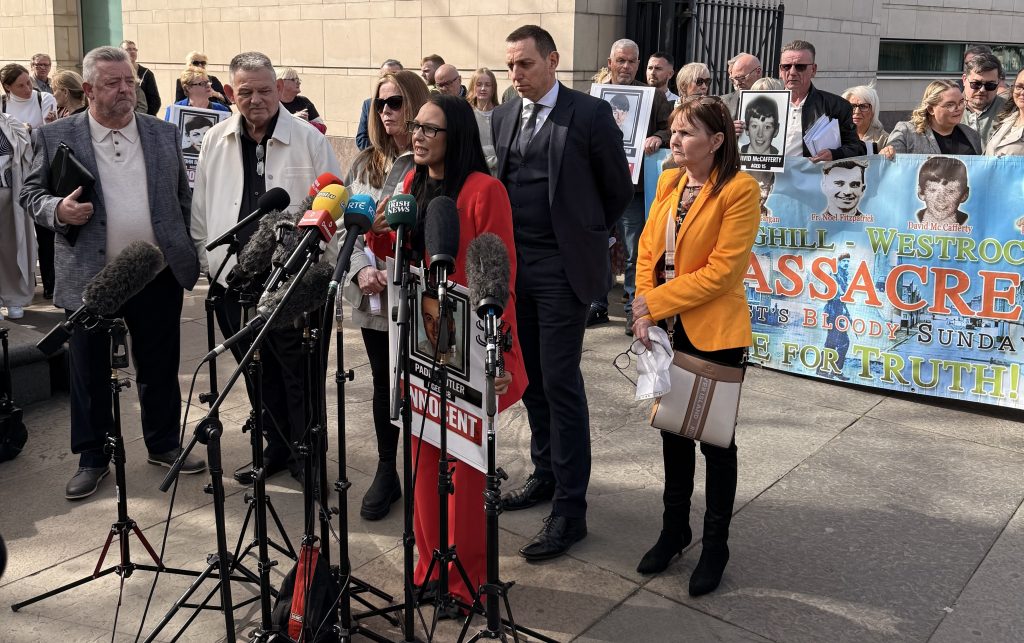
The last few minutes waiting for the verdict in the Belfast court were excruciating. Relatives of five people shot dead by British soldiers in west Belfast one night in July 1972 sat at the back of the huge courtroom. Some of us invited by the families sat behind the glass screen that separated our benches from the judge, listening to his ruling through speakers.
By four o’clock on the afternoon of Thursday, April 30, we had been listening to the coroner, Mr. Justice Scoffield for nearly six hours.
He explained the reasoning behind his findings on how the five – John Dougal (16); local priest Fr. Noel Fitzpatrick (42); father of six Paddy Butler (37), David McCafferty (15) and Margaret Gargin (13) – had been killed in the Springhill/Westrock neighbourhood on the night of 9 July 1972.
The judge had heard evidence over several months in early 2024, listening to testimony from locals, forensic experts, and British soldiers who had been there that night. He then took two more years to deliver his verdict.
Before announcing the verdicts on how the five had been killed, and by whom, he explained some of the difficulties of ruling on a case more than 50 years old. People’s memories had changed over the decades, some witnesses had died, and the British Ministry of Defence had withheld, lost or destroyed important evidence.
For example, the radio logs of the British Army’s 1st King’s Regiment during the hour of the shootings were mysteriously missing. A list identifying which soldiers had provided statements detailing their role in the incident couldn’t be found.
He also related at some length the difficulties in deciding what exactly was happening in the neighborhood that night, as an IRA ceasefire was breaking down a few miles away, and determining what exactly John Dougal, the first of those killed, had been doing. John Dougal had been in the Fianna, the youth wing of the IRA, and the judge said that although he was “not satisfied” that the 16-year-old was acting innocently, he was equally not satisfied that John Dougal was armed.
Just as the clock ticked towards 4pm, and Justice Scoffield prepared to deliver the verdicts, the sound system broke. After waiting nearly 54 years for the truth about how their relatives had been killed, the families could not hear the judge’s words over the loud, crackly static.
Justice Scoffield paused, realizing the commotion in the back as we waved and gestured though the glass. After a few false starts the system began to work again, and the verdicts were delivered.
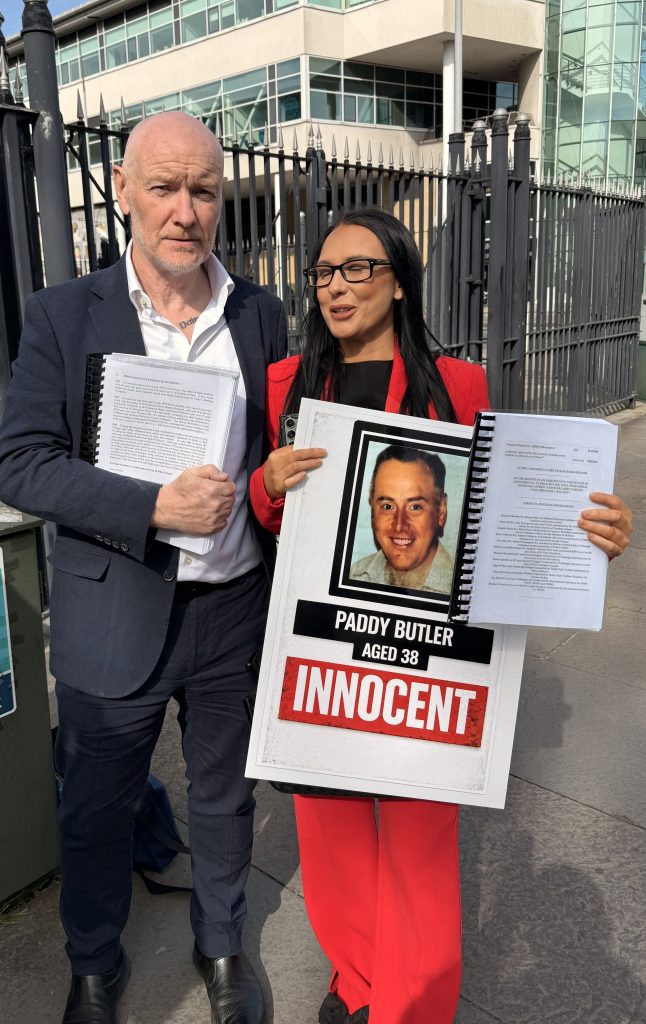
Justice Scoffield found that 16-year-old John Dougal had been shot in the back while running away from gunfire by British soldiers from the 1st King’s Regiment based in a local timber yard. He found that Fr. Noel Fitzpatrick and Paddy Butler had been killed by the same bullet while trying to reach and help Dougal and two other wounded teenagers. Both, he ruled, were unarmed.
He found too that 15-year-old David McCafferty was unarmed, posing no risk, and had been killed while trying to recover the body of Fr. Noel. He ruled too that 13-year-old Margaret Gargin had been shot in the face by a British soldier from a distance of about 60 yards. Margaret, said the judge, had been “unarmed and was posing no threat. She was talking to friends.”
Some of the families in court reacted with applause, hugs and tears. Others sat in solemn silence, their heads in their hands.
The 640-page ruling from the inquest provides much more detail on each of the deaths, and of the actions of the British soldiers that night. The verdicts were a major vindication of the decades-long campaign by the relatives to get a coroner’s inquest into the killings. In 2023, the British government passed the Legacy Act addressing issues related to the Northern Ireland conflict. It came into effect a year later, abolishing such inquests. This case was the very last to be heard, with evidence concluding just hours before the cut-off deadline.
Part of London’s motivation in stopping these inquests is to prevent verdicts such as this one, finding that British soldiers shot civilians dead with impunity and without proper reason during the Northern Ireland conflict. In 2021, a coroner’s inquest found that in 1971 ten innocent people were killed in Ballymurphy, close to Springhill/Westrock in West Belfast. The coroner found that at least nine of the victims were killed by British soldiers.
In 2022, another coroner’s inquest ruled that a British soldier was unjustified in killing Kathleen Thompson, a 47-year-old mother of six, when he shot her in the back garden of her Derry home in 1971.
Legislation is before the British parliament now aimed at overhauling the terrible Legacy Act, but whether it will reopen these coroners’ inquests, and allow more bereaved families to bring cases to establish the truth, is still unclear.
For the Springhill/Westrock families there is little prospect of prosecutions of the soldiers identified as the killers (referred to as Soldiers A and E by the court, their anonymity protected). But their campaign is vindicated, the names of the victims cleared, and the truth is finally out.
Brian Dooley is a prominent Irish human rights activist, author, and expert on transnational civil rights and human rights defenders.
Finally justice was served. What a terrible waste of these young lives.
Let us hope that unification comes to Ireland in our time!