John Dunlap: The Irish-born Printer of the Declaration of Independence
At the age of ten John Dunlap was sent to Philadelphia to help his immigrant uncle who was a printer there.
He took over his uncle’s business and became the official printer to the provisional government of the 13 states which rebelled against British rule. On the night of July 4, 1776, Dunlap printed for publication the first copies of the Declaration of Independence, which Congress had approved that day.
He served as George Washington’s bodyguard in the War of Independence. He established the first newspaper of significance in America to be published every day.
In the 1770s tensions, were rising between Britain and its thirteen rebellious American colonies, from Maine in the north to Georgia in the south. The Continental Congress was established to be a collective challenge to oppressive British rule. The Congress was based in the State House in Philadelphia. John Dunlap had his printing business nearby.
By the middle of 1776, there’d been fighting between the colonists and British troops for over a year. Common opposition to British taxation and defense of individual rights brought the colonies together. In July, after a month of debate, Congress declared: “That these United Colonies are, and of Right ought to be Free and Independent States; that they are Absolved from all Allegiance to the British Crown..” and “We hold these truths to be self-evident, that all men are created equal, that they are endowed by their Creator with certain unalienable Rights, that among these are Life, Liberty and the pursuit of Happiness;”;words that have echoed down the centuries.
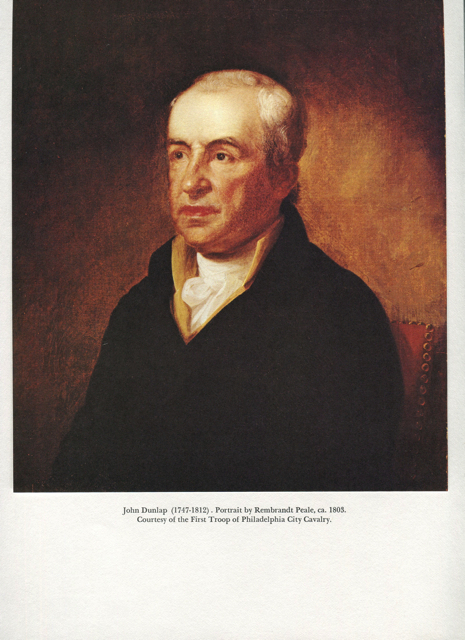
On the evening of the 4th of July 1776, President of Congress John Hancock ordered John Dunlap to print broadside copies of the Declaration, that is, on a large sheet of paper on one side only. Dunlap was 29, an Irish immigrant. He took the handwritten fair copy and spent the night setting it in type, correcting it, and running off what’s thought to have been around 200 copies. With British troops converging on the colonies, the Declaration was a dangerous document. Dunlap was as much at risk as any of the signatories. According to the historian Ted Widmer: “There is evidence it (the printing) was done quickly, and in excitement- watermarks are reversed, some copies look as if they were folded before the ink could dry, and bits of punctuation move around from one copy to another. It is romantic to think that Benjamin Franklin, the greatest printer of his day, was there in Dunlap’s shop to supervise, and that (Thomas) Jefferson, the nervous author (of the Declaration) was also close at hand.”
The copies came to be known as the Dunlap Broadsides and were sent across all thirteen states in the next two days. Commander-in-Chief George Washington ordered that the Declaration be read to the troops on the 9th of July. What’s thought to be a fragment of that Broadside is in the Library of Congress in Washington. In all, some 26 copies are known to still exist, most of them in museums.
John Dunlap was born in Strabane in 1746. It’s thought he was taken on as a very young apprentice at one of a dozen printing presses in the town. Gray’s Printing Press is the last remaining, preserved by the National Trust. When he was about ten, Dunlap was sent to Philadelphia to help his uncle William, also a printer, who had emigrated to America. The well-trained assistant slept under the counter in the printing shop at first, but Dunlap prospered, bought his uncle’s business, and set about expanding it. In 1771, he started a weekly newspaper, the Pennsylvania Packet. Later he began publishing it as the first successful daily newspaper in the US.
He married Elizabeth Ellison, a widow from Liverpool, in 1773. They had eight children, two of whom died in infancy.

As British troops closed in on Philadelphia in the autumn of 1777, Dunlap left the city and moved his press to Lancaster, safely behind American lines. He was the first printer back into Philadelphia in July 1778. By then he himself had seen active service in the war of Independence as an officer in the First Troop Pennsylvania City Cavalry. He was George Washington’s bodyguard and is believed to have fought alongside the Continental Army at the battles of Trenton and Princeton. He led the Cavalry in suppressing the Whiskey Rebellion against President Washington’s government in 1794, when armed farmers fought a tax imposed on distilling surplus grain. Dunlap wrote: “With pleasure I tell you, that when the Laws and Government of this happy country require defence, the First Troop of Philadelphia Cavalry wants but one hour’s notice to march.” The Troop is the oldest military unit in the United States still in active service.
As part of his contract with Congress Dunlap was also responsible for the printing of the US Constitution and published it for the first time in the Pennsylvania Packet . He printed paper money for Pennsylvania and Virginia. During his life Dunlap gathered considerable personal wealth. He bought up the property taken from loyalists who refused to take the new Pennsylvania Loyalty oath. Eventually he owned nearly 100,000 acres in several states.
John Dunlap died on November 27, 1812, five months after the United States declared war on Great Britain.He was buried with military honors in Christ Church graveyard, Philadelphia.
In 1949 Michael J Walsh, who first catalogued the then-known broadside editions, called the Dunlap broadside “the single most important printed document in our national annals”.
The first printing of the Declaration is an extraordinary moment in world history, in which John Dunlap, the young apprentice from West Tyrone, became a key player.
Paul Roelle from the U.S. Consulate in Belfast says: “As we mark Freedom 250 and celebrate the ideals that have shaped the American nation, we’re reminded that the early chapters of our history are strongly intertwined with emigrants from these shores.
As printer of the Declaration of Independence, John Dunlap played a central role in bringing our nation’s founding document to the American public. His legacy reflects the profound influence of people from places like Strabane in the trajectory of the United States.
We commend the Ulster History Circle, the Ulster-Scots Agency and the National Trust for their dedication to preserve the stories that connect us. Their work enriches our understanding of a shared past, but it also strengthens the bonds of friendship and partnership that unite Northern Ireland and the United States today.
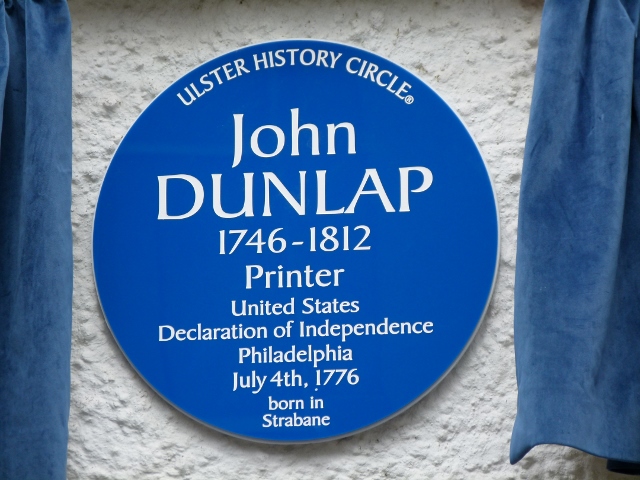
Ulster History Circle chairman Chris Spurr says: “John Dunlap arrived in Philadelphia as a boy, with no inkling that there in July 1776 he would print a document which would change the history of the world. 250 years later, the Ulster History Circle is delighted to commemorate the Strabane-born printer of the American Declaration of Independence with a blue plaque at the last-remaining historic printshop in his hometown. The Circle is grateful for financial support towards the plaque from the Ulster-Scots Agency, and to the US Consulate in Belfast and the National Trust for their valued assistance.”
Seamus McKee is a member of the Ulster History Circle, which puts up blue plaques to people who have made a significant contribution to life in the nine counties of Ulster and beyond.
Leave a Reply