
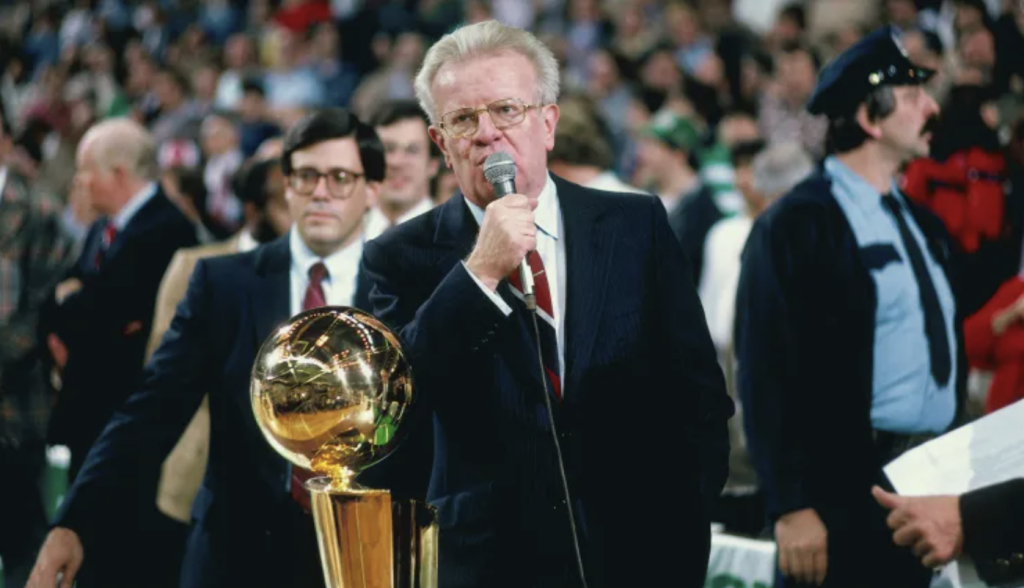
When someone mentions the NBA Finals, you might think of Jordan or Kobe slashing their way to the rim. Or, more recently, the video game-like exploits of three-point assassin Steph Curry.
You’re less likely to think of a sub-6-foot, visually-impaired, cigarette-smoking Irish-American political operative. And yet these supreme athletes were indeed pouring their sweat and souls out for the Larry O’Brien NBA Championship Trophy.
Lawrence Francis O’Brien Jr. was born in his father’s boardinghouse on July 7, 1917, in Springfield, Massachusetts — where the sport of basketball itself began (invented by Dr. James Naismith in 1891).
Both of O’Brien’s parents were immigrants from County Cork. His mother, Myra Sweeney O’Brien, came from Dunmanway. And his father, Lawrence O’Brien Sr., came from Kilbrittain.
The father was a staunch Democrat and personal friend of James Michael Curley (longtime mayor of Boston and onetime governor of Massachusetts). In O’Brien’s home, the two would brainstorm over possible strategies to “break the hated Yankee Republican grip on western Massachusetts.”
The younger O’Brien became politically active at a very early age, volunteering for the 1928 presidential campaign of Democrat Al Smith (Irish on his mother’s side, he was the first serious Catholic candidate for the U.S. presidency).
As a young man, O’Brien obtained a degree at the Western New England University School of Law (then known as Northeastern University — Springfield Division). But he didn’t really want to practice law, so he instead worked as a bartender in his father’s establishment and briefly served as president of the Hotel & Restaurant Employees Union.
O’Brien was drafted into the army during World War II, but his severely limited eyesight (20/400 vision reportedly) made him ineligible for combat duty. So he remained at Camp Edwards in Massachusetts.
Around the time of his military discharge, he married Elva O’Brien née Brassard. They would have one child, Lawrence O’Brien III.
For years, O’Brien worked on the campaigns of local politicians. But his career really gained momentum in the 1950s, when John F. Kennedy appointed him as the director of his election campaigns for the U.S. House of Representatives.
He then served as Kennedy’s national campaign director for his 1960 presidential campaign. Upon winning the election, Kennedy tapped O’Brien for the role of Special Assistant.
O’Brien was riding in the motorcade in Dallas when Pres. Kennedy was assassinated. He later served as Postmaster General for the ensuing Lyndon B. Johnson administration.
After Pres. Johnson declined to seek reelection, O’Brien began working as an adviser to Senator Robert F. Kennedy.
In the wake of the second Kennedy assassination on June 6, 1968, O’Brien returned to his hometown “with nothing to do and nothing I wanted to do.”
Later coaxed out of his dejection, O’Brien would serve as the chairman of the Democratic National Committee. His was one of the telephone lines bugged by Pres. Nixon’s henchmen: Among other activities during the June 16, 1972, Watergate burglary, they were seeking to replace the secret listening device within O’Brien’s phone.
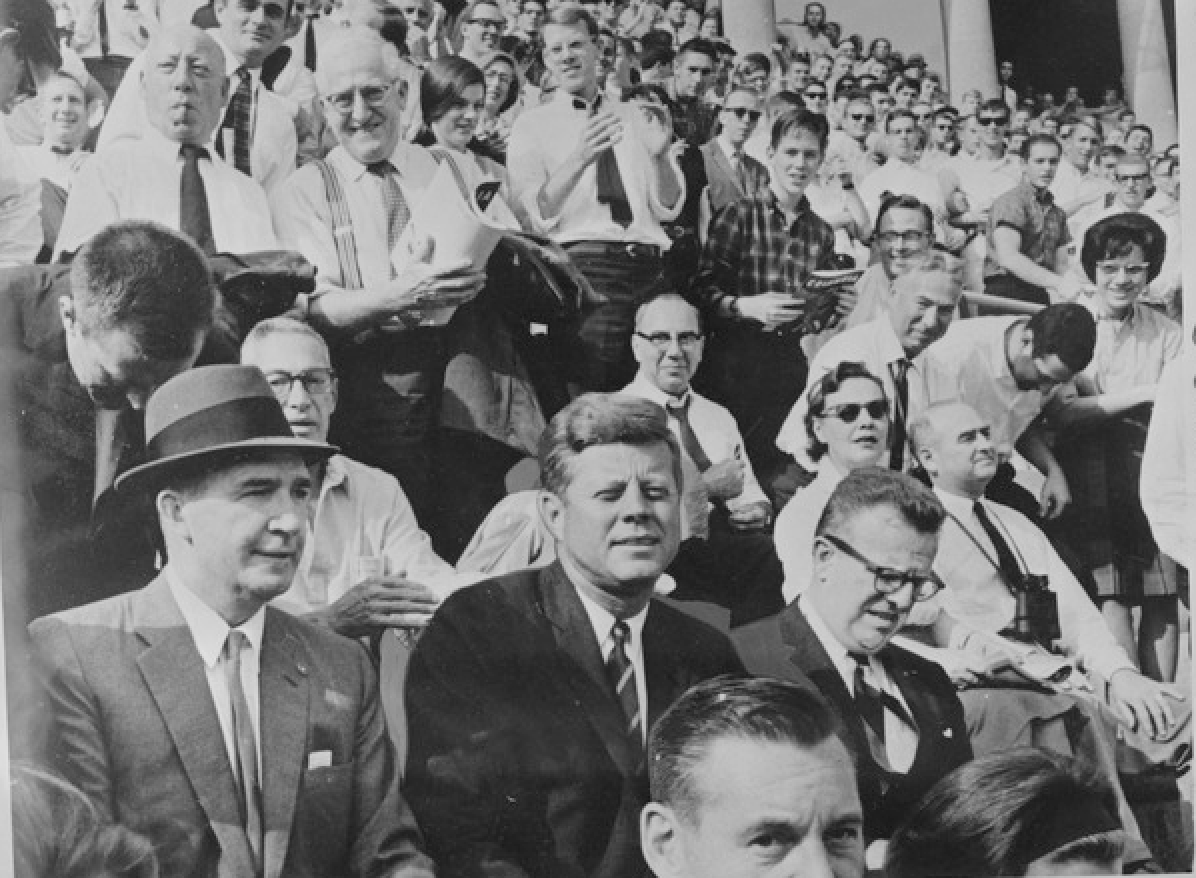
Boston Public Library – © Paoletta, Rocca A.
In 1974, O’Brien released the political memoir No Final Victories: A Life in Politics from John Fitzgerald Kennedy to Watergate. He also authored the “O’Brien Manual” — a handbook of instructions for how to organize politically.
Additionally, he invented the “O’Brien Home Telephone Technique,” which used a female volunteer to call everyone listed on a single page of the phone book, asking them for their support and promising free transport to the voting polls.
O’Brien himself described his technique as “the full utilization of womanpower” (keep in mind, this is more than half a century ago).
The master political technician entered the sports world when he accepted the role of commissioner of the National Basketball Association in 1975.
At that time, the league was only a fraction as popular and lucrative as it would later become. It was also the middle of the drug decade. Many of the players were hooked. They also wanted more money.
O’Brien — who later in his tenure introduced the salary cap — launched what were then the strongest substance abuse regulations in U.S. professional sports.
He also oversaw the merger of the NBA with the ABA (American Basketball Association). During his near-decade of stewardship, game attendance and TV revenue soared.
O’Brien resigned as commissioner on Nov. 10, 1983. The NBA Championship Trophy was given his name soon after.
He later served as president of the Basketball Hall of Fame in his hometown of Springfield, MA. O’Brien died of cancer in Manhattan on Sept. 28, 1990, at age 73.
By his own admission, he was no athlete. But O’Brien was a superstar when it came to running things. And the ultimate dream of some of the world’s most freakishly gifted sportsmen is to hoist his trophy over their heads.
Note: There has been a new injection of Irish-American relevance into the NBA with the recent triumph of the New York Knicks, who just ended their 53-year title drought. The current Knicks owner is Irish-American James Dolan. Also of Irish heritage is Knicks assistant coach and defensive coordinator Brendan O’Connor. The Knicks franchise was founded in 1946 by Ned Irish, who, despite his surname, does not actually have Irish ancestry.
Leave a Reply