

The Beckett Festival at the Gate Theatre during Dublin’s Theatre Festival was the first ever of its kind, presenting all 19 of Beckett’s plays in just three weeks.
One couldn’t help wishing Sam were there to witness the hugely favorable response of ordinary theatergoers to plays once reputed to be of extraordinary difficulty. Even though I didn’t get to see the entire retrospective, I managed quite a lot and discovered that Beckett in bulk isn’t the ordeal one imagined it could have been. Once I entered the labyrinth of Beckett’s mind, I was constantly struck by his incredible inventiveness, will, and unpitying, formal precision—in the short pieces as well as the major plays. Many of us, I suspect, wanted to camp out in the Gate and wait for more, like kids at a Saturday matinee.
According to Michael Colgan, director of the Gate, the series was a terrific success, sparking interest in Europe and the U.S. as well as in Dublin—it has been invited to ten other countries.
Colgan first met Samuel Beckett in the early eighties and discussed with him then the idea of putting on all his plays. The famous writer was not averse to the idea, but had one piece of sage advice: “Keep it simple. And simple it was—with stark sets by noted Irish painters Louis de Broquey and Robert Ballagh and directors from European countries who had personal experience with Beckett, the man and his work. Beckett always said that the voices he heard in his head spoke with Irish inflections. The robust Dublin accent of Johnny Murphy as Estragon in Waiting For Godot was perfectly matched by Barry McGovern’s more neutral cadences as Vladimir. With sheer speed, Didi and Gogo detonated their one-liners like firecrackers, drawing loud laughs from the audience.
“You should have been a poet,” says one of the tramps to the other. “I was once,” is the instant response, pointing to his rags, “Isn’t it obvious?”
Though they are hobos, they once had expectations. In Walter Asmus’ production at the Gate, there were no long silences filled with unspeakable pain. I was reminded of Beckett’s own production for the Schiller Theatre, which he brought to the Abbey in the seventies. Beckett showed us then how he wanted the text played: fast, light, and rhythmic, with everything in proportion—as long as the stage Oirishness of it all doesn’t obliterate the real tragedy of the piece, because Beckett insists on the necessary link between suffering and wit. He told us that “nothing is funnier than unhappiness.” In this production, Alan Stanford’s Pozzo was masterful and Stephen Brennan’s Lucky brought tears to my eyes.
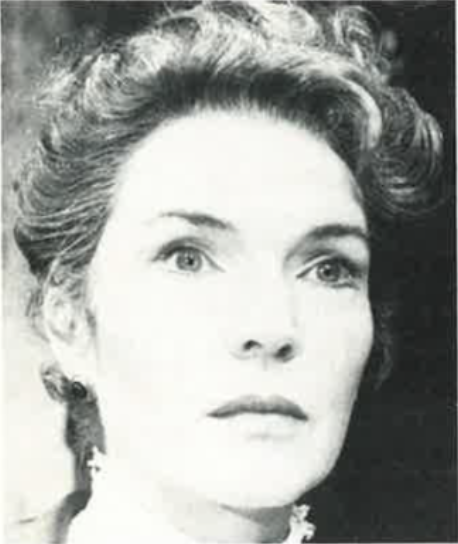
Fionnula Flanagan’s powerful interpretation of Winnie in Happy Days made me see the difficult challenge Beckell offers an actress. Until this play Beckett never fully featured the personality of a woman. There are no females in Godor. Winnie is usually played as a prattling, if adorable, pest, as she sinks deeper into her sand dune, but Flanagan, in the production directed by Caroline Fitzgerald, makes Winnie a survivor. Beckett’s first real female character is also as revealed here as his only the first act Winnie is a housewife who happens to be half-buried in sand. As she rambles on, there are hints that she once had a better life, and she has had fleeting moments of passion with husband Willie (Bill Golding), who is out of sight. She occasionally showers him with wifely concerns and fills the rest of her time fiddling with the contents of her handbag and her memories of her life: she sat on the knee of a bishop once, her first kiss was in a tool shed. She can barely tolerate bodily functions – as taken to the extreme by Willie.
Flanagan orchestrates the text with a recurring sequence of changes in register so as to present Winnie as a character simultaneously blind to her fate and excruciatingly conscious of it. The second act is very short.
Flanagan is no longer fat but svelte and beautiful. When Willie finally crawls into view, she falls on him with the accumulated disgust of a lifetime.
She has been oppressed by his cowardly silences, by the boredom of being an under-occupied housewife, and most of all by being fat, female, and fifty in a culture which does not approve.
Flanagan’s brilliant performance was one of a great Dublin actress returning to her home city.
The last play of this wonderful Beckett Festival was, very appropriately, a production of Endgame directed by Antoni Liberti. Hamm (Alan Stanford) sits in a wheelchair blind and crippled, and Clov (Barry McGovern) waits on him in return for board and food. Hamm’s ancient parents, legless after an accident, hold out inside dustbins for the last minutes of their lives. Endgame takes up from where Godot left off. But it is, by Beckett’s admission, “more inhuman.”
So why watch it? The delight to be found here is unlike any other ever experienced. There is no emotional gratification, no conclusion. All you have is Hamm and Clove’s question, “Are we beginning to mean something?” and their cosmic laughter at the very idea.
Editor’s Note: This article was originally published in the February 1992 issue of Irish America. ♦
Leave a Reply