
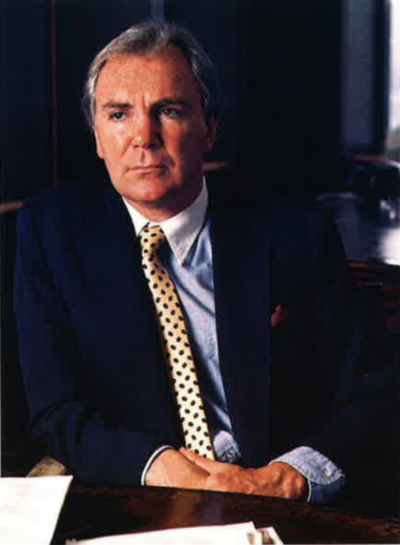
Read about Dr. Anthony J.F. O’Reilly, Chairman and C.E.O. of H.J. Heinz, in Fortune or The New York Times and you will discover how his executive skills propelled him from a position on the Dairy Board of Ireland to head of a global food processing company that manufactures its products in 15 countries and sells them in 200. Read media journals and you will find out about Independent Newspapers, the largest publishing group in Ireland, with chains of newspapers in Australia and an advertising agency in Mexico. Try House and Garden for stories about his beautifully restored home in Ireland, Castlemartin, or the share his Pitzwilton company holds in Waterford Wedgwood.
Now all may mention, too, his involvement with The American Ireland Fund and the other Ireland Funds in Canada, Australia, Great Britain, France, Germany and New Zealand. But Irish America found that it took Seamus Heaney to put the words on what may someday be judged the most important of Dr. O’Reilly’s achievements. The poet describes the funds as “having, as it were, the power of an international equipment to boost and transform the Irish vernacular.” How, you may ask, does such a description apply to a program basically devoted to the good works of peace, culture and charity in Ireland though the generosity of the Irish of whatever generation who live outside Ireland?
In the address he delivered before Dr. O’Reilly and the members of the combined boards of the Ireland Funds, Heaney spoke of “the doubleness of our focus in Ireland, our capacity to live in two places at the one time and two times in the one place.” Certainly Dr. O’Reilly himself embodies this capacity.
A United States resident since 1971, he told the New York Times, “I never really felt I left Ireland. I feel a sense of loyalty, commitment and indeed debt to Ireland.” As a constitutional nationalist one of the ways he repays the debt is by supporting programs through the Ireland Funds that contribute to a peaceful resolution of the conflict in Northern Ireland. With that in mind Dr. O’Reilly announced the latest Ireland Fund grants in a ceremony at Belfast’s historic Linen Hall Library, itself a recipient of a $50,000 grant in 1989.
“I am particularly pleased to announced these grants in the Linen Hall Library,” he said. “It stands in the heart of Belfast and is open to all sections of the community for all cultural traditions.” The latest of the more than 1,600 ventures funded by the $58 million raised by the Ireland Funds include aid to the Scientific and Heritage Foundation in County Offaly for the creation of a science museum park; The Mayo Resource Center for the Unemployed; The Field Day Theater Company and the Derry Center for Creative Communications.
The Confederation of Concern, O’Reilly’s name for this union of international funds, provides an opportunity for the 70 million people of Irish descent scattered throughout the world to satisfy, in Heaney’s words, “the sharp desire that all of us occasionally experi-ence, to pay into an effort that would have renovative effects upon the unfocused, yet beloved, Ireland of the present North and South.”
The particular pattern of O’Reilly life equips him to understand and implement this desire.
As a star rugby player he toured the world with both the Irish and the British Lions, playing away, but very much representing his country. As head of H.J. Heinz, he must think globally and yet he remains embedded in Ireland. He seems to have found a way to reconcile himself to the dilemma Heaney presents of “a secular modern citizen of the world,” who still feels “vaguely in exile from somewhere inside or outside.” For Dr. O’Reilly and millions of others, that “somewhere” is Ireland, both the “dreamtime” country and the modern State.
With the American Ireland Fund Dr, O’Reilly provides an opportunity for those separated from it by distance and time, to reaffirm connections from the past and offer hope for the future.
Irish America magazine is proud to name Dr. Anthony J.F. O’Reilly our Irish American of the Year.
Editor’s Note: This article was originally published in the March 1992 issue of Irish America. ♦
Leave a Reply