
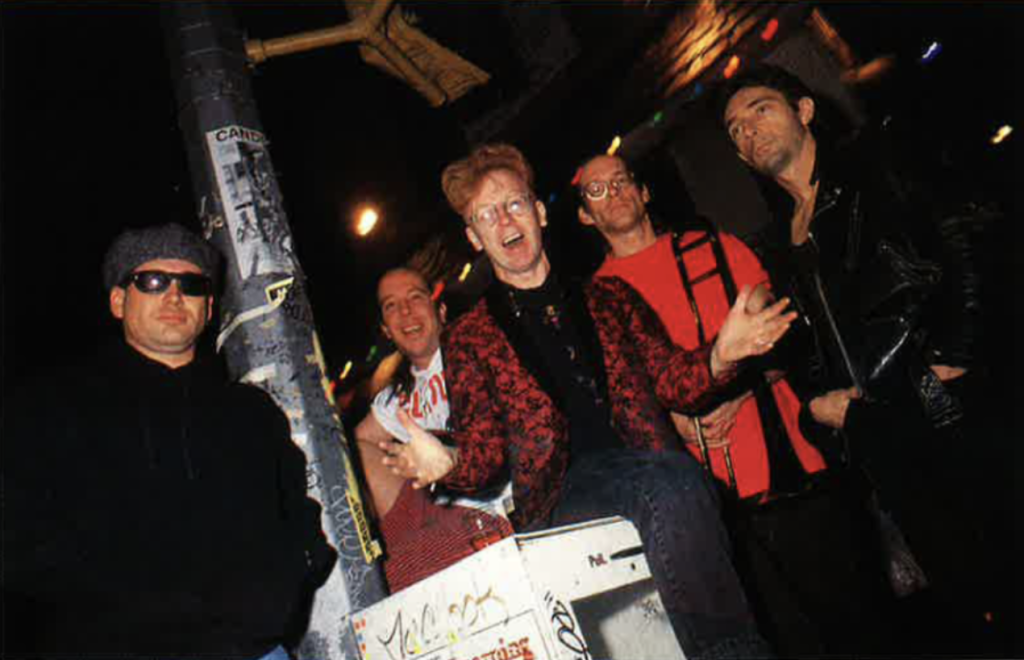
As Larry Kirwan, the wiry lead guitarist and singer drags out this melodramatic emigration song, the eyes of the young Irish woman beside me mist over. She silently mouthes the words to herself as Chris Byre’s plaintive tin whistle comes in over Kirwan’s dirge.
Byre, his crew-cut head bowed, dark shades hung low, continues with a slow air on the tin whistle, adding to the sombre mood and evoking images of a bleak Irish countryside. In front of him Paddy Reilly’s bar is hushed, sweaty and jammed, and behind the band, through the plate glass window, the traffic on Second Avenue rushes by.
There is a sudden, wrenching change of mood when Kirwan segues into Bob Dylan’s “Like a Rolling Stone.” “How does it feel… to be on your own with no direction home, like a complete unknown … just like a rolling stone.”
Kirwan spits out the lyrics and the band is roaring on all cylinders.
It is a perfect segue, with the theme of displacement and alienation in a fresh setting. The drums crash, the saxophone and tin whistle squeal and two young men pressed-up against the stage almost spit the words back at Kirwan. With the Black 47 treatment an old standard cover takes on a new meaning.
You don’t have to be standing for too long in this popular Manhattan venue to get the kind of feeling that comes from experiencing a band doing something exciting. The lines outside the door are a testimony to the buzz that this band have generated in New York. And after a couple of years on the road Black 47 are now attracting substantial music industry and media attention.
They have been profiled in places as diverse as New York Newsday, the Irish Times, Rolling Stone and Penthouse magazine, who had this to say: “There are those few lucky souls who saw the Beatles play The Cavern, Dylan at the Gaslight, or Springsteen rip the Stone Pony. Add to those ranks anyone who has spent a sweat-drenched Wednesday or Saturday night this past year jammed into Paddy Reilly’s Pub…” Hmm.
On recent nights at Paddy Reilly’s there had been visits from the likes of actors Matt Dillon, Liam Neeson, Kiefer Sutherland and, (God preserve us!) Brooke Shields. A rock video was also in progress and Johnny Cash was making a guest appearance.
But, as the saying goes, ’twas a long way from the likes of Brooke Shields and Johnny Cash these guys were reared. “The first gig we played,” as Larry Kirwan remembers it, “was a benefit, and we opened for Bernadette Devlin. It was in the back room of the Galtymore Pub in the Bronx.
I also remember that some guy shouted, “play something Irish for God’s sake!’* There was a logic to all this that the original duo, Wexford native Larry Kirwan and Brooklynite Chris Byrne, had worked out. “We had this idea of taking original songs and playing them in an Irish bar setting. We figured that only the best songs would survive,” Kirwan said. So they took an electric guitar, a drum machine, Byrne’s suillean pipes and tin whistle, and a bunch of Larry Kirwan songs and headed for the Bronx.
The reaction from somewhat inebriated audiences who were used to U2 and Dire Straits’ covers was oft times problematic.
“Sometimes they were downright hostile,” Byrne remembers, “and owners would say that we could come back if we stuck to cover versions.” But Byrne and Kirwan, who were later joined by Fred Parcells on trombone, were not easily deterred.
“We never thought about jacking it in,” Byrne said. “To tell you the truth, the more shit we got the more reinforced we became. I used to think, the Pogues wouid get through this.”
In young immigrant pubs like Sarsfields, the Phoenix and the Village along the Bainbridge Avenue strip, they peddled their stuff. “We thought the young Irish would go for it but they really didn’t. They came to socialize and we didn’t want to be treated like a jukehox. At the end of songs we would have to shout, ‘Thank you’ over the buzz of conversation, “Kirwan remembers. And it wasn’t as if they weren’t playing fun music-like “Funky Ceili,” the song about the man who was mad for jigs and reels and leaves Bridie, the baby and the job in the bank back in Ireland:
“Fiddleeee diddicece deidelydee! / was born to play the funky ceili Over the seas and far away off to Americay/Fiddleeee diddleeee deidelydee/Where the wild, wild women are waiting for meThink of me Bridie whenever you see me there on your MTV! I love you, a cushla, but how couid I bel Without me punky, funky ceili.”
The band just kept playing the music but according to Kirwan they soon started to run out of bars. It was around then-and just in the nick of time-that they discovered Paddy Reilly’s and its brash, if somewhat eccentric manager, Steve Duggan.
At first sight it didn’t seem like a match made in heaven. In his previous life in Ireland, Duggan was a Gaelic footballer, greyhound owner, sports store owner. bookie, ballroom manager and showband agent–and not necessarily in that order.
In New York, Duggan was best known as an agent for Irish country singer Daniel O’Donnell, a performer renowned for, and downright proud of his blandness.
But Duggan, one of the great characters on the New York bar and entertainment scene; saw Black 47 had something different and gave them a Saturday night residency and plenty of time.
And eventually the crowds found them.
Along the way former Dexys Midnight Runners’ saxophonist Geoff Blythe, and percussionist Tommy Hamill were added to the line-up. giving the band an accomplished depth and texture of sound.
This new audience—a fairly typical New York crowd with a strong core of Irish Americans—saw an honesty and passion in this band that is not born of the market place. Unlike say, the cynical posturing of a band like U2 that as someone commented, would give world peace a bad name, Black 47 songs are strongly rooted in beliefs about life, love, emigration, politics and as their name suggests (after 1847, the worst year of the Great Irish Famine) the long journey of Irish people and their culture in America.
A typical set can start with the Kirwan song “Forty Shades of Blue,” about a friend who ended up on the Bowery having hallucinations about Johnny Cash, to “Free Joe Now,” a rousing number written by Chris Byre about Joc Doherty that blazes along with trombone and sax tooting and flurries of percussion into a squaling climax, followed by a touching Kirwan love song, “On the Banks of the Hudson.”
The band is not shy about politics either.
Part of the repertoire is a Kirwan number about the Irish republican socialist martyr, James Connolly. On that night in Reilly’s only a scattered applause greeted the introduction. “Well I can see he’s well appreciated in this bar,” Kirwan growled, “What the hell is this, yuppies night out?!”
The band is unequivocal about things like British withdrawal from Northern Ireland and the low opinion they have about the petty repressions of Irish society. “Land of de Valera” is sung like many of their songs in a kind of hip-hop beat with an Irish trad/rock overlay: “Fianna Fail, Fine Gael, Labor’s got me on the rails! It never seemed to make no sense, I couldn’t tell the difference! Stay married, hate her guts, no no no divorce! Little girls all end up pregnant, hypocrites in every convent.”
“It’s safer not to sing about Northern Ireland,” Byrne says, “but if you ignore it you’re accepting it. You’re also put on the defensive about the IRA. That’s stupidreally. Afterall they never ask Bob Geldof to defend the SAS, do they?”
Although the band’s ethnic roots are diverse: Byrne and Hamill (Irish American), Kirwan (Irish), Blythe (English) and Parcells (“Oh, he’s a WASP from Detroit,” Kirwan says), they want to root the band in a progressive Irish American identity.
“The last boost we had was the Clancy Brothers in the 1960’s and since then everything has been static. That was radical stuff,” Byrne says, “Our ambition is do something like that in the 90’s. Let’s face it, Irish Americans have to aspire to something higher than three cheers forold Notre Dame!”
Byrne says that some of his generation looked to U2. “I remember seeing these young Irish Americans at a U2 gig waiting for “Sunday, Bloody Sunday” and on comes Bono to lecture them about how it’s not a rebel song. They’re really tired of being patronized.”
To pigeon hole Black 47 as some kind of ethnic water-carriers would do the band a major injustice. Their music is as diverse as the band’s own roots in new wave, Irish traditional music, soul and jazz. “It’s New York music, I suppose,” Kirwan says.
Byrne nods. “That’Il do,” he says with a grin.
Editor’s Note: This article was originally published in the February 1992 issue of Irish America. ♦
Leave a Reply