
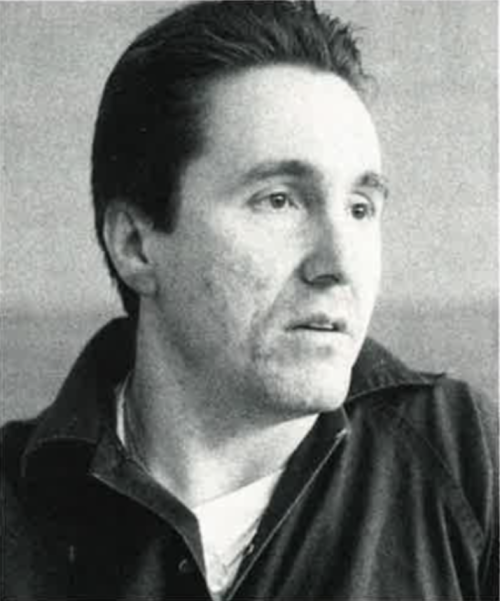
At the end of it all, it was from his fellow inmates at the Lewisburg, Pennsylvania, federal penitentiary that Joe Doherty heard the news. “Hey Joe, you’re going to go,” shouted an inmate who was tuned in to the radio, which had just announced the U.S. Supreme Court’s decision of that day, January 15. The Court decision had effectively paved the way for Doherty’s deportation back to his native Northern Ireland.
The decision meant that it was the end of the line for the 37-year-old Belfast native. The Supreme Court decided that, despite almost a decade of legal victories, and consequent appeals by the U.S. government, Doherty is not eligible even to apply for political asylum. At press time Doherty, with no cards left to play, was expecting to be sent back within a matter of days.
Immediately after the announcement there was an outcry in cities across the U.S., led by politicians who have fought on Doherty’s behalf all the way. Dozens of members of Congress have sent a letter of protest to President George Bush’s Attorney General, William Barr.
However Doherty has become far more than a pet cause for Irish Americans and their politicians. The United Nations and Amnesty International have protested Doherty’s treatment, and the case has become a matter of concern for all Americans concerned about interference from the U.S. executive in matters of the law.
Coming from a nationalist background in Belfast, it is not surprising that Doherty was only 17 when he was first arrested. He was rounded up with hundreds of other men, women and children in the great internment raids of 1972. Guilty or not, these people were rounded up by the British security forces and jailed without charge or without hearing as a way of dealing with the rising violence in Northern Ireland.
Ten days into Doherty’s internment came the Bloody Sunday massacre in Derry. For Doherty the trauma of Bloody Sunday was the breaking point; the day after he was released he joined the IRA.
In 1980 Doherty was arrested along with three other IRA men after a shootout left a British officer dead. In 1981 Doherty escaped from Belfast’s Crumlin Road jail along with seven others, and he promptly fled for the Republic of Ireland before heading for a new life in the U.S. Doherty was settling in just fine, living uneventfully in New Jersey, until he was picked up by federal agents while working as a bartender at Clancy’s in Manhattan. Soon enough the British government filed an extradition request.
The problem however was that, as-U.S. judge John Sprizzo ruled in 1984, Doherty was exempt from extradition because his offense against the U.K. was a political one, not a criminal one. He fell under a time-honored tradition of refuge for political enemies of foreign states which could be traced back as far back as the day when George Washington refused to extradite Citizen Genet back to France. In the ruling Sprizzo asserted that Doherty’s was a political offense case “in its most classic form.”
This did not deter the Reagan administration however, which in 1986 created an amendment to the U.S./U.K. extradition treaty that erased the political exemption clause.
This amendment, coincidentally, was just weeks ago ruled unconstitutional by a federal Court because it was unfairly and specifically targeted at Doherty and two other IRA members. To Doherty supporters, it seemed apparent that the U.S. government would stop at no length in their attempt to deliver Doherty back to their political ally, Britain.
In 1986 Doherty asked to be deported 1o the Republic of Ireland, but that too was blocked by U.S. Immigration officials, who ordered he be delivered to the U.K. The Irish Republic’s 1987 extradition agreement, which allowed for political offenders like Doherty to be extradited to the U.K., took away that option for Doherty anyway, and Doherty’s lawyers, Mary Pike and Steve Somerstein, had him apply for political asylum.
An Immigration Appeals board granted Pike and Somerstein’s request for a political asylum hearing, but then-Attorney General Richard Thomburgh reversed the ruling, ordering Doherty to be returned to the U.K. Once again, despite the repeated favorable decisions by the U.S. judicial branch, the executive intervened. The matter was heard by the Supreme Court last October.
Justices Scalia, Stevens and Souter argued that Thornburgh unfairly denied Doherty the asylum hearing because of foreign policy considerations. However Justices Rehnquist, White, Blackmun, O’Connor and Kennedy agreed with Thornburgh, and the case was over.
And so, after almost nine years in American jails without a charge, Doherty will now be deported back to Northern Ireland, where he could face up to 20 years in Long Kesh prison outside Belfast.
According to Pike, Doherty is thankful for his supporters in America, whom he said often have more respect for the Constitution than their government does.
Editor’s Note: This article was originally published in the February 1992 issue of Irish America. ♦
Leave a Reply