
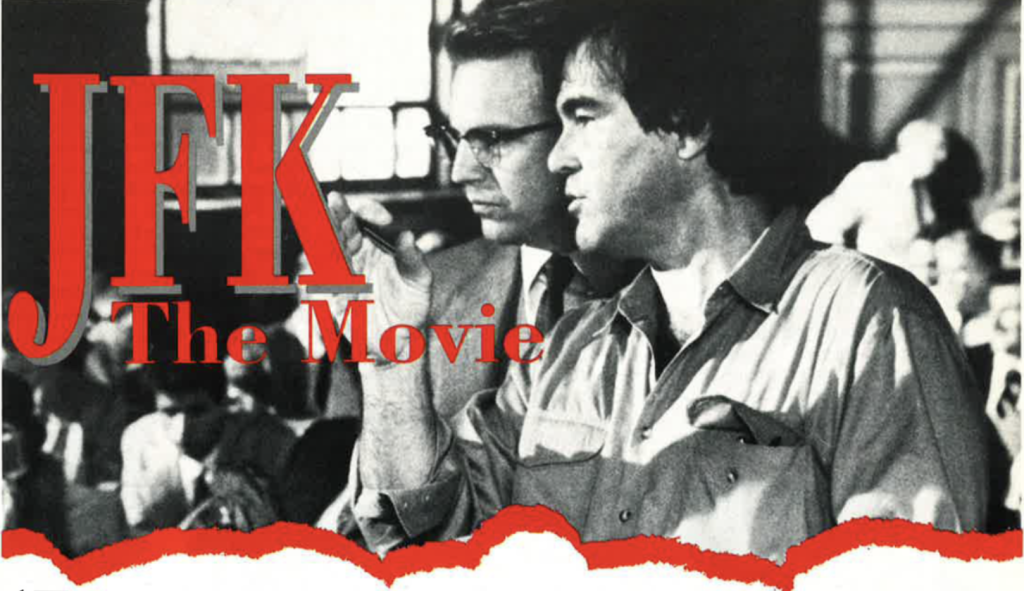
“It is distressing, and saddening,” said Senator Edward Kennedy about the movie JFK.
“Obviously it’s a very painful experience to have, you know, the advertisements, the pictures, the scenes,” Kennedy told an interviewer on WGMC-TV. The memory of the assassination of a much-loved President is distressing and saddening to all of us. Oliver Stone’s movie drew fire even before it opened, when a first draft of the script was leaked to the press. But as more and more people see the movie, pressure has grown to confront the unfinished business of President Kennedy’s death.
In a Gallup poll conducted in July 1991, asked “Do you believe that the Warren Commission was right that Kennedy was killed by Lee Harvey Oswald acting alone and on his own—or do you believe that others were involved?” Seventy-three percent of Americans said they believed others were involved. Even though Senator Kennedy does not plan to see the movie he says that “there should be more items declassified.” At present the sealed records on the president’s assassination will not be available until the year 2029. Kennedy while stating ” I think you’ll find out over any period of time that the Warren Commission was clearly the most responsible re-sult,” went on to say “but I respect other peoples’ conclusions.”
The New York Times in a story headlined “J.F.K. May Elicit Action On Files,” reported that Representative Louis Stokes, who chaired the House committee investigation into the assassination was now ready to consider recommending that hereto secret files be unsealed, if only to refute implications that his panel was negligent.
The man who has fueled the controversy, Oliver Stone, director of JFK makes no secret of his admiration of John Fitzgerald Kennedy and his belief that his murder profoundly changed the essence of America. For Stone, Kennedy was “the Godfather of my generation. He was the new man, young handsome, full of love of life and laughter. Great smile. Great Irish delivery.”
Stone’s theory is that the desire of the military-industrial complex to escalate the war in Vietnam motivated the assassination.
Pulitzer-prize winning journalist Michael Pakenham, whose career as reporter and editor include covering John F. Kennedy and interviewing five other U.S. presidents, interviewed Stone for SPIN magazine of which he is executive editor. The following was not included in the version of that interview which appeared in the January issue of SPIN.
Pakenham: At what point in your personal evolution do you think you came to believe that Kennedy was killed by a conspiracy of elaborate proportions?
Stone: Oh, late in the game. I bought it.
I thought, in the words of Kevin Costner in Bull Durham, “Lee Oswald did it all by his lonesome.” I didn’t really get into it very much until I read Jim’s (Garrison) book, in the 1980s. I thought it was one hell of a whodunit, right off the bat. It was a tiny book. Well written and never reviewed, by the way, in any serious newspaper. That was my initial igniter, and then I started to read all the books. [Texas journalist] Jim Marrs’ book, which is not bad. It’s called Crossfire, [published 1989). Jim Marrs is an old-line newspaper man from Fort Worth, a Texas boy. He’s been on the case, and he did, I really think, a commendable job of writing, of making it exciting.
So I bought the book because I wanted to update the Garrison version. The Garrison story ends basically in 1969 at the trial. And I wanted to include all the post-Garrison research, credible research theories from the “70s, the ’80s —and Mars had that in his book. And then I read the top books about it and the more I read-Anthony Summers’ book, [Conspiracy: A Thoroughly Updated Edition of the Definitive Book on the JFK Assassination], Sylvia Meagher’s book [Accessories After the Fact: The Warren Commission, the Authorities & the Report], Mark Lane’s book Rush to Judgment arid the movie, the documentary. I also saw Executive Action [based on Lane’s book about the JFK assassination, starred Burt Lancaster, 1973].
All these thing collided in my mind in one year basically, in the late ’80s. I wrote the script, with Zachary Sklar, who was the editor of Jim’s book.
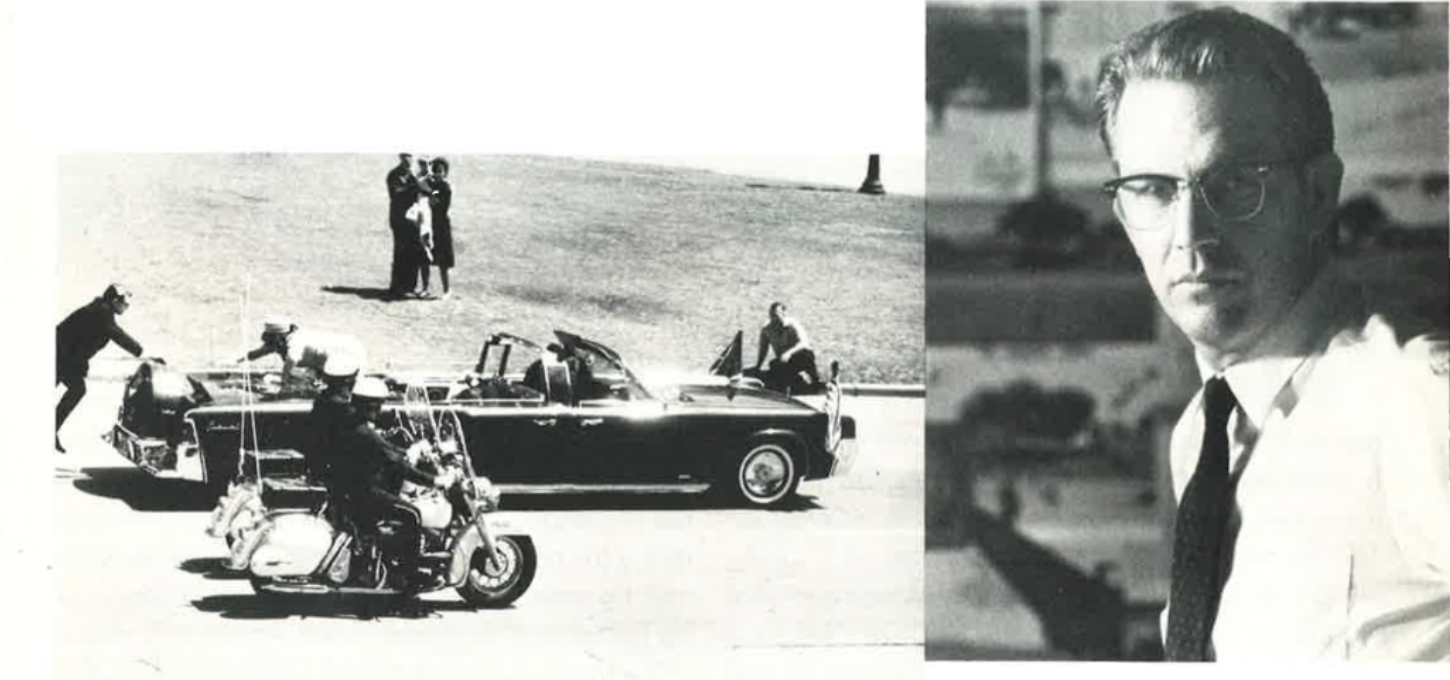
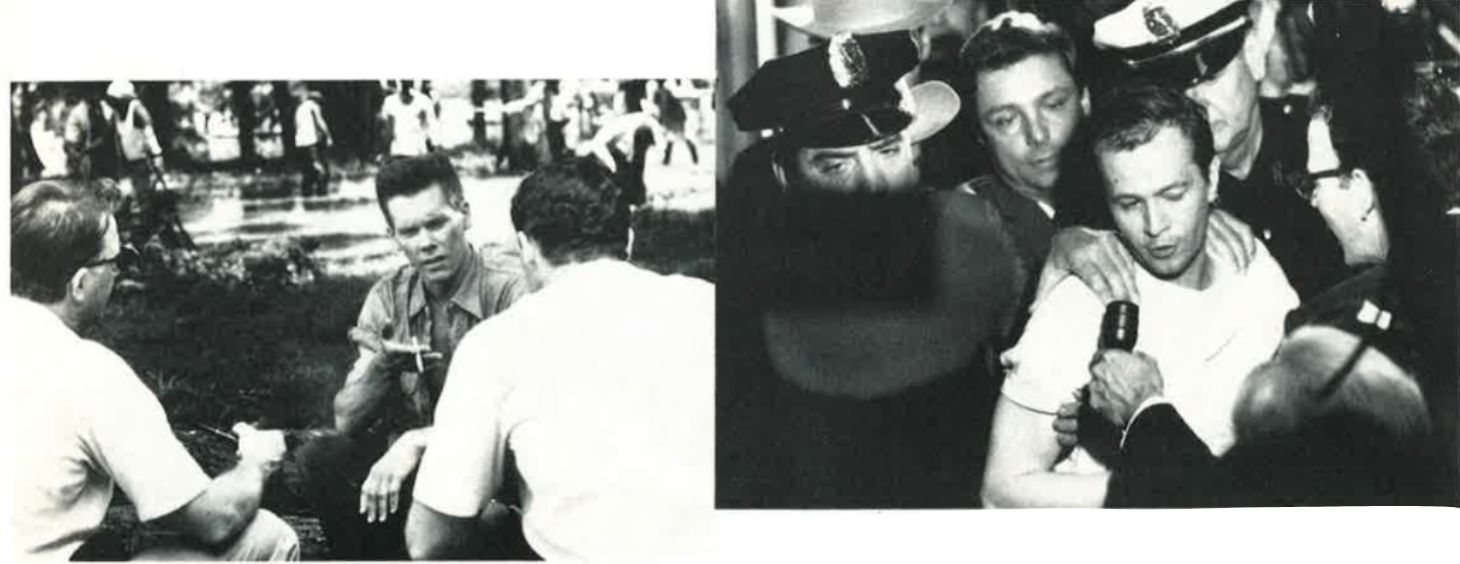
In the movie Garrison’s expose of the case deals with two parts. Garrison goes after the New Orleans connection from Guy Banister through Jack Martin to David Ferrie and Clay Shaw and Lee Oswald. Separately from that he explores the Dealey Plaza witnesses. He goes through a series of people that tell him what happened to them that particular day in Dealey Plaza. Out of that he formulates his own analysis of the Zapruder film and what happened to Kennedy.
Packenham: You used John Kennedy in Born On the Fourth of July.
Stone: Yes. He gives that keynote speech at his inauguration saying that we’ll go anywhere to defend the rights of all to freedom. Of course that was used to tie into the Vietnam experience. The implication in that movie was that his call to serve sent the boys to Vietnam which is mythically true. People like Ron Kovie did respond to that, and I responded to it. But in fact he [Kennedy] did not send combat troops to Vietnam.
And I do not believe he would have engaged in Vietnam. He would never have sent combat troops over there after ’64. There’s a book that’s coming out in January called JFK and the Deception of Vietnam by John Newman, which has been quite an interesting ground-breaking work. There’s new documentation that shows that Kennedy and his generals were hardly getting along. There was quite a lot of dissension between them, between the Joint Chiefs, specifically Lemnitzer, Harkins and Max Taylor and Kennedy. I’m going to reiterate this several times, staff right up to the eve of his death when they were meeting in Honolulu, November 20. He was very worried about getting into a war. He said to Mike Mansfield, “How the hell can I send troops into Viet-nam, American boys into Vietnam to fight? People will not support it when they won’t even support an invasion of Cuba, which is 90 miles away. How are they gonna support it 9,000 miles away?” He made that point repeatedly. And told Mansfield, [Senate Majority Leader] who had been criticizing him, that he was right, and that he was going to do something about it after the election. But he could not do anything up front, except maybe this: He did issue a withdrawal order for a thousand men, by Christmas of ’63. A thousand advisers were to come out. It was an NSAM— National Security Action Memorandum— 263. It was never announced. It was hidden. But it was there. And then when Johnson came into office three days later, the first thing he did was issue NSAM 273. which in effect canceled the withdrawal.
Pakenham: Yet in the 100 days after the assassination, when the Vietnam policy was largely shaped, in the first three and a half months of the Johnson presidency. there was very little debate in Washington, as I remember it—and I was there, so I think I remember it—about what Kennedy would have done. About the course that was going on, supported by, among others, Mansfield. Isn’t that, according to your interpretation just now, flying in the face of what would have been Kennedy’s intent?
Stone: Kennedy was ambivalent— ambiguous would be the right word, not ambivalent. Publicly, a strong posture; privately, I’m not going to go to war there. I’m going to withdraw.
But Jack Kennedy did refuse to send combat troops in 1961 and in 1963 he planned to withdraw the remaining advisers in Vietnam after the election. And he told several intimates including Mike Mansfield and Wayne Morse and [Kennedy’s adviser] Kenny O’Donnell that he was going to do that. He was ambiguous about it because he wanted to publicly maintain a tough Cold War posture to win the re-election of ’64.
Pakenham: Do you think the forces who were responsible for killing John Kennedy or leading to his death are still alive and functioning today with the same essential motives and potency?
Stone: No, I think the world has changed now, radically, because of the Russian withdrawal from the Manichean system.
But those forces are still in place and what they are going to do now is a key question for our age. Are we going to honestly cut back on armaments or not? I don’t know. Are we going to create new enemies, new demons, like Saddam Husseins? And Nicaragua, you know, Danny Ortegas? Or are we going to live in a more economic competition with the world?
Pakenham: Your suggestion is that these people were interested in developing war essentially for profit. Is it that simple or are the motivations really more complex than that?
Stone: I think you’ve asked the key question. I mean, one could argue that World War I was started for profit.
Pakenham: It’soften been argued much more than, say, World War II.
Stone: One could argue that World War Il was started for profit. War was never declared against Germany, it was declared against Japan first. That war was coming, it was predicted 15, 20 years before. Why?
Because the Japanese were chasing Southeast Asia. They wanted Southeast Asia.
There were a lot of reserves, resources down there. America always felt some kind of a protective relationship to Southeast Asia. The domino theory goes back to that Japanese era.
Pakenham: Kennedy could have reversed that?
Stone: Kennedy would have been a great hero now because he would have been the man meeting Gorbachev and they would have probably have ended this nuclear race quicker and we would be in a different position now. But Reagan, of course, was slow to accept the realization that Gorbachev meant this and as Tom Gates was saying it was all a trick as late as 1986 and 1987 when [late CIA director] Bill Casey was in office….
Pakenham: Interestingly enough, and I don’t know how it fits or if it doesn’t, John Kennedy was personally closer to more journalists than any President in history. He had extraordinary close relationships— for example, Ben Bradlee was his next door neighbor.
Stone: Ben Bradlee! With friends like that, who needs enemies. I mean Ben Bradlee has done so little to investigate his friend’s death it is beyond me. One begins to wonder about Ben Bradlee in the light of reading Silent Coup [by Len Colodny and Robert Gettlin, St. Martin’s Press, 1991].
Ben Bradlee is supposedly the hero of liberal journalism because he has been played by Jason Robards [Jr.]. I think he should be played by Rod Steiger based on his Kennedy investigation.
Pakenham: Was it tough for you to walk from a rock’n’roll icon to an icon of political culture?
Stone: No, no. Because they were both stars in the sixties. But bear in mind that Garrison is the protagonist in this movie, that John Kennedy is a ghost. That’s why the movie is called JFK, sort of like the initials are a code that he lives after his death.
Pakenham: You’ve been quoted widely, but I’m not sure how fairly, on trying to reshape the world through movies.
Stone: Sounds good, huh? Let me put it this way, I think I’ve ended up reshaping my world through movies. I like to reshape the world as I see it through movies. Of course, you would hope your movie makes it across the world and everyone would love it and it will just reshape the mythology of Kennedy from the Warren Commission mythology of Kennedy to the movie’s mythology. But it ain’t going to happen that way. Mythologies take time to replace. I think if my movie is good and has entertainment value and people are excited by it, then it has the ability, by being seen all across the world, to supplant the Warren Commission conclusion. But I don’t think the Warren Commission is believed in Europe-that Oswald did it.
We had a scene in the movie, where Johnny Carson interviewed Garrison [not in the final cut] and he said “Aren’t you being a little paranoid? And Garrison says “No, I’m not Johnny, you know, what if this were 1963 and this were Moscow and a prime minister who wanted to accommodate the West was shot by a lonely capitalist sympathizer from an office building in Moscow. And who then was subsequently shot by an angry, patriotic Muscovite in a police station. Wouldn’t you say that there had been a transference of power there? A coup d’état?”
And Johnny Carson says “But this is not Russia.” And I think that sort of sums it up, the world view of this thing. It’s much too simplistic. As [H.L.] Mencken said, Americans want something very simple with a good guy and a bad guy and they can’t take anything in between.
Pakenham: But as you said some time ago, the assumption until the assassination and the acts that followed was that Americans could not only trust their governments, but could trust the people in them and the government as an institution. That there was something benevolent about the institution of government. Which is not really true in most of Europe. They’ve been throwing governments over as methodically as changing taste in clothes, except arguably in Britain.
Stone: Except in Sweden. But no. They had gone through such upheavals after the war that in ’63 it was still close enough to the war for them to remember. That [Socialist leader] Leon Blum had been shot in France. People get shot in politics. My father was a strict Republican and I used to be. God, I thought Eisenhower was great and I thought Earl Warren was great. And Dulles I thought was great. And now when these clips that I’m cutting for this movie.
I sit in that room and I see the Warren Commission assembled, I really want to gag. When I see poor Earl Warren, who was senile, being led around—he couldn’t open his mouth. His assistants did all the work. Then he’s got (Representative] Gerry Ford, the CIA’s friend in Congress, Allen Dulles, who’srepresenting the intelligence community on the Warren Commission, so he’s feeding all the information he wants into the Warren Commission. His famous line about John Wilkes Booth being the lone assassin of Lincoln, of course, when we have a photograph of four assassins being hung for Lincoln. Allen Dulles reinterpreting history for the Warren commission.
Pakenham: But there were no dissenters at the time, on the Commission.
Stone: No. But there wastwo [Louisiana Representative] Hale Boggs and [Kentucky Senator John] Sherman Cooper, I think – thought – there was going to be a follow up report.
Pakenham: And where is Hale Boggs now that we need him?
Stone: Yeah, he vanished.
Pakenham: You are not enthusiastic about the “moral parable” reading of Oliver Stone films. They often are seen by critics as single efforts to expose the real forces of history. The evils that lurk and work in the heart of society. And you talk a lot about that today. Do you think this is a process of peeling the onion of America’s problems, of helping it face itself? Do you think that JFK the film and what it has to say about the nature of America can work to heal?
Stone: The truth always heals. Time and the truth. I feel the country would accept the fact that there was a coup d’etat now, 28 years later – if it could be proven.
As the former editorial page editor of the New York Daily News and associate editor of The Philadelphia Inquirer, Michael Pakenham has written frequently and with great insight on Ireland. He is now the executive editor of SPIN magazine.
Editor’s Note: This article was originally published in the February 1992 issue of Irish America. ♦
Leave a Reply