
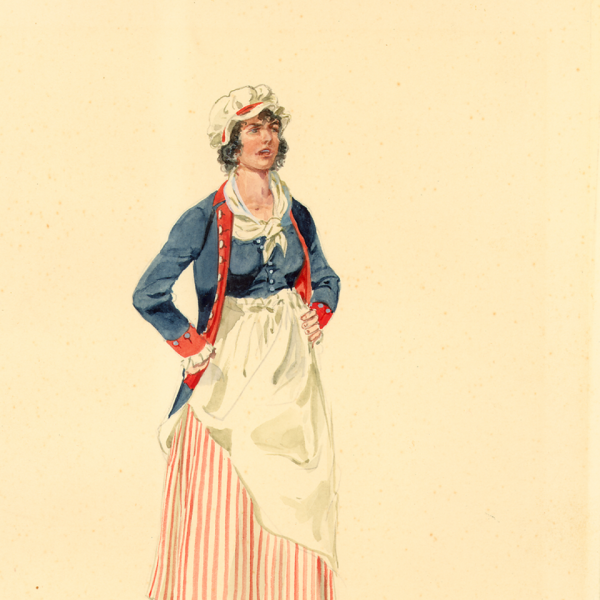
There were a number of women who played an important role in helping the American side during the Revolutionary War. But very few women in that era became involved with the actual fighting. And almost none of them seemed as combat-ready as Margaret Cochran Corbin, who was the first woman in America to obtain a pension due to military service.
The daughter of Irish immigrant Robert Cochran, Margaret was born in western Pennsylvania on Nov. 12, 1751. At that time, the French and Indian War had thoroughly destabilized the area, and scattered outbreaks of violence were the norm.
During an attack by Native Americans opposed to nearby settlements, Margaret’s father was killed and her mother was kidnapped — never to be seen again. She and her brother would almost surely have met a similarly evil fate, but their parents had recently placed them with a nearby uncle whose homestead was less vulnerable to attack. They would stay with this uncle for the remainder of their youth.
At age 21, Margaret married John Corbin, a farmer from Virginia. With the outbreak of the Revolutionary War, he enlisted in the First Company of Pennsylvania Artillery as a member of a cannon crew. She chose to accompany her husband instead of staying at home alone.
As related by the website of the National Women’s History Museum, Margaret Corbin, like a significant number of other women, worked as a cook and cleaner wherever her husband and his military unit made camp. The other military wives dubbed her “Captain Molly” because of her headstrong personality.
Corbin followed her husband’s regiment to New York, where they stayed at Fort Washington in Manhattan. The website of the New York Historical Society relates that, by September 1776, the British side had taken control of all Manhattan except for this fort, which they attacked on Nov. 16, 1776.
Dressed as a man, Corbin headed with her husband into battle. This was especially courageous seeing as how the Continental side, which had 2,800 soldiers, was severely outnumbered by the enemy, which consisted of 8,000 German mercenaries (known as Hessians) fighting on behalf of the British.
Making things even riskier for the Corbins was that cannons were the most potent weapons of that era, and so anyone around a cannon was a prime target for the enemy. Also, loading cannons in the 18th century was time-consuming and left one highly exposed to counterattacks.
When Corbin’s husband was shot and killed right in front of her, she immediately assumed his combat role — having learned from him the ins and outs of handling artillery — and continued to operate the cannon.
This endeavor, of course, put her at the same level of danger as her dead husband. In a fury of return fire, she was hit by three musket balls and grapeshot. Her left arm was almost severed. She was also wounded in the jaw and left breast.
Having been taken prisoner after the battle, British doctors helped save her life, but her left arm was forever paralyzed. When her medical situation was no longer so precarious, she was granted parole to the Continental side and joined the Invalid Regiment at West Point, New York.
At West Point, other women “rejected her for her rough manner and drinking habit,” according to the New York Historical Society. It seemed Corbin got along far better with other soldiers.
The Continental Congress (a precursor to the U.S. federal government) awarded Corbin one-half of a soldier’s pension on Jul. 6, 1779. This was one-half more than any other woman had ever received. The Continental Congress also granted her a rum allowance.
Corbin married a wounded soldier in 1782 but he died soon after. By that point, she herself needed special assistance and was provided with a caretaker, courtesy of General Henry Knox, the Continental Army’s former artillery commander.
On Jan. 16, 1800, Corbin, then age 48, died in Highland Falls, New York.
In 1926, her burial setting was transferred to West Point, where she received full military honors. Her previous burial site had been a pauper’s grave.
In the mid-1970s, amid bicentennial celebrations of America’s independence, Corbin’s story received renewed attention. There was particular interest from people involved with historical preservation in Manhattan’s Washington Heights neighborhood, as related by the website of the New York City Department of Parks & Recreation.
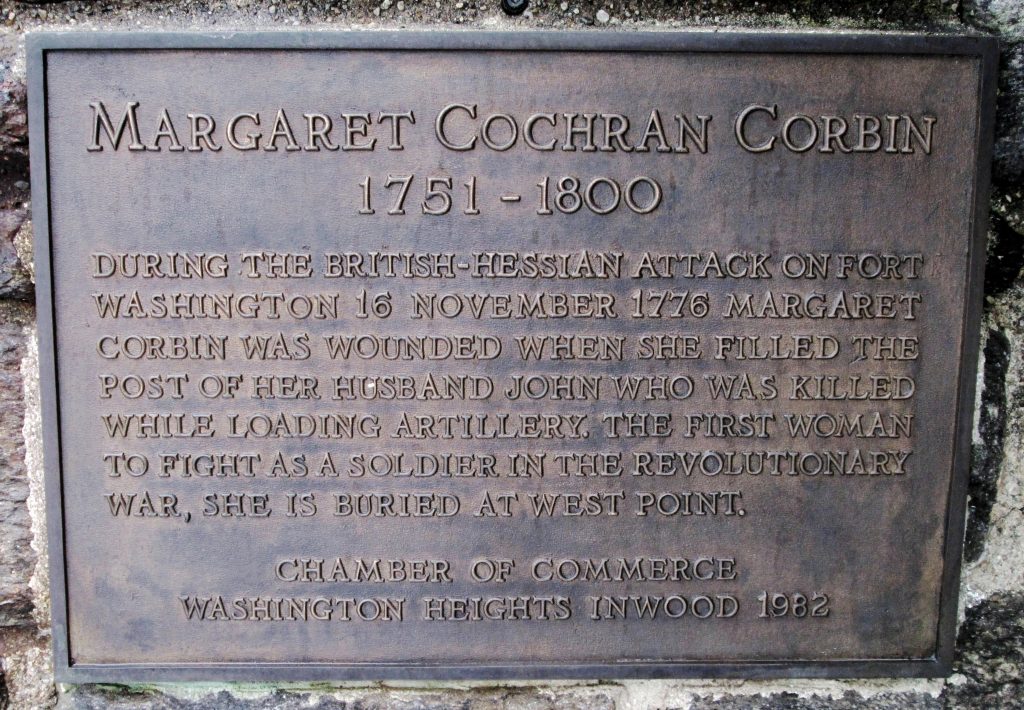
In 1982, a plaque honoring Corbin as “the first woman to take a soldier’s part in the War for Liberty” was installed at Manhattan’s Fort Tryon Park, which is adjacent to the site of the Battle of Fort Washington.
More recent years saw an unexpected turn in Corbin’s story. As the Associated Press reported, a forensic anthropologist in 2017 determined that the remains attributed to Corbin in West Point Cemetery were actually those of an unidentified man. So the real location of her remains is currently unknown.
Despite this revelation, the Margaret Corbin Monument at West Point still stands. As does her valor.
Leave a Reply