
Americans Stationed in N. Ireland During WWII
Remember that last scene in Yankee Doodle Dandy? An elderly George M. Cohan, played by an artificially aged Jimmy Cagney comes from an audience with Franklin Roosevelt. The U.S. has just entered World War II. Cohan feels left behind by a generation that doesn’t remember the days when he dominated Broadway, first in his family’s vaudeville act and then as the composer of shows that unabashedly celebrated America and set the country singing his songs.
A company of soldiers marches by. They are singing “Over there, Over there. Send the word, send the word over there” — Cohan’s World War I anthem made relevant again. A Sergeant sees the old man standing there.
“Don’t you know the words?” he asks. Cohan/ Cagney begins singing “The Yanks are coming. The Yanks are coming, The drums rum tumming everywhere.” The characteristic bouncing walk returns and George M. marches with the troops, promising “We’re coming over, We’re coming over, And we won’t be back “til it’s over over there.” A great moment enhanced by the sense of fitness that the Irish American George M. Cohan, who created a jaunty patriotism for the generation that fought in the first world war, is being played by Jimmy Cagney, who mirrored the urban toughness America needed to win the second.
As we all know and as we explored in past issues, those marching rows of soldiers were full of Irish Americans who fought heroically to defeat the Nazis. But there’s another Irish dimension to the story not as widely known. “Over There” for the American troops set to liberate Europe, was at first the North of Ireland. It’s a multi-layered and fascinating story and this article will just whet your appetite.
January 1992 marked the 50th anniversary of the Yanks’ landing. This story will unfold with the help of lan Henderson, acting chief executive of the Northern Irish Tourist Board and an expert on the history of America’s wartime presence in the North of Ireland, Earl Jagust who served in the U.S. Army Special Forces and visited all the bases in Northern Ireland, Sarah “Sally” Cook, a Belfast native who married Bill Cook when he served at Langford Lodge repairing planes shot up on bombing raids over Germany, and Frank Curran. As a 19 year old, he watched the American troop ships sail up the River Foyle in Derry.
The first G.I. to arrive in Europe was carefully chosen. Private First Class Milburn H. Henke of Hutchinson, Minnesota of Company B, 133 Infantry, stepped ashore in Belfast on Dufferin Dock on January 10, 1942. Ian Henderson speculates that his open-faced Midwestern looks and farm boy background made him an apt symbol for a beleaguered populace. “These were the bleakest hours of the war,” Henderson says, “The Battle of the Atlantic was going badly and Belfast had been badly bombed in 1941—700 or 800 were killed in one night. The Germans had targeted Harland and Wolff Shipyards and it was a rough time.”
Sally Johnston Cook recalls that as a teenager she feared the worst. “We’d been in it since 1939 and there was a sense that we were floundering. We felt that we were sitting ducks and that we were just waiting for the Germans to get us. The Americans were the saviors. When they came we suddenly believed we could win.”
Actually, though America only officially entered the war after the December 8, 1941 attack on Pearl Harbor, quiet preparations for what was considered inevitable U.S. involvement had begun when Navy Seabees started constructing a deep water port outside of Derry City in Lisahally the previous year. Frank Curran, retired editor of The Derry Journal and a journalist for
45 years, recalls that the town seemed filled with Americans in civilian clothes. “They mixed easily with the people,” he recalls, “making personal friends and finding their own local pubs.”
The base they constructed was crucial to the war effort. As the most westerly port, it became the home base for the ships and planes that protected the convoys coming from the United States.
“In April 1943,” Henderson writes in After the Battle magazine, “it supported 149 oceangoing warships (American, British and Canadian), compared with 60 at Liverpool and fifteen at Greenock.”
Though the ports in Britain have gotten more attention from writers on the war, Lisahally’s contribution was recognized in an extremely dramatic way. It was chosen as the site of the surrender of the German U boats. They had been the instrument of destruction for thousands of Allied soldiers and sailors.
“Eight U boats sailed up the Foyle in formation,” Henderson relates. “Onc tied up to the dock. The German admiral disembarked and presented his sword to Admiral Horton.” From 80 to 100 U boats joined these eight and Frank Curran remembers going down to see them–fearsome no more–up at Lisahally. Nor was the contribution of Navy and Air Force pilots forgotten. They too had fought the U boats in an effort to protect Allied ships.
As a final gesture, the U boats were towed out to sea off the Donegal Coast.
Ian Henderson described the scene in which American, Canadian, British, Australian, and Norwegian pilots were invited to bomb their adversaries and send the crewless U boats to the bottom of the Atlantic. The action was filmed by the U.S. military and the footage was used in the movie adaptation of Nicholas Montserrat’s The Cruel Sea.
Much earlier in the war, there was a famous sinking, but the involvement of an American pilot based at Lough Eme in County Fermanagh was kept secret. Ensign Leonard “Tuck” Smith was part of the team training R.A.F. pilots on the lend-lease Catalina aircraft sent to them by the U.S. These Flyingboats were searching for the German ship Bismarck that was so devastating for British shipping.
Ian Henderson recounts the incident, “At 10:15 a.m. with Ensign Smith, USN, at the controls, the ship was sighted and he took violent evasive action to avoid the hostile barrage with which the Bismarck greeted them. This sighting was vital in the final hunt for the German ship. In the press and radio interviews that followed with the Catalina’s crew, only the pilot Flying Officer Dennis Briggs got a mention and the co-pilot who was actually at the controls had to remain anonymous.” Northern Ireland became a training ground for combat flying crews throughout the war. Henderson points out that for pilots Northern Ireland offered a peculiar advantage. “They had learned to fly in places like Arizona and Texas, where there were bright, sunny skies. Now they had to adapt those skills to European conditions.
Their eight week training sessions in Northern Ireland provided the necessary clouds and rain. They learned how to go into battle in Greencastle and Lough Neagh and then left for the bases in England.” From there these crews carried out bombing raids on Germany.
Bill Cook, based at Langford Lodge Air Field, remembers the consequences of those missions. “At the very tip of the tail of the B17 is a small space where the gunner lays on his stomach to operate his machine gun. In front of his face was four to five inches of plexiglass. I remember one coming in where a 20mm shell had penetrated that shield. I stood there imagining what had happened to that poor gunner; he had come with the very first wave of Americans. As a civilian employee of Lockheed he was part of the effort to turn Langford Lodge, an estate 30 miles north of Belfast, into a completely equipped airbase where all needed repairs and modifications could be made. “The people were very friendly and welcoming to us. Many of us married Irish girls.”
His Irish girl, Sally Johnston Cook, remembers the dances where suddenly, droves of handsome young Americans appeared. “We went to the dances in groups. It’s a national pastime after all.
We would do Irish dances like The Pride of Erin, as well as the Waltz and Fox Trot. All kinds of organizations were holding dances for the service-men. There was a big Red Cross Club. It was a very exciting time.”
The Lockheed group have held reunions over the years.
“We all did miss home,” Sara says. “T’ve had a good life here. But you do give up a lot. Il’s a lovely wee place we left.”
For Earl Jagust and most G.l.’s, the “lovely wee place” represented the calm before the storm of the North Africa invasions, and most importantly, D-Day.
Stationed at Enniskillen as part of a Special Services Company, he toured the bases as a projectionist showing Hollywood movies to the troops. “They were happy to be in a place where the amenities were good,” he recalls. Their closeness to the border meant that meat and eggs and butter were available, but the reality of the war was not forgotten.
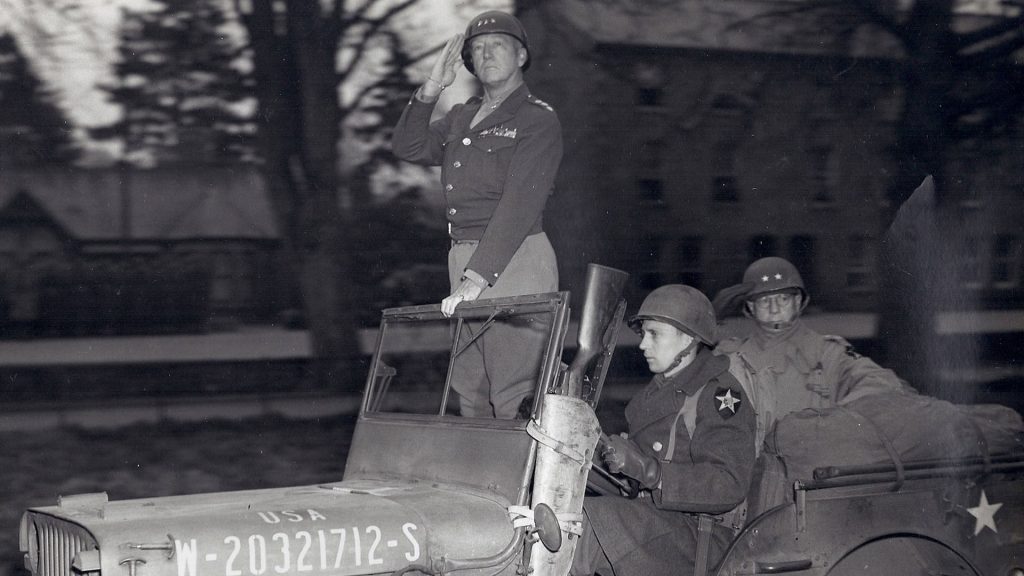
“I remember when George Patton came to address the troops. I set up the PA system. He basically told them to expect to be killed. He said that he didn’t care how many troops it took, he was going to take back Europe. It left everyone very silent. I disliked Patton. But when an Irish girl offered to take me to the Free State to get me out of the war I refused. Since those years I’ve been pro Irish. I married a Kearney.”
Frank Curran recalls many marriages, and a renewed economy where jobs were suddenly plentiful and the G.I. ‘shad money to spend. “We were all very friendly, though it was said the Norwegians liked to get into fights. We called it the retur of the Vikings.” He remembers the visits General Eisenhower made to the troops, staying at his headquarters in Knock Na Moe in Omagh, County Tyrone.
“General Eisenhower was made a Free Man of the city of Belfast,” points out lan Henderson. Henderson also said that the Northern Ireland Tourist Board has available a number of itineraries for those who wished to visit the places associated with the G.I.’s in Northern Ireland.
He himself designed a comprehensive guide in After the Battle.
Fifty years have passed since Private Henke arrived in Belfast and yet much remains to be learned about those early days “Over There.” If you were there let us know.
Editor’s Note: This article was originally published in the February 1992 issue of Irish America. ♦
Leave a Reply