
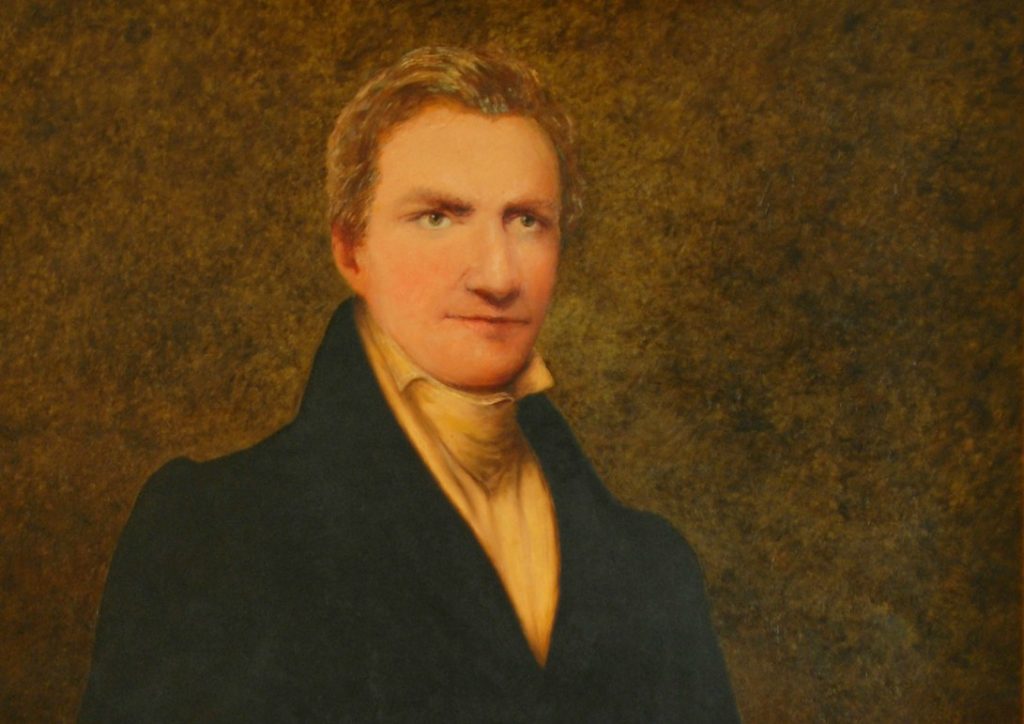
Matthew Lyon was a man on the rise. But not in a slick and ingratiating way. He was bold and brash. These traits apparently surfaced quite young in life. He may well have possessed them from the time he was born in County Wicklow on Jul. 14, 1750 (some sources say 1749).
According to The Journal of the American-Irish Historical Society, Lyon’s father was executed for treason against the British Crown when Lyon was age seven.
The boy later worked in a printing shop. As a teenager, he became very curious about America. So he eventually presented himself to the captain of a ship about to depart for America. But there was one big obstacle: Lyon did not have enough money to buy a ticket. So he offered himself as an indentured servant in exchange for trans-Atlantic passage.
Upon his arrival in New York, Lyon was sold at auction for £60 to a prosperous merchant from Litchfield, Connecticut. He was later traded for a pair of bulls valued at about £60.
Within three years of coming to America, Lyon — who took odd jobs when his master was not around — was able to purchase his freedom. (In this regard, he fared far better than many of his countrymen who “were sold for such sums that they could not live long enough to work the time out completely,” as the American-Irish Historical Society reported.)
A few years after obtaining his free status, he married Mary Hosford. They later migrated to Vermont (which was then known as the “New Hampshire Grants”). Not long after their arrival came the American Revolutionary War.
Lyon took part in the war’s northern theater, which included such regions as Vermont and upstate New York. Multiple sources, including American Heritage Magazine, place him fighting at the Aug. 16, 1777, Battle of Bennington and, several weeks later, at the Battle of Saratoga.
However, Lyon was dismissed from the Continental Army for reasons of misconduct. Lyon and others would claim that he argued with his commanding officer because he felt that he and his men were given a meaningless assignment that involved guarding a wheat field.
In later years, though, Lyon’s political opponents would claim that he was singled out for cowardice and forced to carry around a wooden sword.
Whatever happened exactly, Lyon rejoined the Continental Army effort, serving in a separate unit before returning home to Vermont. There he became involved in manufacturing, establishing a paper mill, a saw mill and an iron foundry. Along with these endeavors, he established a newspaper called The Scourge of Aristocracy and Repository of Important Political Truth.
Lyon also entered the political domain. After failing three different times, he managed to win election to the United States House of Representatives.
President John Adams was aghast at Lyon’s political victory and would refer to him as the “boor from Vermont.” Upon joining the House of Representatives, Lyon didn’t need much time to find controversy, albeit under considerable provocation.
On Jan. 30, 1798, Lyon had a notorious incident with Roger Griswold, a Congressman from Connecticut. They began quarreling in front of their colleagues because Lyon, whose political leanings were opposite those of Griswold, went out of his way to show that he was ignoring Griswold’s attempt to speak to him.
When Lyon soon after mentioned that he was fighting for the common man, Griswold sarcastically asked him if he would be fighting with his “wooden sword.” This was a reference to Lyon’s punishment for alleged cowardice during the Revolutionary War.
The rumor wasn’t necessarily true, but it was more than incendiary enough to ignite Lyon, who, in a spasm of rage, spat his tobacco juice on Griswold.
For this reaction, Matthew Lyon was quickly dubbed the “Spitting Lyon.” He would later apologize to the House for this breach of Congressional etiquette. But things weren’t finished: Two weeks later, Griswold attacked Lyon with a wooden cane on the House floor.
Absorbing some blows on his head and shoulders, Lyon backpedaled to a fireplace and grabbed a pair of fire tongs. But before Griswold and Lyon could settle things with weapons, a group of fellow Congressmen broke up the fight.
Less than a year later, in October 1798, Lyon was found guilty of having violated the Alien and Sedition Acts (regulations that were largely expunged not long after the Adams presidency) for maligning President John Adams as being too much like a monarch and having “an unbounded thirst for ridiculous pomp.”
At one point during his ensuing four-month incarceration, a mob of Lyon’s supporters gathered outside the prison holding him and began threatening authorities that they would liberate Lyon by force.
But the Wicklow native intervened. Through his barred window, Lyon told his supporters that such an act would be counterproductive and that they should instead express their discontent through their voting ballots.
Lyon, still incarcerated, soon after won Congressional reelection in a landslide. But there remained one more hurdle to clear: His punishment involved not only imprisonment but also a $1,000 fine (equivalent to $20,000-plus in today’s currency).
His supporters footed the bill. This was most fortunate for Lyon, as he had suffered some serious financial losses: During his incarceration, Lyon’s printing equipment (which he used to produce The Scourge of Aristocracy magazine) had been confiscated. Also, his manufacturing properties had suffered suspicious fires.
Fresh out of prison, Lyon would return to the House and serve Vermont until 1801. He then relocated to Kentucky, where he established himself as an entrepreneur and also served Kentucky in the House of Representatives from 1803 to 1811.
The website of the United States House of Representatives says that Lyon’s congressional tenure dissolved due to his opposition to the War of 1812. Not long after his political downfall, his businesses began to fail.
He later found work as a government negotiator with Native Americans of the Cherokee tribe. While engaged with such pursuits, he died in Arkansas on Aug. 1, 1822, at age 72.
Lyon’s son, Chittendon Lyon, would later serve Kentucky in the House of Representatives. The son’s political career was significantly less tumultuous.
More than two centuries later, Matthew Lyon remains the only person elected to U.S. political office while incarcerated.
Leave a Reply