
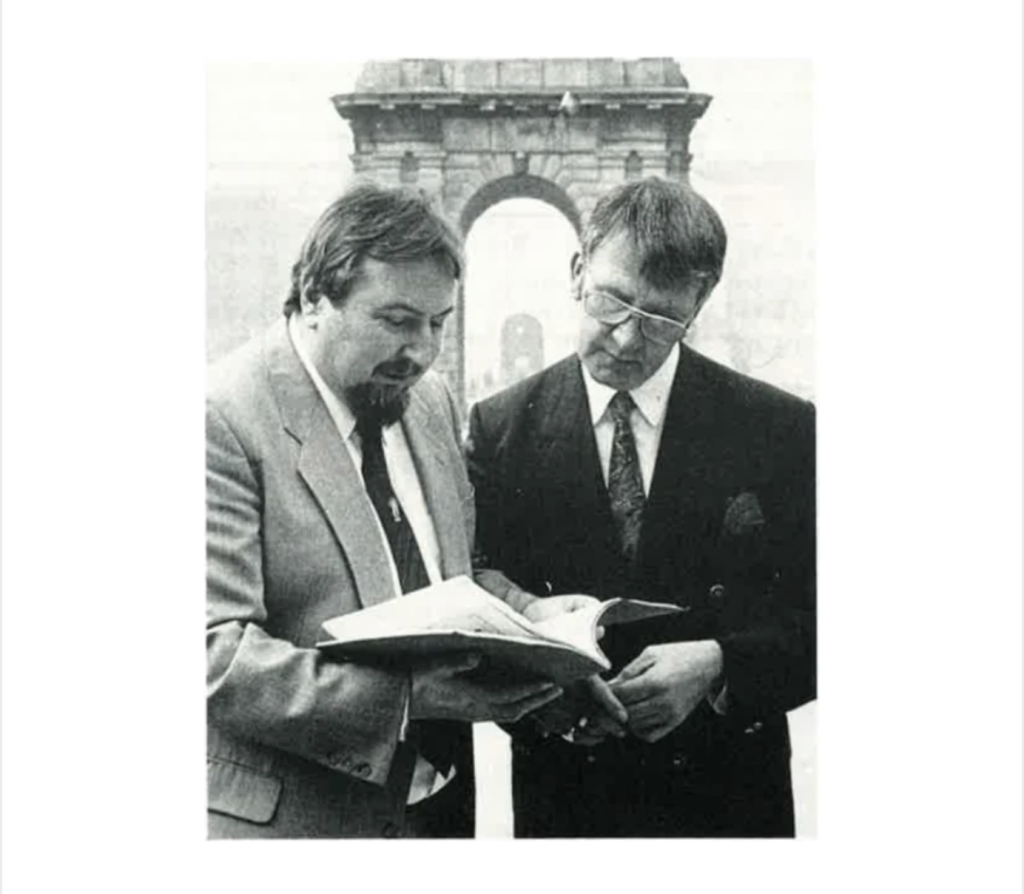
A major breakthrough by an Irish research team in identifying the gene that causes the inherited eye disease Retinitis Pigmentosa promises new hope for millions.
Tucked well in behind the famous landmark of Trinity College, Dublin, is the small and rather dilapidated home of the University’s Department of Genetics. The department that just a few months ago won worldwide acclaim by making a significant breakthrough in the puzzling area of genetic research. The six-person Irish team reported that they had located a second causative gene responsible for one form of an extremely debilitating and blinding eye disease Retinitis Pigmentosa (RP) which afflicts about two million people worldwide.
It was the second such “victory” for the team—in 1989 they located the first causative gene for dominant RP the second most common form of the disease. And although a cure is probably years down the road, the identification of the genes means that half of all dominant RP cases are now diagnosable—the first step towards future prevention and a possible cure.
The discovery also raises the often impoverished Irish research field over the international parapet—and it ensured that, for this project at least, the international funds would keep rolling in.
Because RP is an inherited disease of the retina and can take three forms dominant, recessive, and sex-linked– the disease cuts through families in a variety of ways. It can cruelly hit every generation of a family, or can skip several generations and occur out of the blue. It can, like haemophilia, be carried by a mother and passed on to one in every two of her sons, and leave one in every two of her daughters carrying the disease.
It can also strike without warning at any age of a person’s life. However, it most often strikes young adults. Symptoms usually begin with “night blindness,” explains Professor Peter Humphries, the self-effacing 43-year-old director of the RP research team, which is the inability to see in dim light or dulled areas. This is followed in some cases by “tunnel vision” where side vision is narrowed. In other cases, the disease can take a completely opposite path with the central vision becoming blurred and the peripheral vision retained.
Very often sufferers become completely blind.
Because of its marked movement through families, the key to tracking the RP-causing gene lies in tracking afflicted families— particularly large ones with a number of affected members.
Just such a large Irish family was found 60 miles outside the Dublin area. Out of 100 living members, 50 were found to suffer from dominant RP. Over a period of four years, 80 members of the family participated in the Department’s research project, including intensive eye exams.
(Described as quiet and unassuming, the family have kept their participation in the research intensely private.)
The genetic material from the affected members was compared with the unaffected members. The family members were all interviewed and a comprehensive family profile was built up. Through such painstaking research, the scientists were able to locate the first defective gene, rhodopsin, and lay the groundwork for the second, more significant breakthrough at the end of last year when they localized the second gene, peripherin.
One of the particular advantages of doing such research in Ireland, admits Professor Humphries readily, is the ease of access to such large families. “It’s a small country, you can drive around it readily, and so we have contact with all of the people, virtually, who have RP in the country.”
Admittedly the number of sufferers in Ireland is not that large— there are no more than 2,000 in the Republic of Ireland, and the disease is no more prevalent in the country than anywhere else.
In the U.S., however, the disease afflicts 100,000 Americans, with 1,500 new cases being discovered each year. The Dublin team worked closely with a number of major American laboratories, such as the University of Texas Health Science Center in Houston. Scientists there also studied a family in southeastern Kentucky who had a less severe form of the disease.
Sharing the results of each other’s research is not a problem, according to Professor Humphries. “The community of scientists who work on RP is a very closely knit one,” he says.
But vying for limited and highly sought after research funds is, and one which all scientists are acutely aware of. The breakthrough in Dublin will go a long way towards ensuring that the RP project–which costs three-quarters of a million dollars a year- will continue.
“It was a tremendous achievement for the Irish team,” Humphries says sitting in his small, dusty office which is dominated by a sizeable refrigerator used to store precious samples of blood. “It has gained them a lot of international recognition, and given a good boost, in terms of generating the international funding that is required.” Keeping the international funds rolling in is a crucial-albeit tasteless-priority for almost all Irish research teams. ” All researchers in Ireland have got their eyes open, they know the problems of doing research in a small country.” The vast bulk of the RP project is funded by foreign money. The National RP Foundation in the U.S. has contributed up to $2 million; the George Gund Foundation, the Wellcome Trust in London and the British RP Foundation have also contributed several thousand dollars.
Lately, the impoverished Health Research Board in Ireland, which has a tiny budget of $4.5 million to share out among a vast array of projects, also kicked in some funds.
The only way to sustain that level of funding on a year to year basis is to deliver on research, Humphries concedes. “We’ve been lucky, ” he says; “we’ve worked very hard but we’ve been lucky.”
Luck indeed may have played a part for the Irish team. Their first identification of the second gene, peripherin, just narrowly beat a Boston team of scientists who identified mutations in the same gene. “We just beat our competitors in Boston,” Humphries says with a smile. But, he adds hastily, the “competition” is a healthy one and done in the spirit of cooperation.
Competition for international funding aside, the Irish project might never have gotten off the ground without the hard work of the Irish RP Foundation who virtually kick-started the whole project in 1986 with a mammoth fundraising effort which garnered $175,000.
The catalyst for that fundraising effort was Dubliner Paddy Byre, who is now chairman of RP Ireland and who knows all too well how the distressing disease can blight people’s lives.
Seven years ago Paddy’s wife Helen was diagnosed as suffering from RP. Before that she had suffered from hearing loss, a concomitant problem common to many RP sufferers.
The couple were then dealt another cruel blow when all three of their children were diagnosed as RP sufferers. Now aged nine, twelve and fifteen, the two girls and one boy all face the bleak prospect of progressive loss of vision. Paddy Byrne is acutely aware of the problems that could affect his children in their late teens.
“There isn’t a day that goes by that it doesn’t cause me some sort of pain or worry,” he says frankly. Just recently, his eldest daughter had mentioned her desire to embark on a nursing career. A noble choice, but one that is painfully out of the question for her. Paddy delicately suggested his daughter might try another career, such as physiotherapy, which she could hopefully sustain through vision loss.
When his wife’s problem was diagnosed, Paddy became actively involved in the fledgling RP Foundation. Through various raffles, they raised the huge sum of money which they presented to the Genetics Department at Trinity. “It’s amazing what can come out of a few cake sales,” he says bashfully.
As well as its key fundraising role, the Foundation also acts as an important network of information and support for affected families. Paddy is now keen to get a formal counselling service underway where RP counsellors could offer help and advice to RP sufferers around the country.
The Foundation is also keen to raise the public’s consciousness of the disease.
“Many RP sufferers deny the fact that they have it,” he says. The denial is prompted mainly be a fear that admission could lead to loss of a job. In job-starved Ireland that fear is very real indeed.
The successful progress of the RP project in Ireland also raises the perplexing and often controversial role of genetic counselling-basically a service to advise on the risk of inherited disease disorders. Up until this year the Republic of Ireland has lacked a genetic counselling service. A few months ago, the new Health Minister, Mrs. Mary O’Rourke, finally committed a budget of $500,000 to get a limited service off the ground.
Professor Humphries is unequivocal in his belief in the necessity for such a service. People have the basic right to ask if their children will be at risk, and to what degree, to inherited genetic disorders, he says.
“All you are talking about is families being advised of the real risk they are running, and through that advice they will take their own steps to decide what to do,” he says.
For someone who is at risk, and deciding on their career, having such a pre-symptomatic diagnosis could be very necessary in helping them to choose a correct path.
He’s optimistic that within the next decade the causes of all types of RP will be known. “People who have got RP have every reason to be hopeful,” he says, “but we have got to take it one step at a time.” Knowing the causes will bring scientists to the very cutting edge of human molecular genetics and the futuristic hope of finding a cure through targeted gene replacement, he says.
But for now, the daily grind of research and analysis goes on for the team at Trinity who are backed up by another six part time personnel. Later this year they will gladly move from their cramped quarters to a new building just around the corner.
But the history of their present home is not lost on the team. The very room which is now Professor Humphries’ office was where eye surgery was performed on Oscar Wilde’s father. “Sometimes we feel the guy looking over our shoulder,” he remarks. Wilde’s “ghost” epitomizes the marvellous tradition of research that permeates the building. A tradition that keeps the team going, nudges them forward, looking for clues…. and cures.
Editor’s Note: This article was originally published in the April 1992 issue of Irish America. ♦
Leave a Reply