
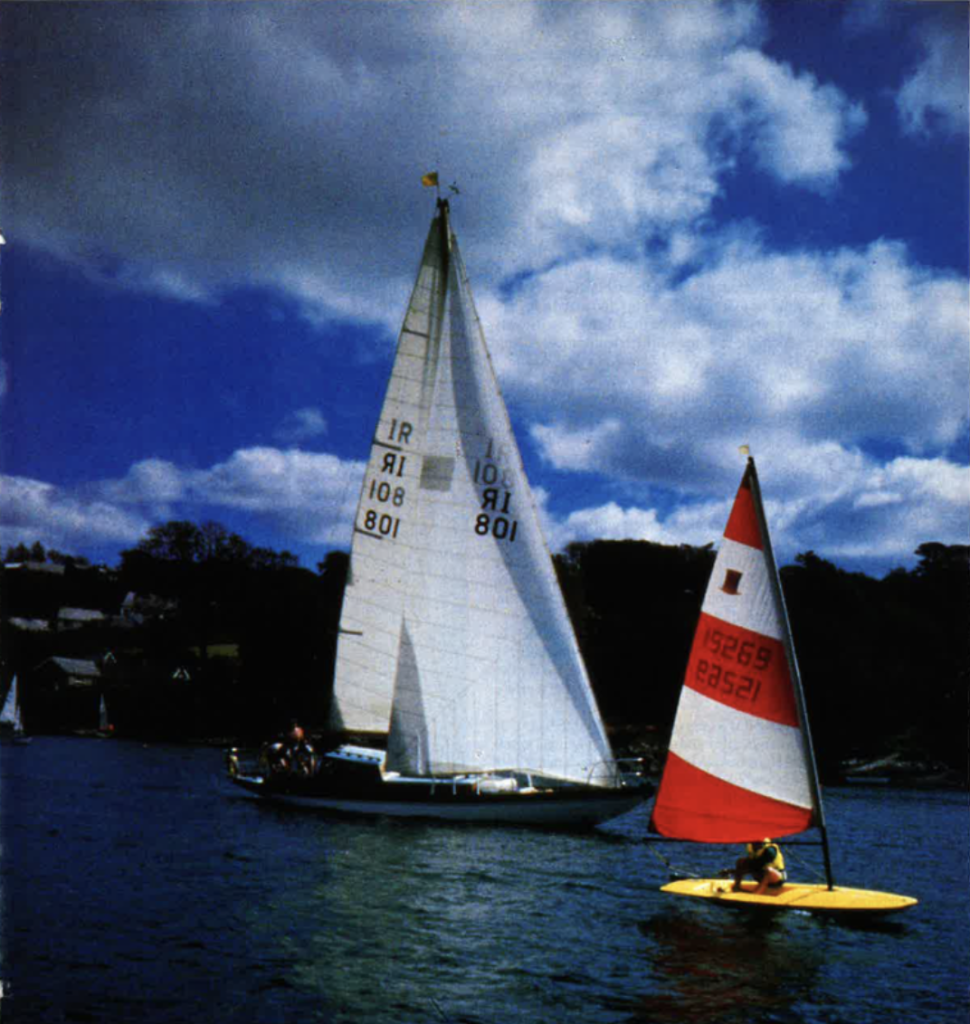
It would be impossible in one issue to cover all the possibilities for holidaying in Ireland, for Ireland, every inch of it, and it only measures 302 by 171 miles, is an enchanting place to visit and it offers an abundance of activities. You can sail around the coast or on any of its inland lakes or take a cruise down the River Shannon. You can golf on high cliffs overlooking the ocean or in the serenity of its quiet valleys. You can drive on forgotten byroads that lead nowhere and everywhere.
It is a spiritual place full of forts and castles and ancient ruins. In historic Newgrange you can link up with your Stone Age ancestors or in Dublin you can be part of the celebrations marking its year as “European City of Culture.”
Go to Ireland this year. You won’t regret it.
-The Editor
The Sea, Oh The Sea – Is Grá Gheal Mo Chroí
My first glimpse of Ireland from the sea is a lonely tower. It’s on a promontory called the Old Head of Kinsale, and we’re beating past it against a headwind with monster cliffs off our starboard bow.
It takes us five hours to anchor at Glandore. And ten minutes to realize the lovely berth we’ve landed in.
There’s a certain logic to exploring Ireland in a sailboat. After all, the coastline covers 3,500 miles; why share a beach with hundreds of others when you can sun on a deserted island? The Royal Cork Yacht Club is the world’s oldest, dating to 1720. And all of Ireland’s past visitors arrived by sea-Normans, Danes, Spaniards- though many refused to leave.
The season isn’t long—June to September’s advisable – but the Fastnet Coast that stretches from Cork to Bantry Bay is prime cruising ground for anyone who enjoys the water. Last August, when four of us rented a 32-foot sloop from Yachting International in Kinsale, the skies were clear, the seas so calm we had to motor much of the time. But sudden rain squalls and four-foot-high whitecaps aren’t uncommon. So if you’re an inexperienced sailor, hire a skilled helmsman.
Our Bianca 320 “Vinnie” was comfortable for four; two couples are ideal. It’s equipped with a 20hp Yanmar diesel engine, self-tailing winches, dinghy with outboard motor, flush toilet and handheld shower, hot water, central heating, a small fridge, ample closet space, radio and tape player, kitchen utensils, and a propane-operated stove. All the comforts of home, including flannel sheets and down comforters.
Reading nautical charts is an art, but even the best sailor misses hidden coves on this rocky southwest coast. A good bet is to pump Eddie McCarthy for navigational tips before you leave Yachting International headquarters. He knows the directional pointers that can take you straight to your anchorage.
We missed the entrance to Glengarriff on our first try because we didn’t check our position in the water against the chart.
Once anchored, we inflated the dinghy and motored ashore to the Eccles Hotel, where we enjoyed Guinness on the veranda and salmon steak in the dining room.
The Eccles swarms with tourists and suffers from wear and tear. But if you sit on the porch facing the bay and think of Yeats. Synge, and Shaw—all of whom were guests—you’ll know you’re in the right place.
Swans greeted our boat when we arrived at Castlehaven, a picturesque town that boasts the South Cork Yachting Club and Mary Anne’s famous pub. Streets here are so steep cars park at a 45-degree angle to the curb. Two dolphins escorted us out of the channel next morning, cresting and diving in harmony.
Crookhaven is a hidden harbor marked by a white lighthouse on one promontory and medieval watchtowers on the other.
No less than seven bars keep this tiny village lively. We explored gravesites at the Old Church of Ireland, circa 1650, and then quaffed Irish coffees at O’Sullivan’s (attending to both body and soul).
Heading back to Kinsale, we passed two landmarks: Fastnet Rock lighthouse and Clear Island, rising straight out of the waves on granite cliffs. All around us were the red, blue, and yellow spinnakers of racing boats. Their bright sails against Clear Island’s quilt of green pastures and gray stone walls kept our cameras clicking endlessly.
Plan on at least eight days for the trip from Kinsale to Bantry Bay and back. If that’s too long, Yachting International will come fetch your yacht in Bantry Bay. And keep your itinerary open. Weather can force a change in the best-laid plans. Speaking of weather, don’t forget raingear and good deck shoes.
A Golfer’s Paradise
With 180 courses in a country the size of Maine, a golfer is never more than 20 miles away from the green in Ireland. Courses like Ballybunion and Killarney Golf and Fishing Club may have garnered the fame, but every town of more than 1,000 has its own course, many of which are in some of the island’s most scenic areas.
Courses are usually uncrowded, green fees are low—$5 to $35—and clubs can often be rented (though not shoes). Golfers who visit Ireland can choose from a variety of golf packages, which include car, accommodation with breakfast, and green fees.
The professionals such as Tom Watson, Sam Snead, Tony Jacklin, Arnold Palmer, Severiano Ballesteros and Gary Player speak highly of the Irish golf courses they have played. In fact, they admit to spending some of their happiest golfing hours here, and all have returned for more.
Sam Snead refers to Waterville Golf Club (Ring of Kerry, County Kerry) as magnificent, “In particular, I will never forget the par-three holes. As a group they must be the greatest in Europe, possibly the world.”
The Tralee Golf Club is a magnificent new links which is Arnold Palmer’s first European creation. He said of the place, “I have never come across a piece of land so ideally suited for the building of a golf course. I am happy to have one of the world’s great links here.”
And Tom Watson had this to say of the Ballybunion links: “It is a course you will always enjoy and never tire of playing. I know I never will.In short, Ballybunion is a course on which many golf architects should live and play before they build golf courses. I consider it a true test of golf.”
The avid golfer can play the tournament circuit of the great links that form a necklace around Ireland. This group of tournament-standard links and courses are tough and are for those carrying low handicap figures. Each course demands unusual golfing skill to make par.
Historic Newgrange: A Visit to Ancient Ireland
One of the delights of traveling the byways of Ireland is discovering history around every other curve in the road, from unnamed, unmarked prehistoric stone circles, with cows grazing among them, to Celtic hillforts and medieval castles amid agricultural fields, to world famous monuments down tree-shaded country lanes.
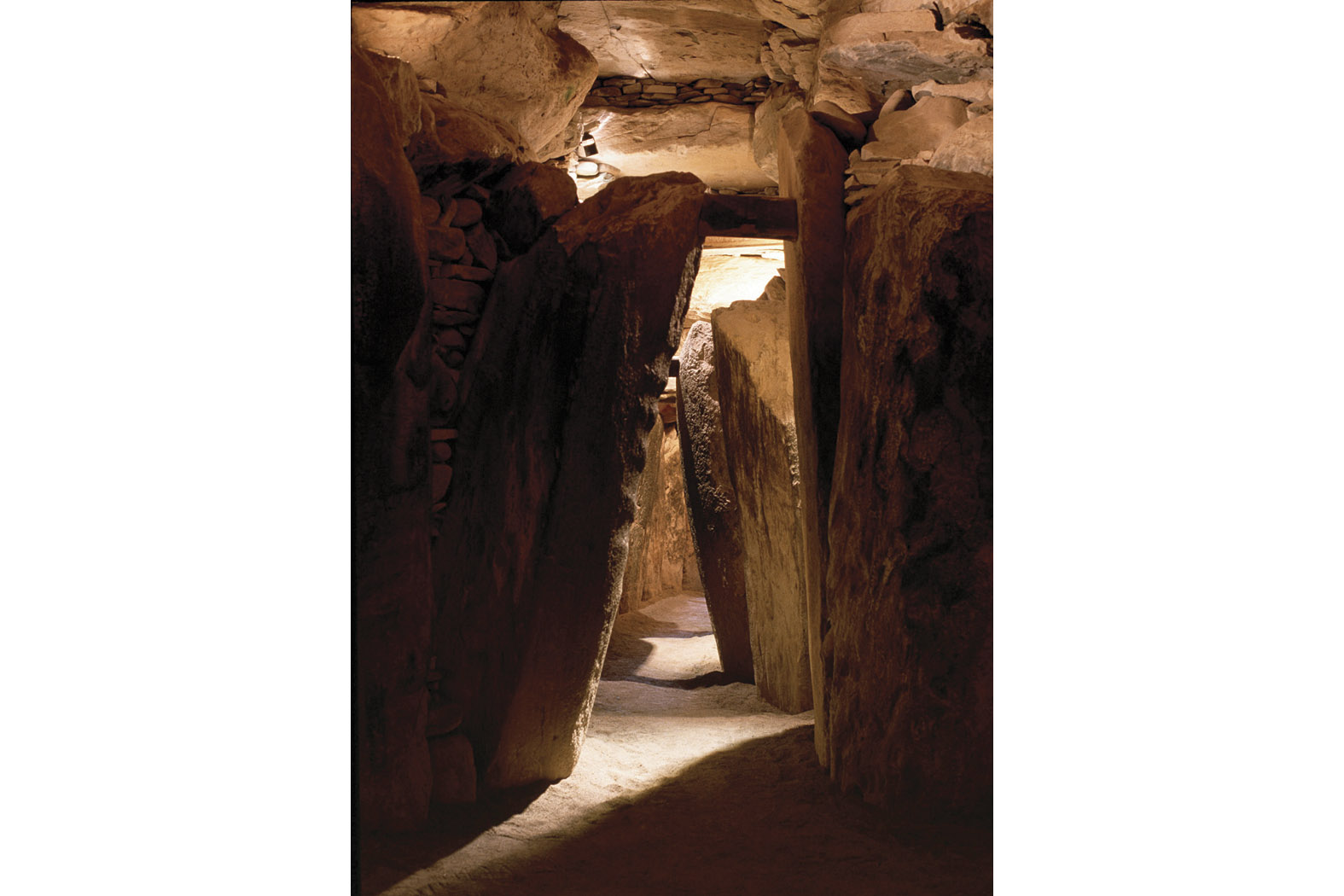
Newgrange, Ireland’s premier national monument, comes dramatically into view through a break in the trees, as the Slane-Newgrange road turns sharply to the left, revealing a gleaming white stone building high on a hill, overlooking a bend in the river Boyne.
At first glance, it looks like some modernistic grain silo, rather than one of the oldest stone buildings in the world. Scientists have dated this national monument to 3,200 years before Christ, centuries before the pyramids, and some 900 years before Stonehenge.
Like Stonehenge, Newgrange is one of the marvels of the ancient world, and was built by a related people.
Little is known of these Neolithic builders, who scattered their stone monuments across Ireland, England, France, and maritime western Europe as far south as Malta, as far north as Scandinavia.
The only details that are certain about these Irish Stone Age settlers is that they cleared the land of forest and raised cereal crops; and they had time to build an astronomically sophisticated, stunning circular monument, and decorate it with boldly carved swirling spirals, diamond patterns, chevrons, and zigzag lines cut into foundation and interior passageway rock slabs.
This artistic legacy in stone has few rivals in European prehistory.
Some archaeologists have called Newgrange the “Cathedral of the Megalithic (mega from Greek for large and lithos for stone) because of its carvings, its winter solstice display, its elegantly simple architecture-for this is architecture, and not just construction. Newgrange is considered a passage grave, although archaeological terms don’t do it justice, for there is a magnificence and serenity to this building that isn’t captured in general labels. It consists of massive foundation stones, an interior passageway of freestanding rock slabs, leading to a vaulted burial chamber that is roofed with large rock slabs. The rock slabs were stuffed with sand and turf as a binding agent-no mortar was used.
And the entire structure was then topped with smaller stones and turf.
Several of the large roof slabs had grooves cut into them to carry water seepage away from the main burial chamber.
In 5,000 years the roof hasn’t leaked yet.
As a finishing touch, the front sections were faced in gleaming white quartz, the balance of the structure was finished in regular fieldstone.
Archaeologists in the 1960s, led by the late Michael J. O’ Kelly, professor of archaeology at University College Cork, found the remains of five bodies inside the burial chamber, along with offerings of stone and bone beads, pendants, pins, and small stone “marbles.” But the archaeologists’ biggest surprise came on the shortest day of the year—December 21, when they saw sunlight streaming into the burial chamber through a specially designed roof-box. This dramatic display reaches its height during the winter solstice, when sunlight bathes the chamber for 17 minutes, although light is visible for about a week before and after December 21. During the rest of the year light doesn’t enter the tomb. The roof box is found in no other megalithic structure.
The purpose of the display isn’t known, but just as recent research showed that Stonehenge was more than a religious site, and that it also served as some kind of astronomical clock to mark the summer solstice and other important phases of the sun and planets, Newgrange, too, was more than a burial site. It was probably an important religious site. That view is reinforced by other evidence uncovered here:
The monument at one time was ringed by up to 38 freestanding stones, some eight feet high, although only four are prominent today.
The remains of a large woodhenge was also discovered, a few yards from the passage grave.
Regardless of its other uses, Newgrange is the best example of a passage grave in Ireland, and perhaps in all of Europe, and is related to stone circles, dolmens, and other megalithic structures that were built from approximately 4,500 B.C. to 1,500 B.C. The European megaliths have forced a change in the traditional view held by earlier generations of archaeologists that civilization and its building techniques spread from the early centers of settled life in the Middle East’s Fertile Crescent and spread outwards in a chronology that could be consecutively dated from ancient Egypt, Crete, Mycenae, and then slowly over time throughout western Europe.
With the widespread use of radiocarbon dating from the 1950s onwards, many assumptions were turned on their head, for the megaliths are scores of centuries older than structures in ancient Egypt, Mycenae, Crete, and other places that they were supposedly modeled after. Radiocarbon dates have been verified in France, England, Ireland, and elsewhere, proving that the megaliths were an independent, purely European development and weren’t dependent on knowledge from the Mediterranean basin.
But it isn’t the lessons of Newgrange that impress today’s visitor, it is something more subtle. It is tracing your finger through the swirling spirals, diamonds, and zigzag lines etched into rock, and for a moment linking yourself to the flow of life across 250 generations.
Editor’s Note: This article was originally published in the February 1991 issue of Irish America. ♦
Leave a Reply