
Charleston, South Carolina: At first I saw what I anticipated-streets of beautiful eighteenth-and nineteenth-century homes and public buildings lovingly restored. True, Hurricane Hugo had struck. But the people had fought back. Injured buildings were shedding their scaffolding to stand proud again. Memories of both the Revolutionary and Civil wars abounded. We saw Saint Michael’s Protestant Episcopal Church, where George Washington and Lafayette had worshipped. We heard that Charleston was the first city to haul down its British flag and raise the Stars and Stripes. We looked across the harbor at Fort Sumter, on which South Carolina’s Confederate troops fired the first shots of the Civil War.
As we strolled around the sunny city, we were pleased with ourselves as half-remembered history lessons came alive and the seventy-degree November day confirmed our escape from winter.
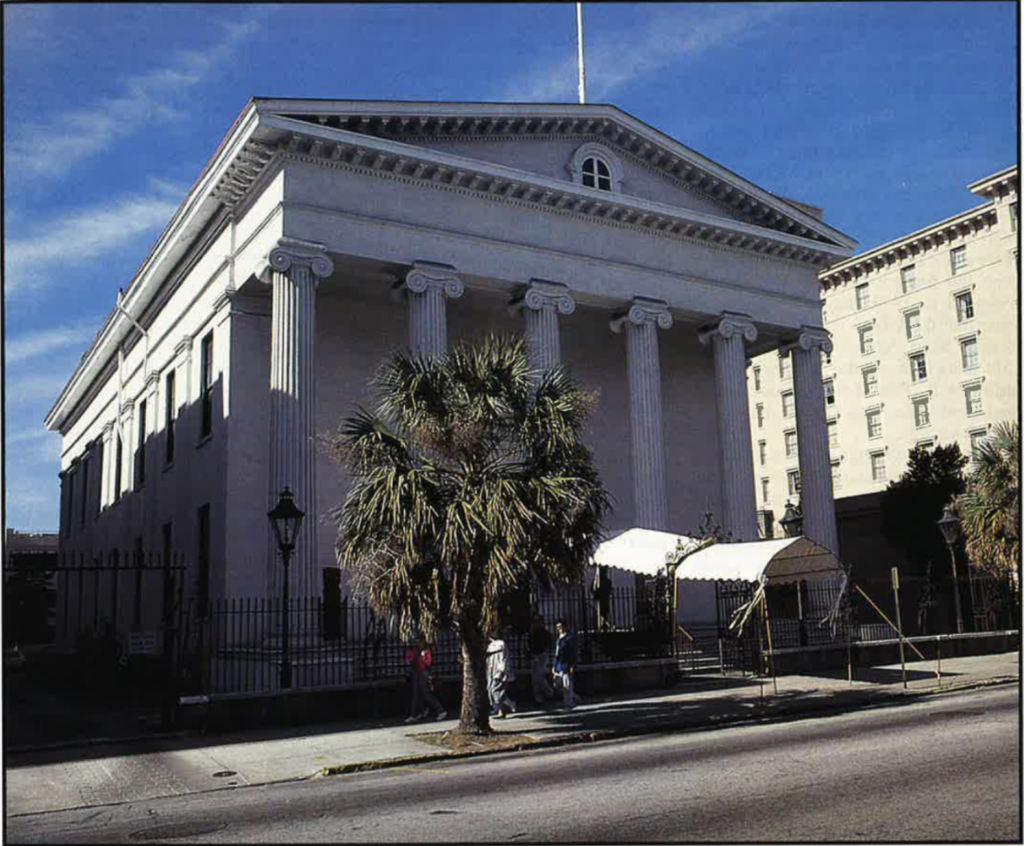
But then we noticed a particularly beautiful Greek Revival Building. It was set grandly back from Meeting Street behind a graceful wrought-iron fence. Had famous events happened here? We wondered. They certainly had, the sign informed us. For here was the Hibernian Hall, home of the Hibernian Society. They were an independent group, not affiliated with the Ancient Order of Hibernians.
Founded in 1799, they were 31 years older than the A.O.H. They had been celebrating Saint Patrick’s Day for almost 200 years here and this was the first I’d heard of it. That shook me out of my historical haze. Luckily the hall welcomed visitors.
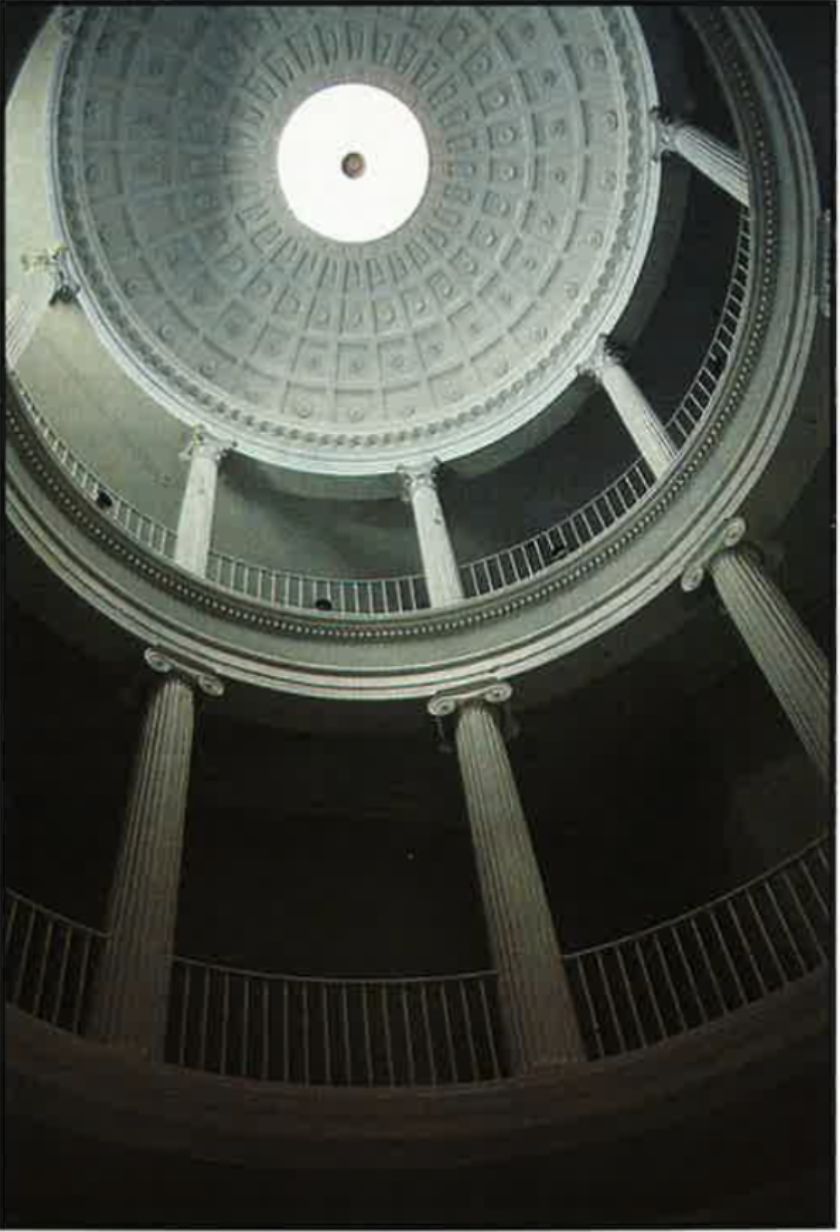
The interior with its high rotunda, circular stairways, and marble floors matched the stateliness of the exterior. In fact, Thomas Walker, who designed the hall in 1836, had also served as the architect of the United States Capitol and we could see similarities.
But the large golden harp that hung over the entrance to the ballroom proclaimed the uniquely Irish character of this place. Along the walls of the rotunda and the smaller wood-panelled library hang portraits of past presidents. Who were these Irishmen? “Scotch-Irish” — the cliche explanation for the Irish roots of so many Southerners sprang to mind.
And indeed, one of the most impressive faces belonged to the Reverend Simon Gallagher, DD, first president of the Society.
Reverend? I saw no collar, only a cravat like the one Thomas Jefferson wore in his portraits.
But reading the plaque more carefully, I found that this Reverend Simon Gallagher had been a Catholic priest. The first pastor of Saint Mary’s, the Mother Church of the Dioceses, Georgia and the Carolinas, he was born in Ireland in 1756. He had studied at the University of Paris.
After his ordination, Father Gallagher went to Baltimore and then to Charleston in 1793. He built Saint Mary’s, and joined the faculty of the College of Charleston. According to a contemporary account, he was “admired extravagantly by his students.”
But, as documents in the glass display cases revealed, though their first President was a Catholic priest, most of the founders were Ulster Protestants. It seemed that from the beginning the society made no distinction based on religion.
In a tradition that continues to the present, the two-year presidential term is alternated between Catholic and Protestant.
As for “Scotch-Irish,” that term was unknown to these early Hibernians. They were Irish. Many had fought with Wolfe Tone in the revolt of 1798. They felt great concern for their native land and all its people. A small pamphlet stated that the Society’s aims were “fraternal intercourse, convivial relaxation and charity exhibited in the form of relief to the Irish immigrant.”
Here was evidence of a wonderful story.
Though it might be well-known to historians and to the people of Charleston and the South, it was a surprise to me and others who assumed Irish Americans made most of their history in New York, Boston, Philadelphia, Chicago and the West.
Of course, there had been Irish people among the early settlers in the Southeast but hadn’t they been assimilated into the population? What had they kept besides their surnames and the Irish airs that underlie bluegrass music? Plenty. Ilearned that many of the Irish in South Carolina had taken to heart the words of Michael Patrick O’Connor, Hibernian president in 1874. “No people can give up their past without surrendering their future,” said this Fordham University graduate. But he also stressed a theme central in this society, that holding to traditions did not require separating from fellow citizens.
“We have a mission… to give charac-ler, worth and potency to the Irishman in America,” O’Connor said. “Not by teaching clanship or segregation of parties and individuals but by the elevation of the individual Irish character so as to graft healthy shoots onto the tree of American life.”
My desire to know more about the society led me to past president Carl S. Pulkinen, its historian. He has assisted Professor Arthur Mitchell of the University of South Carolina in writing a history of the Society that fleshed out the story. It introduced me to such characters as Brigadier General James Shields. He led Charleston’s Irish Brigade, which contained many Hibernian members, in the Mexican American War. Unlike most of the Brigade, he fought on the Union side in the Civil War. He then served as a Senator from Minnesota, Missouri and Illinois as well as Governor of the Oregon territory.
Generally, members of the Society supported the Confederacy. Their unit, Irish Volunteers, under Captain Edward McGrady, was legendary for its bravery. The Hibernian Hall suffered during the war. But though “shelled and battered,” it remained structurally sound and became a sanctuary for the people of Charleston. Professor Mitchell quotes contemporary reports, “So many of the churches were burned, congregations had to double up in the Hibernian Hall. The Roman Catholic Bishop preached to his parishioners on the second floor while members of the Circular Congregational Church held their services on the first.”
Though the brave deeds of Confederate soldiers and the endurance of the civilians were impressive, the question remained, why did descendants of Irish rebels fight to preserve a society built on slavery? Daniel O’Connell, “The Liberator” so active in the Abolitionist movement within the British Parliament, had challenged his countrymen in America. “If you, Irishmen, dare to countenance the system of slavery, we will recognize you as Irishmen no more.”
Yet the Bishop of Charleston, John England, an Irish nationalist born in Cork and one of the most talented churchman of his time, made this reply to his boyhood friend O’Connell, “We cannot at once do all that your imagination conceives to be perfection. I only hope that you succeed in raising the ruined population of Ireland to the level of the comforts of the Carolina slave.” England, Bishop of Charleston from 1820 to 1842, and the heart of the Hibernian Society during those years, had opened a school for free African Americans and supported Pope Gregory XVI’s condemnation of the slave trade. Yet on the issue of domestic slavery he seemed blinded by his times.
Still, in 1831, he went against popular opinion to support the Union against an attempt by the South Carolina legislature to nullify a federal law.
In this final literary work, Letters on Domestic Slavery, he wrote, “am I friendly to the existence or continuation of slavery? I am not but I also see the impossibility of now abolishing it here. When it can and ought to be abolished is a question for the legislature and not for me.” Perhaps England’s sympathy for the Southern point of view was influenced by his experiences of the religious tolerance within the Hibernian Society. In contrast, anti-Catholic feeling ran so deep throughout much of the rest of the country that in 1822 John Quincy Adams could characterize the religion as “that pretentious system of despotism and superstition” that had nothing in common with the new religious freedom of the United States almost as a matter of fact. It was Bishop England who defended the Church in a speech to the House of Representatives on January 8, 1826. Catholicism was compatible with democracy, he said. Neither the Popes or bishops have the right to interfere in elections. Separation of the church and state and the principle of freedom of worship were blessings. Bishop England’s portrait hangs near that of another Hibernian, Augustus Smythe, son of a Belfast Presbyterian minister. All the members of the Society, Catholic and Protestant, attended each other’s funeral services but Bishop England received at his death the highest mark of respect, granted to no one else in his memory, the Society’s members wore black crepe armbands for thirty days.
The issue of the Civil War also divided the “Young Ireland” leaders who after their escape from imprisonment made such an impression on mid-nineteenth-century America. Thomas Francis Meagher was a hero to his fellow Hibernians. They named their regiment the Meagher Guards and applauded his statements in favor of the South, until he emerged as a Yankee officer. On the other hand, John Mitchell, Meagher’s companion in rebellion and captivity, supported the South. One of his sons served in Charleston and the other under Confederate General Clement Evans, who called him “one of our bravest men.”
The Hibernian Society barely survived the Civil War. At one point they had to sell all their whiskey save twenty-five gallons. Nor did they hold their annual Saint Patrick’s Day dinner during those years the only break since 1842. Then the members had voted to send funds usually used for the banquet, along with the $15,000 they had contributed and collected from local businesses, to the victims of the Irish famine. But now the Society itself was broke. They had invested all their funds in Confederate bonds. At one point it seemed that the hall would have to be sold. But a loan from a New York banker, Eugene Kelly, saved the day. In 1868, they were feasting again. In fact, the Charleston Daily Courier reported that thirteen bottles of champagne were consumed in eleven minutes, and “the rattle of small arms and the salutary detonations of champagne reminded one of mimic engagement on a bloodless field.” In 1869, they were able to send money to O’Donovan Rossa, the Fenian leader in Ireland and begin again their charitable activities and support for Irish causes. In the same period they supported a speaking tour for Parnell in the States and contributed to an orphanage run by the Sisters of Mercy.
The fortunes of the society ebbed and flowed. At one time they had only fifty paying members. But the struggle for Irish independence galvanized them. In 1920, they welcomed Eamon de Valera to the Hall. Other presidents followed —Harry Truman and Gerald Ford both attended Saint Patrick’s Day dinners. At every dinner a verse from the poetry of Thomas Moore appeared on the program: Such an acceptance of difference remains an impressive part of the society’s character. A bust of Thomas Moore presides over the reading room. The society’s expert on Moore’s poetry presented it in 1874. He was Judge Joseph Fromberg, one of the Society’s numerous Jewish members.
Perhaps as the Hiberians enter their third century, they may open their doors even further. But time teaches even bishops and the society’s pluralistic nature bodes well for the future. So does the sentiment taken from Virgil expressed on its seal, “Non ignara mail miseris succur-rore desco.”
“Being familiar with misfortune, I learn to assist the unfortunate.” The society, which sponsors scholarships and contributes to Charleston charities. seems able to remember amid the magnificence of Hibernian Hall what it means to be familiar with misfortune.
Of course there is much more to tell about the Irish in this area. We then went to Savannah—they were having Saint Patrick’s Day parades when most New Yorkers were Dutch. And the Rev. Simon Gallagher—the conflict between him and the French bishop could make a miniseries and …. I must stop. I have an appointment at the library of the American Irish Historical Society. Director William P. Cressler says there are fascinating accounts of the Irish in early Kentucky then-Davie Crocket, Daniel Boone….
Editor’s Note: This article was originally published in the March 1991 issue of Irish America. ♦
Leave a Reply