
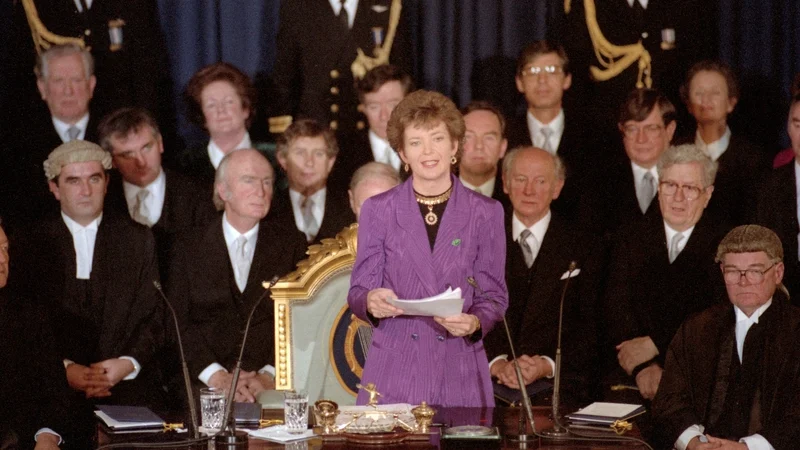
On December 3, 1990 Mary Robinson was inaugurated as the first woman ever to be elected President of Ireland. That in itself, was a history-making event in a country where politics have been almost exclusively confined to the “Boys’ Club.” The world took note. A major British newspaper named her Woman of the Year and there were no fewer than 2,000 media requests for interviews. Suddenly Ireland had a bright, and different, face to present to the world.
But it was on the “plain people of Ireland,” that Robinson’s election had the most telling effect. For long stereotyped as backwards, rural, innately conservative, the electorate took a daring leap of the imagination which seemed to surprise even themselves.
For not only is Mary Robinson a woman, she has worked long and hard for the liberalization of laws on divorce, contraception and homosexuality, unpopular issues in conservative Roman Catholic Ireland. Robinson also strove for change on issues such as deserted wives, battered women, the homeless, the travelers and many other groups marginalized in Irish society.
How did such a woman get to be President? Not without a fight. Her campaign lasted all of six months, in a country that normally spends just a few weeks on political contests. She was helped by a political scandal which hurt her main opponent, Brian Lenihan, of the Fianna Fail party.
But her most successful move was that she took her case to the people, to small towns and country places, and she addressed herself to Mna na hEireann—the women of Ireland—and they are the ones who came out massively to make their mark on the ballot paper and on a new Ireland In her inauguration speech Mary Robinson promised that her presidency would be one of reconciliation and renewal, and made a firm commitment to pluralism and peace on the island. She also stated that she was not just President of those citizens living in Ireland but of all Irish people and promised that there would always be a light on in Aras an Uachtarain (home of the president) for exiles and our emigrants. And indeed, these days there is a light that can be seen shining through the darkness of Phoenix Park, perhaps it’s just a welcoming symbol and perhaps the new president’s power is largely symbolic but what a powerful symbol she is. Editor Patricia Harty talked to her about her role as president and how she hoped to expand on the promises made in her inauguration speech.
Irish America: In your acceptance speech you said that you were President “not only of all those here today also of those who cannot be here,” referring to the Irish abroad. How do you intend to fulfill that role?
President: I’m the directly elected representative of the people of Ireland, of Irish citizens. Just because an Irish person leaves to go abroad to get a job, doesn’t mean he or she ceases to be an Irish citizen. In talking to a lot of young emigrants, and talking to their families, I found that there was a tendency for them to feel nobody cares, to feel cut off. In my speech I was very strongly signalling that this office is one that particularly links the Irish all over the world and I want to try to avail myself of every practical opportunity to build on that linkage. There’s a light shining in a window at Aras an Uachtarain which symbolizes my continuing interest in these emigrants and to welcome people back.
Do you feel that those people who did leave, perhaps unwillingly, and are still citizens should have a right to vote in elections such as your own?
There has been quite a lot of discussion about that and indeed I think it’s a matter that’s going to come before the parliament shortly. It certainly is interesting to see the number of European countries which automatically retain voting rights for their citizens who go abroad. I think we are tending to think more in European terms in relation to issues like voting so it may well be that strong support for that kind of legislation will emerge. It’s a way of linking Irish people abroad and at home, there’s no doubt about that.
Do you intend to visit the immigrant communities in Britain and the U.S.?
The state visits are a matter of government policy; they’re not entirely in my personal say-so, but I would like to incorporate the possibility of visiting immigrants or support groups on an official visit, particularly to countries like the United States and the United Kingdom where there are large numbers of Irish.
I have also expressed an interest in receiving immigrant support groups here at Aras an Uachtarain and listening to what they have to say about the issues and the problems and the concerns. And at least that would very much validate the importance of their work and recognize that a great deal of good work is done outside of Ireland for the benefit of Irish immigrants.
Do you think that immigration will always be an unfortunate aspect of Irish life?
It has been an aspect down the years. I never believed that something has to be just because there is a long established pattern of it. I do fecl that it is regrettable that many of our young, talented Irish find that they have to go abroad for jobs and for career opportunities. Unfortunately, the possible policies that can insure more jobs within Ireland doesn’t come under the scope of the presidency. But I am, I think, in a position to link up with those who have gone abroad and perhaps encourage those who might be thinking of coming back and show them that they would be welcome and that we need them here in Ireland. And to help provide the kind of infrastructure, the right kind of social planning for our future.
Do you feel that there’s an unwillingness on the part of Irish people to draw on the richness that the Irish American can offer or that the Irish tend to be dismissive of the Irish American?
Perhaps to some extent. I don’t think the potential either way has been fully realized. Because we’ve had such a pattern of immigration I think we should give a lot of thought of how to develop these linkages.
It shouldn’t just happen by hazard and ad hoc–it should be a very thoughtful process. I’m conscious that I now hold an office which will enable me, I hope, to project the modern Ireland. I feel that that will perhaps awaken or promote among Irish Americans a keener interest in being in some way associated with development in Ireland.
With regard to Northern Ireland. You have offered your hand in friendship to both communities. Do you feel that you can make a difference?
I made it clear during the presidential campaign that the possibility is quite a modest one because the office of president is not concerned with political development, but I said that within its modest scope, the president can do something that is not being done, which is to extend the hand of friendship to the two communities, with no strings attached, with no hidden agenda.
I’m greatly encouraged by the response that I’ve had. I’ve had a very large number of letters, cards, messages from a very broad spectrum of people in the North.
We’ve had a very healthy volume of requests from people in the North to come here to Aras an Uachtarain. Only last weekend I had a group of students from McGee College. I’m having other groups very shortly.
Some of them are North/South, some of them are purely from the North. And I’ve also had a lot of invitations to go North myself.
There’s a limit to how often that can happen but it’s nice to feel that there is a very broad welcome and interest in the possibility of the president of this part of the country travelling north.
Most of the invitations are outside the political sphere altogether. I think the real message has come across that the office of president relates to people, and relates to people in a broad range of activities.
I’ve also noticed with great interest a positive development in that various voluntary organizations and bodies in this part of Ireland are inviting me to come and either open something or launch something. And the hand of friendship is very often mentioned in their letters. Now that’s where, I think, the influence comes in, to be able to influence a whole range of bodies to change their approach, and to open up, to perhaps travel North more. I’d like to see much more mobility from this part of the country to the North of Ireland. There’s so much happening in the cultural/sporting field that we don’t support enough. And there’s also a magnificent coastline up there.
Do you think that it’s because the people in the twenty-six counties are uninformed about the North?
I think there’s an underlying sense that there may be some risk involved. And although there is an element that’s obviously deeply regrettable, and a difficult situation – there is also the normal community life going on. There’s a barrier— a psychological barrier to going. And I think this applies to sporting groups, and to community bodies of different kinds.
But those who travel North realize, in fact, that there is a whole normal life there to be supported. And those who go will very often go back on a regular basis. But I’m glad to say I think there is an opening up and more inclination to travel to various parts of the North now than there was, say, two or three years ago.
Can you talk a little bit about the Hand of Friendship being rejected by one side? The incident with the Belfast City Council for instance? (The Unionist-dominated Belfast City Council refused to issue an official invitation.)
I think it was a very positive step, in its own way, that there was a motion before the Belfast City Council, that they at least considered inviting the president of Ireland to come and visit. The debate was not negative, and debates in Belfast City Council inevitably tend to be very polarized. The ultimate decision was that it wasn’t appropriate at this time. And that in itself seemed to me to be a very real indication of an unwillingness to close off the possibility of developing the Hand of Friendship and all that goes with it, at a future time.
And also, I feel that the primary focus of the presidency, and my primary focus should be on establishing links outside the political sphere. I say the primary purpose because obviously I would warmly welcome any elected representatives who wish to come to Aras an Uachtarain and came in whatever context. But I think the real scope for building better broad community relations is outside the direct political sphere.
What would you say to Irish Americans who sincerely want to help find a solution to the situation in the North, but really have no idea what to do?
I think there are now a number of different ways in which it’s possible to help. There are very good organizations which are involved in promoting cross-community ventures and peace initiatives in Northern Ireland. And there is the generous official support of the International Fund on the part of the United States, that has been an important stimulus both to enterprise and to the various cultural activities which have a job-creation dimension to them in the North.
I think support from Irish Americans who express goodwill can be rather easily channeled through quite a wide range of organizations. Eight or ten years ago it might have been more difficult to find appropriate channels, but I think they are there now. I don’t really want to mention them-because if I mention two or three, I’ll have left out four, five, six and seven.
But there is quite a range of them. Over the years, I have been very impressed with groups from the United States who take a genuine interest in the development of this island and in the encouragement of peace and reconciliation within Northern Ireland. Not only are they prepared to be involved in funding appropriately, but they come to see and to listen and to consider the different views.
Many Irish Americans would feel that they are more concerned about finding a solution in Northern Ireland than a lot of people are in the twenty-six counties.
Well, it’s exactly that, because I’ve met a considerable number who have had a very deep commitment over many years, and I think it has to be acknowledged how much good will there is among Irish Americans.
Turning to Ireland and the issues at home, you said, “To all those who have no voice or whose voice is weak, I say take heart. There is hope.” Is there real hope in Ireland today for such people?
Well, I was encouraged by the fact that this was an issue highlighted at the very beginning of the campaign. And it was one that clearly struck home. I had the opportunity —during quite a long campaign—of getting right around the country. I met a lot of small support groups, visited job centers, and volunteer organizations, women’s support groups, and the small environmental groups – and when I say small, I’m saying it because these were very local groups working with the homeless and with the handicapped.
And the fact that this was an actual theme of the presidency in itself meant a great deal to them. Because of that I’m now receiving invitations to come along to various activities at the local level, to be part of them, to be aware of what’s happening and there are requests to come and visit. And this allows me the opportunity to get right around the country. I think it is very important not just to be Dublin-based. It also allows an opportunity to be with quite small groups where they might not have expected the president to turn up, and see first-hand what’s happening. It is local groups themselves who must be encouraged to empower themselves, and as president I can actively promote that value.
What would you say to those people who say that they’ve lost an important worker in the Robinson victory because of the restraints of the presidency?
I hope that’s not the way that it’s perceived because a number of people who would work, for example, with the homeless, have visited here already. And there is such potential now for developing the linkage with the office of the President in a way that is appropriate to the office which has no policy-making role—so it’s a question of valuing.
With your qualifications you could have lived and been successful anywhere. Why did you stay in Ireland?
Well, I have had opportunities to be outside Ireland. When I was studying I spend a year in the United States. And my work has taken me to Strasbourg and to Luxembourg and to Brussels on fairly regular occasions. But I have never regretted in any way, having the opportunity to live and make a living and bring up a family in Ireland. I find that this is a country of great generosity of spirit, of great humor, of great compassion.
Whenever I leave Ireland and come back, I’m always glad to be home. From a personal point of view, and a family point of view, it is a great country to be able to live and work in, provided you can, of course, find the appropriate work. We’re lucky in many ways, to have the natural advantages that we have in Ireland.
Would you say your year at Harvard had a positive effect on your outlook?
Yes, I think so. Because I went there straight from studying law in Trinity College in Dublin and it was a very questioning time in the United States- questioning the values of the Vietnam War, which led to questioning legal education, the rule of law, and the rule of society and so on. And I was very much influenced by the openness and the different approaches that the American students, and indeed American professors, had to many of the issues of the day, to urban development, the Civil Rights movement and so on.
I think what I benefited from most of all, was the kind of energy that was addressed to resolving various problems. And I think, when I came back to Ireland, the strong injection I had of this can-do spirit, was very helpful to somebody who as a young person got involved in politics. I had more self-confidence than a lot of other people of my generation—particularly women— which helped to open certain doors at the time.
I enjoy visits to the United States for that reason. I enjoy — what’s the word? – the sort of frontline energy to handle problems and deal with them—as opposed to what I think is a tendency in our culture to say well, this is going to take a long time – (Laughs) – and you know, it will— we may or may not ever manage to resolve it.
Because you are a Catholic, when you went to Trinity College you had to get permission from the Archbishop. How did you feel about that?
I must say even at that time many of us felt that this was something which was very hard to really understand in terms of religion.
It was very much protocol permission, rather than a strong impediment to being able to go. But I must say, I was very glad when the necessity was withdrawn, or disappeared, because it wasn’t something that there was any justification for. And it perhaps encouraged me on a path on which I was already heading, to wish for a more pluralistic Ireland. To have a very strong commitment to our concept of Irishness as being broad and inclusive.
I have been very struck, even since my election as president, at the number of letters or messages I’ve received from people who said, “You know, I was delighted at your election. As a Protestant I feel at home in Ireland for the first time.” Or, “As somebody who no longer practices any religion, I breathe more freely.” I was interested in these thoughts and that kind of emphasis because I think it does indicate that the more space we can create for people to feel at home, to feel that they belong in Ireland, then the more we are maturing into the kind of open and tolerant and pluralistic society I think we now aspire to be.
There was a sense of amazement in those of us abroad—who feel that Ireland is very slow to change– that Ireland elected Mary Robinson, a woman and a liberal, as president.
Well, in that way, the election has been a very refreshing one because it does indicate an openness both to change and to electing a person with whom the voter may not necessarily agree on every stand or viewpoint. That could be very good for Irish politics because it may allow politicians generally to take stands on more issues– [CHUCKLES]—and to, you know, be prepared to actually take a strong moral stand, particularly on a difficult issue where there is clearly going to be a divided viewpoint in the general population.
I spoke to a young woman and she said she really wanted you to be president but she voted for Austin Currie. Can you address that kind of schizoid thing about the Irish where they’re afraid of change-they want it but they’re afraid to follow their instincts?
Well, I think that in this particular election, there certainly was a commitment to voting in quite a different way. It’s evident, for example, in the significant number of women, wives, who for the first time voted differently from their husbands.
And I think that this has injected a kind of heady sense of freedom into them and a capacity to make up their own minds when it comes to voting.
I doubt if that will change in the forthcoming elections. I think in its own way this election has perhaps helped to focus more on what kind of society we want, what kind of issues have a real appeal for people and that they will now vote for.
And I think that must be a positive signal for politicians with a commitment, who may feel that they can put forward their ideas, now that they’re likely to gain support because people are going to vote more in accordance to issues than the traditional patterns of voting.
The role of the presidency up to this time has largely been a symbolic one.
Do you see that changing?
Well, it is a non-executive office. But there are important constitutional functions—in particular, for example, referring a bill to the Supreme Court if there is a doubt about its constitutionality. Or in rare circumstances, possibly declining to dissolve the Dáil. A great deal of the role
is a symbolic one but it’s also a representative one. And it’s that representative dimension that I believe has considerable potential. It’s obviously easier for a president who has been elected by the people, to promote and enhance certain values and certain activities, and to develop the role by identifying with certain issues and concerns.
One such concern is emigration and a link with the Irish abroad. And there are a number of others. By focusing and concentrating and using the office of the president in a supportive way, the more practical dimensions can come through. It’s a question of using the president as a person and Aras An Uachtarain as a new throne and as a supportive resource to be used in a broad range of ways.
People have said what you’ve done for Irish women by being president is like what Jesse Jackson did for the blacks in America.
Certainly, there’s no doubt that it has been a boost and of great importance to Irish women generally. And I very much welcome that, because I certainly campaigned very consciously as a woman—l drew a lot of support from women. My election was an important way of promoting the self-confidence of women, as you say, raising the expectations of all women as to what can be done and so on.
I’m glad to say that’s true also of teenagers and very young girls. I think it has made a great difference to their sense of themselves. But it was never a narrow perspective and I was anxious to be-during the campaign and afterwards a president for all the people.
Do you think that these are changing times for Ireland?
Yes. I’m fortunate to be president of Ireland at a time when the country is going through a very creative period. So much is happening in the arts, in Irish craft, in music, and in local community development.
As somebody who grew up in Mayo I’m very interested in what happens in small towns and rural communities. And I relate very much to local empowerment and to developing the potential of the young people in these communities.
I think the president should be out and about a great deal and in touch with those who most need that kind of support and enhancement and valuing. So that the goodwill that has been generated by the campaign now helps in carrying through to the actual performance and furthering of these values.
Can you tell me about your family background?
My background was being the only girl among four brothers; in fact, sandwiched between four brothers. And our parents were both doctors. There was never any sense that there was a limit on what I could do because I was a girl. On the contrary, we were all encouraged in a very supportive way. We were a close family.
Did you always have an interest in law?
Yes. At a fairly early stage, I had an interest in law-which I think I inherited from my grandfather, my father’s father.
That was my focus. It was not a case of having a particular career in sight and moving in that direction; it was an interest, a genuine interest, in law, which I’ve always had—and still have.
How did it happen that you were elected to the Senate at such a young age?
It wasn’t a planned thing. When I returned to Ireland from America, to practice law, it happened that there was a general election, and an election to the Senate shortly afterwards. And that sense of self-confidence, which I talked about earlier, caused me to talk about a younger person going forward and then my friend said, “well, why don’t you go forward, and we’ll back you.”
Did you have any thoughts on being president at that time?
No. I did not in any way anticipate standing for the office of president. It was an invitation that was put to me.
And initially, I must say, I wasn’t immediately of the view that it was relevant to what I was doing as a lawyer.
But when I realized that it was an immense opportunity to give leadership and to represent what’s happening in the country, and to be in touch with what’s happening, I found my interest grew very rapidly.
The adrenaline started to flow and I found that the campaign caused me to think a lot…to think about Irish society, and about representing this country. And since the election, there’s been a great need for thought.
Now it’s a question of thinking it through and carving out the relevant and the practical potential of representing the country as a whole and representing the people in it, and also projecting Ireland’s image abroad. So the day is not long enough at the moment – [CHUCKLES].
Editor’s Note: This article was originally published in the March 1991 issue of Irish America. ♦
Leave a Reply