
“I don’t think that there is any point in being Irish if you don’t know that the world is going to break your heart someday.”
—Senator Pat Moynihan after the assassination of John F. Kennedy.
But you didn’t have to be Irish to feel a broken heart that cold November weekend in 1963 when – as a nation – we sat glued to our television sets to witness images forever etched on our memories: the President’s small son, John-John-still innocent of his loss-saluting the flag-draped coffin of his father. The single riderless horse with boots turned backwards in the stirrups-the symbol of our fallen hero-clopping along a crowd-filled but silent Pennsylvania Avenue behind a horse-drawn carriage that bore the body of the young President. The slow skirl of bagpipes as the casket is carried to the grave-site and the slow beating of the drum. The final prayers and sprinkling of holy water by Cardinal Cushing before the body is slowly lowered into the ground.
Little did we know then of the shock that awaited us less than five short years later.
It is April 1968. Robert Kennedy appears on the nightly television news programs after being told of Martin Luther King’sassassination. As a group of black Americans crowd around him, he turns to comfort them with words he has learned by heart since the death of his brother—words from the ancient Greek, Aeschylus: “In our sleep, pain that cannot forget, falls drop by drop upon the heart, and in our despair, against our will, comes wisdom through the awful grace of God.”
Just two months later, Robert Kennedy himself is cut down by an assassin’s bullet in a Los Angeles hotel. He had just claimed victory in the California presidential primary.
His body is taken to New York where a funeral Mass takes place in St. Patrick’s Cathedral.
Edward Kennedy delivers the eulogy with dignity and reserve until near the end his voice begins to crack as he describes his brother’s life and quotes the Irish dramatist George Bernard Shaw: “Some men see things as they are and ask why. I dream things that never were, and ask why not.”
An era ends.
Edward Kennedy, the youngest and only surviving son, steps forward to carry on the family name. Elected at age 30 to the Senate seat left vacant by John Kennedy when he became President, he has been a Senator from Massachusetts for almost 29 years. During that period he has built a record of legislation that is, in fact, greater than that of his brothers.
Few figures in public life have received as much negative press as Edward Kennedy. After Chappaquiddick, after his failed run for the Democratic presidential nomination in 1980, and after the recent incident at the Kennedy compound in Palm Beach over the Easter weekend, he has been thoroughly probed and scrutinized by the media.
Many people have been critical of him for what they consider the “character” issue. Catholics have faulted him for his pro-choice position on abortion. Factions of the Irish community have criticized him for his opposition to the I.R.A. In a country moving more and more towards conservatism, he is portrayed most often as the nation’s leading liberal – wedded to the stale rhetoric and outmoded ideas of the past.
In the face of these ongoing slings and arrows, the option to just walk away from it all must sometimes be tempting.
He could choose to set out in his schooner with his multimillion dollar trust fund in tow and retreat forever from politics and public life.
Instead he has stayed the course. In the process, he has become the champion and best known defender of virtually all programs that have helped the poor and elderly and handicapped of this country. Any significant legislation affecting these groups in the areas of education, jobs, housing or health care is sure to have Kennedy’s stamp on it.
And if you ask his fellow senators—liberals or conservatives—who’s on their list of the hardest-working and best Senators, Kennedy’s name is always there. Certainly the people of Massachusetts would agree – they have elected him with landslide victories six successive times.
As for Irish issues, he has been a key figure in pushing for an annual appropriation of U.S. funds for the disadvantaged areas in Northern Ireland. He has also been one of the main driving forces behind the new immigration bill that will grant legal status to over 48,000 new Irish immigrants to this country over the next three years.
It was the day before St. Patrick’s Day when I went to visit the Senator at his Washington, D.C. office.
The first thing you notice when you enter is the sign underneath his name. It is made of brass with raised Gaelic script and says: Cead Mile Failte (One hundred thousand welcomes). The walls of the reception area are filled with photos of the Kennedy years and the one that catches the eye first is a birthday greeting to the Senator from his staff.
It is a composite of photos. The first shows him as a young boy licking a spoon while the cook looks on with amusement. In the next, he is a teenager stuffing cake into his mouth and smiling straight into the camera. A third shows him as an adult with two other officials, about to cut a ceremonial cake. And then there is a picture of the Senator as he is today—slimmer than he has been in years. The birthday greeting reads:
For Our Slender Senior Senator
Happy 59th Birthday
You’ve Come a Long Way, Baby
(Of course, we are referring to pounds, not years.)
It’s obvious that the self-deprecating brand of humor first made so famous by the Kennedys in politics almost thirty years ago is still alive and well in the offices of Ted Kennedy.
On another wall, a picture shows a row of houses on a block in an old neighborhood. Underneath are the words:
“Birthplace of Joseph Kennedy—East Boston.” Another picture showing a similar scene is labeled: “Birthplace of Rose Kennedy—North End.”
Both of these humble scenes contrast sharply with the pictures we have seen throughout the years of the magnificent Hyannisport mansion and the Palm Beach residence that Joseph and Rose Kennedy lived in since the late 1920’s.
Photographs of Robin Williams, Billy Crystal and Whoopi Goldberg on the wall are reminders of the fascination the Kennedys have always had with show business figures, starting in the 20’s and 30’s when Joe Kennedy was a successful movie producer in Hollywood and continuing through the years of JFK. There are pictures also of sailing boats of all kinds and one is reminded that Ted Kennedy was always considered the best sailor in a family of men who loved boats. There’s a pair of boxing gloves hanging on the wall with these words written on them: “Senator TedI hope these boxing gloves help you to knock out injustice.” Signed, Muhammad Ali.
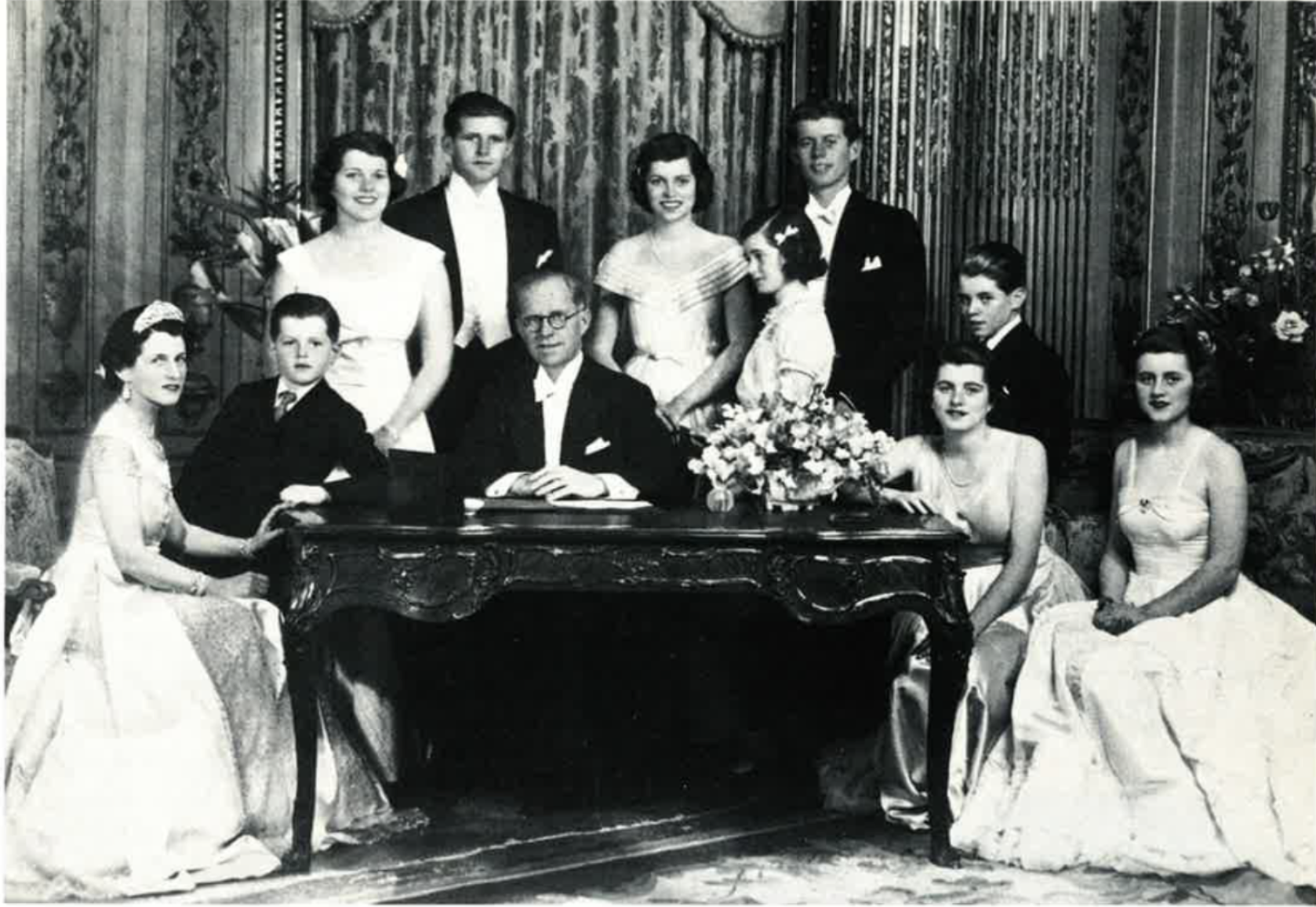
And then there is the picture of the three brothers together—Jack, Bob and Ted. Their handsome faces tanned and healthy, their big white smiles full of vitality and exuding optimism. It brings back memories. This was a picture taken shortly after Jack became President, when the whole country was infatuated with these Kennedys of Massachusetts, when Irish-American Catholics, in particular, held their heads just a little bit higher because one of their own—in just three short generations—had made it from the famine coffin ships to the White House.
One generation earlier, a bright young lad with an uncommon drive for success named Joe Kennedy was denied entrance into the posh clubs of the Boston bluebloods because he was Irish Catholic and the son of a barkeeper.
In time, he made more money than those who had rejected him and by the summer of 1961, he stood as the paterfamilias of the most magical family name in America.
His son, Jack, had just been elected President of the United States. His other son, Bob, was the Attorney General and Ted, the one everyone said was the most natural politician of the family, with the out-going amiability of a handsome Irish cop, was about to embark on a campaign for Senator of Massachusetts at the young age of 29. It was a dynasty in the making. An achievement beyond what any father ever could have dreamed.
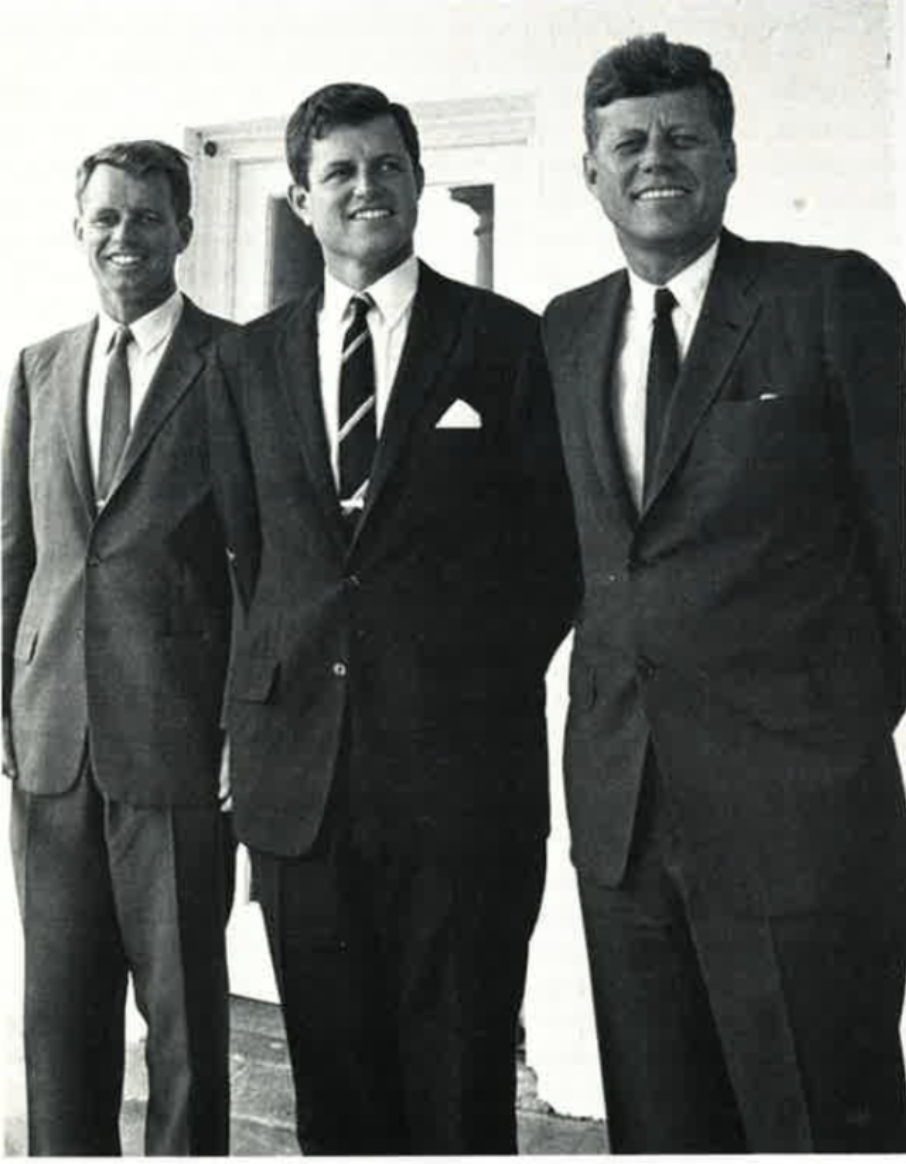
What must it have been like on those summer evenings at Hyannisport when the entire clan—the Kennedys, Shrivers, Lawfords and Smiths—gathered around for the evening meal after a day of sailing or touch football? The laughter, the good-natured teasing, the absolute sense of fulfillment. You can see it all right there in this picture of the three brothers. And you can see something else there too: a carefree innocence—in this brief shining moment of all the pain that lay ahead.
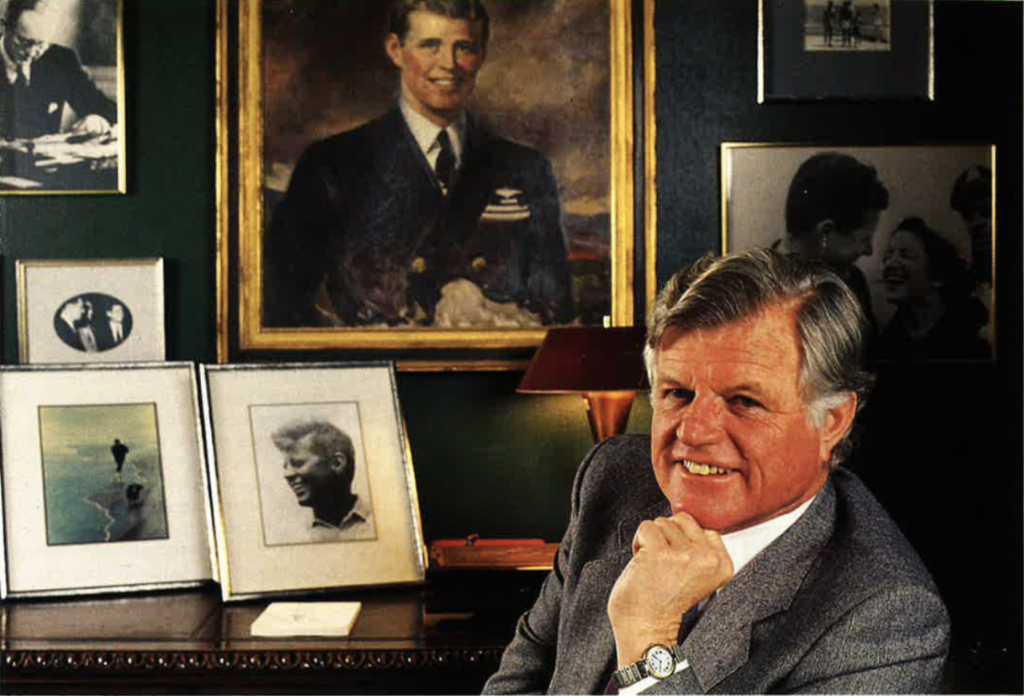
I am called into the office to meet Ted Kennedy. He looks trimmer than expected and wears a bright green tie in honor of St. Patrick’s Day. His office has a feeling of warmth and coziness and is filled with Irish and Kennedy memorabilia. There is a large Irish flag next to a flag of the Kennedy coat of arms, which depicts three helmets on a white background. Near his desk is an Irish Sign Post from County Wexford that reads: “Baile ui Dhonnaagin” and underneath “Dunganstown.”
There is a little framed note on the wall. “Dear Mother,” it reads, “It is the night before exams…Can I be godfather to the baby? Lots of love.” It was written in 1932 by fourteen-year-old Jack Kennedy on the eve of Ted’s birth.
Young Jack wanted to name the new baby George Washington Kennedy because he was born on February 22.
Now, 59 years later, it is hard to believe, that were he alive today, President Kennedy would be 74 years old.
I had heard that the Senator liked to paint and asked him about it. He showed me an album of photos of his paintings—mostly still lifes and seascapes done in acrylics—and they displayed remarkable skill. He said his brother Jack had started him painting. He continued to sharpen his skills while recuperating from his near-fatal plane crash in 1964.
He pointed to a photograph of his sailing boat, “You can see I’m flying the Irish tri-color here in honor of the Taoiseach, Charlie Haughey, who was my guest for the day.” Senator Kennedy and Ireland’s Prime Minister are good personal friends and visit each other often, sharing a common interest in sailing and love of the sea.
Kennedy tells the story of the time the Prime Minister was visiting him a few years ago. It was around re-election time for Kennedy and he and the Taoiseach were approached by a reporter from the Boston Herald. “That newspaper has not always been the most favorable to me,” Kennedy said. “And it turns out that the previous summer on a very misty, stormy night my boat had hit a break water.
I was not at the helm at the time but since I was the captain, I took responsibility for it. And the reporter, in trying to embarrass me, said to the Taoiseach, ‘I understand you own a boat.’ And the Taoiseach said, ‘Yes, I do.’ Then the reporter asked, ‘Well, how many times have you sunk your boat?’ And Charlie took a pause and then said casually, ‘Oh, twice!’ We both looked at each other and started to laugh. The reporter from the Herald just stood there with nothing to say because he had just lost the angle to his story.”
Kennedy visits Ireland often most recently the summer before last when he went there for a short holiday.
“I’ve been there a total of eight or nine times. I went there once with my son Teddy when he lost his leg to cancer. We rented John Huston’s house in the west. Teddy had several friends with him and I drove them around and took them to the Aran Islands. And the following year, when they were doing a film on Teddy, he insisted on going back to Ireland again.”
When asked about his Irish ancestors, he showed a genealogical chart. “We’re Irish on all sides,” he said. “My mother’s mother was Josephine Hannon and my father’s mother was Mary Hickey. And, as you can see, we also have the names Cox and Murphy in the line too.” He then picked up a framed picture post card of Boston’s old City Hall with an inset photograph of his mother’s father, John Fitzgerald, who was known as “Honey Fitz,” because of his sweet singing voice.
Kennedy pointed with pride to the remarkable resemblance between himself and his grandfather.
“Grandpa Fitzgerald was one of the very first Irish Catholic Democrats to be elected in New England—first as Mayor of Boston and then as Congressman. He was a colorful and lively figure and very proud of his Irish ancestry and talked a good deal about it. His family was from the west of Ireland. He took my mother back to Ireland when she was young and a great deal of the Irishness in the family came through him. He liked to sing and there was always a lot of Irish music and, of course, my mother played the piano. She played, in fact, up until the past few years.” Rose Kennedy will be 101 years old this year and presides over four generations of Kennedys.
“My other grandfather, Patrick Kennedy, whose family were originally from County Wexford, was also in politics as a state senator. And my own father always had an interest in public life, though he never sought clective office. He was a supporter of Roosevelt and served in the Maritime Commission and the Security Exchange Commission and then as Ambassador to England.”
“And growing up, did your parents encourage you children to get involved in politics?” I asked.
“Well, I was always interested in politics and elective office. Some form of public service was always emphasized and stressed in the family. And it seemed to have come naturally to us,” he said.
When asked if he thought the Irish had a special predilection for politics and public life, he said, “Yes. It’s partly intuitive. There’s an inherent kind of warmth and enjoyment of people that the Irish have. And then, you know, it is often said that the English wrote the English language but the Irish taught them how to use it. The Irish have this love for literature and music and these, combined with an emphasis on family and a devotion to freedom in their history, are pretty fundamental ingredients that go into political life. But there’s another part to this, too. The Irish came to politics out of necessity in earlier generations. They saw it as a way of moving upwards and achieving their hopes and aspirations. And the Irish have done that well.”
Many people feel that the state of Massachusetts is one of the most liberal states in the Union. He disagreed that it was a liberal state. He pointed out that he is only the fourth or fifth Democratic senator in the entire history of Massachusetts. “It’s only recently, since my brother’s time, that the state has voted Democratic. Up until then it was dominated by the Republicans—the Lodges and Coolidges and Saltonstalls. Don’t forget, too, that within the last ten years the state has elected Governor King, who is about as conservative as you can get.”
How then did he explain his victories? He’s considered liberal and he wins big there.
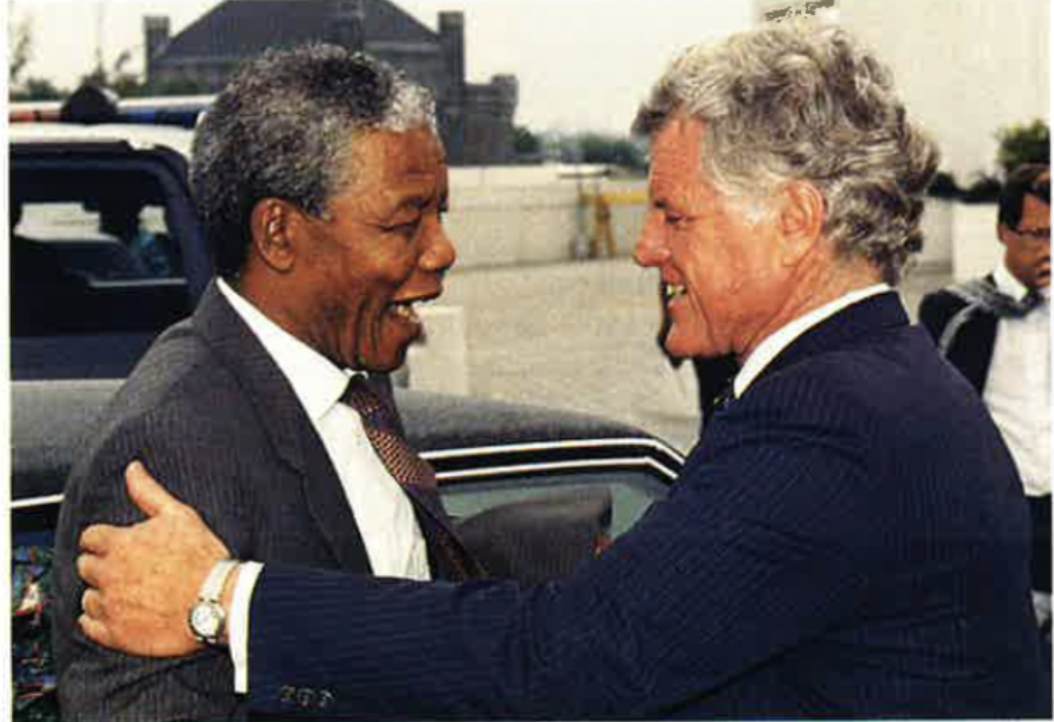
“Well, the label means nothing,” he said. “I think you have to define yourself and not let anyone else define you. They can put whatever label they want on me but I think what the people of Massachusetts sense is that I have a tradition of caring about them and about their needs. I’ve always tried to exercise my best judgement on issues and people have a sense of that. I work hard at this office and I am immensely proud to be a senator from that state.” Kennedy was first elected to the Senate from Massachusetts in 1962. He won his fifth re-election in 1988 with an astounding 67 percent of the vote.
There are few subjects Irish Catholic politicians will agree on so readily as a United Ireland. Kennedy is no exception. “A number of years ago I helped form a group called the Friends of Ireland. I joined with Tip O’Neill, Pat Moynihan and Governor Hugh Carey and we built up a bi-partisan group in the House and Senate that seeks to be a positive force in the U.S. Congress for a united and free Ireland. We stress peaceful resolution and economic development rather than support for the I.R.A. And, of course, we’ve been encouraged by the recent announcement of the new talks that should take place soon between Prime Minister Haughey and Prime Minister Major on the future of Northern Ireland. These discussions show movement towards a non-violent, political settlement. And we’re all a lot happier this St. Patrick’s day because of the release of the Birmingham Six.” The mention of the I.R.A. brought up the question as to what he thought most Irish Americans felt about that organization.
“I think they see the I.R.A. the same way I do – as a cutthroat, terrorist organization. There are some Irish Americans who don’t see it that way, of course. But my family has seen too much of that kind of violence first hand. I feel strongly about it—as does my family. We know about violence like that and it’s just not the solution to problems,” he said.
Kennedy, with other members of the Friends of Ireland, has thrown his support behind the International Fund for Ireland. This is a project established to channel financial support from the United States, Canada and the European Community to encourage jobs and economic development in the areas most affected by the conflict in Northern Ireland. Since its inception in 1986, the Fund has helped start more than 1500 projects. The United States’ contribution to date has been $170 million.
When the Fund was first set up, there were several funded projects difficult to justify, such as $2,500 allocated towards refurbishing the front of a bank in County Tyrone, which received wide publicity. A few Irish American groups leveled stinging criticism at the Fund and doubts began to grow in Congress about continuing to reach out a helping hand when some seemed so ready to bite it.
Senator Kennedy stepped in to play a key role among his colleagues in Congress to keep support for the Fund alive.
“After a few missteps in the beginning, the Fund has responded with a new series of initiatives that puts special emphasis on the disadvantaged areas of the North and the Fund gets high marks for its performance in the past year. For the vast majority of people on both sides of the conflict in Northern Ireland, this Fund has become a symbol of hope for a better future. It is helping to reduce the violence, mistrust and discrimination that have plagued Northern Ireland for too long.” During the past year, the United States Congress appropriated $20 million to the International Fund for Ireland. The amount for 1991-92 has not yet been set.
On another front, Kennedy’s commitment to immigration reform was crucial in winning the passage of last year’s immigration bill. On one vital vote, Kennedy personally called dozens of key congressional figures to bolster support. “The 1965 immigration act worked in a way we never predicted. It was a good act in the sense that it helped ethnic groups from nations that had suffered under racial bias but it put restrictions on nations like Ireland. During the 1970’s there was an average of only about a thousand visas a year from Ireland. I was strongly committed to changing that. And we did last year. And we’re delighted.”
The new law essentially will give 48,000 green cards to Irish applicants over the next three years. “The gates are swinging open again as they should be,” he said.
There is a partial listing on the wall of the Senator’s office of legislative bills he has sponsored and when I asked him if there was any bill he was especially proud of, he answered: “Well, I can’t point to any particular bill. I think it’s the overall progress we’ve made for the average citizen. Whether it’s in the area of health, where we focused attention on the research of diseases affecting babies and the newborn, or whether it’s improving the quality of education or striking down racial discrimination and barriers to the handicapped. Which one is more or less important than the other? I take pride that in some of these areas we’ve been able to make a difference. Not as much as I would have liked, but nonetheless some. And there’s a lot to do, and we’re looking forward to the battles ahead.”
Our interview ended and just as I was about to leave the Senator called me back. He was smiling and said, “You know, I’ll always remember when Jack came back from his trip to Ireland. He really loved that trip. And he loved the film they made of the trip. And when the whole family was up on the Cape for a weekend, he insisted on showing the film in each of our three homes.
The first night everyone went to see it at his house. Then the next night he showed the film again at Bob’s house. Fewer people came this second time. Then on the third night, he showed it again at my home and there were just the two of us—me and him sitting there watching it alone. He loved that film of his trip to Ireland each time he saw it,” Kennedy smiles wistfully, “And so did I.”
Two weeks after meeting with Senator Kennedy, I picked up a newspaper with a headline that screamed: “Kennedy Scandal At Palm Beach.” Another media circus was instantly in full swing as warring tabloids competed for shocking headlines.
The “real” story of what happened that Friday night in Palm Beach changes more often than the weather in Connemara. But one set of facts has become more clear with each passing day as they relate to Senator Kennedy. He went out on a weekend night for some drinks with his son and his nephew. He came home, had a night-cap and he went to sleep.
Once you cut out all the hype and sensationalism, that is the extent of his actions.
Allegations against his nephew are still being investigated. As of this writing, no charges have been filed. The lawyer for the alleged victim has stated he is satisfied that the investigation is proceeding with caution, care and deliberation.
No doubt, in time, the complete truth will be revealed. We can only hope that all parties are treated fairly and with equal justice.
Editor’s Note: This article was originally published in the May 1991 issue of Irish America. ♦
Leave a Reply